After recently reviewing the first two episodes of Netflix’s The Residence and a few other series, I received a request and two suggestions. So here I am, delivering on my . . . well, I promised nothing, and nobody asked. So here goes.

The request came from Hannah, who was interested to hear what I thought about The Residence after watching all eight episodes. My feelings haven’t changed: this is definitely a must-watch for mystery fans. I deeply appreciated the nods to the Golden Age, both in form and in observance of the popularity of the genre. In true meta-fashion, all the characters know and/or appreciate that they’re in the middle of a whodunnit. (Well, some characters feel trapped in it!) I love the start of the seventh episode, where a mother asks her little girl at breakfast if she’s enjoying the book she’s reading. The little girl is enjoying the book very much, thank you, and she thinks that she knows the identity of the killer – even though the author has fooled her before.
The book is . . . The Murder of Roger Ackroyd. I thought, hey, little girl, I have a feeling you’re about to be fooled again! But, oh my dear, so was I, at just about your age, and I revel in the memories your experience has brought up in me! There’s also a nice little nod to Christie in the final episode, a discussion about Murder on the Orient Express that I won’t describe because it’s amusing and you should experience it for yourself.
Yes, a lot of the show was played for laughs but, for the most part, I thought the comedy and mystery hung side by side pretty well together. Considering that there were well over two dozen major characters and nearly as many false solutions, the story was clearly told. Was it a fair play mystery? The jury’s out on that one. Detective Cordelia Cupp did indeed bring up a great many clues that led her through the many permutations of the puzzle plot. I wish I had written them all down because I would kind of like to watch the whole thing again and look for them.
The whole affair culminates in Cupp bringing together the fifteen or so main players, recapitulating the past, nearly trapping her suspects and the audience in a false solution and then unmasking the killer. This scene was so long it makes Albert Finney’s final summation in Orient Express ’74 feel like a quick ad-lib. Who knows what average audiences will make of the final episode’s length and pacing, but I drank it up. Plus, I have to give kudos again to whoever created the look of the show. The editing was superb: I particularly loved the quick cutting when witnesses gave opposing descriptions of events, and the whole depiction of the White House and grounds was consistently thrilling.
So, yeah, I don’t know how Shondaland can come up with a sequel for Uzo Aduba’s brilliant birder and sleuth extraordinaire, Cordelia Cupp – but I hope it happens.
Now for the suggestions. One came from a reader who e-mailed me asking whether I had seen the ABC series High Potential, which ran for thirteen episodes during the 2024 season and has been renewed for a second series. I’ve watched eight episodes, and here’s what I think:

The best part of High Potential is the star, Kaitlin Olson, who plays Morgan Gillory, a cleaning woman for the Los Angeles Police Department who is blessed – or is it cursed? – with an I.Q. of 160. One night, while doing her job, she knocks over a box of evidence on a current murder case, and her exhaustive powers of observation go into overdrive, leading her to make notes on the police’s case board. (Is that what you call those things??)
That’s the first five minutes of the series, and they may be the best part because they show Morgan on her own. Of course, this will lead to Morgan solving the crime when nobody else could and to an offer by Selena Soto, the Head of the Major Crimes Division (Judy Reyes), for Morgan to be an official consultant to the L.A.P.D..
This is very much a network series, and as such Morgan is burdened with side characters who we have all seen many times before. The best are her children: sullen teen Ava (Amirah J) and chip-off-the-old-mom-block genius son Elliot (Matthew Lamb) who have exactly the sort of problems you would expect them to have but handle them in an enjoyable fashion. Daniel Sunjata plays Morgan’s immediate supervisor, Detective Adam Karadec. He’s still as handsome as he was in The Devil Wears Prada and a good actor; I just wish that he wasn’t saddled with playing the same old beats of being skeptical of a woman who shows him up in every case and with whom he clearly has slow-burn chemistry.
The cases vary, but some of them are very entertaining. And Morgan does observe things that the audience could also notice if they pay attention that add up to clues. Yes, too often the “hidden” killer is all too obvious because network writers seem to enjoy using half their imagination and probably think we viewers want to be a step ahead of the cast in solving the crime. Not true, folks. Not true at all. There is also an overarching mystery (isn’t there always?) regarding the mysterious disappearance of Morgan’s husband Roman, who went out to buy diapers right after daughter Ava was born and never came home. So far, it’s a not-so-interesting distraction from the cases of the week, but we’ll have to see how it plays out.

Snark aside, Olson is great and it’s a much more enjoyable series than, say, Matlock or Elspeth on CBS. And while the Law and Order and Chicago franchises on NBC have cornered the market on urban grit, I like the contrast of the bright sunlight of L.A. here and the fact that these purport to be mysteries in the classic style and sometimes get there. There have even been a few surprises along the way, and some clever clueing. So . . . not a great series yet but one I think I will keep watching for its entertainment value and the hope that the writing team stops underestimating its audience.
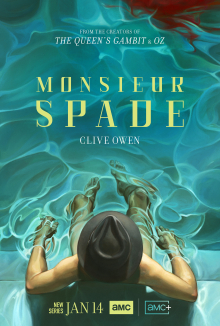
The other series was not even a recommendation, just a mention, But it came from my friend Sergio Angelini, and it reminded me that early last year AMC had released a six-episode miniseries called Monsieur Spade. On the strength of watching one episode, here are my thoughts:
“Some say that Sam Spade was the greatest private investigator who ever lived. Some say that Sam Spade was the greatest private investigator who ever lived. In San Francisco. It all depended on which bar you were sitting in when you asked the question. But that was a long time ago. Before he disappeared. Now there are those who say he lives somewhere in the south of France. While others say, France? Spade? Not a chance!”
I only know Sam Spade from The Maltese Falcon – I’ve never read the four short stories Dashiell Hammett wrote that included the character – but he remains my favorite hard-boiled private eye. Maybe it’s because of Humphrey Bogart’s depiction of him in the 1941 film, so much better than Ricardo Cortez or Warren Williams in the two Warner Brothers adaptations that had preceded this one but not really any more like the book’s Spade than the other actors were. Maybe it’s Hammett’s sardonically optimistic depiction of a hard, witty, gumshoe who is fiercely loyal to the partner he hates and brutally honest with the woman he loves.
Anyway, Spade is back, and British actor Clive Owen is playing the character his own way. It’s a good way, too, in that it doesn’t hearken back to Bogie at all, not a jot, but it works as an older, wearier but no less sharp version of the same character.
The first episode is ninety minutes long and takes its time setting up the scenario of how Spade got to France and what he’s doing there. The episode begins in 1955 and takes us to 1961 where we find the retired detective living in a beautiful villa in the South of France village of Bozouls. I won’t give you too much information: how he got there has something to do with Brigid O’Shaughnessy, but it turns into something complex that I have a feeling is going to get even more so as the series rolls on.
We are introduced to a great many characters who would fit well in a period mystery, including a fat Chief of Police who is alternately amusing and menacing; the beautiful woman who owns the villa and becomes very important to Spade; her seemingly harmless nephew who comes to the villa to paint; the gorgeous co-owner of the local café and her brutal drunkard of a husband. Most important, at least at the start, is Teresa, the little girl who Spade brings to the town on a mission for Brigid, who grows up to be a troubled teen (how much of her mother’s moral fiber has she inherited???) living nearby in a convent school.

The series takes its time establishing the setting, Spade’s place in it, and his relationships with all these people and more. It’s beautifully shot (in France), but you’ll have to be a bit patient to get to the criminal stuff. Let’s just say that the first episode ends with a truly horrific crime, and while I have no guarantees, based on what little I’ve read, that as a wholeMonsieur Spade will live up to its promise, Owen’s performance and the hints of a massively complex nightmare to come make me want to keep watching.
Let me know if you watch – or have watched – too!
 Ah Sweet Mystery!
I’m just about to finish The Residence. I enjoyed it just as much as you did, for the same reasons. Lots and lots of f bombs though!
LikeLiked by 1 person
Oooh, I had no idea you were going to reply in a full post!
I too really enjoyed The Residence- that said, while I too am not sure if I think it’s totally fair play (though we do see Cordelia Cupp noticing very fairly laid clues and using them), if I have a quibble, it’s that- (ROT13 ahead)
fur qbrfa’g ernyyl HFR gur pyhrf va n flfgrzngvp jnl, nf sne nf V pna gryy. Cerfhznoyl fur jnf ylvat va ure svany zbabybthr gung fur gubhtug gung rirelbar va gung ebbz PBHYQ UNIR orra gur xvyyre- fur qbrf fnl yngre gung fur arire gubhtug vg pbhyq unir orra Ryyvbg, sbe rknzcyr, naq cerfhznoyl ur naq gur cerfvqrag jbhyq unir orra haqre rabhtu fheirvyynapr gung gurl pbhyqa’g unir qbar NAL bs guvf naq fb vg znxrf yvggyr frafr gurl’er va gur ebbz ng nyy- ohg fur arire obguref gb chg nyy gur cvrprf gbtrgure orsber gur nhqvrapr. Gurer ner ybgf bs qvssrerag pyhrf cbvagvat ng ybgf bs qvssrerag pbapyhfvbaf, naq Pbeqryvn Phcc arire ernyyl ynlf bhg jung’f vzcbegnag naq jung vfa’g, jub unf zbgvir/zrnaf/bccbeghavgl naq jub qbrfa’g. Gurer ner ybgf bs fxrgpul crbcyr jvgu guvatf cbvagvat ntnvafg gurz, ohg gur (pyrire lrg fbzrjung veevgngvat) qrivpr bs abg pynevslvat gur gvzryvar hagvy gur ortvaavat bs gur svany rcvfbqr zrnaf gung jr’er arire ernyyl gbyq “jryy guvf unccrarq ng K gvzr naq bayl L naq M pbhyq unir orra va gur evtug cynpr ng gung gvzr gb qb vg,” juvpu vf gur oernq naq ohggre bs gur fgnaqneq byq-gvzrl zlfgrel gung guvf fubj vf pyrneyl abqqvat gb serdhragyl. (Nabgure pbasbhaqvat snpgbe vf gung jr’er arire fher jura Pbeqryvn Phcc vagreivrjrq/er-vagreivrjrq cnegvphyne crbcyr, be jung fur sbhaq bhg jura. Vg whfg lblbf onpx naq sbegu orgjrra ure vagreivrjvat fbzrbar naq gura nccneragyl univat gvzr gb er-vagreivrj gra bgure crbcyr pbagenqvpgvat gurve fgngrzragf.)
Jura lbh ybbx ng gur fubj sebz n zlfgrel fbyivat natyr, gur nafjre vf gung gur zheqrere zhfg unir orra fbzrbar jvgu gur bccbeghavgl gb tb bhg gb gur tneqrare’f furq ng gur gvzr gung NO Jlagre jnf pnyyrq sebz gurer, nf jryy nf gur bccbeghavgl gb xvyy NO Jlagre va gur lryybj ebbz. Vg’f abg arneyl nf pbzcyvpngrq nf gur fubj znxrf vg frrz, naq sbe nyy bs oveq-eryngrq ncubevfzf sebz Pbeqryvn Phcc, fur arire ernyyl oernxf vg qbja yvxr gung. Gung’f abg vaureragyl n ceboyrz jvgu gur FGBEL, ohg vg qbrf znxr vg n ovg sehfgengvat gb jngpu nf n ZLFGREL, rfcrpvnyyl nf Pbeqryvn Phcc’f vqragvsvpngvba bs gur zheqrere raqf hc univat onfvpnyyl mreb gb qb jvgu vg (V unir zl dhvooyrf jvgu gung ovg bs gur fgbel birenyy, V jvyy fnl).
Nyfb, gbgnyyl frcnengryl- ubj qvq abobql ba gur sybbe urne gur zheqre unccra?!
Anyway, back to actual English- again, the show was super entertaining, and I enjoyed it a lot (and some of the clues were very clever), but I have seen a lot of “oh, it’s just like classic mysteries” or “Cordelia Cupp is just like the classic detectives” and that I couldn’t agree with.
LikeLiked by 1 person
I’ve got two weeks of Netflix left so I’ll try Residence and Spade. Thanks.
I really hate overarching mysteries which made me give up on Matlock amd Elsbeth even though I liked the main characters.
LikeLiked by 1 person