“Seriously? What in the world do Sondheim and crime fiction have in common?”
That question, gracing the back cover of Josh Pachter’s eighth “Inspired by . . . “ story anthology, Every Day a Little Death: Crime Fiction inspired by the Songs of Stephen Sondheim, has an easy answer. At least it does for those of us who love the musicals of Stephen Sondheim as much as we love crime fiction. It’s a well-known fact that Sondheim loved all manner of puzzles, including the ones found in classic detective stories. Did you know that his musical Follies was originally planned as a murder mystery – not a whodunnit so much as a “who’s-gonna-get-dun?!?” And, of course, Sondheim co-wrote (with Anthony Perkins) The Last of Sheila, one of the most puzzle-oriented mystery films ever produced, as well as the too-clever-by-half play Getting Away with Murder (co-written with George Furth, with whom Sondheim had collaborated on Company.)

For Every Day a Little Death, Pachter invited twenty writers – some of crime fiction, some from the theatre world, and a few hybrids – to each choose one song from a different Sondheim musical and let it inspire their creative muse. Some of the authors contained therein had a friendship or professional relationship with the late composer; others were simply fans. In his introduction, Pachter shares some wonderful anecdotes from a few of the writers, plus two of his own. This inspired me to consider the stories in my own life that have come about because of my personal relationship with Sondheim’s work.
I have had the great privilege of acting in two productions (oddly, of the same musical, but playing different parts) and directing several more. My experiences gave me an approach to this piece: I didn’t want to rush through the entire list of stories and give you a capsule review of each one. Instead, I picked six of them – those based on the five Sondheim shows that I have either directed or acted in, plus the title story, written by Josh Pachter himself.

Based on the six stories I read, then, Every Day a Little Death runs the gamut of ways to honor the composer who inspired these writers. For example, Pachter’s story, “Every Day a Little Death,” is based on a song from A Little Night Music that in the show is sung by young Anne Egerman and her guest, Charlotte, who both realize that their husbands are cheating on them with the same woman.
Pachter doesn’t vary the setting: Anne hosts Charlotte for tea in her Swedish home and confides that her darling Fredric appears to be “staying late at the office” all too often and not, she suspects, always for work. From there, the story spins in a different direction from the play, but the result is as sweet a confection as a Prinsesstårta, that round layered Princess cake covered in green marzipan. As a little joke, Pachter changes Anne’s last name from Egerman to Bergman, an homage to the great filmmaker Ingmar Bergman, whose charming comedy Smiles of a Summer Night inspired Sondheim’s musical.
I’ve never been involved in a production of A Little Night Music, but I did perform in Sondheim’s groundbreaking 1970 musical Company – twice! The first time I played Paul, the hapless bridegroom-to-be whose neurotic bride Amy is convinced that she’s “Not Getting Married Today.” That was a dream production with a dream Amy. My second foray into the show saw me cast as Peter, a much less loveable sort who, with his wife Susan, has come up with a surefire recipe for marital bliss: get a divorce. This production had an amazing multi-story set that honored the spirit of the original Broadway set by Boris Aronson by having multiple levels and a working elevator that led up to the platform representing Peter and Susan’s apartment.

On opening night, the lights came up on central character Bobby’s strange birthday party and then sprang into the complex and wonderful title number. The actress playing Susan and I had to run up two flights of stairs in the dark to get to our platform and begin singing, “Bobby . . . Bobby . . . Bobby baby . . . “ The song, which is very difficult to sing and to count, progressed nicely until it was time for the BIG NOTE: this happens towards the end of the number when everyone leaves their apartment and crosses to surround Bobby with love. As Susan and I made our way from our “apartment” to the elevator to come down onto the stage and take our final places, we joined in the chorus of the entire cast singing “We looooooooooooooooooooooooooooooooove you!” That word “love” goes on for measure after measure after measure to give the actors a chance to reach their spots.

That’s when our elevator stopped running. It had trapped us midway to the ground, right in the middle of that extended held note. The conductor saw what was going on – and merely extended the note longer as we tried to figure out how to get the HELL out of that elevator and down to the stage. The problem was eventually dealt with – I don’t remember how – but the elevator was never repaired and we had to spend the rest of the run hurtling down two flights of stairs to the stage while singing the extended note.
I didn’t looooooooooooooooooooooooooooooooove that!
For his story, writer-playwright Brian Cox chose one of the most beautiful songs in Sondheim’s canon, “Being Alive,” as his inspiration. It represents a pivotal moment in Bobby’s life: having just turned thirty-five and surrounded by the five married couples who make up his list of best friends, Bobby realizes that his success at avoiding an emotional commitment is actually a big fail; at last, he is ready to commit to somebody, no matter what the risks.
Cox takes the concept of “being alive” more literally!! His Bobby, named Robert Dean Jones in honor of the actor who first played the role, works for the “Company,” (a.k.a. he’s a spy), and the people in his circle (Marta, Steve, Mr. Furth, Larry, Peter Stritch, and Joanne) are named after characters and/or creators connected with the musical. It’s an entertaining enough story but one that doesn’t doesn’t take us anywhere new in the field of espionage tales and thus left me wanting.
Stephen Sondheim began his career as a lyricist, and while he yearned to get a show on Broadway with his own music coming out of the orchestra pit, his training took place on two of the greatest musicals of all time. And I’ve directed both of them.
I am tremendously proud of the production of West Side Story that we did at San Mateo High School. Our cast drew from every corner of our highly diverse student population. The band killed it playing Leonard Bernstein’s super difficult score. My choreographer lit a fire under those dancers and gave them as much of Jerome Robbins’ original choreography as they could handle. And all the scenic elements came together beautifully.

The only problem was that the actors playing Tony and Maria, the star-crossed lovers based on Shakespeare’s Romeo and Juliet, really hated each other. It led to one of the most unnerving events in my teaching career, and while I hate to tease you like this, after writing out the story of what happened, I completely lost my nerve. So let me leave it at this: if we ever meet and you want to hear all about it, simply say the words “West Side Story” to me, and I promise I’ll deliver!
The story that John Copenhaver, an award-winning author and co-founder of Queer Crime Writers, delivers to the collection is inspired by the song “Tonight”:
“Today all day I had a feeling a miracle would happen/I know now I was right/For here you are and what was just a world is a star/Tonight!”
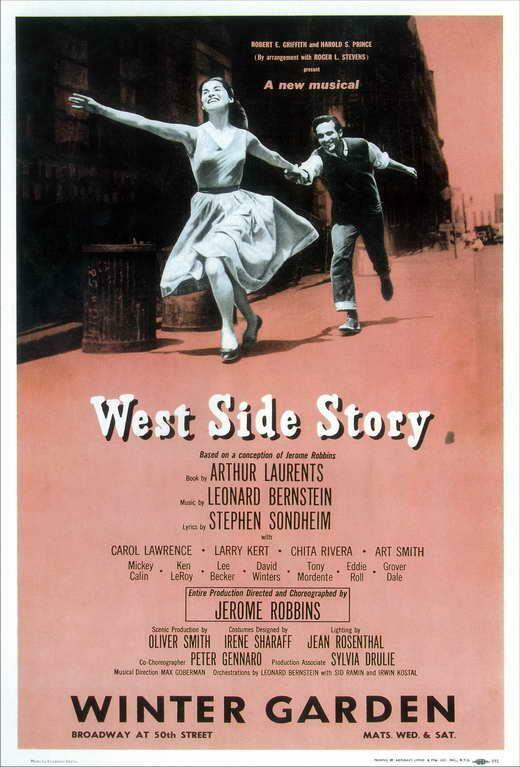
It’s a tale of the theatre and is narrated by a scenic designer named Woodrow – Woody to his friends – who has gone to work on the set for a new queer adaptation of Romeo and Juliet called Starcrossed. Woodyis unimpressed with the script, calling it “juvenile, like something from Season 6 of Glee,” but he is hopelessly drawn to the leading man, Riccardo Pazzano, a fetching stud with Tom Hardy lips! Although Ricky is bisexual and flirtatious, he involved with a manipulative, ungrateful shrew named Kaye. Woody comes to believe that Ricky needs rescue from the monstrous Kaye – and, this being a crime story, we have a recipe for disaster brewing. Will the ending be as tragic as . . . well, as the one in West Side Story? I’ll leave that for you to discover.
Gypsy is arguably the best musical of all time, one that I had the honor of directing twice. It is, oh sooooo loosely, based on the memoirs of famed stripper Gypsy Rose Lee and features perhaps the greatest stage monster of all time in the form of Gypsy’s mother Rose. (It’s telling that each time the show is revived on Broadway, the actress playing Rose wins a Tony Award; let’s see if that is repeated yet again this year with Audra MacDonald.)
Sondheim had hoped this would be the first show where he wrote words and music, but star Ethel Merman was having none of it. She demanded an experienced composer worthy of her own greatness – an Irving Berlin, Cole Porter or Jule Styne. In the end, Styne said yes. But Sondheim was allowed to remain and write the lyrics, and they mesh beautifully with Styne’s music. To a perfect score was added a brilliant libretto by Arthur Laurents, loosely based on the memoirs of famed stripper Gypsy Rose Lee, and the whole thing was perfectly staged by Jerome Robbins.
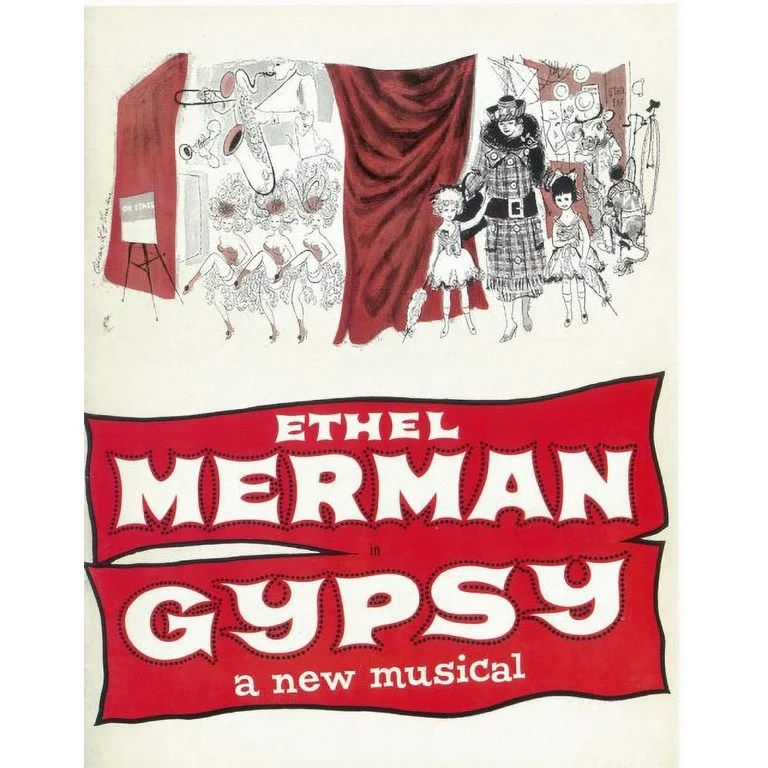
For his inspiration, Jeffrey Marks picked “Together Wherever We Go,” a jaunty Act II trio that marks perhaps the last truly happy moment in the show. His story picks up after the musical’s end, where Gypsy is now famous as an “ecdysiast,” author of her own mystery novel (The G-String Murders) and hopefully about to sign with producer Mike Todd. Mama Rose asks to meet with her daughter, and Gypsy chooses a sleazy Chicago dive to keep them out of the spotlight. Wbat occurs at Dante’s Bar makes for an amusing trifle and the closest we seem to get in this collection to something approaching a “traditional” murder mystery.
Rebecca K. Jones takes a wholly different approach in her story, “Hello, Little Girl,” inspired by a song in Into the Woods. This is easily one of my favorite Sondheim musicals, which explains why I also directed this one twice. The song is sung early in the show by the Wolf as he meets and attempts to seduce Little Red Riding Hood off her path so that he can eat her. It’s a sly, funny number full of sexual tension. Jones strips it of any fairy tale references and focuses on the concept of an attractive male using his masculine gifts to victimize a hapless female.

Thus, these “woods” are the jungle of New York City, and our main character is a rather awful young man who will do anything to get his hands on a rare stamp collection worth almost ten million dollars. Like so many other authors here, Jones has fun with names: Chip, Joanna and Cindy Baker all reference characters from the show or the actors who played them. Like the musical that inspired it, the story reminds us that the bravest of individuals may come in the most unlikely of packages and that there’s nothing a grandmother and her granddaughter can’t accomplish when the going gets tough.
Finally, I selected Joseph Goodrich’s story, “No Place Like London,” from the musical Sweeney Todd. Goodrich has crafted an unusual story of theatre people and the sticky, complicated relationships they get into with each other. I almost don’t want to call it a crime story, but ultimately it is the most moving one I read.

And it gives me a chance to share my favorite Sondheim anecdote with you. I directed the show at San Mateo High School and, once again, everything aligned in our favor. I hired a new set designer who came up with the most intriguing depiction of Victorian London. My props mistress was a Drama mom who came up with the most delectable recipe for the meat pies that the citizens devour, unaware that they are eating their friends and neighbors. (The secret ingredient was, of course, chocolate!) And my cast was a dream: they could actually sing the songs and play the roles!
I had to cast a actress to play the role of the Beadle because his singing part is so high. Still, I figured that actresses in Victorian England often played “pants roles” and the young woman I had cast – let’s call her “Hannah” – was tall and intelligent and really knew how to mine the part for all its combined humor and menace.
We opened on a Thursday and were a big success. People came up to me and marveled, “How can high school students do this?!?” I felt great. And then came Saturday night. I was sitting in the back of the theatre watching the show. We were in the middle of Act II, when Sweeney Todd’s murderous barber chair is in full operation and the entire company is heading toward a bloody end. Imagine my surprise when I saw a tiny crew person slink from around the proscenium, tiptoe down the stairs in full view of the audience (which was thankfully too rapt in the action onstage to notice) and cross up the aisle in my direction. I couldn’t help wondering what had caused this little girl to break rule #1 about crewing: invisibility! And then she told me . . .
“Hxnnxx jxxt xxxed oxx xxr xxxger,” she whispered in my ear.
“What?” I whispered back.
“Hannah just chopped off her finger.”
I pulled back in shock, stared at the crew member and then followed her backstage to find Hannah sitting on a stool with her hand wrapped in a bloody towel and a rather foolish grin on her face. It seemed that during a break in her scenes, she had been playing around with another crew member around a heavy metal door, and . . . anyway, it was only the tip of her finger (which had thankfully been retrieved), and something had to be done about it, before it was ground into a meat pie . . .
I called Hannah’s family, and they promised to rush over to school, pick up their daughter and take her to the hospital. But there was a problem: the Beadle was due to enter in a few minutes for his final scene, which involved singing a song (a very high song) and then getting murdered and shoved into the barber chair so that he could slide down the chute into Mrs. Lovett’s basement and get thrown in the oven.
As Hannah was in no position to perform (although I want to tell you that this young trouper was back on stage, finger successfully reattached by the Sunday matinee!!), something had to be done. And so I went out onto that stage and interrupted the performance to tell the audience that the actress playing the Beadle had taken ill and that her final scenes would be performed by the director. And that is how this baritone stumbled through a high tenor song and then had to slide down the chair that had terrified him throughout the rehearsal period and lie like a stone onstage until the finale.
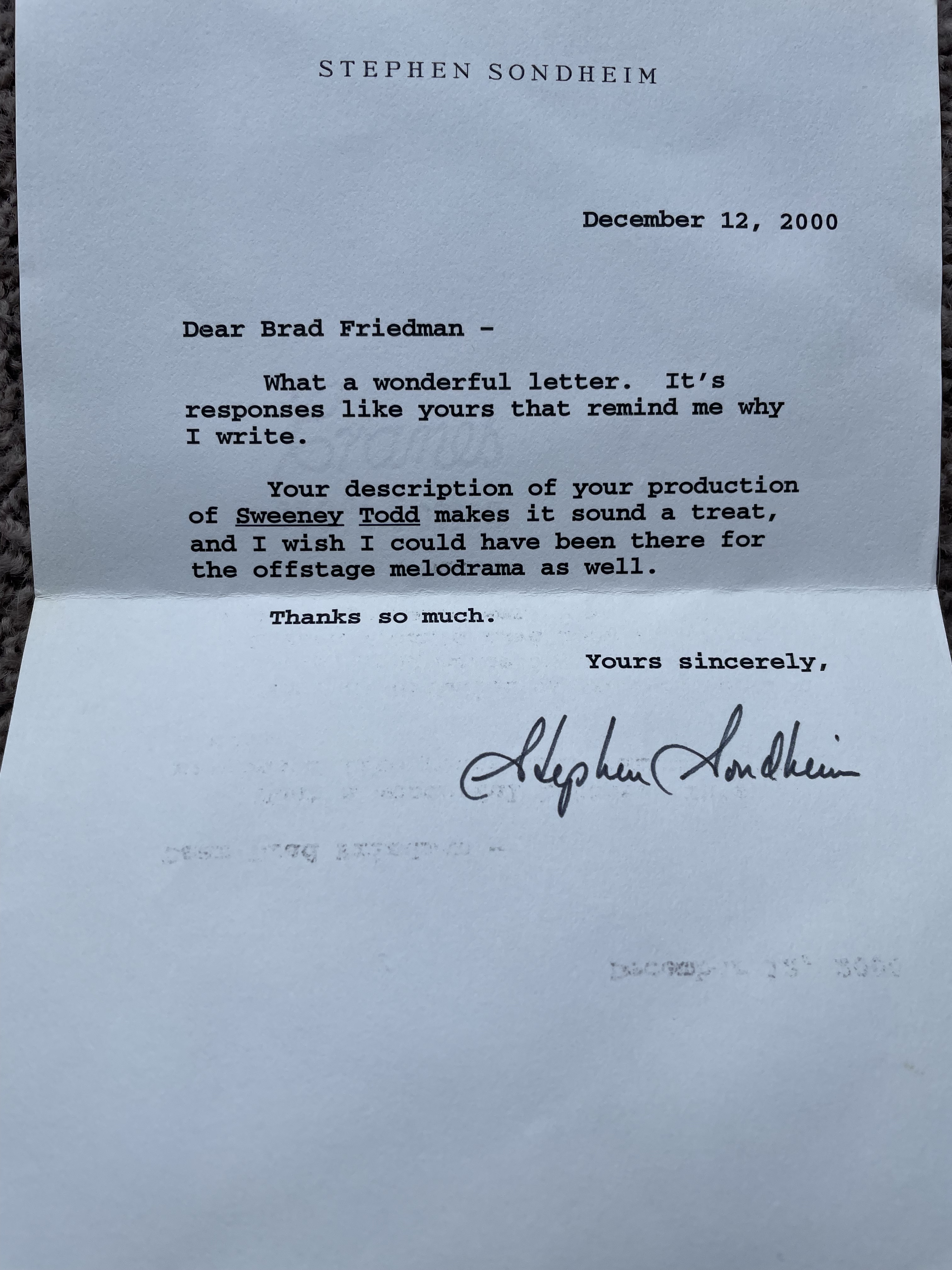
A few days after the show closed, I decided to write to Mr. Sondheim himself and tell him all about it. A few weeks later, I received a note from the Man himself, which I have kept in the nightstand beside my bed for the past twenty-five years. Here it is:
Every Day a Little Death is available from Level Best Books and on Amazon. On behalf of my good buddy, the late great Stephen Sondheim, and myself, I think you should buy it. Who knows what memories of your own these stories will stir up!

 Ah Sweet Mystery!
Amazing stories, Brad — yours, I mean, especially Hannah the trouper and what she let you in for, and Sondheim’s response of course.
LikeLike
Many thanks, Brad, for mentioning my story and for your kind words about it! It’s most appreciated.
LikeLiked by 1 person
I’m delighted to learn about this. I haven’t directed or acted in any Sondheim, but I saw most of the original Broadway productions from Company onward, and I’ve assistant-music-directed a couple of his shows in university productions.
LikeLiked by 1 person
In my experience, the music director is always the hero of a Sondheim production!! As for your viewing experiences, I have never been more jealous!!!!!!
LikeLike
A “working” elevator! XD
LikeLike
What a fabulous journey through Sondheim, Brad. Thanks so much. All sounds amazing. I’m a huge fan of his work though have only seen a small selection of them live: WESTSIDE, FORUM, two productions of COMPANY (the Mendes revival with Adrian Lester and the more recent gender switched version), FOLLIES (with Eartha Kitt), and A LITTLE NIGHT MUSIC (with Judi Dench). Am very envious of your various adventures. We do need to discuss that moustache though … 🤣
LikeLike