“‘Well,’ Mason said, ‘now that the parrot’s dead, we might as well . . .’
“‘But the parrot isn’t dead,’ Drake interrupted. ‘You have the parrot. I suppose that the parrot is a witness to something or other – probably the murder – but damned if I see how he could have been. Tell me, Perry, could a parrot be used as a witness in a court of justice?’
“‘I don’t know,’ Mason said. ‘It’s an interesting point, Paul. I’m afraid the oath couldn’t be administered to a parrot. In other words, he might commit perjury.’”
After reading Erle Stanley Gardner’s The Case of the Perjured Parrot, I did a little research into how parrots learn to talk. After my oh so extensive dive into the subject, I can be reasonably sure when I say that at least one aspect of this, the fourteenth Perry Mason case and our fourth foray this year into The Mason Menagerie, is ridiculous in the extreme. This is 1939, and I don’t think anyone has proven by this point in time that parrots 1) can pick up complex phrases on a first listen, or 2) understand the meaning of what they say. (If I am visited tonight by the King of the Parrots, I will share in a future post any choice words he had for me!)

None of this matters a jot. If Parrot doesn’t impart any fantastic truths about Mason & Co. the way The Case of the Lame Canary revealed the startling truth about Della Street’s feelings for her boss, this novel makes for a far more enjoyable read. It’s does the formula of Perry-Della-Paul Drake extremely well, and it has the bonus of a more intriguing mystery with a genuine surprise ending.
We begin with one of those lovely brief scenes that sometimes occur before the client shows up, where Perry is bored, bored, bored with office routine, and offers Della some variation on his usual lawyerly credo:
“‘You know, Della, I wish people would learn to differentiate between the reputable lawyer who represents persons accused of crime, and the criminal lawyer who becomes a silent partner in the profits of crime.’
“’Just how would you explain the difference?’ she asked.
“Mason said, ‘Crime is personal. Evidence of crime is impersonal. I never take a case unless I’m convinced my client was incapable of committing the crime charged. Once I’ve reached that conclusion, I figure there must be some discrepancy between the evidence and the conclusions the police have drawn from that evidence. I set out to find them.’
“She laughed. ‘You sound as though you were more of a detective than a lawyer.’”
You tell him, Della! But then early Mason is more action-oriented and openly idealistic than the guy we meet in the TV show. We know how much Mason detests office routine, craves the challenge of a puzzle that certain murder cases give him, and likes nothing better than driving up and down the California coast in search of clues. He works poor Paul Drake to the bone twenty-four hours a day, but Mason’s just as likely to join the P.I. on the chase.
It’s time for the new client to enter: Charles W. Sabin is a wealthy businessman who has come to ask Mason to look into the recent murder of his father, Fremont C. Sabin. After amassing millions of dollars, the elder Sabin had decided to retire and escape the clutches of his grasping second wife, Helen, by dressing like a slob, visiting libraries and trailer parks, and conversing with the common man. He also loves to drive up to his isolated mountain cabin to get in some fishing and animal-watching. Wherever he goes, Sabin takes his beloved parrot Casanova, a gift from his reclusive brother.
In early September, a neighbor discovers Sabin’s body on the floor of the cabin. He has been shot to death, and he has clearly been dead a while. The sounds of parrot squawking emanate from a nearby cage – for some reason, the murderer was thoughtful enough to provide enough bird feed to keep the animal alive until he was found. Charles Sabin wants Mason to look into the murder, as well as protect the family’s interests from the dead man’s greedy widow and her fool of a son. And Charles has two pieces of intriguing information to share with the attorney: first, there were items of women’s clothing, intimate apparel, found in the cabin, and secondly, the parrot found near the victim was not Casanova!
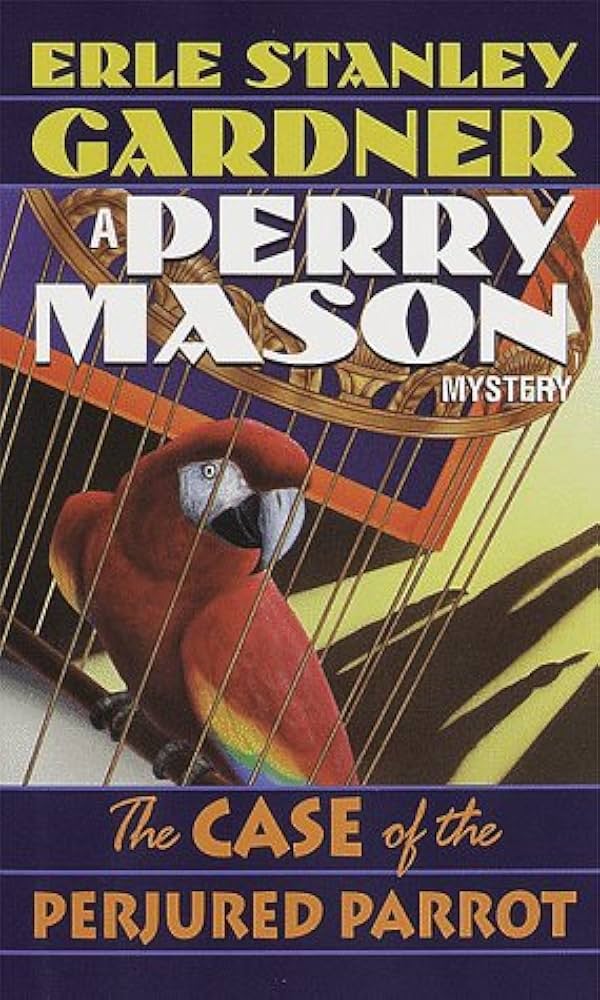
Who was the woman who had occupied the cabin? What’s with the bird switch? And what do either of these things have to do with Sabin’s death?
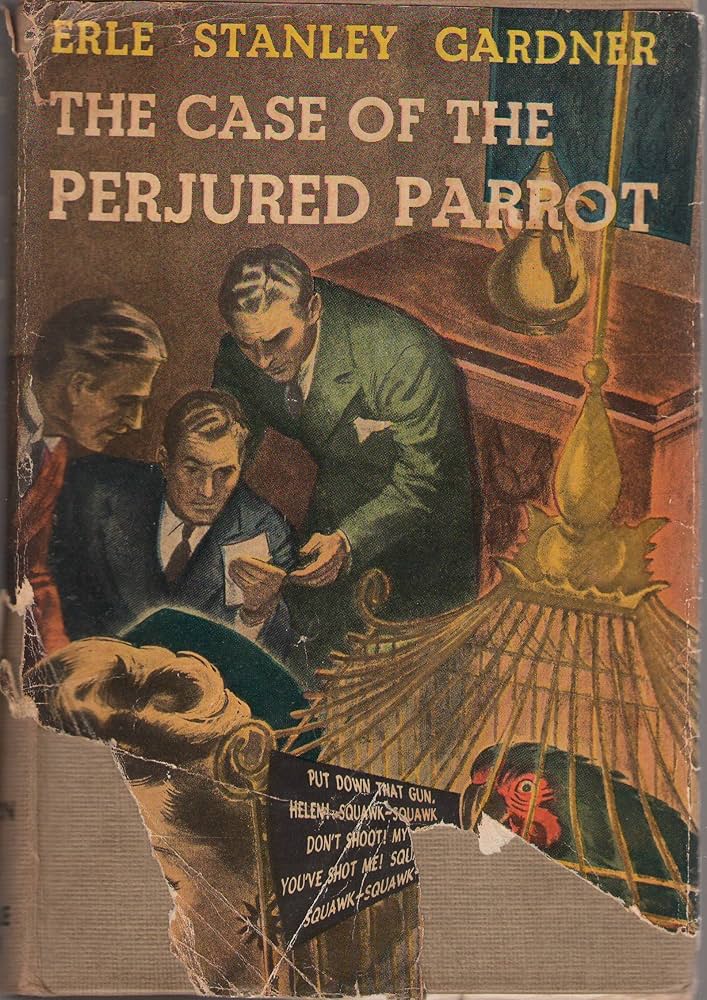
We’ve been here before, right? I’ve established that most Perry Mason mysteries begin with an odd little question like this – the lame canary, the howling dog, and so forth. Usually, these oddities peter out as the main case gets going, but here both facts lead to an increasingly complex situation that is highly entertaining, if more than a bit unrealistic. I can accept the possibility that the victim chose to become a bigamist. What are the odds that both wives would be named Helen, a salient fact given that Casanova has taken to squawking: “Put down that gun, Helen! Don’t shoot! My God, you’ve shot me!”
The coupling of the coincidence and the parrot’s message flies in the face of logic. Are we supposed to believe that Casanova witnessed one of these wives shooting down her husband, that Sabin uttered these words with his dying breath, and that the bird immediately picked up on them and began to repeat them incessantly? Given what I think I know about parrots’ speech, this seems impossible.
And yet – it’s an absolute blast to read. And it’s made even more special for being a book where Gardner is clearly sharing some of his personal beliefs, both his philosophy of life and his feelings about love. There’s a wonderful romance at the heart of this novel. Gardner spends much time on it, and he saves his best surprises for it. And it is Della’s task throughout to hear about this romance and react accordingly with fountains of tears, while Paul Drake works tirelessly for Perry, and shows up often with information.
Since this is still the 1930’s, a prominent position is reserved for Sergeant Holcomb, the world’s worst homicide detective and no fan of Perry Mason’s. One of the lawyer’s peeves with Holcomb and his ilk is their reliance on circumstantial evidence to “prove” a case against an innocent person without admitting to holes in their facts. While we get no courtroom murder trial, there is an extended scene at an inquest where Mason proves his point by cross-examining Holcomb, reducing the Sergeant’s case against his client to dust and unmasking the true killer. To be honest, I had own circumstantial suspicions of this person from the start. And what’s interesting is that as Mason explains his reasoning, it felt like his case was just as circumstantial! Mason himself feels like certain loose ends have remained untied, and this leads to a deduction that comes out of nowhere and unleashes the novel’s biggest and best surprise.
So yes! Nobody can accuse Erle Stanley Gardner of adhering to a strictly “fair play” formula. But it’s a formula that works nevertheless. The defendant is more radiant than usual, the other suspects and witnesses are a varied lot, especially that awful second wife, the interplay between law enforcement members – a kindly coroner, a smart-as-a-whip country sheriff, and the offensive Holcomb – makes the pages turn, and our stalwart trio of lawyer, secretary and P.I. is vibrant as always.
“The Case of the Perjured Parrot” premiered on December 20, 1958, as the eleventh episode of the second season of Perry Mason. The best I can say for it is that it features performances by two droll comic veterans of classic TV: Joe Kearns (Mr. Wilson in the sitcom Dennis the Menace) plays a character that is not a member of the police but serves the same function as Sergeant Holcomb in the book; Edgar Buchanan (Uncle Joe from Petticoat Junction) gets top billing as the Coroner. Whole swaths of dialogue are taken from the novel, and much of the plot is, well, kinda sorta familiar. But book characters are cut, new ones are created (one of these is the murderer!) and the plot is severely truncated.
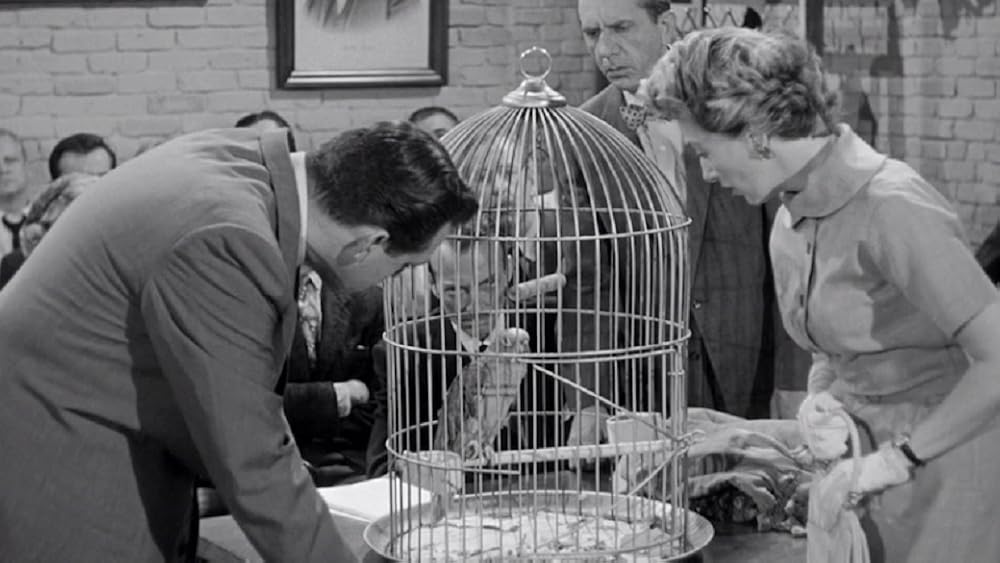
Not a great treatment for a book that was mentioned in historian Jacques Barzun’s A Catalogue of Crime: “This early Perry Mason is uncommonly full of detection, and the games played in it with parrots do not detract from plausibility. Denouement not huddled – all in all, a model in his special genre.”
So, yes. A perjured parrot hit the bullseye for me. Let’s find out next month whether or not a drowning duck can do the same!
 Ah Sweet Mystery!
Sounds good!
LikeLike
This was my first Mason so it holds a special place in my heart, but I don’t really remember anything about it besides the parrot, the courtroom scene being an inquest, and that I wasn’t really impressed by who the murderer was. If I reread it, most of the surprises in the plot you mention would probably get me a second time!
Of course this book always reminds me of that one part in the first Ace Attorney game where you have to cross-examine a parrot…
LikeLiked by 1 person
You get to cross-examine a – my God! how can I play this game?!?
LikeLike
Thanks to your post, I got this and completed reading yesterday. As you’ve pointed out, this one is certainly unusual in portraying the Helen Montieth romance – with unusual depth. And yes, the final surprise ending is, well, surprising!
LikeLiked by 1 person
Pingback: THE ERLE STANLEY GARDNER INDEX | Ah Sweet Mystery!
Pingback: BECAUSE YOU LIKE THE LISTS . . . Brad’s Top Ten Reads of 2025 | Ah Sweet Mystery!