Let’s say A wants to kill B.
(It’s a perfectly acceptable conversation starter around here.)
If we’re in a whodunnit, A and B are hanging around with C, D, E, F, and G, who also want to kill B. (Popular fellow.) Once B is dead, the reader must decipher the clues, untangle the red herrings, and figure out that A dunnit before Inspector LeClerq hands in his solution. A good writer will make all of this exciting, but most of the suspense, in fact, is manufactured by the reader: can I solve the mystery before the literary clock runs down and the truth is revealed?
If we’re in an inverted mystery, B can surround himself with enemies from C to Zed, but it’s A who wants to kill him – and will probably succeed. Here suspense is derived in two parts. First, there’s the unfolding of A’s plan and the question of its successful, ahem, execution. The oddest fact here is how often readers find themselves siding with A! Secondly, there’s the investigation and the question of if and how A will be exposed as the killer.
As much as I prefer a whodunnit, there is variety to be had from an inverted mystery, largely based on how many things may go wrong for the killer, the victim, or the detective. And, unlike the whodunnit, where suspense is found in the trappings of the murder plot, it is deeply imbued in the actions of the killer before and after the fact.

If we’re in a novel of domestic suspense, B knows full well that A wants to kill her, and B is going to do anything she can to stop them. True, sometimes A wants to kill C, but that just means that C is important to B, and the prevention of the crime is still the paramount goal. Sometimes, A has already killed C and D, which means that B wants to prevent the killing of E and F. Despite the comparable looseness of this scenario, these books, when played right, can be as full of twists as their brethren (see A Kiss Before Dying).
Warning: these types of novels tend to eschew the Golden Age rule against romance, sometimes to the point of irritation. Still, I would remind everyone that the word “suspense” is built right into the name. Even with a lot of icky kissy parts, a successful example of is teeming with SA (Suspense Appeal).
The Golden Age of Detection was truly the Golden Age of the whodunnit, but inverted mysteries have even longer histories (that murderous tenant heard the beating of the telltale heart in 1843), and domestic suspense comes straight out of Gothic fiction. As all three forms loosened up in the 50’s and beyond, the puzzly edges of the whodunnit softened, and the inverted mystery found its greatest success on television. The most exciting developments occurred in the field of domestic suspense. For fifty years, it had been dominated by Mary Roberts Rinehart and Mignon G. Eberhart, both hugely popular authors who may have become a bit turgid for modern tastes. Things got leaner and darker and altogether more exciting with the coming of new voices, including Shirley Jackson, Celia Fremlin, Nedra Tyre, Margaret Millar, Bernice Carey, Dolores Hitchens (when she wasn’t writing about cat ladies), Jean Potts . . . and Charlotte Armstrong.
I don’t mean to put a strict box around the kind of writing these women produced because their work contains elements of whodunnits and inverted mystery, even horror. Millar and Armstrong, who began writing in the early 40’s, dabbled first in the whodunnit. Charlotte debuted in 1942 with a trilogy of traditionally styled mysteries premiering featuring an amateur detective named MacDougall Duff. But by 1946, she had found a different voice with The Unsuspected, a master lesson in domestic suspense.
I dabbled with Armstrong so long ago that I cannot even remember what I read. And then, a couple of years ago, my Book Club decided to tackle the author by reading her 1954 novel, The Better to Eat You. It did not go well.
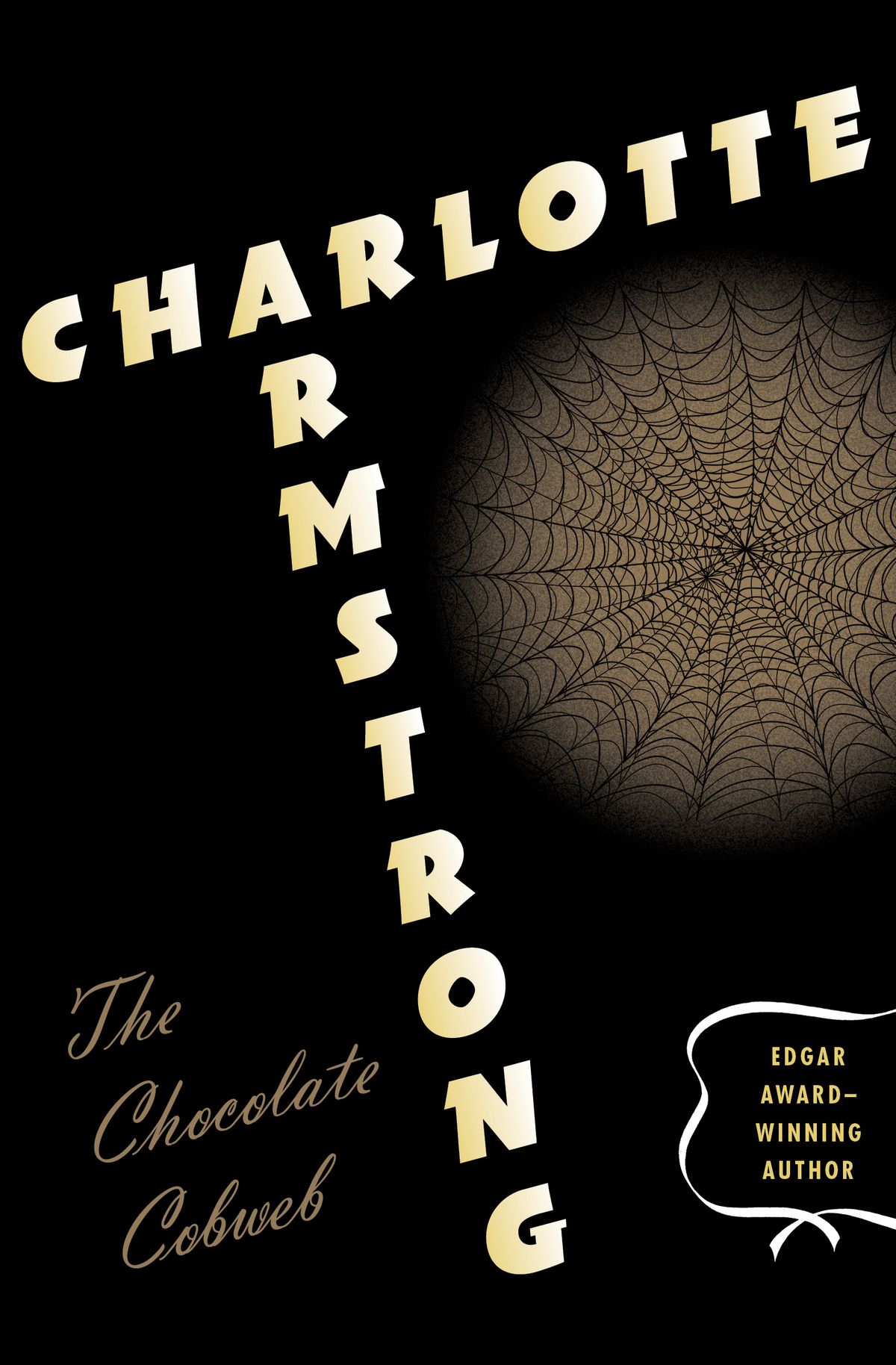
Last month, Book Club gathered together to talk about our favorite 1940’s novels. (Here are mine.) And, wouldn’t you know it, Charlotte Armstrong came up. This time it was her follow-up to The Unsuspected, 1948’s The Chocolate Cobweb. I promptly bought both titles when they were re-issued by Otto Penzler’s American Mystery Classics – and then I shelved them, unread, for several years. However, everyone gushed so enthusiastically about Cobweb that I figured it was time to give it a try.
Reviewing any sort of mystery is tricky because you don’t want to give too much of the game away. I’m almost sorry to have read the blurb on the back cover before I began: half the fun here is the way the novel twists and turns. Domestic suspense may lack the puzzle elements of its cousins, but it also has the least predictable structure, if put in the hands of a master like Armstrong. I’ll be as sparing as I can with details from now on, but be forewarned.
The novel begins with casual remark that sends our heroine, budding artist Amanda Garth, into a tailspin. It seems that, as an infant, Mandy had been on the verge of being switched at birth with another family’s baby. What’s more, the instigator of this switcheroo was the renowned painter Tobias Garrison. Amanda quickly becomes obsessed with meeting Garrison – not to prove whether or not he is her father, but to play a little game of “what if?” with herself and to perhaps meet an artist she admires.
Amanda gets her wish early on, and what she encounters is potentially life-changing: not only is she given the opportunity to learn from Tobias, but she meets his gorgeous son Thone and falls deeply in love. However, Mandy has stepped into a situation that is fraught with danger. Being young, she accepts the risks; the question is, will she survive them?
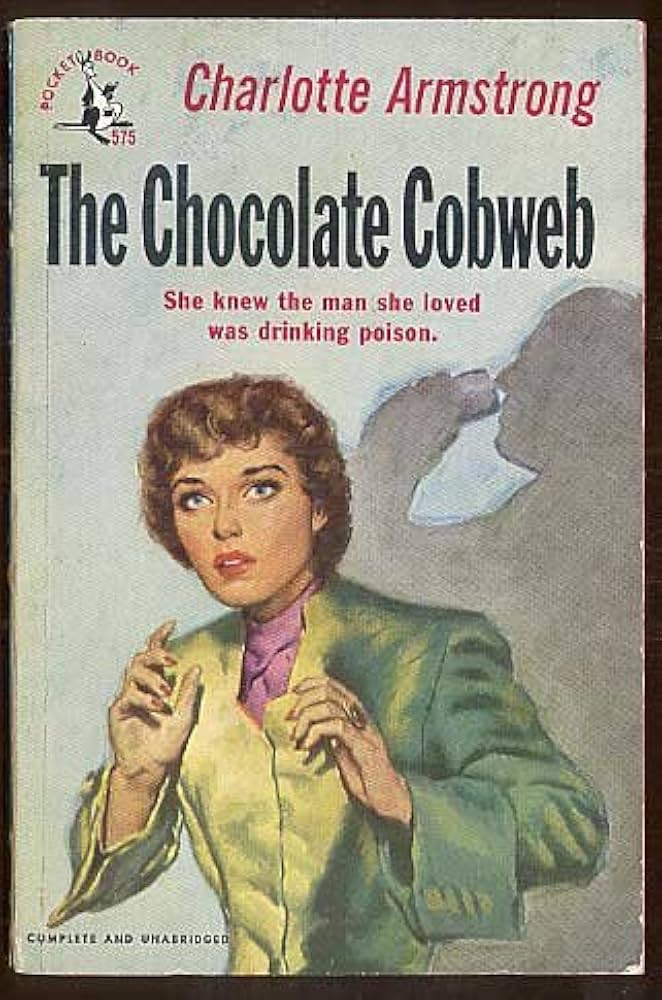
Slow reader that I am, this book moved like a house afire! Through a fluke, Mandy quickly becomes aware of the source of evil in the household, and from there, the book becomes a huge cat and mouse game, that I have to admit faltered just a bit when the romance aspect became a little too, well, icky kissy. Mostly, though, Armstrong carries us through a plot that works like clockwork told through some gorgeous prose. She even throws in some elements from the other mystery sub-genres we’ve discussed. Mandy has to ultimately solve elements of past and present tragedies, and she does so by utilizing one of the oldest clues in the whodunnit book! As for traces of the inverted mystery, Armstrong frequently takes us into the mind of a cunning psychopath, whose sick plans juxtaposed against their outward nature makes these passages some of the most chilling stuff in the book.
The Chocolate Cobweb was a great read, and I look forward to revisiting Armstrong in the near future with The Unsuspected. (Heck, if it’s half as good as the movie . . . ) I’m also excited that Book Club will be looking at other writers of the genre: in the coming months, we’re tackling Margaret Millar and Celia Fremlin, and who knows what other dark recesses of the domestic mind we will get to explore?
 Ah Sweet Mystery!
I am glad this was a more successful Armstrong read than your other one. Hope you enjoy The Unsuspected too.
LikeLiked by 1 person
This sounds really good.
LikeLiked by 1 person
The only thing I didn’t like about this book was that I had no idea how one pronounces “Thone” and “Ione”. Answers on a post card, please…
LikeLiked by 1 person
One rhymes with “That’s a bunch of baloney”, and the other I’ll tell you on the telephone.
LikeLike
Pingback: POOH AND PIGLET ON THE CASE: The Red House Mystery | Ah Sweet Mystery!
The only thing I didn’t like about this book was that I had no idea how one
LikeLiked by 1 person
Oh, I can explain that easily. You see, she
LikeLike
Pingback: LAY OFF MAC DUFF: The Unsuspected by Charlotte Armstrong | Ah Sweet Mystery!
Pingback: BECAUSE YOU LIKE THE LISTS . . . Brad’s Top Ten Reads of 2025 | Ah Sweet Mystery!