My Book Club’s recent discussion about our favorite 1940’s mysteries is the gift that keeps on giving. That our lists displayed such marvelous variety, with very few crossover titles, is a testament to our voracious reading habits and differing tastes; it may also explain why we have such trouble agreeing on what to read each month.

Easily the most eclectic and original list belonged to Carol, whose selections contained several titles that were totally new to me. Thus, after complaining about my rampant book purchasing habit and the size of my TBR pile to the group, I immediately ordered three titles from Carol’s list. One of these, The Deadly Percheron (1946) by John Franklin Bardin, appealed to me because when I asked my fellow club members, “What the heck is a percheron?,” not only did everyone else know (it’s a horse, of course) but they also corrected my pronunciation (it’s “PREH – sheh – ron”).
Bardin is yet another one of those eccentric writers who manage to deliver three crime novels in a short space of time – between 1946 and 1948 – and then fall off the face of the earth. Well, he didn’t fall, exactly: he had a highly successful career in advertising and even wrote several other, non-crime, novels which nobody reads anymore. He might have remained in literary obscurity had not a British politician and massive crime novel enthusiast named Denis Healey been a guest speaker at a CWA dinner in the 1970’s, where he sang the praises of Bardin’s all-too-brief career as a crime novelist. This resulted in the books receiving their first reprint in decades . . . all so I could write about it here!

The book begins almost like a joke: this guy walking into a psychiatrist’s office and says, “Doctor, I think I’m losing my mind!” And then the guy – Jacob Blunt – proceeds to tell the psychiatrist – Dr. George Matthews, who also happens to be our narrator and hero – a truly crazy story about being approached by a leprechaun who offered him ten dollars a day if Jacob would buy a different assigned flower each day and wear it in his hair. (On this particular afternoon, it’s a scarlet hibiscus.) When Jacob manages this successfully, the leprechaun introduces him to another leprechaun who pays him to whistle at Carnegie Hall. And then a third leprechaun gives Jacob ten dollars a day to give away a roll of quarters.
Jacob’s dilemma is existential in that he wants Dr. Matthews to prove he’s crazy:
“If I’m crazy, doc, then you can cure me. But if I’m not crazy, and these little men are real, why, then, there are such things as leprechauns, and they are giving away a tremendous treasure – and then we’d all have to begin to believe in fairies, and there’s simply no telling where that would lead to!”
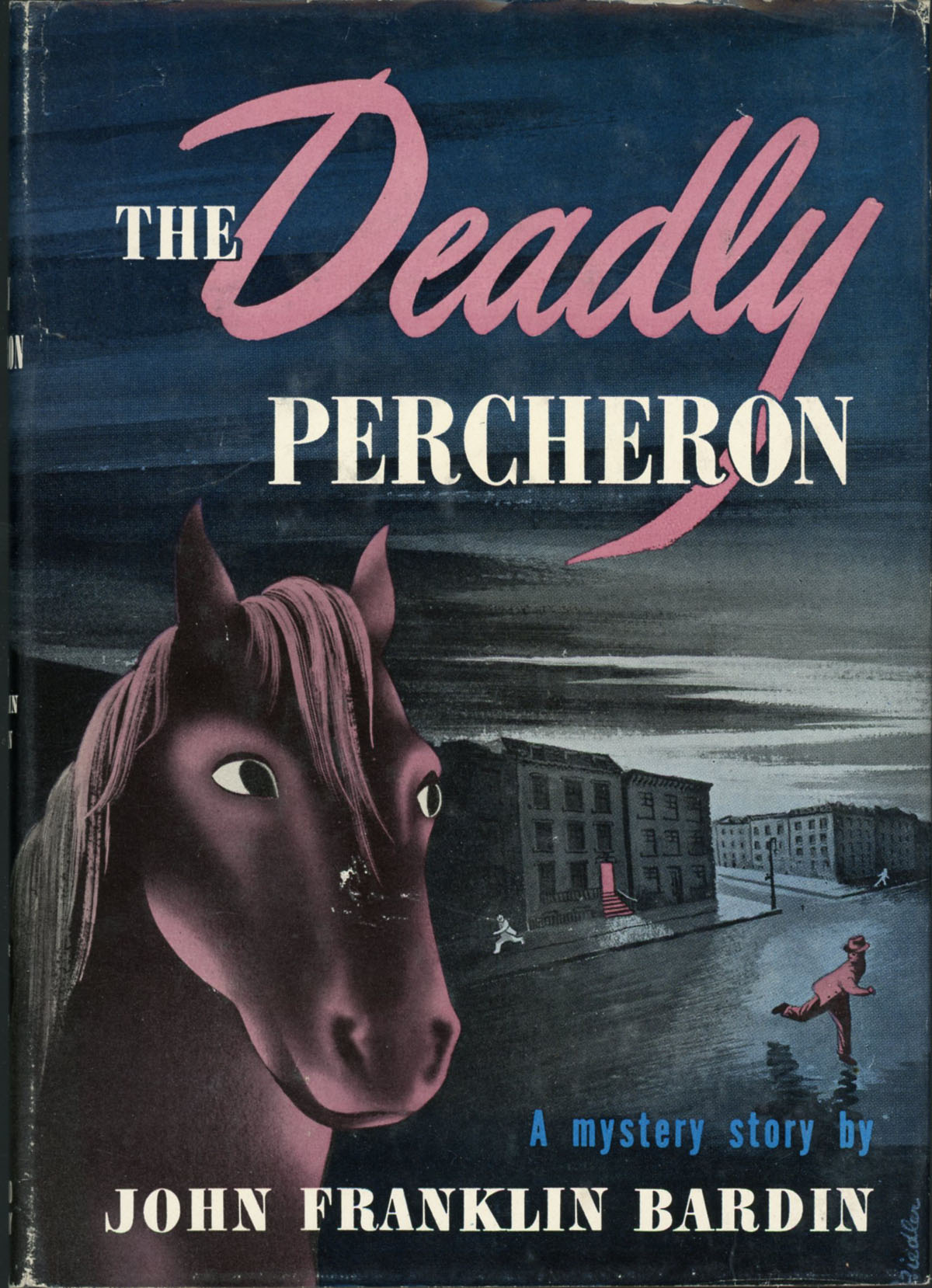
Amidst all the screwball details, the canny crime reader will latch onto one salient fact: Jacob is rich, his late father having been a “Big Four” type of gazillionaire in the automobile industry. Is someone tossing leprechauns at the young man as a means of robbing Jacob of his own pot of gold? Or is the patient pulling a fast one on his psychiatrist? Whatever the case, Dr. Matthews decides to help Jacob – and what started out as silly quickly becomes sinister with the discovery of a murder. And after that – all hell breaks loose!
I’ll keep this short because to tell you much more about this book would lessen the pleasures and surprises in store. For me, The Deadly Percheron was an experience akin to reading Joel Townsley Rogers’ The Red Right Hand, (another book that both Carol and I loved) in that it is a masterful depiction of a nightmare. In style, the books read very differently from each other, but they both manage to have an almost hallucinatory effect on the reader. With Rogers, a large part of that is due to his poetic writing, which takes some getting used to. In contrast, Bardin writes like a breeze: his prose is taut and funny, making you laugh and feel incredibly uneasy at the same time.

As the book progresses, the author unleashes one shock after another on us. I counted at least eight major twists, which take us all the way through to the Epilogue, where Bardin provides us with an essentially rational explanation for all that went before. (Rogers did the same thing at the end of Hand.) That denouement is aptly delivered in an abandoned Fun House on Coney Island, in a situation guaranteed to leave the reader and the characters open-mouthed and dizzy.
I highly recommend this one if you’re looking for something a little different. Imagine throwing the elements of a screwball comedy, a whodunnit, a psychological suspenser, and a horror noir into a blender and switching it onto “puree” – with the top off!
And then you feed it to the horse!
 Ah Sweet Mystery!
Hi Brad…so happy to have stumbled upon this! The Deadly Percheron is, by far, one of my absolute favorite books in any genre, but most specifically in the region of “noir lit.” It’s an uninhibited joyride through the most diabolical landscape, alternately funny, terrifying, and deeply human. I would also recommend Bardin’s other masterpiece, Devil Take The Blue-Tail Fly. It’s nearly the equal of Percheon, which should tell you all you need to know.
LikeLiked by 1 person
Elliot, I kept thinking that if someone could have figured out how to film this, it would have been as unsettling a classic as Nightmare Alley!
LikeLike
I think the late David Lynch would have been the perfect director for this.
LikeLiked by 1 person
I want you to think of any kind of French cart horse. Right now. Not to put the pressure on.
LikeLiked by 1 person
No idea – but as I read your comment, I was spreading some homemade Sauce Boullanaise onto a Breton cracker. Does that count?
LikeLike
I wonder if Lynch knew it, actually… Anyway, the book is mentioned in “Mona Lisa” by Neil Jordan.
LikeLiked by 1 person
Yes, someone – Bob Hoskins? – is reading the book!
LikeLike
Reading your review triggered me to pull this off the big pile where it has sat for too long. And I really enjoyed it.
The psychological noir of “The Deadly Percheron” had touches of Jim Thompson and Cornell Woolrich, including identity, madness, paranoia, and moral ambiguity.
The head spinning reveals in the last quarter of the book almost felt too much and I worried that Bardin wasn’t going to bring the ending together in a cogent, satisfying (albeit dark) way, but he did.
Thanks for the recommendation. This makes me wonder how many other gems are sitting TBR. I have slowed my book buying way down as I fear that every book I buy now could mean I might never read the outstanding ones like “The Deadly Percheron”.
LikeLiked by 1 person
We’re in the same boat, Scott, only I’m having the hardest time curtailing my own book buys! (TDP was a new purchase after Book Club!) I’m glad you enjoyed the book. I just bought a couple of Woolrich titles, and two people have told me that if I liked this I have to read Bardin’s Devil Take the Blue-Tail Fly!
What’s a guy gonna do???
LikeLike
Pingback: POOH AND PIGLET ON THE CASE: The Red House Mystery | Ah Sweet Mystery!
Everything Bardin wrote has been pretty unusual in my experience, and each in a different way. My favorite by him is The Longstreet Legacy (aka A Shroud for Grandmama) published under the name of Douglas Ashe, although it took a long time to track that down for a cheap price. FYI he also published under the name of Gregory Tree.
LikeLike
Pingback: #1323: The Deadly Percheron (1946) by John Franklin Bardin | The Invisible Event