To all you true Christie fans, have I got an adaptation for you!
As I’ve said repeatedly, I have come around to a much more open-minded attitude when it comes to adapting Christie, which is why I enjoyed the BBC’s recent Towards Zero more than most of my fellow Christie fanatics did. It was far from perfect – too many plot points left out, a nonsensical reinvention of Audrey Strange – but it was moody, well-acted, and great to look at. Sometimes, that’s all you get, but here’s the thing: Agatha Christie’s books stand on their own and always will. And sometimes it’s interesting to see someone’s different take on those classic stories. And, yes, sometimes it’s horrifying.
But adaptation makes one remember and appreciate the originals. I recently went to an exhibit of Wayne Thibaud’s art. This is a man who knew the classic artists and reveled in his thievery of their work. Each painting I saw had the original beside it, and I can’t tell you how much fun it was to see how Thibaud’s whimsical brain reimagined the works of Degas, Mondrian, Picasso and many more.
Maybe Thibaud should have tackled a Christie novel!!!
Anyway, one fantastic thing came out of watching the BBC Towards Zero: a friend gave me the opportunity to watch L’Heure zéro, the 2007 French adaptation of Agatha’s 1944 novel. And here’s the great news: if anyone had any doubt that a two-hour film based on a Christie novel can successfully transfer the entire plot to the medium of film, and do so with style and attention to detail, then look no further than director Pascal Thomas’ movie. The film is, for the most part, brilliantly cast and scripted and sumptuously produced. We are living in a time when Christie adaptations cut characters, alter plot threads and, worst of all, have the nerve to change the solution. What favors did the BBC’s Ordeal by Innocence, the Marple Sittaford Mystery, or the Poirot adaptation Appointment with Death do to the reputation of the author?
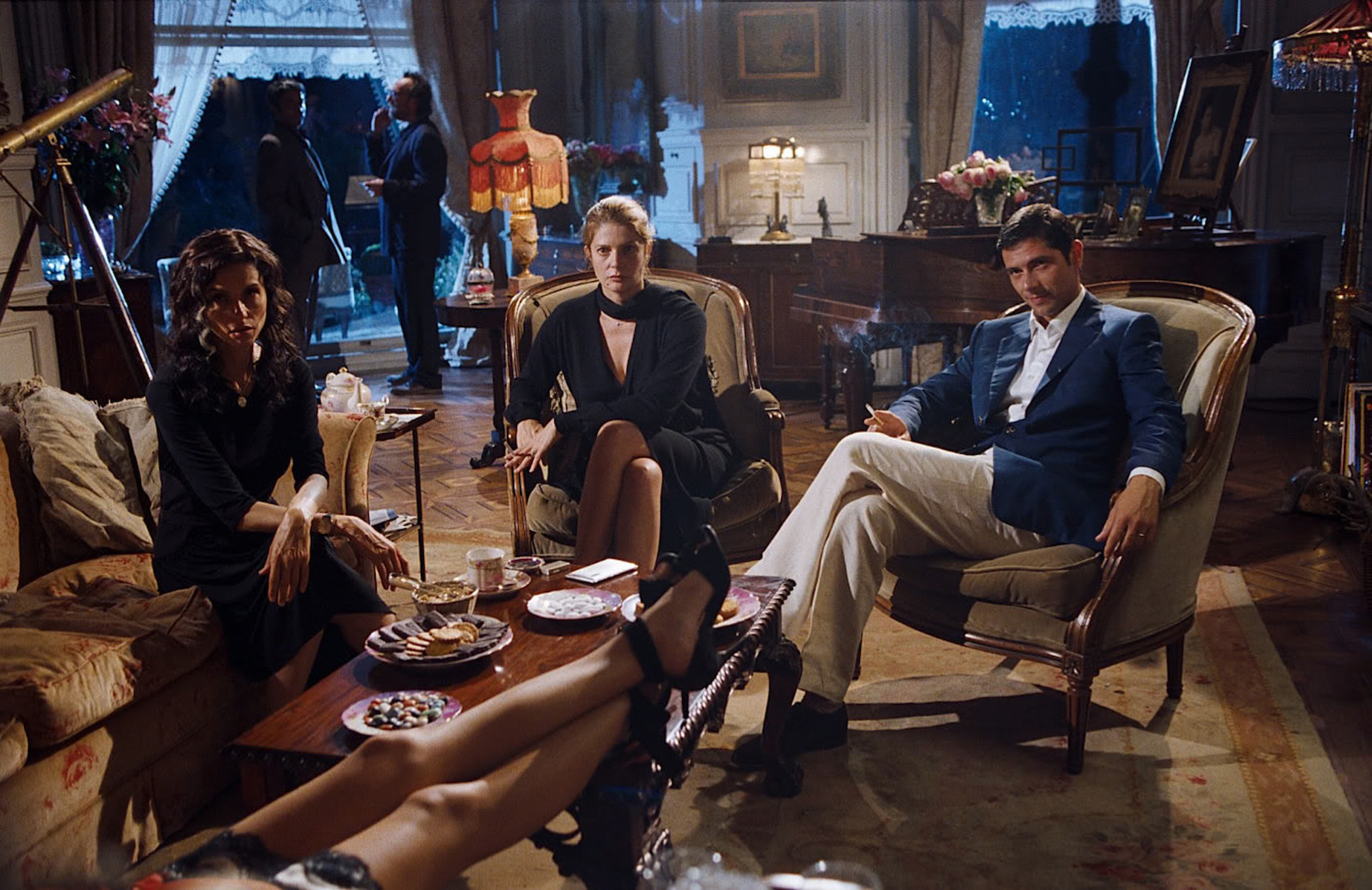
L’Heure Zero is lovingly faithful to the original. From the moment that the lawyer Mr. Treves gathers a group of associates together and explains his theory of murder as Zero Hour to the finale on the boat where an insane killer is exposed, the film follows the novel in nearly every way. Sylvia Battle’s travails at school are here; Andrew MacWhirter’s suicide attempt and all that follows is here. (Well, most of it . . . but due what I believe is a casting issue, the ending for that character is changed.) The tale of a child killer with a physical abnormality is here (and plays beautifully). The death of Adrian Royde plays its part in the plot. The murders are handled correctly, and the solution is presented intact.
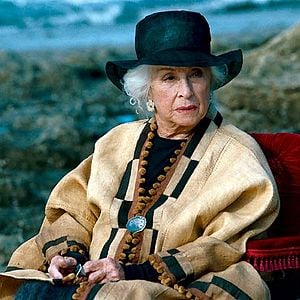
For the most part, the casting is also excellent. Top marks to Danielle Darrieux, one of the queens of French cinema, whose career spanned nearly eighty years, for her performance as Lady Camilla Tressilian. (I just rewatched Ms. Darrieux in one of my favorite 60’s musicals, Les Demoiselles de Rochefort, where she was the only leading actor who sang their own role!) Unlike Angelica Huston at the BBC, Darrieux eschews darkness and gives us the portrait of an aged but always beautiful woman whose aristocratic nature is tinged with a generous heart. (Her death, which we witness in flashback, is both horrific and heartbreaking.)
A handsome actor named Melvil Poupaud plays Guillaume Neuville (Neville Strange) just as he should be played – as the good sport whom every man should like for a friend and every woman for a lover. Equally good is Chiara Mastroianni, whose pedigree as the daughter of Marcello Mastoianni and Catherine Deneuve makes her a shoo-in as Aude Neuville (Audrey Strange). I also really enjoyed Alessandra Martines, Clément Thomas and Jacques Sereys as the French equivalents, respectively, of Mary Aldin, Thomas Royde and Mr. Treves. Xavier Thiam acquitted himself well as Ted Latimer, although this being a French film, prudish viewers should be aware that Ted is on the make in a variety of sexy ways.
Okay, what did I not enjoy as much? Superintendent Battle, here called Inspector Martin Bataille, is played by François Morel, an actor who seems to be known more for his comedic performances. There are moments that work well for me, such as his meeting with daughter Sylvie at school when she is falsely confesses to theft (the parallels to Audrey are particularly well played here). But there is also too much comedy in Morel’s performance for my taste. The same holds true for the late Hervé Pierre, a member of the Comédie-Française, who plays Ange Werther (Andrew MacWhirter), the man whose suicidal nature gives way to a sort of bumbling enthusiasm for life. He performs all the amateur detective duties that MacWhirter accomplished in the novel, but he’s played as such a nebbish that rather than give her heart to her bumbling savior, Audrey ends up with no one.
Still, Morel and Pierre come off as Shakespearean tragedians compared to the actors playing the butler and housemaid, who seem to have been lifted from some French version of Benny Hill: the low point of the film is catching this pair engaged in sexual intercourse while on the job (It’s done fully clothed, along the lines of a modern farce.) I could have done without the excess of silly humor, especially with the bulk of the cast embracing the character-driven drama of Christie’s novel.
But all of this is soooo minor up against the loving care with which this company presents Christie’s story. If you ever come across the chance to watch L’Heure zéro, be sure you take advantage of it. You won’t be sorry.
* * * * *
My friend was doubly generous by giving me access to another gift: the 2015 two-part TV adaptation from Japan of Oriento kyuukou satsujin jiken (Murder on the Orient Express). Part One adapts the novel itself – or rather it seemed to me that it was, with small exceptions, a faithful re-rendering of the 1974 Sidney Lumet film. Certain scenes from that movie seemed to have been wholly lifted for this, like the opening scene where the embarrassed soldier is trying to figure out what to do with Poirot while they wait for his train.
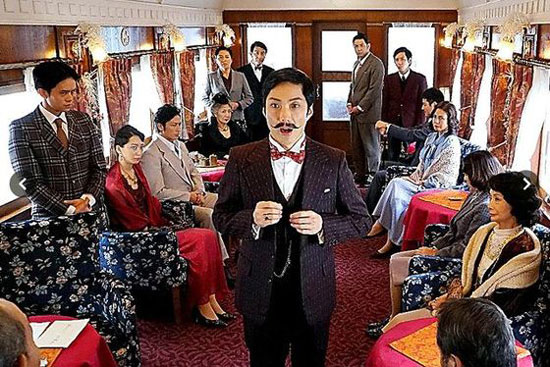
I said “Poirot,” but the detective here is a Poirot-like figure named Suguro Takeru. He is played by Nomura Mansai, who has been appearing in films since the age of three but is also a star of Japanese kyogen theatre, a traditional comic form. To me, there was something a little too cutely comic about his performance, such as the moment when he is trying to climb into the top bunk in Hector MacQueen’s cabin. But once the murder occurs, he settles down a bit.
To be honest, this adaptation posed some problems for me. The bulk of it may have been faithful to a fault to the original, but that merely served to highlight some of the flaws of the book’s structure. Most of the text consists of interviews with the twelve suspects and the conductor, all of whom are questioned twice! It’s frankly a bit wearying, and it’s less fun to watch than read – unless you’re watching stars you love playing these roles while standing on fabulous sets and wearing sumptuous costumes. Wikipedia informs me that many of the actors here are beloved stars in Japan, so I assume audiences enjoyed watching their versions of Lauren Bacall, Wendy Hiller, Sean Connery, et. al. But it did not have the same effect on me. Compared to Lumet’s sumptuous film, the whole thing felt a bit threadbare.
The aspects of the plot that were missing here couldn’t be helped, and yet they are part of what makes the book so much more intriguing to English readers. Since Japanese actors play every character, we lose the important aspect of an international crowd appearing on the train at a slow time of year. The family that suffered from the crimes of the Ratchett figure are prestigious, but the historical parallels to the Lindbergh case are gone. At least Japan seems to have the same jury system as America, and, as in the book, Suguro must choose which of his suspects is innocent rather than guilty.
At the end of Part I, Suguro confronts the Mrs. Hubbard/Linda Arden figure and accuses her of being the ringleader of this murder plot. The actress then begs to tell the whole story to Suguro of what happened five years earlier and how it led to this moment. That is the cue for Part II to begin. Here we get the kidnapping and murder of “Daisy Armstrong” and the subsequent deaths of both her parents and the maid. We see how Linda Arden and the Princess Dragomiroff figure instigate the conspiracy, how they makes their plans and set the scene for their murder on this Orient Express, and how they deal behind the scenes on the train itself with the presence of a world-famous detective and how it alters their plans.
It’s all well filmed and well-performed by the cast, but to my surprise I found myself thinking how unnecessary, even unfortunate, it was to watch all of this taking place. It reminded me of how much I enjoyed Part One of A Study in Scarlet but lost interest in Part Two, where the killer’s history and motivations are explained. Or how much I appreciated the Harry Potter books never placing us on the scene to watch Harry’s parents get murdered. Christie presented all we needed to know about the past in the book. And, yes, Sidney Lumet made a haunting use of flashbacks to give us a little more. But just a little – we did not need as much detail as we get here.
The end of Part Two brings us back to 1934 and the decision that Suguro and his assistants must make as to which solution should be presented to the police. I am not a fan of the Suchet adaptation, where Poirot undergoes une crise de conscience intense, but here the whole thing is played way too much for laughs, with one character forced to run around in the snow to create fake footprints while Suguro and his buddies head back to his cabin to consume dried puffer fish. Yuk, yuk!
So if you have a chance to watch this, rest assured that Part One is extremely faithful, and Part Two does a lovely job providing you with history you may have never wanted to know.
* * * * *
Postscript: The Young Girls of Rochefort has nothing to do with Agatha Christie – or even classic crime at all. It is a bubbly French musical, one of the best of the 1960’s. It was nominated for an Oscar for Best Scoring at the 1967 Academy Awards but lost to Oliver. Though that latter film won the Oscar for Best Picture (and five other awards), I think Young Girls is a far more interesting and enjoyable film.
The “young girls” are a pair of twin sisters, played by real-life sisters Catherine Deneuve and Françoise Dorléac, who live in the small town of Rochefort where they give dancing lessons to kids, but who dream of making it big as performers in Paris. They each have a fairy tale of a love story that unfolds across the course of the film, as does their mother, played by the fabulous Danielle Darrieux, who runs the local café and dreams of the men she has loved and lost. There are also two young men, played by George Chakiris and Grover Dale, who run a traveling fair and flirt with all the women in town (although I do believe they were truly meant for each other, and to prove it they end up with no girl at all!)
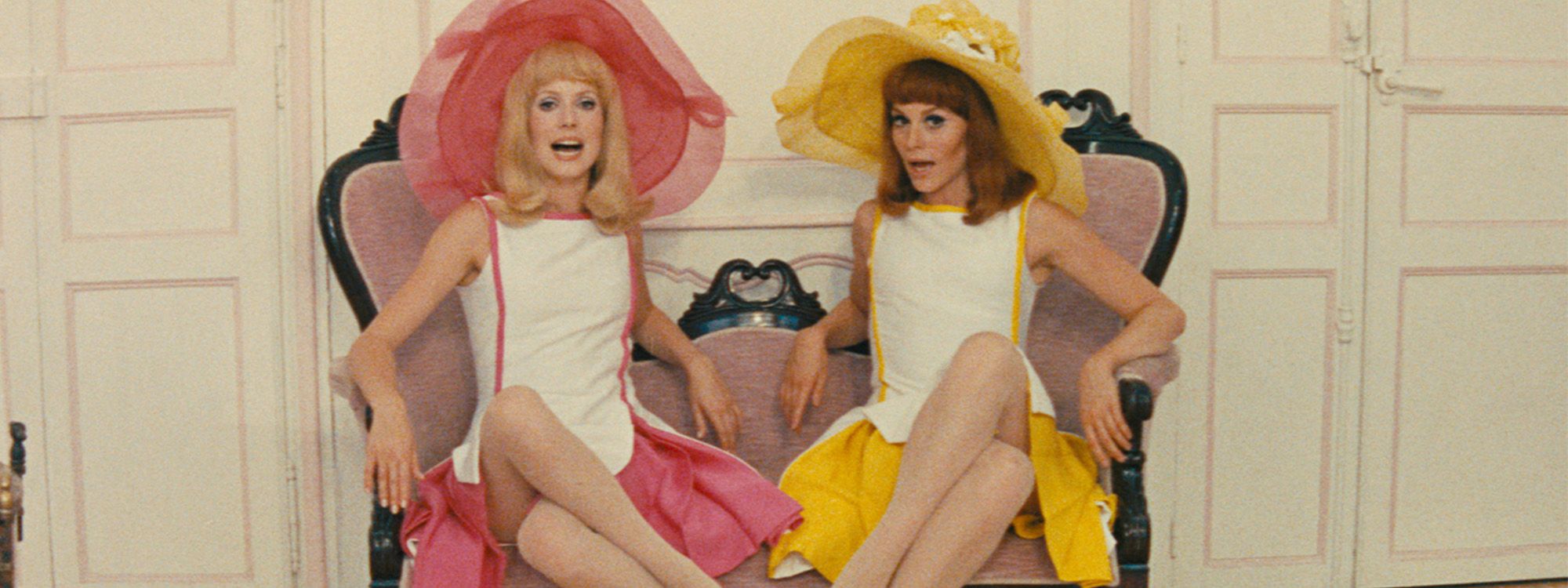
It’s light, frothy, sexy fun with a complex plot that serves mostly as a place to hang a fabulous Michel Legrand score. So why even mention it here? Because at one point, the girl’s mother picks up the newspaper and reads that a local woman has been hacked to death with a knife!! Mom actually sings about this in the most lighthearted way (“A man has cut a woman up in bits, you know, on Rue Lafayette, not far from the chateau!”) and everyone makes jokes about how the victim’s life is now “in pieces!!”.
The dead woman is not a character we ever meet. Ah – but her murderer is! In the end, we learn that somebody out of this large lovable cast has been arrested for this brutal crime. And once again, everyone has a good laugh over the denouement to this murder mystery (and the way the killer had balked at slicing a birthday cake!!)
I can’t recommend it highly enough!
 Ah Sweet Mystery!
I’m so pleased you liked L’Heure Zero! It is so much better than other versions of Towards Zero.
As for Mansai Nomura’s Orient Express. This was his first outing as Takeru Sugoru (I may have gotten the name order incorrect) and in the two subsequent films (Murder of Koriodo and Appointment with Death), he dialed the tics back substantially. The date change may have made a difference too; pre-war Japan versus postwar Japan.
We saw his films out of order, not getting his Orient Express until two years later.
We enjoyed the second half of Orient Express more than the first half which was a pretty obvious homage to Albert Finney’s version. But the second half! Tragedy mixed with comedy and what do you do? I had never once considered how the family worked out a complicated plot and then, when things went wrong, how they coped.
As for The Young Girls of Rochefort, how could you forget that Gene Kelly is in it?????
Thanks for the reminder! We have to add it to our current movie musical marathon.
LikeLiked by 1 person
I didn’t want to take too deep dive into Rochefort because it’s not a mystery – although the plot does resemble something out of Raymond Chandler or a Dickens novel – if either had been French and written in the 1960s. (“It was the best of times, it was the best of times!”) Gene Kelly is sexy as hell in it – it’s hard to believe he was fifty-five and paired with a 25-year-old actress. (Well, France or Hollywood, that last point isn’t hard to believe at all!!!) It took me fifty-five years to find this film!!
LikeLiked by 1 person
These sound really worthwhile Brad, tgsnks! By the way, I presume you’ve seem the predecessor to Damoiselles de Cherbourg, Demy and Legrand’s sublime, The Umbrellas of Cherbourg? No murders in this one but … it’s stunning.
LikeLiked by 1 person
And soooooo sad!! It feels like a modern opera to me compared to the pure musical theatre of Rochefort. But it’s a beautiful film!
LikeLiked by 1 person
Super happy you enjoyed both films. I sure do, well worth a rewatch some rainy, stormy night.
LikeLiked by 1 person
And now I can, thanks to you! ❤️
LikeLiked by 1 person