
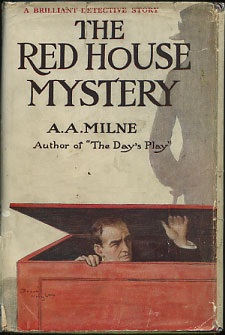
Like most classic mystery fans, I have long been aware that in 1922, three years before he created that immortalis ursi Winnie-the-Pooh, A. A. Milne wrote a single crime novel called The Red House Mystery. The book was a great success! Even Raymond Chandler, Public Enemy #1 when it comes to country house mysteries and locked room puzzles, wrote in his screed “The Simple Art of Murder” that this country house mystery and locked room puzzle was “an acknowledged masterpiece.” Of course, he went on to use the book as evidence of the folly of reading this sort of thing. But wouldn’t you know it? When Pushkin Vertigo reissued the book last year, it slapped “’An acknowledged masterpiece,’ Raymond Chandler” on the front cover!
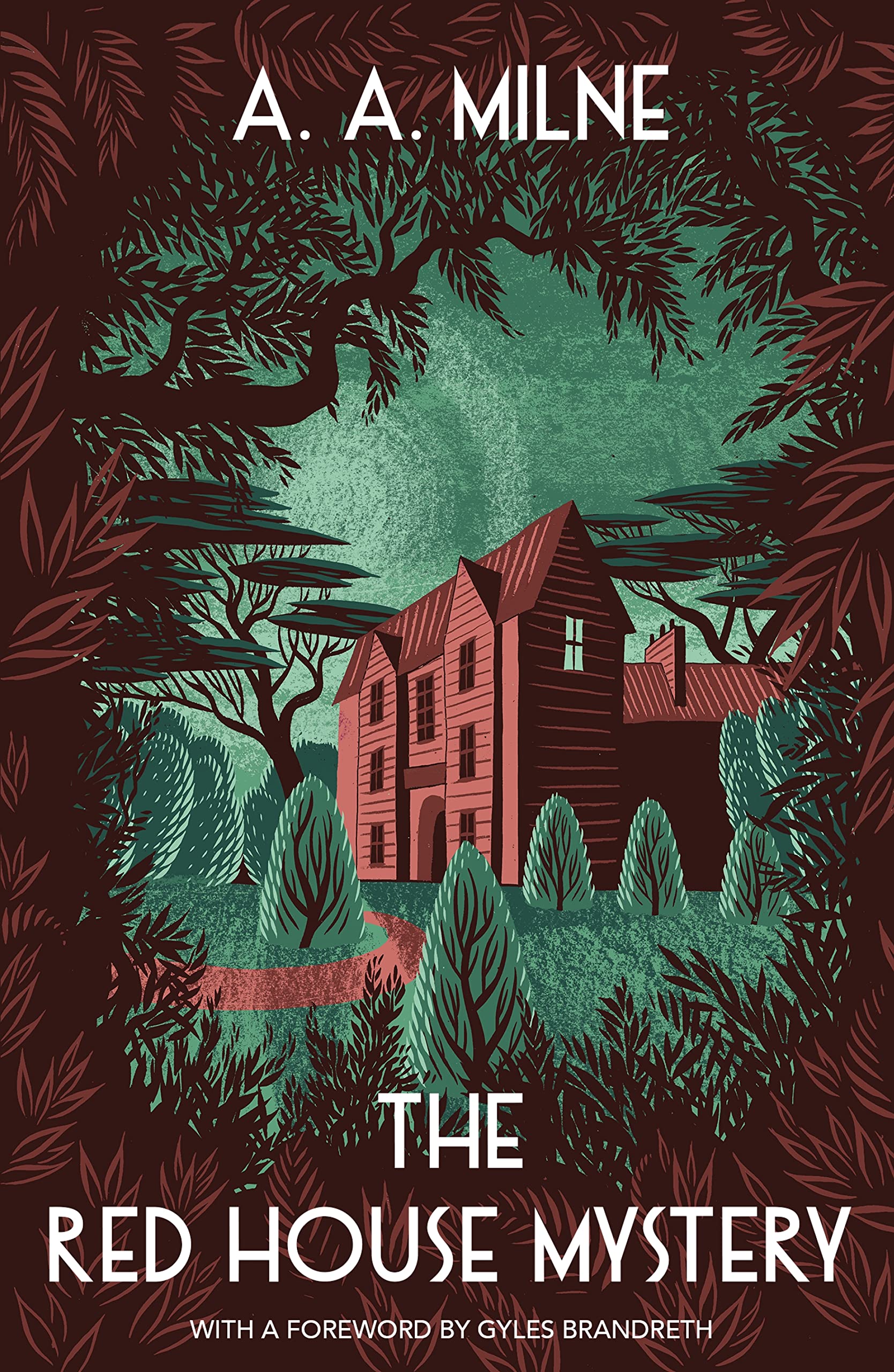
This is the edition I grabbed a pristine copy of in my favorite used bookstore when, working on a project for my Book Club, I started looking for mysteries written in the 20’s. My tastes for this decade are admittedly narrow, but I figured that 1) I enjoyed reading Winnie-the-Pooh just as much as the next kid growing up; and 2) since Milne only wrote the one mystery, if I didn’t like it I would still have covered the man’s entire oeuvre (let’s not get into the Four Days Wonder controversy, okay?).
Pushkin Vertigo has included the introduction that Milne wrote for the 1926 British reissue, and it is delightfully funny. While the Pooh books may have been amusing, I hadn’t been aware that Milne’s early efforts appeared in Punch and that he was a true wit. A longtime devotee of detective novels, Milne claims that when he told his agent he was going to write one, the agent begged him to stick to Punch. Two years later, when he wanted to write a book of nursery rhymes, he was urged to do another detective story instead! Too late! Having debuted Winnie the Pooh to great acclaim in a 1925 Christmas Eve story, he feared that writing a second book full of murder and mayhem would be in poor taste!
Milne clearly knows and loves the genre, as evidenced by the informal list of “rules” he urges all would-be mystery authors to follow. I’m impressed that these appeared three years before Father Knox unleashed his Commandments in the world, for they are very good rules indeed!
1. ”I prefer that a detective story should be written in English.”
Never fear – Milne isn’t decrying other cultures, just fancy language! He poses a case where the criminal has broken into the murdered man’s library and posits the sentence: “The detective was more concerned to discover how the murderer had effected an egress.” Milne questions the necessity of such a sentence: “It is, to me, a distressing thought that in nine-tenths of the detective stories of the world murderers are continually effecting egresses when they might just as easily go out.”
2. “On the great Love question opinions may be divided, but for myself I will have none of it.”
This aligns with the preferences of both Knox and Van Dine, but Milne is funnier about it, complaining of the time wasted “while Roland clasps Angela’s hand a moment longer than the customary usages of society dictate.” Milne suggests Roland find another book where he can canoodle; as long as he’s in a detective novel “he must attend strictly to business.”
3. The detective must be an amateur. (And, conversely, the murderer should be one, too.)
Lots of readers enjoy, maybe even prefer, to have a professional policeman investigate a crime. Not Milne – and I believe his argument is sound:
“In real life, no doubt, the best detectives are the professional police, but then in real life the best criminals are professional criminals. In the best detective stories, the villain is an amateur, one of ourselves . . . It is the amateur detective who alone can expose the guilty man, by the light of cool inductive reasoning and the logic of stern remorseless facts. Indeed, this light and this logic are all which I will allow him. Away with the scientific detective, the man with the microscope!”
4. “The detective must have no more special knowledge than the average reader. The reader must be made to feel that, if he too had used the light of cool inductive reasoning, and the logic of stern remorseless facts (as, heaven bless us, we are quite capable of doing) then he too would have fixed the guilt.”
This is the most problematic of Milne’s rules because it does not allow for the existence of an Hercule Poirot, a Sherlock Holmes, a Dr. Thorndyke, or an Ellery Queen! As it turns out, in fact, the author breaks his own rule pretty quickly in his first and only mystery novel. But it’s interesting to note Milne’s antipathy for authors who present facts in such a way that the reader has fewer chances of taking notice than the detective. (Milne breaks that rule, too.)
5. “Are we to have a Watson? We are.”
The other rule-makers have covered the Watson, but they don’t have as interesting a reason for his existence. Milne decries the author who saves all explanations for the final chapter, “making all the other chapters but prologue to a five-minute drama.” Better that the detective should have an ally to whom he explains things throughout Milne even gives their dialogue a verb form: to “watsonize”.
And Milne sees no reason to make our Watson a fool just so that the detective can look better. Since the Watson’s job is to receive information, “ a little slow, let him be, as so many of us are, but friendly, human, likable . . .”
An important sixth rule is not mentioned in the introduction, but Milne states it plainly throughout the text –
6. The detective should be an outsider to the closed circle of suspects, victims and killers.
Most Golden Age detectives were outsiders, although some amateur sleuths gained their status by coming under suspicion and fighting to clear their name. Milne shows us the value of this in Red House, as his amateur sleuth fears that nobody in the house party could look at each other objectively enough to gauge whether their friend or relation is a killer.
The back cover blurb certainly prepares us for a classic country house mystery and “a tantalizing locked-room puzzle:”
“The Red House, with its delightful countryside setting and genial host, is the perfect place for a summer party. But as the house and its gardens doze peacefully in the heat of an August afternoon, a shot rings out. Then a body is discovered in the locked study, with a bullet hole between the eyes. Enter charismatic amateur sleuth Anthony Gillingham and his amiable sidekick Bill, who are determined to get to the bottom of this rum affair.
The blurb isn’t lying to us: the ingredients are all there for a classic locked room mystery. And it starts, as many such mysteries do, with a houseful of amusing servants all agog over the news that the genial host, Mark Ablett, has a ne’er-do-well brother Robert who, having been exiled for years in Australia, has chosen this country weekend to pay his brother a most unwelcome visit. Add a passel of your typical country weekend guests – a cousin/secretary, a retired military man, a professional actress, an equally dramatic matron and her bright young thing of a daughter, and amiable chap Bill Beverley, who has a thing for the bright young thing – and you have all the makings of a smashing example of “the body in the library” – or, in this case, the office.
Enter Antony Gillingham, a clever young man who, finding himself between jobs, happens to be vacationing in the next town over. Discovering that his pal Bill Beverley is weekending nearby, Antony hikes over to the Red House, only to come upon the cousin/secretary, Mr. Cayley, knocking frantically on Mark’s office door, into which the host had just escorted his surly brother for a showdown. Unable to break the door down, Cayley and Anthony rush around to the back of the house. Looking through the locked French windows, they see a body lying on the floor. Is it Mark or Robert? And where is the other brother?
So the stage is set for a traditional GAD experience – but that is not what we get. First of all, since all the “suspects” were at golf and have an alibi, the closed circle is sent away – for good. Only Bill remains behind because his pal Antony, who has decided that his latest job will be to become the next Sherlock Holmes, needs someone to play “Watson.” Next, the locked room puzzle is dispensed with in a matter of pages, in ways that I won’t detail here but which explains why this book isn’t listed in Adey’s compendium. What’s left appears to be a very simple problem which depends on Antony and Bill figuring out the actions of three people on that fatal day.
Having stated the “simple problem,” I won’t say The Red House Mystery is without its twists, but it eschews most of the qualities of a classic mystery: the interviews, the intrigues among the guests and staff, the conflicts between the amateur sleuth and the police (the representative of the law, Inspector Birch, appears infrequently and encourages Antony to investigate).
What we get instead of the traditional methods of mystery story-telling, is 250 pages of “Watsonizing” between Antony and Bill. The pair spend their time exploring the vast estate and uncovering its secrets, wandering to the village on errands, or lazing about on this bench or that settee, talking over theories and hugging each other over how much fun they’re having together. It’s all jolly fun because Antony and Bill are great company. Sometimes they reminded me of Pooh and Piglet wandering through the Hundred Acre Wood, philosophizing about life, and having mild adventures together. And sometimes I found myself asking, “Where did everybody else go?” But this is what you get.
In fairness, I will add that our sleuth, who possesses the gift of instant recall of everything he sees around him, does get some clever deductions in, although even he has to admit at the end that some of his success at uncovering the truth amounted to guesswork. Thus, I find myself in the horrifying position of agreeing with Raymond Chandler, who wrote:
“. . . it is an agreeable book, light, amusing in the Punch style, written with a deceptive smoothness that is not as easy as it looks.” Ultimately, the book contains all the things Chandler hates – an implausible murder plan and a “brash amateur” sleuth let loose due to the incompetence of the police.
I’ll agree that the solution, when it comes, is as ridiculous as it is clever. And I sure wish that there had been more suspects!! Ultimately, The Red House Mystery is a comic lark about two charming young men playing dress-up Sherlock Holmes. It’s also the perfect book to pick up after you’ve read The Chocolate Cobweb and The Deadly Percheron in succession and are about to tackle Margaret Millar. But, in a nod to Chandler, would I call it “ “an acknowledged masterpiece” of the mystery genre? As Piglet would say, shyly, “Oh, d-d-d-dear – no, I think I wouldn’t.”
 Ah Sweet Mystery!
Yeah, I do remember the emptiness of the estate feeling weird when I read it… now that you mention it again – and now that I’m currently playing a videogame set in a mysterious mansion – it makes it seem like Anthony and Bill are playing Myst or something, with everyone conveniently off-screen (so we don’t have to animate them, and so they can’t mess up the story by wandering around).
You know, I think these “20’s classics” (like this or Trent’s Last Case) feel like they are classics not because they actually exemplified the form, but because they did one particular thing very well – in this case the Watson, like you pointed out. But the book has completely faded from my mind, even though I only read it a few years ago.
LikeLiked by 2 people
Funnily enough, Trent’s Last Case was published in 1913 – and Philip Trent did not reappear until the mid-1930’s. Looking at his bibiography, it appears that E. C. Bentley skipped the 1920’s altogether!!
The 20’s are hard for me – I’m not a fan of Sayers, I’ve already got Berkeley covered for my project, and while I’m a big Ellery Queen fan, I find his 1929 debut, The Roman Hat Mystery, impossible to get through.
LikeLike
Pingback: SIX SKIDOO: My Favorite Mysteries of the 1920’s | Ah Sweet Mystery!