Sometimes you have to look around at all the great authors you’ve added to your collection – and still never read – and just hang your head in shame. Among my unforgiveable omissions is a charming married couple, the Millars. (Sounds like “Miller.”) He (Kenneth) wrote primarily under the pseudonym of Ross MacDonald and created one of the great private eyes, Lew Archer. My buddy Sergio has much to say about my not having read about Lew! She (Margaret) got the jump on her husband as a mystery writer in 1941, crafting traditional whodunnits.
But then Margaret began to branch out into territory that defies a single classification. What ties her detective novels, thrillers and domestic suspense tales together is her keen psychological insight (Millar studied psychology but never practiced), her marvelous powers of description, and her ability to weave moments of unbearable suspense, even horror, into her work.
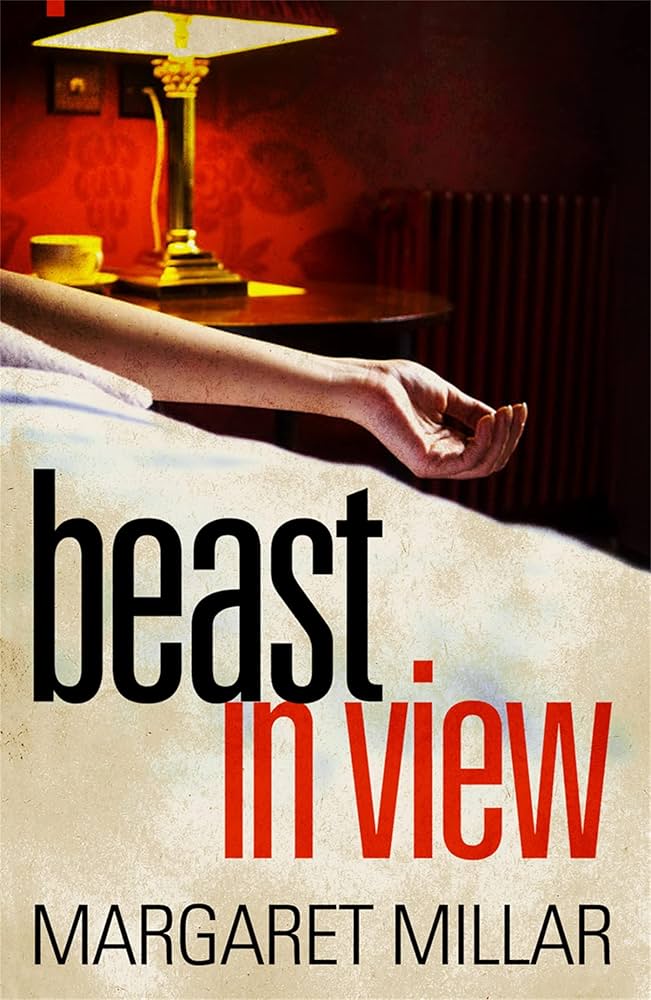
I have picked up several of Millar’s novels over the past few years and left them sitting ominously on the shelf. finally, thanks to my Book Club, I picked up Beast in View. Published in 1955, it won the Edgar Award for Best Novel the following year. I can understand why: six lines into the book and I already started getting chills.
The voice was quiet, smiling. “Is that Miss Clarvoe?”
“Yes.”
“You know who this is?”
“No.”
“A friend.”
“ I have a great many friends,” Miss Clarvoe lied.
It’s that last word that tells you we’re in for a chilling ride. Helen Clarvoe lives a secluded life in a transient hotel, estranged from her family since the death a year earlier of her beloved father. Dad left quite a bit of money to his daughter, which doesn’t sit well with her mother Verna or her brother Douglas. Now Helen dwells off her money, bored, friendless, pathetic. Millar’s character descriptions are brilliant and merciless. Helen may very well be the heroine of our story, but she is both pathetic and unsympathetic – a hallmark of nearly every character we meet here. When she looks at her reflection in the mirror, she sees,
“. . . an old friend, familiar, but unloved; the mouth thin and tight, as if there was nothing but a ridge of bone under the skin, the light brown hair clipped short like a man’s, revealing ears that always had a tinge of mauve, as if they were forever cold, the lashes and brows so pale that the eyes themselves looked naked and afraid. An old friend in a crystal ball.”

The voice on the phone identifies itself as Evelyn Merrick, another “old friend,” but Helen can’t place her. And the things she says to Helen are not the words of a friend – they are violent, frightening things. Distraught, Helen reaches out to the only person she can think of for help: Paul Blackshear, the family’s financial advisor. Although he doesn’t know Helen well and initially doesn’t like her much, Paul is disturbed by the things Helen says she heard on the phone. He agrees to track down Evelyn Merrick and find out what her beef is with Helen.
I’m going to proceed with great caution here because this is another book the plot of which is too full of delightful twists and turns to tell you too much more about it. Admittedly, it makes blogging about these terrific books so difficult (but it’s a lovely problem to have!) Let’s say that entering the world of Helen Clarvoe, Evelyn Merrick, their families and friends is akin to inhabiting a nightmare. These are not people to trust – except maybe for Paul, but even he is damaged by grief after recently losing his wife.
Every character is memorable here, even the minor ones, like the lobby employees at Helen’s hotel. There’s the desk clerk, “a thin, elderly man with protuberant eyes that gave him an expression of intense interest and curiosity. The expression was false. After thirty years in the business, people meant no more to him than individual bees due to a beekeeper.” And the switchboard operator, “an emaciated blonde with trembling hands, and a strained, white face, as if the black leech of the earphones had already drawn too much blood.”

Given the title of the novel, it’s understandable that these and other characters seem animalistic or predatory. The sources of threat, of violence, of evil, seem to multiply as the story develops, but Millar keeps us guessing as to where the main source of danger lies. Yes, she’s telling us a gripping story, but she’s also asking us, “Of whom should we all be most afraid?” By the end, I don’t think the answer to that question will surprise any of us.
The most difficult aspect of this read for me was the way Millar deals with the topic of homosexuality. This is not a story about sexuality per se, but there are several gay characters in the book. Amongst them we find a shared thread of self-loathing, which they counter with unpleasant, even cruel behavior. Two of these characters end up dead, one violently murdered and the other killed by their own hand. It’s not that Millar doesn’t have sympathy for some of these people, and I know she’s operating with old, misguided suppositions about the mindset of queer men and women. I’m just warning you that a lot of this can be upsetting.
Ultimately, though, I’m glad to have read this book. It straddles domestic suspense, the whodunnit, even horror. It’s easy to understand why the author’s husband, who was even more popular a writer, once stated that he wrote under a pen name because Margaret was “the better Millar.”

Beast in View was adapted twice by Alfred Hitchcock Presents, first in the penultimate season of the original series (starring Joan Hackett as Helen and Kevin McCarthy as Paul) and then in a 1988 rehash of Alfred Hitchcock Presentswhich I didn’t know had existed. I haven’t found the first episode online, but the second is available on YouTube. I watched it so you don’t have to – it insults the memory of this excellent book.
Margaret Millar wrote twenty-five novels, and from what I gathered, she didn’t adhere to a particular “type” of book. I do have a few more of her works on my shelf – Rose’s Last Summer, A Stranger in My Grave, Spider Web and Beyond This Point of Monsters. If there are Millar fans amongst you out there, I would love to hear your suggestions of what I should tackle next.
 Ah Sweet Mystery!
So glad you are finally embracing the Millars!! It’s a crucial book – hard to imagine Ruth Rendell becoming who she was without Millar coming before her. STRANGER IN MY GRAVE is a really superb book, you should read that soon, buddy 👍
LikeLiked by 1 person
Glad I’ve got another winner in my collection! And I promise to try Ross MacDinald soon: I’ve got The Galton Case and The Chill on the shelf.
LikeLiked by 1 person
THE CHILL is … sublime!
LikeLike
HOW LIKE AN ANGEL is my Millar recommendation.
LikeLiked by 1 person
Many thanks! This one seems to be a favorite of Miller fans.
LikeLike
Thank you for remind me I have some Millar books to be read. My notes on Beast in View are here:
LikeLiked by 1 person
Fwiw I have Vanished in an Instant and A Srranger in my Grave to be read next
LikeLiked by 1 person
The consensus is starting to look like Stranger in My Grave and How Like an Angel!
LikeLiked by 1 person
I read this years and years ago, and have not forgotten the shock of that ending – it wouldn’t surprise me now but it did then!
>
LikeLike
Pingback: Beast in View (1955) by Margaret Millar – crossexaminingcrime
Pingback: Beast In View (1955) by Margaret Millar – In Search of the Classic Mystery Novel
Probably a good thing I’m not at Book Club to discuss this one, as I think we’re polar opposites on this one. Very predictable, and fairly tedious. Just not my thing at all – but I’ve linked to your review in mine so readers can get a second opinion…
LikeLike
Pingback: Oh #$%&! Not Another Blogger’s Tenth Anniversary!! | Ah Sweet Mystery!
Pingback: BECAUSE YOU LIKE THE LISTS . . . Brad’s Top Ten Reads of 2025 | Ah Sweet Mystery!