“‘Suppose,’ Mason said, ‘I should give you a dose of poison, and you should die. That would be murder, wouldn’t it?’
“Della laughed. ‘Sometimes when I’ve made mistakes I think it would be a justifiable homicide. But go on. What’s the idea?’
“‘But suppose that before the poison had quite resulted in death, someone came along, whipped out a gun, fired a fatal shot, and made his escape. – Who is guilty of murder?’
“Della Street frowned. ‘Both of them,’ she ventured.
“ Mason shook his head. ‘Not unless there’s a joint venture, or a conspiracy. In the absence of any joint effort, or any conspiracy, only one could be convicted of murder.’
“‘Which one?’
“‘Figure it out.’”

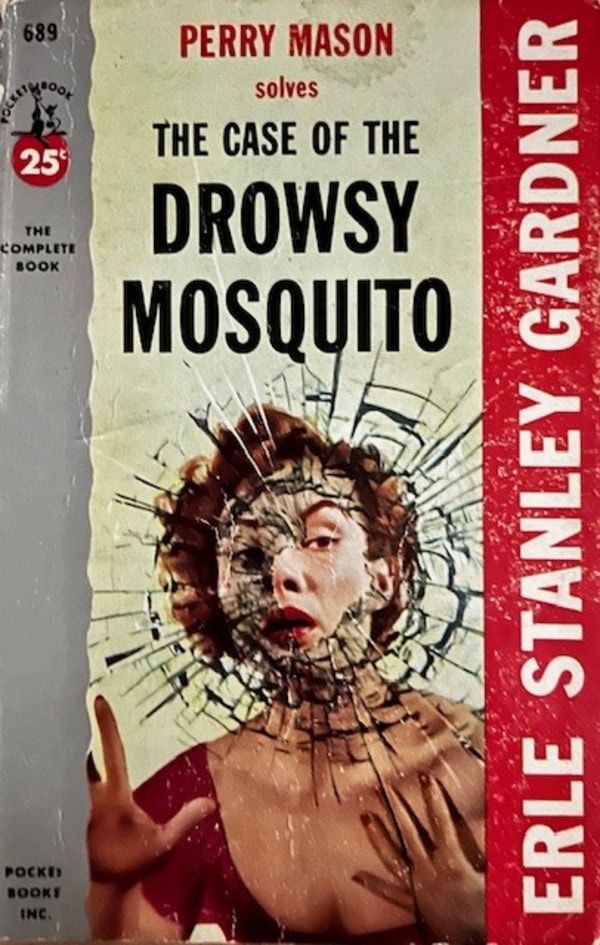
1943’s The Case of the Drowsy Mosquito stands out from the rest of the Perry Mason books I’ve read. Most of them are structured in the linear fashion of a private eye novel: a client comes to Mason and lays out his or her problem, and then, step by step, witness by witness, Mason uncovers information that ties everything up in knots until the lawyer gets it all untied at the end. Sure, the novels are both legal thrillers and whodunnits – but sometimes just barely. Mostly, they are an excuse for Perry to tear around L.A. and other destinations, often with his trusty minions Della Street and Paul Drake at his side. Each action he takes or decision he makes puts Mason and his team at odds with the bureaucratic machinery generated by the police and/or the district attorney’s office. Things get worse before they get better (at least in a good Mason book) . . . but they always get better in the end.
As a formula, this never bores me (at least until things get stultifying toward the end of Gardner’s career.) Still, it’s exciting when the author veers from the tried and true and gives us a different take – as in The Case of the Substitute Face (1938) or The Case of the Half-Wakened Wife (1945), both of which find Perry and Della witnesses to murder on board a ship.
Drowsy Mosquito might take us down the oft-trod path into the mining industry – clearly one of Gardner’s favorite professional settings – but it also immerses us in the closest we’ve come yet in the canon to a traditional closed circle mystery. It begins when Salty Bowers, a lovable old prospector, visits Mason’s office and asks the attorney to help his friend, millionaire Banning Clarke. The mining business has made Clarke successful but ruined his health, and Salty has persuaded him to give up his luxurious lifestyle and live and eat in the great outdoors. Now Clarke is repaying his pal by asking Mason to protect his and Salty’s interests. He fears his in-laws are out to steal his business and that a woman with whom Salty has become romantically linked is part of the conspiracy.

Perry and Della go out to visit Banning’s San Bernardino property and meet a bevy of eccentric characters, including Clarke’s world-weary doctor, his voluptuous and friendly nurse with the perfect Gardner moniker of Velma Starler; Clarke’s housekeeper Nell Sims, who likes to mix her classical aphorisms, and her wayward husband Pete, who blames all his con artistry on a split personality named Bob. Almost immediately, terrible things begin to happen, including sneaky legal maneuvers, multiple poisonings by arsenic, and sniper fire. By the midpoint of the novel, you might be surprised as to who has fallen victim to all these attacks and who winds up as a corpse. Given that most murder victims in these books are odious people or keepers of secrets, I was a bit shocked by who died. What’s more, their death poses an interesting legal problem, as they were both poisoned and shot. Which leads to the question quoted above: if you fatally poison your enemy and then someone shoots them to death before they die from the arsenic you gave them, who is legally liable for their actions?
And where the heck does the drowsy mosquito come into it?
As it turns out, the pesky insect is a clever aspect of a deliciously complex plot. But it’s the package in which this plot arrives that is so – you should forgive the term – arresting. For once, Gardner takes us away from the hustle and bustle of Los Angeles, from the nexus of Mason’s office and the criminal courts, and drops us in the great outdoors, where a man can find a new lease on life in a sleeping bag under the desert skies with his trusty burro at his side. It’s wartime in the U.S. and the country is on rations – but that doesn’t stop these folks from eating good grub and using what stock they have to bake a delicious pie.

As always, there are good and bad people populating the case, but it’s clear that ESG has a great fondness for most of this cast. The whole mood of the book is lighter, full of elegiac descriptions of the desert and bursting with humor, especially when Paul Drake enters at the halfway point and is sent by Perry on an undercover mission. Whether or not the humor is to your liking is up to you – I enjoyed it fine – but Gardner certainly treads into comic territory, as in this moment when Drake, disguised as a prospector, bursts drunkenly into Nell Sims’ restaurant and demands her specialty:
“’What do we care for the various vicis-viciss-ssitudes of life when we have pie? Madam, we shall have pie, or as you would doubtless express it, eat – drink – and be merry, for tomorrow we pie.’
“Nell Sims said, ‘That isn’t the right quotation.’
“’What is?’ Drake asked belligerently.
“’Eat, drink, and be merry, for tomorrow and tomorrow and tomorrow roll on their dreary course.’
“Drake put his head in his hands and thought that over. ‘You’re right,’ he agreed at length.”
The county sheriff assigned to the murder is an appropriate ineffectual thorn in Mason’s side; he also has the asset of being the brother-in-law of none other than Lieutenant Tragg, who is in the area on vacation and makes an entertaining cameo here. There’s also a brief appearance at the very end by the local D.A. – but that’s about all we get of legalities. Mason avoids the courts and still manages to extricate himself out of some tricky legal difficulties and produce a surprising murderer.
The novel ends with a couple of wonderful quotes: one of them is Della Street’s response to yet another marriage proposal from Perry, who has been inspired by the romance of the desert. I’ll leave you to discover that one for yourself. We’ve seen it before, but it’s still lovely to see how much Della cares for her boss because he is her boss. The other quote comes from Salty Bowers, upon whom Gardner bestows the final word. It sums up the atmosphere of the story and, I imagine, the philosophy of both the fictional speaker and his literary creator:
“No matter what I’m doing, I always knock off for a few minutes along about this time of day just to look out over the desert – makes you realize man may be pretty active, but he ain’t so darn big. You know, folks, the desert is the kindest mother a man ever had, because she’s so cruel. Cruelty makes you careful and self-reliant, and that’s with the desert wants. She don’t want any softies hanging around. Sometimes, when she’s blistering hot and the light burns your eyes out, you see only the cruelty. But then, along about this time of day, she smiles back at you and tells you her cruelty is really kindness., And you can see it from her viewpoint – and it’s the right viewpoint.”
It reminds me of when I was a kid and my family lived for a little over five years in Phoenix, Arizona. How we hated the heat and the spiders and the snakes – and did I mention the heat? But once in a while, as evening was getting on, my dad would drive us out to the desert and we would walk around a bit. The skies would turn from red to purple to black, and a million stars would burst onto the horizon. I have to admit that it was a thing of natural beauty that I have never seen before or since.
* * * * *
“The Case of the Drowsy Mosquito” debuted on October 10, 1963, as the third episode of Season Seven of Perry Mason on CBS. Grizzled veteran actor Arthur Hunnicut played Salty Bowers, unaccountably renamed Sandy Bowen by screenwriter Jonathan Latimer. It was Hunnicut’s second appearance of the season.

Full disclosure: I read this book nearly a year ago and have been chomping at the bit to get here and recommend it. The TV adaptation? Not so much. As you might expect, Latimer makes wholesale changes to the novel’s plot, including a different victim and a different murderer, who happens to be a character created for the episode. The saddest change is the complete absence of Gardner’s love of the outdoors that imbues the book; in fact, the episode’s plot trades on the old cliché of small Western towns being full of stupid, greedy people who hate the intrusion of city slickers like Perry Mason.
And that concludes our sole excursion through the Hall of Insects in our Mason Menagerie. It seems a vote has already been taken as to which animal we will visit next month, and . . .
. . . the neighs have it.
 Ah Sweet Mystery!
I am so glad that you recommended this title to me, as it has been one of my favourite reads of the year.
LikeLike
It has to be one of the best titles ever, lol!
LikeLike
Pingback: THE ERLE STANLEY GARDNER INDEX | Ah Sweet Mystery!
Pingback: BECAUSE YOU LIKE THE LISTS . . . Brad’s Top Ten Reads of 2025 | Ah Sweet Mystery!