Since this is a blog that deals in genre secrets, I’ve got a good one for you: not everybody collects Dell Map Back Mysteries because they’re great literature – it’s because they look sooo cool!!
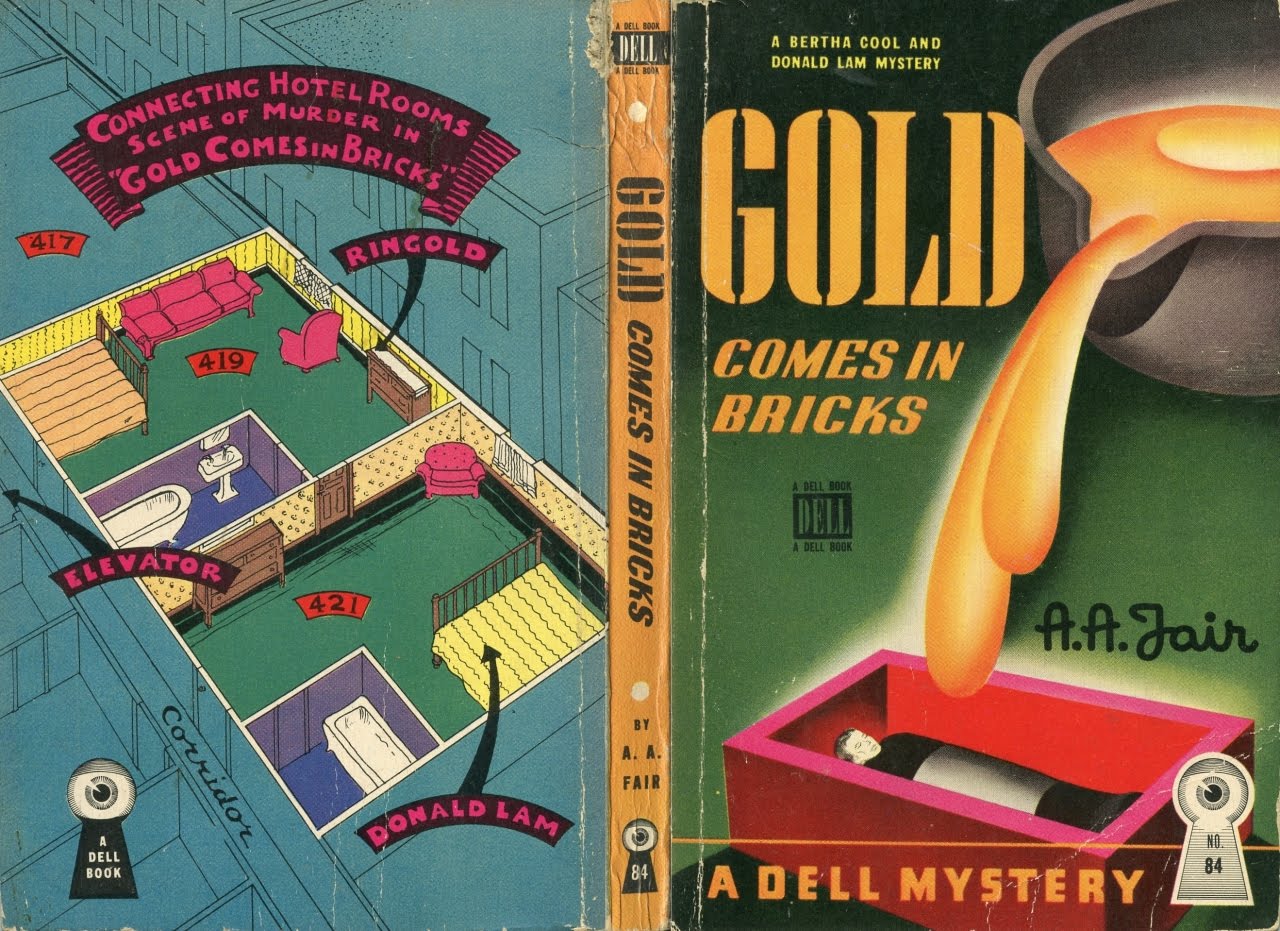
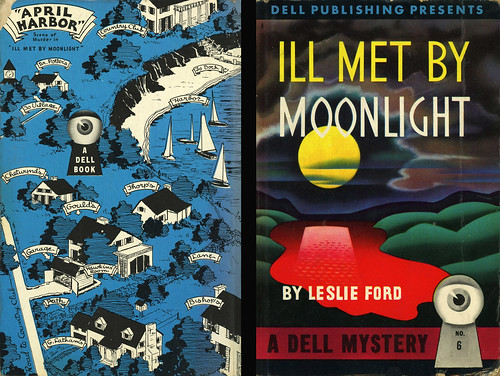
I have no idea how many of the 8500 titles Dell published in this format between 1943 and 1950 would interest fans of crime stories, but Wikipedia mentions that the list includes “a number of mysteries by writers who have fallen out of favor over the years – or who were never popular.”) Even in my small collection, I have some of those – anyone remember Martha Albrand, William O’Farrell or H. W. Roden? – but I have also scored a number of treasures, including some Carr, Stout, and three Helen McCloys, as well as a few rare titles from the likes of Delano Ames, Anthony Boucher, A. A. Fair, Clayton Rawson, and Kelley Roos. Here’s just a sampling of what I own:

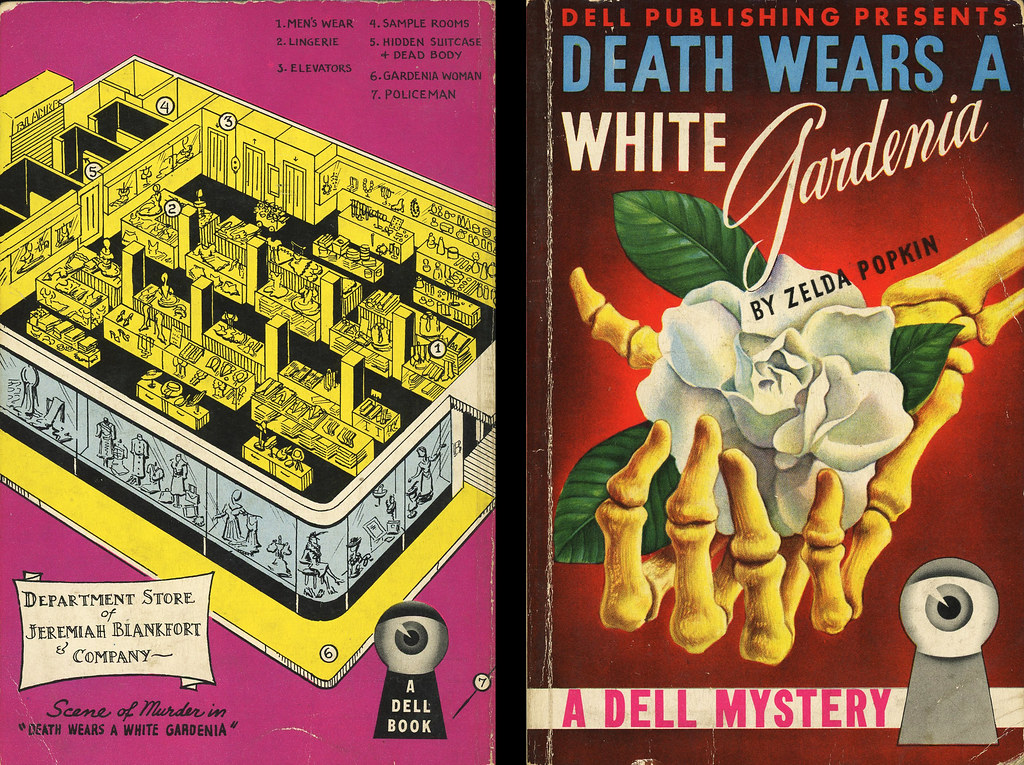
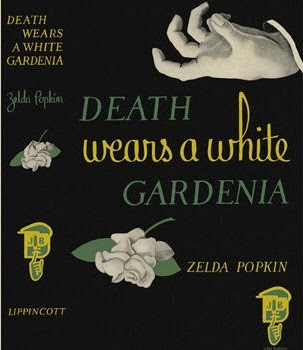
Among this collection are two mysteries by Zelda Popkin, whose mystery-writing career comprised five titles in six years (1938-1944) before she became a mildly lauded author of “legitimate” novels, most of them centered on Jewish themes. (She wrote one of the earliest novels concerning the Holocaust and the first English-language novel about Israel’s struggle for independence.) Popkin’s debut mystery, Death Wears a White Gardenia, has proven useful in a couple of Kate’s Murder Every Monday categories. The cover art by Gerald Gregg is exquisite, and the map on the back indicates that this is one of the rare subset of mysteries that take place in a giant department store. The only other examples I know of are a pair of 1930 mysteries: Vernon Loder’s The Shop Window Murders and Ellery Queen’s The French Powder Mystery.
In his review of Popkin’s book, John Norris calls such books “specialty” mysteries, in that they give readers a glimpse into a rarified world, the details of which we might otherwise never see. Ellery Queen did this in several of his 30’s novels, taking us into the environs of a Broadway theatre, a hospital, and a touring rodeo. But every detail he provided was in service to the puzzle. With White Gardenia, Popkin creates something quite different. This is definitely a whodunnit – a man dies, a number of people on and off site had reason to kill him, and in the end one of them is unmasked – but the mystery elements are absurdly simple in comparison to Queen’s book.
The real pleasure of White Gardenia lies in its trappings, our entry into the the magnificence of the eight square blocks between 5th and 6th Avenues that comprise Jeremiah Blankfort and Company, one of the finest shopping emporiums in New York City. Since we are in the midst of the Depression, businesses like Blankfort’s are always in the midst of economic stress. But our novel begins on the eve of the store’s 50th anniversary, and that can mean only one thing: a big sale! Blankfort and Company is pulling out all the stops, with early morning speeches by the store’s owner (Mr. John Blankfort himself) and the Governor’s wife! The thousand employees have spent days preparing for record crowds of customers, in the hopes that the massive purchases of the day will fill the company’s coffers.
From the start, Popkin is having fun here: she introduces the setting and the murder through the eyes of a dapper man named Joseph Swayzey, alias “English Joe,” one of the city’s most notorious shoplifters. Joe has a whole scam prepared, and it goes like clockwork – until he goes to retrieve his loot and stumbles upon the dead body of Andrew McAndrew, the store’s credit manager. Joe has caught the eye of Chris Whittaker, the chief store detective, who attempts to seal the crisis off and solve the murder before the police send the sales crowds scattering.
Chris gets help on this from his assistant detective, Mary Carner, Popkin’s series sleuth. Mary isn’t the first woman detective in crime fiction, but I imagine she’s the first woman store detective; she’s educated, fiercely independent, sensitive – and she sure is pretty! Her regular job consists mostly of spotting shoplifters, and she provides an observant eye to the comings and goings of clerks and customers on this big sales day:
“The main floor was jammed when Mary Carner hurried through it to the elevators. A mob of women fought for sheer silk stockings at fifty-two cents a pair; they pounded one another’s ribs, lacerated, each other’s skin, knocked off hats to get to house dresses at sixty-seven cents, two gloves at two pairs for a dollar. Mary Carner strode by them with a twinge of conscience. Plenty of merchandise would march out of the store unpaid for today. Of all days! There certainly was enough routine crime in the store without adding a murder.”
Much of the novel takes place in Chris’ office where he, Mary, Inspector Heinsheimer of the NYC Homicide Squad, and the District Attorney himself (with the august name of Judge Graham Van Namee Hodges!) conference together to determine whodunnit. As convenient as it would be to place the blame on the shoplifter, investigations point to a lengthening list of other suspects amongst the victim’s family, friends, and fellow employees. While McAndrew was known to be a nice guy, he seems to have had his hands in a number of affairs, including – well, yes, an affair! as well as some sort of scheme involving married men opening accounts for their mistresses.
To be honest, the narrative doesn’t chug along so much as it stops and starts. When it comes to police interviews or theorizing, Popkin seems to prefer monologues to dialogue. And because of the sale, a great many employees are not interviewed until the end of the business day, which occurs at Chapter 18 and involves a lot of people we’ve never met before droning on and on about elevators and work details. Popkin is much better at using characterization to give us a richly specific depiction of Depression-era New York. We get a real sense of people struggling to make it, from the immigrant ladies who spend late nights cleaning the huge mess, to the struggles of those who buy and sell the merchandise. One customer is caught shoplifting baby clothes while his wife is in the delivery room because his relief checks won’t cover the addition of a child. Inspector Heinsheimer lets him go and then admits to feeling “like a Red” because he sympathizes with men who resort to stealing to survive.

For me, this called to mind much of what is going on in our country today, as did Popkin’s startlingly modern views of sexuality. As the sleuthing team investigates the possibility that prominent men have been setting up store accounts for their mistresses and are being blackmailed for that, the team argues about the morality of women having sex outside of marriage. While the dead man’s secretary must sneak around to obtain an abortion, her roommate, Irene from Advertising, affects a guilt-free attitude over the lifestyle she has chosen:
“The detective shook his head. ‘You’re a pretty unmoral person, aren’t you?’
“’Call it that if you wish. I think I’m just being honest with myself, and the rest of the world. A woman capable of supporting herself can do as she pleases about her friendships with men. I hurt no one. However, my notions of sex morality have nothing to do with the case, as far as I can see. The thing you want to settle is where Bill Smith was last night. He was with me from six last night to seven this morning . . . He wasn’t out of my sight during all that time. He seemed perfectly cheerful. Anything else you’d like to know?’”
There’s a whole movement afoot these days to eliminate this sense of female independence, to brand it as “immoral” and push young women away from such lifestyles and back into that traditional mindset of “marriage or sin.” How I would like to find Irene from Advertising and sic her on these modern Puritans!
Popkin’s foray into the genre didn’t set the world on fire, but I think this title would be a great one for Otto Penzler’s American Mystery Classics series. I don’t imagine anyone is planning on republishing all six of the mysteries Popkin wrote. Fortunately, my treasure trove of Map Backs includes a tattered edition of Mary’s final mystery adventure, 1942’s No Crime for a Lady. Expect my report one of these days!
 Ah Sweet Mystery!
This one has been sitting on my TBR pile for a while now, a charity shop find. Not a nice Map Back but a hardback without a dust jacket. Thanks for the review, it has helped to give me an idea of the style of the book.
LikeLiked by 1 person
Ultimately, I think it disappoints as a mystery, and it might lean in too far to that hard-boiled style you’re not particularly fond of. Maybe you should read a Nero Wolfe instead! 🤪
LikeLike
Popkin is an interesting writer in many respects, and she indeed would be a nice recruit for the AMC series (Boucher thought highly of her only standalone, the appealingly and it seems adequately named So Much Blood.) Carner I think is a good character that doesn’t get the recognition she deserves as one of the few Golden Age female detectives who is neither an old maid or played for laughs.
LikeLiked by 1 person
It seems that Mary weds her boss and then leaves him home with the kids while she’s off detecting. A real trailblazer!
LikeLike
Great post as usual. I must confess that I have a weakness (on the way to addiction) for Dell mapbacks with some special ones collected from Christie, Carr, Gardner, McCoy, as well as other obscure authors. I don’t often think that a cover can enhance a particular book, but there is something special about mapbacks that grabs my attention. Whenever I am trolling through the shelves of any secondhand book shop, I will buy any mapback that is in good shape and reasonably priced. Yes – a sickness I know 🙂
Looking at the big TBR pile, I see that I have both Popkin’s “Dead Man’s Gift” and “Murder in the Mist” as mapbacks. I like the front and back cover of the one you read as well and will search for that since the mystery is not bad from your review.
Finally, I wonder who owns the rights to the front and back covers of the mapbacks? It would be great to see them re-issued. Probably only wishful thinking, but perhaps a coffee table book that contains all the Dell mapback covers might be possible someday.
LikeLiked by 1 person
Scott, it’s just possible that you and I both need a couple of weeks in GAD rehab! While I love your idea for a coffee table book that collects all the Dell map back covers, there are so many wonderful indexes online where we can scroll to our hearts content, I have a feeling that your idea would seem antiquated these days!
Sadly, I have yet to find any map back Christies to add to my collection! Gift buyers, take note!
LikeLike
I have the map back of Dead Man’s Gift and read it several years ago. The setup to the plot sounds like a dream come true (closed circle last survivor will mystery set in a burning house beset by a flood), but Popkins somehow couldn’t make it that interesting. I’m sad to say it was forgettable.
LikeLiked by 2 people
I fear this may be Popkin’s thing: great set-ups, weak pay-off. I have another one in my TBR to check out, so I won’t worry about finding others just yet.
LikeLike
Wouldn’t you know it? I dropped into my local used bookstore today and found a Dell Map Back copy of Popkin’s Murder in the Mist for four dollars!! True, the copy is so decrepit that the odds are good it will desolve in my hands before I finish it! But since TomCat hated it, it’ll probably be a while before I make the attempt! (He did seem to like Dead Man’s Gift a lot more than you did.)
LikeLiked by 1 person
What absolutely fabulous covers!
Do you know the book “The Art of Pulp Fiction” by Ed Hulse? It’s a coffee table book about pulp covers from the earliest days to the heyday of paperbacks. Fantastic, well-written book.
Your covers fit right in.
LikeLiked by 2 people
Thanks for the information! Scott, did you get that?
LikeLiked by 1 person
Brilliant – thank you. I didn’t know this existed. Looking online, I see it highlights vintage paperback covers from Pocket Books, Popular Library, etc. with a chapter focused on noir and other detective fiction. This will go on my “want” list.
LikeLike
I was really impressed with how well written “The Art of Pulp Fiction” is, the range of art, and how Ed Hulse identified the artists. It’s well worth your time.
LikeLike
Love all those covers, Brad!
LikeLiked by 1 person