If you come here often, you may have picked up that I love talking about movies. Sadly, the most fraught discussions tend to center around the adaptations of my very favorite subject – Agatha Christie. I can’t say I’m surprised: a conversation with the Dame herself would have elicited fervent emotions on the subject. Why shouldn’t her fans have equally strong opinions?
Ask yourself that question after you’ve written a generally positive review of Kenneth Branagh’s A Haunting in Venice!

If you want the perfect reference work on the history of the author’s adaptations, you can find no better than Dr. Mark Aldrich’s Agatha Christie on Screen. This is a comprehensive and beautifully written book that covers the development, success and significance of just about every screen adaptation there ever was, up to the point of the book’s publication. Mark is stingy only with spoilers and his own opinions, which makes this the go-to source for Christie scholars and super-fans.
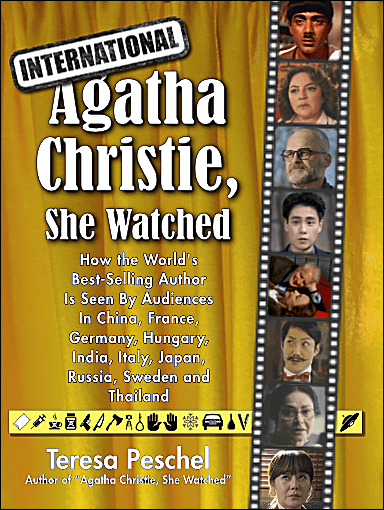
What we’ve been lacking, however, is one of those big coffee-table books filled with reviews of Christie movies, crammed with enough entries so that even the most dedicated Agatha fan can find something he hasn’t seen and enough strong opinions so that you can choose to hug the book to your happily tear-stained cheek or toss it vigorously against the wall if you disagree with the writer. But now there are, not one, but two big coffee-table books crammed with Christie reviews, both of them by fellow Christie fan Teresa Peschel: Agatha Christie, She Watched and International Agatha Christie She Watched.
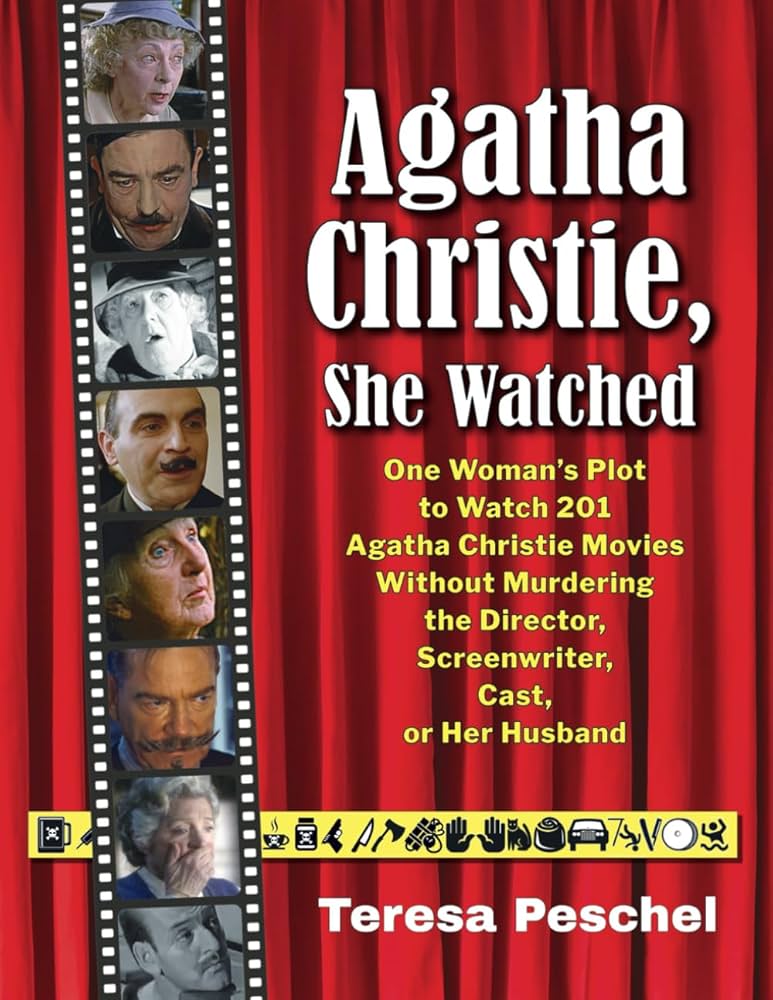
Full disclosure: I met Teresa at last year’s Agatha Christie Festival in Torquay, where she was presenting a talk on Christie adaptations. She was there with her husband Bill, one of the nicest guys I’ve ever met. Together they run the small Peschel Press from their home in Pennsylvania. They have annotated and published editions of the first six Christie novels and are now doing the same for Dorothy L. Sayers. This project inspired the couple to dig deeper into Christie by watching as many of the films and TV shows as they could get their hands on and then writing reviews for their website. I think their original idea was to print some of these reviews as “extras” in the annotated editions, but as the number of entries grew, it seemed natural to put them all together in a great big, beautifully illustrated book..
While the first volume focuses on 201 English-speaking adaptations from Great Britain and the U.S., including individual reviews of every episode of Poirot and the multiple Miss Marple and Tommy and Tuppence series, the follow-up includes reviews of 102 non-English speaking films, as well as write-ups of several documentaries and a few English-speaking films that came out after the first book went to press – films the aforementioned A Haunting in Venice (which Teresa also liked, people, so there!) and the recent Towards Zero mini-series. I bought the first book on my own. When I met the Peschels in Torquay, Teresa told me that the growing availability of international adaptations necessitated dividing their work into two books. I end this full disclosure by telling you that Teresa sent me a copy of the international edition, partly because she knew I’d be interested and partly, I suppose, as thanks for helping direct her to one or two titles.
The book is not written as a scholarly treatise; rather, the tone is reminiscent of sitting down with a strongly opinionated friend. (I would never critique Teresa’s opinions: we agree with each other probably 75% of the time, which is lovely, but in the world of film criticism, to each their own!) The assumption here – and it’s an important one before you decide if this is a book for you – is that the reader has also read Christie’s canon beforehand. It isn’t just that the endings of nearly every film are revealed, thus spoiling the Christie tale upon which it is based, Many reviews begin as if we’re in medias res of a larger conversation about a specific title, meaning that it helps to remember characters and plot details from the books to perfectly follow each review.
This doesn’t bother a person like me, who knows his Christie backwards and forwards, but it may be a challenge for a less well-read fan or a stranger to Christie’s canon. And even I discovered that the spoiling of endings has a sting because more than a few films have either changed the book’s original solution or are completely original stories. I was a little miffed when these twists were revealed, but I solved part of the problem by not reading any reviews of “original” stories.
The book covers films from 17 countries. Some locations have a single entry, while those longer sections include reviews of TV series, divided into individual episodes or sometimes into sections based on Christie titles. A full quarter of the book is taken up with reviews of all three series of France’s Les Petits Meurtres d’Agatha Christie. Other longer entries include Checkmate, a 2022 Chinese mini-series based on a number of Poirot novels and stories, Ms. Ma: Nemesis, the 2018 South Korean K-drama that does a similar thing with several Miss Marple novels (and which I reviewed here), and the Japanese anime series about Poirot, Miss Marple, a little girl and her duck. (It’s on YouTube, and it’s really charming.
Teresa has created a ratings system that covers two basic questions: how faithful was the adaptation to the original work? and how good was the overall production? This is made more whimsical by replacing stars with icons of whatever weapons are used to kill in a particular story. Thus, adaptations of And Then There Were None will be rated with guns, poison bottles, blunt objects – the works! I was pleased that Teresa rarely conflates purity with overall quality, something that has become a central argument when discussing Christie films with fellow fans. So, yes, a film can veer far afield from the original text and still be a highly enjoyable watch. The Christie purist can thus make use of Teresa’s system by looking at the purity ranking and avoiding movies with a low score, while the rest of us can take both ratings into consideration.
One thing you’ll take away with you after reading the book is that the worst sin by far when watching international films is bad subtitling; Teresa mentions this over and over again. I can see how it would be frustrating, but I would have been more interested to hear about why this is so: who creates subtitles, and what are the challenges of translating dialogue and cultural references into another language? I know this is a big topic for those of us reading more and more newly translated mystery fiction, and I would imagine the same challenges apply to film. One of Teresa’s complaints was that sometimes subtitles speed by far too quickly to catch. Is there a reason for this, perhaps having to do with the speed with which each language is spoken?

Occasionally, I came across statements with which I disagree that have nothing to do with the author’s opinion about a film’s quality. At one point, Teresa writes, “The Hollow is one of Christie’s lesser-known novels.” It most certainly is not! – and certainly not to a devotee of the author’s work. (It ranks #6 in my own Top Ten and #9 in the final rankings at All About Agatha.) It may be unknown to the casual fan, but then most casual moviegoers are probably familiar with, at the most, three or four titles.
More concerning were some generalizations on certain cultural tropes and how they affected the ratings. These statements are clearly meant to be taken in a light-hearted fashion, but it felt like an easy joke when a bit of research might have yielded more interesting information. Are all French filmmakers “arty and vague” and obsessed with sex? Maybe so – if you base your opinion on the execrable Innocent Lies, a barely recognizable adaptation of Towards Zero. Otherwise, it’s an unfair generalization.
A little too much fun is made of Indian filmmakers including musical numbers in their films, but there was no attempt to provide any context for this practice. A simple search yielded several excellent reasons: music and dance are an integral part of the theatrical traditions from which Indian films sprang. And then there’s the commercial value of including songs, which provide added revenue through music sales and make a film stand out in India’s huge industry. Finally, in a culture that avoids explicit demonstrations of intimacy, the emotional intensity of a song can resonate strongly with an audience. Hey, this is why I also love musical theatre!
Finally, one of the hardest things to translate from one culture to another is humor. Many countries include farcical comedy to provide emotional “relief” during intense dramatic films – which would explain, for example, the casting of Mehmood, India’s treasured national comedian whose award-winning career spanned more than four decades and over 300 films, as the butler in Gumnaam (The Unknown), the loosely-adapted 1965 Hindi version of And Then There Were None. It feels insensitive to dismiss his presence as “wildly out of place, almost in another movie, but it’s Bollywood, so just go with it.”
These small caveats aside, International Agatha She Watched, like its predecessor, is a labor of love several years in the making. Teresa and Bill spent hundreds of hours watching the good, the bad, and the ugly of Agatha adaptations and putting them together in a well-illustrated package for us to enjoy. The book proves how beloved Christie still is all over the world and how fascinating it can be to watch the different cultural spins that each country puts on her work. And who knows? There are still tons of adaptations out there missing subtitles. Maybe this book will inspire other filmmakers to make their own films easily available to international audiences.
 Ah Sweet Mystery!
Thanks for highlighting this pair of books. I will certainly order the first one given I have seen (and have strong opinions) on many of the adaptations. I’m pleased the author gives her personal view of the films and this is not just a reference volume. Whether I agree or disagree is not the point, it’s fun to read how someone else feels about the adaptations.
For me and I’ve commented on this before … when the book is one that I love (e.g., After the Funeral, A Murder is Announced, Murder is Easy, The ABC Murders, Evil Under the Sun, The Sittaford Mystery, etc.), I am less forgiving on a film that deviates significantly from the source material. When a film is of a book that is not a favorite, I don’t mind if the story is radically changed (e.g., Hallowe’en Party into A Haunting in Venice, Suchet’s The Clocks or Elephants Can Remember, etc.). I will be interested if her enjoyment of a particular book affects her view of how that book shows up on screen.
LikeLiked by 1 person
Thank you! Thank you! Thank you!
The two books were indeed labors of love. The films of Agatha Christie turned into a MUCH bigger project than we realized. If we’d known there were so many, we probably wouldn’t have done it.
The great thing about the films — good, bad, and indifferent — is each one has the chance to introduce Agatha to an entirely new audience.
As for The Hollow, I thought it was obscure! I’d never heard of it, I’d never seen it at bookstores or libraries or among people’s collections of paperbacks, but when I read it, I was amazed.
This is what the film adaptations, for cinema and for TV, did. They made me read her novels far more deeply, more widely, to reread them again and discover things I never noticed the first time around at age 15. I’ve now read almost everything she wrote other than her Mary Westmacotts and Passenger to Frankfurt which my mother raved about.
I became the amateur Agatha film expert by accident. Doing this project had the unexpected benefit of making me appreciate far more than I ever would have how good she is and how she makes it look easy. It is not. People see pictures of Agatha as an old woman wearing a print dress and sensible shoes and they discount her as a writer. They shouldn’t.
Thank you again!
LikeLiked by 1 person