You know the drill! The full list is here. We’re drafting the Top Thirteen 1955 Films Noirs in November. Today’s trio is a decidedly mixed bag: each has elements that work for me – and elements that don’t. I’ll rank the trio at the end, but I wonder if any of them will earn a high enough place on my personal list to place them in the final draft.
Finger Man
Frank Lovejoy is back, in a much better role than in The Crooked Web. Here he plays a loser named Casey Martin, who has spent his life either behind bars or eluding the police. He attempts to rob a truck on the highway and ends up getting pulled in by the Feds, who make Casey a life-changing offer: if he helps them nab notorious gangster Dutch Becker (Forrest Tucker), the government will wipe all charges off Casey’s record.
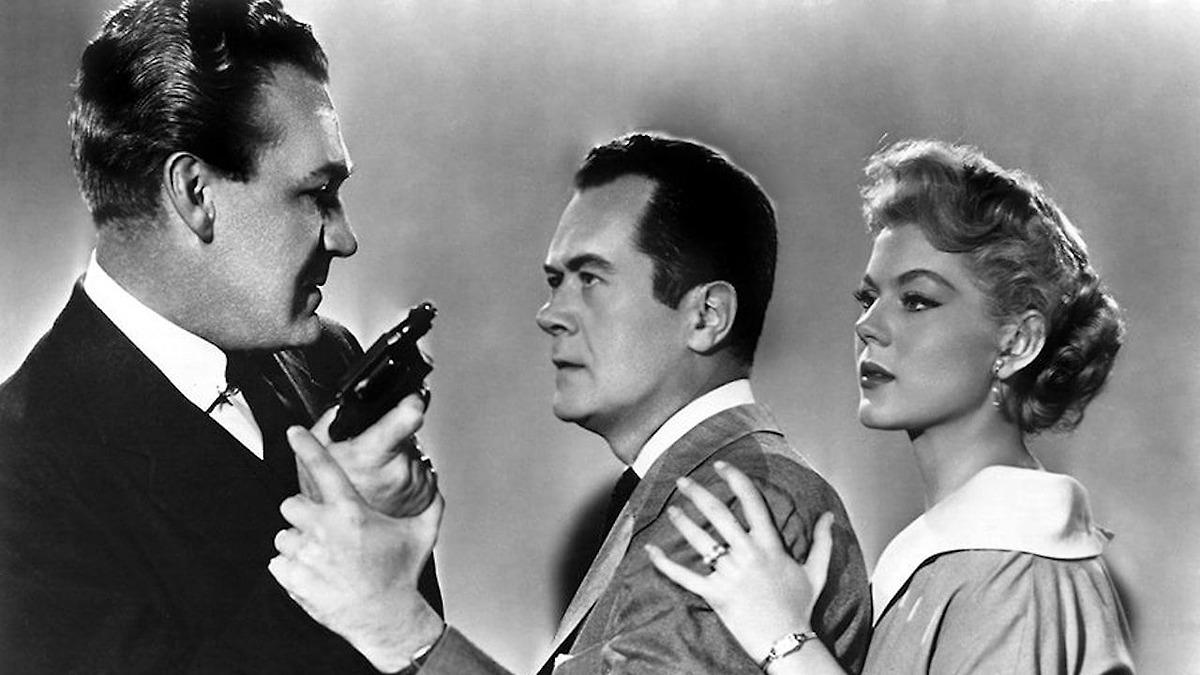
As this is Lovejoy at his most fundamentally decent, he refuses to rat on anyone – until he learns that Dutch is responsible for hooking Casey’s beloved sister on drugs and alcohol. Casey insinuates himself into Dutch’s operation, where he catches the eye of former associate Gladys Baker (Peggy Castle) who falls in love with Casey. (The guy can play a mean piano!) As a result, Casey is always in danger of exposure, and the mob of goons and psychopaths who work for Drake are itching for a reason to take him down.
This is a story I feel I’ve seen a hundred times, and while nothing new gets played, the reason to watch this one is Lovejoy, who embodies the noir protagonist like a comfortable sweater. Even if things work out for him, the odds of Casey finding happiness, even a normal sort of life, are stacked against him.
* * * * *
Illegal
Warner Brothers brings us Edward G. Robinson in a film that I enjoyed watching but wish was much better. It plays out more like a melodrama than a film noir, partly due to a fairly turgid screenplay by W.R. Burnett and James R. Webb.
Robinson plays ace district attorney Victor Scott, who always gets his man. He works side by side with Ellen Miles (Nina Foch), who clearly shares romantic feelings with him, and Ray Borden (Hugh Marlowe), who also loves Ellen. Victor handily wins the Gloria Benson murder case, sending defendant Edward Clary (DeForest Kelley) to the chair. The timing of this, whether due to the script or the editing, is weird: it feels like the jury brings in a guilty verdict, and the defendant is executed that evening. Of course, just before the switch is pulled, a man is brought into the city hospital and, with his dying breath, confesses to killing Gloria Benson. There can be no doubt that this is the real killer, but before Victor can reach the warden, Clary is executed.

This leads to a rapid – and I mean super-speed – decline in Mr. Scott. By the fifteen-minute mark, he is an alcoholic, despised by the public, and in jail for being drunk and disorderly.
The plot builds from there in a very interesting, if totally unbelievable way. In brief, Victor Scott becomes a defense attorney for the mob, led by Frank Garland (Albert Dekker, who excels at playing crime bosses and whom we’ll see in a similar role in Kiss Me Deadly). His tactics for winning his clients’ exonerations may remind you of Perry Mason, but even more reckless (at one point, he grabs the bottle of poison that was used as the murder weapon and drinks its contents in court!)
I had never seen this one before, but I imagined that Scott’s despair would take him down a losing spiral until all hope of happiness is lost. That’s not quite what happens: Victor may be down, but he doesn’t ever really lose his high moral values. The bigger problem is that the whole film is hokey. But Robinson is great, and so is the rest of the cast. (It’s a nice little role for Jayne Mansfield!) I was especially fond of Ellen Corby (Grandma Walton, plus 270 other acting credits) as Scott’s tough but motherly secretary.
Special note: according to Wikipedia, the film wasn’t up to the usual high standards because Robinson was being investigated by HUAC and Warners had lowered the film’s budget. In scenes set in Garland’s office, Victor admires the fine art that the gangster has collected, including a Degas and a Gauguin. These paintings were actually from Robinson’s personal collection. A connoisseur of fine art is likely to make B movies like this one because they need the money.
* * * * *
Killer’s Kiss
I’m going to share with you what I wrote about Killer’s Kiss back in 2011. It’s an important film, but I really didn’t want to watch it again . . .
Killer’s Kiss is Stanley Kubrick’s second film, written, edited and directed by the guy for $75,000. It looks cheap and feels disjointed – and, ironically, provides a stunning preview of the stylized director Kubrick will become. It also happens to fall under the noir genre, although Kubrick was forced to shoot a happy ending before releasing it, which undercuts some of the film’s power. The film clocks in at just over an hour and alternates powerful visual ideas with textual moments that are clumsy and/or silly. The sound is its weakest link: when the location sound failed to work, Kubrick had to post-dub the whole movie, and it shows.
What the film does so well, as referenced by its title, is showcase the juxtaposition in film noir between sex and violence in the graphic style of late 50’s noir. The plot revolves around a triangle between a has-been boxer named Davey Gordon (Jamie Smith), a taxi-dancer named Gloria Price, and Gloria’s boss, Vincent Rapallo (Frank Silvera). Davey and Gloria live across from each other in what amounts to a pair of Hell’s Kitchen slum dwellings. Gloria doesn’t want to go to work, and Davey definitely doesn’t want to get into the ring against Kid Rodriguez, a younger, fitter, better fighter. As both of these sad people pace about their ratty studios, they steal longing looks at each other – but never at the same time.
Rapallo is obsessed enough with his employee to pick her up each evening and drive her to work, where he claims he loves her and then makes crude passes at her. When he sees Davey come out of the building at the same time as Gloria, his jealousy kicks in. What follows is one of the best scenes in the film: Kubrick crosscuts between Davey’s fight and Vincent and Gloria in his upstairs office, where he forces her to watch her neighbor get pummeled on TV. The match is an intimate rout in close-up, all skin on skin, fists and sweat flying, while Vincent uses the fight as foreplay in his attempt to seduce Gloria.
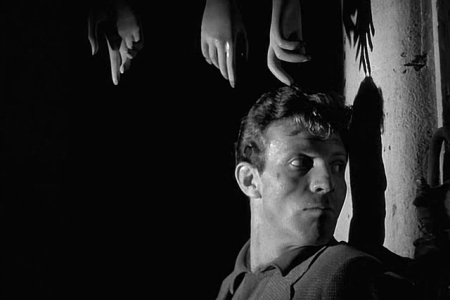
Ultimately, Davey and Gloria will meet, fall in love all too quickly, and have to tangle with Rapello and his goons. The whole thing is told in flashback by Davey as he waits for a train (at the actual old Penn Station), and you don’t want to think too closely about it because Davey relates scenes that he couldn’t possibly have witnessed or know anything about. The film is jammed with imagery that shows Kubrick in a much more experimental mode than he will allow himself the following year. Some of his ideas, like a climactic chase across the urban landscape that ends in a battle in a warehouse full of nude female mannequins, are inspired, while others, like Gloria’s flashback to her youth (a flashback within a flashback!) that consists of her narrating her tragic tale while a ballerina (played by Kubrick’s then-wife) dances an endless solo, are just weird.
* * * * *
The rankings?
This is a hard one! Do I rank for stylistic excellence or for personal enjoyment? In the end, I have to go with my heart!
1st place – Illegal, because I have a soft spot for Robinson, even when he’s in high-level dreck.
2nd place – Finger Man, because Frank Lovejoy is a first-rate embodiment of the spirit of noir even in second-rate noir.
3rd place – Killer’s Kiss, an art film disguised as film noir, it’s stunning to look at but . . . oh, I might be the wrong one to judge this one. Here’s where Kubrick and I did not get on!
Next time . . . something very wicked this way comes!
 Ah Sweet Mystery!
You may not know (or indeed care) that there’s a chapter about Killer’s Kiss written by its leading lady, Irene Kane — the stage name for the writer Chris Chase, in her book How to Be a Movie Star. She makes it sound like a disorganized ad hoc shoot, with little hint of Kubrick’s later eminence. There’s a lot about the production team trying (and failing) to persuade her to play a scene topless “for the European version” (which of course never happened).
LikeLiked by 1 person
I need to see if any of these are in Roy’s dvd collection. I too love Edward G. There are SO many. And by the way Netflix-wise, loved Dept.Q and just started a new nordic noir – the Glass Dome. Suffice it to say, if I EVER tell you I’m thinking of retiring in Sweden, TALK ME OUT OF IT!!
LikeLike