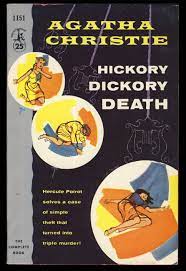
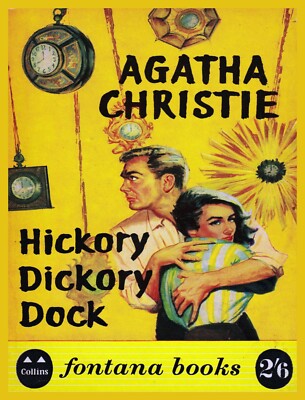
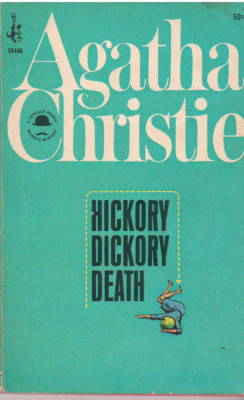
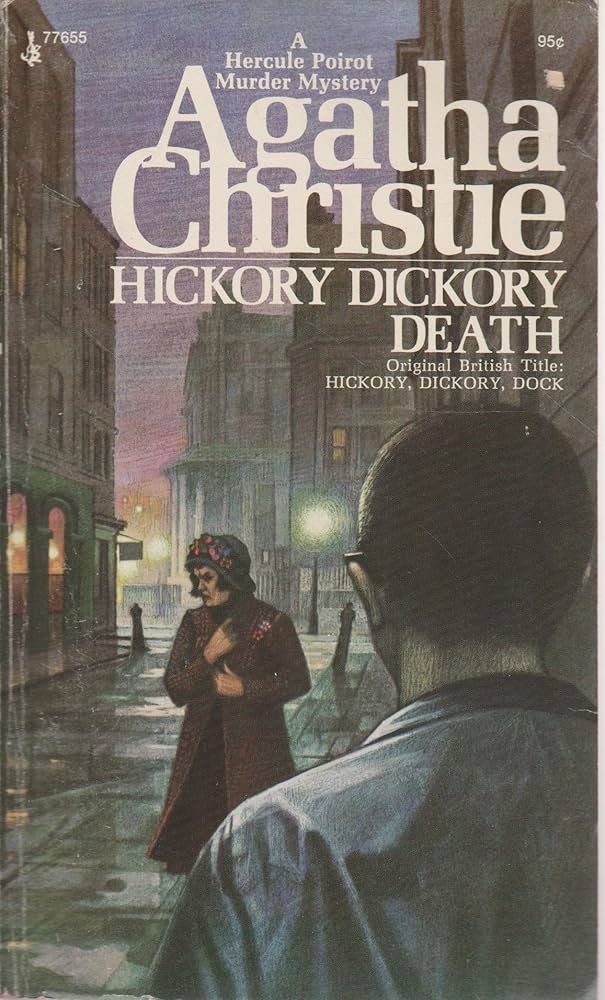
Dr. John Curran’s description of what he found over the fifty pages of Notebook 12 that comprised the planning of Hickory Dickory Dock (U.S. title: Hickory Hickory Death) suggest that Agatha didn’t have much fun writing it:
“Each of the first five pages of notes for this book is headed ‘Holiday Task,’ suggesting that it was written at a time when Christie should have been relaxing. And the plotting of it did not come easily, as endless permutations and much repetition is included. It does not read as if she had a very clear idea of the plot when she started. The first page of the notes has the glimmering of a plot, much of which remains, although there were to be many changes before she was happy with it.”
This is one of Christie’s “nursery rhyme” books in name only. There is no sign of mice or clocks; time, in fact, has nothing to do with anything here. The one concession to the rhyme’s “plot” is Hickory Road, the name of the street where most of the novel’s action takes place – and that was originally named Gillespie Road. At one point, suspect Nigel Chapman recites a snarky variation:
- “Hickory dickory dock
- The mouse ran up the clock
- The police said ‘Boo!
- I wonder who
- Will eventually stand on the dock!’”

I didn’t have to look it up before writing it down here for you, for I know it by heart. See, here’s the truth: this is my “birth day” book. It was published in the U.S. in November 1955, only a month before my actual birthday. Not only do I have a sentimental fondness for it, I remember quite enjoying it the first time I read it. Granted, I was probably sixteen going on seventeen and might have found Christie placing the milieu around a lot of “young people” very cool. The sad thing about growing up and “seeing the light” is that you recognize weaknesses where none used to exist. The book is bursting with characters but not with character. It regurgitates a number of old scenarios from other books – although that doesn’t make them any less effective here.
John Curran states that “The incongruity of the stolen objects presents Poirot, and the reader, with an intriguing puzzle and the explanations are satisfying,” and I would tend to agree with him. Whereas our previous read, Murder in Mesopotamia, had an unbelievable puzzle plot wrapped up in fascinating trappings, here the puzzle is pretty good, but the trappings are problematic. Most of the problems center around the characters; the question is, will that spoil the re-read of a sentimental title for this devout Agathologist?
- Hickory dickory dock
- Does this title contain too much schlock?
- If it does, you know
- I’ll rate it low
- Which probably won’t cause much shock!’”
* * * * *
The Hook
- “Hercule Poirot frowned.
- “’‘Miss Lemon,’ he said.
- “’Yes, M. Poirot?’
- “’There are three mistakes in this letter.’”
People tell me all the time how much they love Miss Felicity Lemon, Poirot’s secretary. Of course they’re not talking about Miss Lemon at all but about Pauline Moran playing her on the Poirot series. Miss Moran is charming in the role – and all wrong for it. Miss Lemon did not accompany Poirot on his cases and did not have an attractive coiffure and a charming manner. Christie described her as “unbelievably ugly.” And, really, she only appeared in four novels and four short stories, which hardly makes her a “series regular.”
I wouldn’t call the hook here a high concept one; rather, its joys lie in its ordinariness. A man expects his secretary to do her job well and without fuss, and Miss Lemon is “so completely machine made – a precision instrument, so to speak – that to think of her having affections, or anxieties, or family worries, seemed quite ludicrous.” What’s more, her great upset seems to be caused by a trivial matter, a series of petty thefts taking place at the student hostel that Mrs. Hubbard, Miss Lemon’s sister, manages.
For the first, and last, time, Poirot does a good turn for one of his employees. He tries to convince himself that it’s for practical purposes – Miss Lemon must return to her original efficiency with due haste – but actually there is a personal motive: “He did not admit to himself that he had been rather bored of late and that the very triviality of the business attracted him.”
These early sections comprise the best part of the book, followed, as it is, by an adequate if somewhat by-the-numbers murder investigation. The problem that Mrs. Hubbard presents appeals to Poirot for its apparent inconsequential nature, and his early analysis of the thefts is impressive. Yes, most of the missing items seem trifling – old flannel trousers, light bulbs, boracic powder, a cookbook – but Poirot makes some intriguing deductions. The diamond ring, one of the only items of value, is returned, possibly to ensure that the police are not summoned. The silk scarf and rucksack are cut to pieces, suggesting the motive for these thefts is vindictive.
It’s sometimes a challenge to talk about a book using compartmentalized ratings, but this is one of those novels that divide almost exactly into these sections: hook first, closed circle information presented next, leading up to the first murder, then Poirot detects. The hook lacks drama, but that might just be its appeal.
Score: 8/10
The Closed Circle: Who, What, When, Where, Why?
Who?
“Here we have young people herded together, of varying temperaments, of different sexes. A loves B, but B loves C, and D and E are at daggers drawn because of A perhaps. It is all that that I need to know. The interplay of human emotions. The quarrels, the jealousies, friendships, the malice and all uncharitableness.”
Ah, if it were all that exciting. But in a year when Hickory Dickory Dock sat in the book displays between Lolita and The Talented Mr. Ripley, 65-year-old Agatha Christie might not come across as the most avante-garde representative of modern youth. Interestingly, this is the first book since 1934’s Murder on the Orient Express to present us with an international closed circle. The major differences are age, of course, and unlike the earlier book, where all thirteen passengers were nice white Europeans and Americans, here we have a diverse ethnic crowd: one Jamaican, several Indians, a West African, an Egyptian, some non-English speaking Turks who don’t count, and so on. In the end, the real suspects are the nice white European and American residents – and one “dark” girl, Valerie Hobhouse. When I was a kid, I thought this meant that Valerie was Black, but now I’m not sure at all. Her mother, a foul Greek woman, is also described as dark.
There’s not much to say about these people. Christie provides very little depth to them; whatever personality traits or emotional arcs they have serve the plot and nothing more. One is quiet, one is arch, one is nasty, one has a temper . . . the end. To make matters worse, there’s surprisingly little “A loves B, but D and E are at daggers, etc.” about this group, but what there is falls along depressingly conventional lines. None of the men love the “quiet” Patricia or the sharp but “dark” Valerie, or the brilliant and “dark” Elizabeth. No, all the men are fighting over “free, white and twenty-one” year old Celia, the most boring and neurotic of the female characters. In the end, however, none of their relationships matter a jot to what’s going on.
For the most positive impression of these characters to be found, I urge you to listen to Hugh Fraser’s reading of the book. His accents are subtle but impeccable. He makes Mr. Akibombo, who reads like a figure of fun, sound like the most impressive of men.
What?
Here’s the problem: the first section of the novel leading up to the first murder is quite entertaining. Poirot’s interest is piqued by the seeming insignificance of the crime “spree.” He solves the “case” forthwith: silly little Celia Austin has been stealing things so that handsome Colin McNab, a graduate student in psychiatry, will think she’s a kleptomaniac, offer to treat her and then fall in love with her. You can almost see why Broadway considered making a jazz musical out of this book! It feels like a cross between Where the Boys Are and On a Clear Day You Can See Forever.
It seems, then, that Celia getting caught will now lead to the happy ending she desired. Which is why nobody is going to believe that her sudden death was a suicide. But they drag that idea along for a bit and then settle in to investigating what might have led to her death. Which leads to a second murder, that of the loathsome Mrs. Nicoletis (a nice scene because it is told from the victim’s perspective). Which leads to a third murder – maybe the only death we care about – of Patricia Lane.
Which leads to the solution – one that simply isn’t much worth the bother.
When and where?
A student hostel is a perfectly adequate location for a closed circle mystery. The one on Hickory Road is characterless, as is the street upon which it resides. The novel feels stuck in time as well, its only concession to “modernity” being the inadequate representations of race and culture amongst the characters. And what do we get? The Egyptian is excitable! The Greek woman is sly! The French student is overly emotional. The “dark” women are cool and mysterious. The redhead is temperamental!!!!! Mrs. Christie has and should have done better than this!
Score: 5/10
The Solution and How He Gets There (10 points)
“Really, Poirot! In the Middle Ages you would certainly have been burnt at the stake. How can you possibly know the things you do!”
How, indeed! This is a solution that, however complex it may be, comes pretty much out of thin air. How to know that Valerie Hobhouse was the head of a brilliant smuggling ring? How to know that Nigel Chapman was the son of Sir Arthur Stanley and that he killed his mother before setting out on his present spree! For this last question, we have two small facts that probably sum up our evidence against Nigel, both having to do with the murderer (and the author) heaping piles of suspicion against Len Bateson at the end. First is the fact that, based on Mr. Akibombo’s supposition the killer must have slipped over Celia’s balcony to place the morphia bottle in her room. The police pounce on the fact that Len Bateson’s room has the balcony next to Celia’s, even as they casually remind us that Len Bateson’s roommate was – Nigel Chapman. Next are the red hairs found in the lifeless grip of Patricia Lane. They’re too short to be Sally Finch’s hairs, so they must be Len’s. But Poirot reminds us that Patricia was coshed from behind and wouldn’t have been able to reach behind her and grab hairs out of Len’s head. And who had the easiest access to the hairs on Len’s hairbrush? Why, his roommate – Nigel Chapman.
We also have statements by two women that indicate Nigel has a past, hidden or not. Patricia Lane urges him to make peace with his father before the old man dies, and Celia calls Nigel a terrific dancer and reminds him that they once danced together at Cambridge. This last comment falls in the same category as Maureen Summerhayes’ comment to the murderer in Mrs. McGinty’s Dead, “I hate being adopted, don’t you?” but since we don’t possess any information about Nigel’s past until the end, the comment just lays there.
That climactic info dump is handed to Poirot by an old friend, Mr. Entwhistle from After the Funeral, who coincidentally happens to have been the personal attorney for Sir Arthur Stanley – who quite providentially left behind a letter with proof that Nigel had murdered his mother. A penalty point for Christie renaming the solicitor Mr. Endicott! For goodness sakes, Funeral was published only two years earlier; surely between the author and her editors, someone could have corrected this mistake. And another point needs to be taken for the idea that Sir Arthur would not have turned his son in for his wife’s murder because, as he himself explains, “she would have wanted her son saved from the scaffold. She would have shrunk, as I shrink, from dragging down our name.” Except – the reason that Nigel killed his mother was because she was ready to turn him in to the police for forging her name on a check. Where’s the consistency, Agatha?
I’ve got one more penalty, based on a totally specious plot twist: the case against Nigel is finalized when Valerie Hobhouse confesses. She is determined to see Nigel pay for his crimes. Why? Poirot knows why – although how he guessed conjures up some ugly thoughts: victim #2, Mrs. Nicoletis, was Valerie’s mother. This wasn’t necessary at all. Valerie could have simply been a smuggler with a conscience burdened by her partner’s murders and the role she played in them.
In the end, Christie has opted for a trope she used before – the killer is the most likely suspect – and in a houseful of young people this makes sense. In fact, Poirot had a sense of it all along:
“They are like that, these murderers – carried away by their own egoism, by their admiration of their own cleverness, relying on their charm – for he has charm, this, Nigel – he has all the charm of a spoiled child who has never grown up, who never will grow up – who sees only one thing, Himself, and what he wants!”
Nigel is clearly a sociopath, perhaps a borderline psychopath, and his actions are the result of blind, selfish panic – he assumed that an earlier police visit to Hickory Road was about him – and being too clever by half – the whole attempt to neutralize whatever “threat” Celia posed was so complicated that it folded in on itself and sealed her doom. It’s not that the explanation doesn’t work, but it feels inorganic when compared to most of Poirot’s earlier adventures.
Score: 4/10
The Poirot Factor
“With George, his perfect manservant, and Miss Lemon, his perfect secretary, order and method ruled supreme in his life. Now that crumpets were baked square as well as round, he had nothing about which to complain.’”
No complaints here! Poirot is around from beginning to end, and his compassion for Miss Lemon’s troubles (admittedly combined with his inordinate need for perfection from his employees) is gratifying. We don’t get the amusing personal episodes, a la Poirot at Mrs. Summerhayes’ B&B of horrors or his impersonation of M. Pontarlier from UNESCO. But he is a delight throughout. He even shows compassion to his creator by quoting the “Hickory Dickory Dock” rhyme at the end to show that he is willing to overlook the utter inconsequence of the rhyme here.
Score: 9/10
The Wow Factor
Try as I might, the only thing I could find was the relative spotlight shone on Miss Lemon. If most of your knowledge of Poirot is based on the Suchet series, you may not appreciate the significance of Christie tapping into the secretary’s private life. And then there’s the sentimental value of this being my birthday Christie.
And that’s all I got!
Score: 3/10
FINAL SCORE FOR HICKORY DICKORY DOCK: 29/50
THE POIROT PROJECT RANKINGS SO FAR . . .
- The Murder of Roger Ackroyd (48 points)
- The A.B.C. Murders (46 points)
- Three-Act Tragedy (42 points)
- Cards on the Table (36 points)
- Death in the Clouds (35 points)
- One, Two, Buckle My Shoe (34 points)
- Murder in Mesopotamia (30 points)
- Hickory Dickory Dock (29 points)
- Dead Man’s Folly (28 points)
- The Mystery of the Blue Train (26 points)
- The Big Four (21 points)
Next time . . .
Good Lord! I’m on something of a roll here! Did the husband kill the wife or did the wife kill the husband? Does anybody care? See you next month!
 Ah Sweet Mystery!
As I think i told you, this is my next Christie read, so I skimmed this for now. I was a little shocked to see that first rating based on my previous experience with this, but the others made much more sense!
I do love that this is a birthday Christie though and that at least is one reason to celebrate it. 🙂
LikeLiked by 1 person
What a coincidence, I just finished this last night! Sadly I did not enjoy it very much, my issues being the same as yours. Too many characters that are completely uninteresting, and the mystery itself was a bore. In my Poirot ranking (doing them chronologically) it ranks third from the bottom, only Buckle My Shoe and Big Four rank below. I know I’m past the haydays of Poirot, but I’m hopeful that the presence of Ariadne Oliver will at least bring a smile to my face in these last few.
LikeLiked by 1 person
Pingback: THE POIROT PROJECT #12: Elephants Can Remember | Ah Sweet Mystery!
Pingback: MY AGATHA CHRISTIE INDEX | Ah Sweet Mystery!
Pingback: THE POIROT PROJECT #13: Hallowe’en Party | Ah Sweet Mystery!
Pingback: THE POIROT PROJECT #14: Death on the Nile | Ah Sweet Mystery!
Pingback: THE POIROT PROJECT #15: Peril at End House | Ah Sweet Mystery!