Ten years ago on this very day, I posted for the first time. I promised you I would cover classic mysteries in every format – page, stage, and screen – and I made no bones about my adoration for Agatha Christie. No wonder I decided to celebrate my first decade with a quiz for all my fellow Christie fans. (If you haven’t taken the quiz yet, you can find it here.) Your task was to write down the title of the novel, story or play represented by each of the thirty quotations I gave you. (Extra points if you could explain the passage’s significance.)
I received over seventy-three THOUSAND entries!!! (Okay, I got about eleven, but you guys did great!) Most of you stumbled on the same few questions. Maybe the book was lesser-known, or it reminded you of a passage in another title. Whatever the cause, I’m not going to stall any longer. Here are the solutions, along with my reasons for including each passage. Although I removed some names in the question portion, I have restored them here. Plus, I will warn you if a response contains major spoilers.
ONE
- “’This house is full of so many beautiful things . . . That green table would look wonderful in your new establishment . . .’
- “’It may be deducted from our share of the estate . . . With the wax flowers thrown in . . . ‘“
- “’They look so right on that table . . . Really artistic. Sweetly pretty.”

Spoilers abound here:
In the latter part of 1953’s After the Funeral, the Abernethie family has gathered at the family estate to do what greedy, cash-strapped relations do when the patriarch has died – they argue over the stuff! Uncle Timothy wants this, Cousin George wants that – and both Rosamund and Susan want the green malachite table for their own purposes. Tempers are flaring, and poor Miss Gilchrist, the late Aunt Cora’s companion, just wants everyone to get along. And so she makes a kindly comment to the girls about the wax flowers that used to stand on the table before Aunt Helen accidentally dropped and broke the vase of flowers . . . which occurred before Miss Gilchrist had ever entered Enderby Hall!!! What a fabulously clever way to lead us to the truth: Miss Gilchrist had been there before to see the flowers on the table – only she was disguised as Aunt Cora!!!
TWO
- “’P.S. I’m enclosing a snap of Bert and me. One of the boys took it at the camp and give it to me. Bert doesn’t know I’ve got it – he hates being snapped. But you can see, madam, what a nice boy he is.’”

Most of A Pocketful of Rye (1953) is quite funny, veering toward a parody of classic family mysteries. But the murder of housemaid Gladys Martin is no laughing matter. It is her ignominious end – strangled with a clothesline and having a clothes peg placed on her nose – that brings Miss Marple to Yewtree Lodge, determined to find justice for the pathetic Gladys. True to a Marple novel, she solves the case with no evidence, just intuition and a deep understanding of human character. But this time, the victim herself provides the necessary proof: Gladys sent a letter to Miss Marple from holiday camp, expressing her utter joy at having found love with her dear Bert. One look at the snapshot, and Miss Marple can understand why dear Bert didn’t like being photographed!
THREE
- “Who is there who has not felt a sudden startled pang at reliving an old experience, or feeling an old emotion? ‘I have done this before . . . ‘ Why do those words always move one so profoundly?”

These are the opening lines of Curtain (1975), the final Hercule Poirot novel. I don’t always have a lot of nice things to say about Hastings – he’s such a stupid Watson! – but this is ultimately Hastings’ novel in every way, and this literary beginning is the perfect way to introduce the culmination of fifty-five years of the Poirot/Hastings partnership, which takes place where it began – at Styles Court.
FOUR
- “Elsa Dittisham got up. She went across to the door. She said again: ‘I died . . . ‘ In the hall, she passed two young people whose life together was just beginning. The chauffeur helped open the door of the car. Lady Dittisham got in and the chauffeur wrapped the fur rug round her knees.”

Spoilers abound here:
These final lines from 1942’s Five Little Pigs constitute one of the best finales in the canon and perhaps the most devastating. In Meredith Blake’s laboratory, Hercule Poirot and Carla Lemarchant have confronted the five people present when Carla’s father Amyas Crale was murdered, a crime for which her mother went to prison, where she died. Carolyn’s motives were grounded in love (and provide one of the best false endings of the Golden Age). In a way, things could not work out better for Carla: the killer is proven to be Elsa Greer, now Lady Dittisham, Amyas’ mistress, whom he planned to throw over and return, as he always did, to his beloved Carolyn. There are no police present to hear Poirot’s summation or Elsa’s confession. The truth is revealed, and then everyone goes home, including the killer. But justice takes many forms, and as Elsa demonstrates with her final actions, justice has been served.
FIVE
- “She couldn’t bear what I told her, she couldn’t face the thought of their being free – and happy. And she saw a way to keep them in prison for ever . . . It was clever – damnably clever – just enough suspicion against each of them. Not enough to convict one but enough to keep them believing all their lives that one of them had killed her.”

I originally began this quiz with the opening line from 1938’s Appointment with Death (“You do see, don’t you, that she’s got to be killed.”), but then I realized that after the introduction of a terrifically dysfunctional family, that novel falters for me – in its “dragging the Marsh” aspect of suspect interrogation and, most particularly, in a solution that isn’t nearly as clever as Christie herself might have believed at the time. I say, “at the time,” because seven years later, when she adapted her own novel into a play, Christie transformed the book’s ending into one of the most experimental solutions she had ever conceived.
I think Agatha was aware that Mrs. Boynton, her victim, was the most compelling character on the page, and the book loses quite a bit of steam after she dies. Her sadism knows no bounds: she loves tormenting her step-family, nearly drives her own daughter to madness, and is always on the lookout for new flies to tear the wings off of (“I never forget – not an action, not a name, not a face!”) It feels right up the woman’s alley for her to stage her own death so that her family would suffer long after she’s gone. It’s a toss-up as to whether fans or critics would have accepted this sort of solution. I myself think it would have turned a middling entry into a classic.
SIX
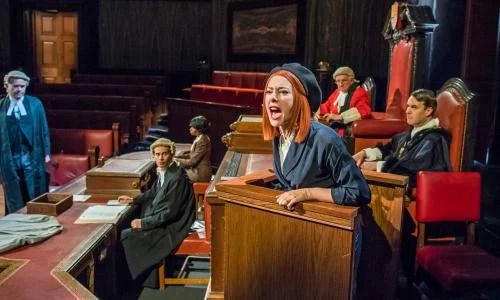
- “No, that will not happen. I shall not be tried as an accessory after the fact. I shall not be tried for perjury. I shall be tried for murder – (She stabs Leonard in the back.) – the murder of the only man I ever loved. (He drops . . . She looks up at the Judge’s seat.) Guilty, my lord.
Spoilers abound here:
Occasionally, when she adapted her own work for the stage, Christie made some improvements. I would argue this is true for the altered solution to Appointment with Death, and it’s certainly true here in the final lines of the play Witness for the Prosecution. The story ends with a proper sting: the defendant we’ve been rooting for is guilty. Christie knew that this would never be a sufficiently dramatic ending for the play, and so she provided a double twist: Romaine lies to protect her beloved husband and then exacts revenge when he mockingly thanks her and then falls into the arms of a younger woman. Another fascinating variation on justice from the Queen of Crime!
SEVEN
- “’Looks as though she stood on the chair, adjusted the rope round her neck and kicked away the chair.’
- “’But that chair wasn’t found kicked over. It was, like all the other chairs, neatly put back against the wall. That was done after Vera Claythorne’s death – by someone else.’”

Christie didn’t have to be so brilliant! If she had jumped from Vera’s suicide to the letter in a bottle, the story of And Then There Were None (1939) would have still been complete – and the greatest classic mystery story ever written. Instead, she gives us a scene between two Scotland Yard detectives who are discussing the case of ten deaths on Soldier Island. Sure, the police are baffled because they weren’t there to see what we saw. And then Christie slips in one final twist to pull the rug out from under all of us, a twist that turns a serial killer horror movie into an impossible crime mystery! Oh, soooo brilliant!
EIGHT
- “’But I really don’t feel it’s right to making him a vegetarian, darling,’ Robin was objecting. ‘Too faddy. And definitely not glamorous.’
- “’ I can’t help it’, said Mrs. Oliver obstinately. ‘He’s always been a vegetarian. He takes round a little machine for grating raw carrots, and turnips.’
- “’But Ariadne, precious, why?’
- “’How do I know?’ said Mrs. Oliver crossly. ‘How do I know why I ever thought of the revolting man? I must have been mad! Why a Finn when I know nothing about Finland? Why a vegetarian? Why all the idiotic mannerisms he’s got? These things just happen. You try something – and people seem to like it – and then you go on – and before you know where you are, you’ve got someone like that maddening Sven Hjerson tied to you for life. And people even write and say how fond you must be of him. Fond of him? If I met that bony gangling vegetable eating Finn in real life, I’d do a better murder than any I’ve ever invented.’”

This scene from 1952’s Mrs. McGinty’s Dead illustrates perfectly why Ariadne Oliver is my favorite Christie character; it also explains why so many people consider the character a stand-in for her creator. I mean – an eccentric foreign sleuth who has gotten on his creator’s last nerve? Who on earth can Christie be talking about?!?
NINE
- “That amiable youth Jimmy Thesiger came racing down the big staircase at (X House) two steps at a time.”

Spoilers abound here:
1929’s The Seven Dials Mystery will never occupy a space at the top of my list, but a recent re-read reminded me of how much fun it is – and what a great job Christie does at reversing all our expectations. The opening line sets up a charming romp in the Wodehouse style. Obviously, we are going to follow Jimmy and his friends as they try to determine 1) the identity of the monster who murdered their friend, and 2) the dastardly plot of the notorious criminal Seven Dials organization. Once that’s done, Jimmy can win the hand of the fair Lorraine. At the very end, we discover that we have been looking at everything the wrong way round! Such cleverness is almost – almost – wasted on this trifle, but it ends up being loads of fun and a great showcase for Superintendent Battle.
TEN
- “’My goodness,’ he cried, ‘I’ve only just realized it! that rascal, with his poisoned cocktail! Anyone might have drunk it! It might have been me!’
- “’There is an even more terrible possibility that you have not considered,’ said Poirot.
- “‘Eh?’
- “’It might have been me,’ said Hercule Poirot”
Spoilers abound here:
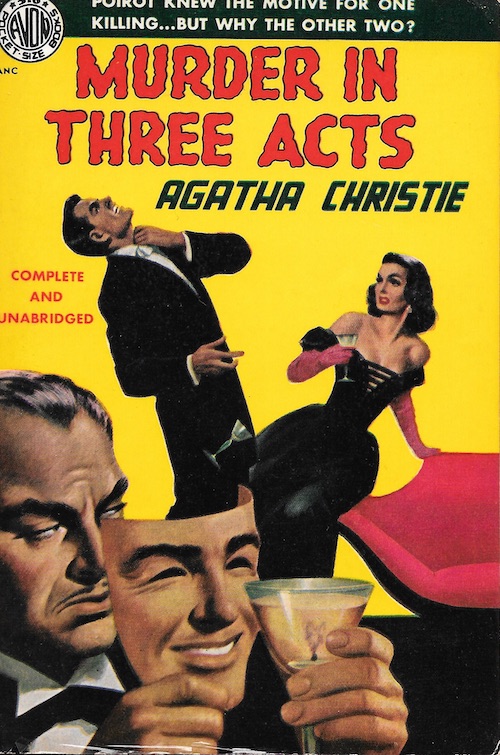
By far, the most significant achievement of 1934’s Three-Act Tragedy is the creation of one of Christie’s most chilling motives. The killer, actor Sir Charles Cartwright, has set up a murder at his cocktail party for the express purpose of rehearsing the switch-up of the offending cocktail glass. It doesn’t matter which of his guests die (although he takes pains to protect the girl he loves), so long as he has a decent dress rehearsal for the real murder. The final lines here, spoken by Mr. Satterthwaite and Poirot, are a comical highlight in the canon!
ELEVEN
- “’Randall couldn’t really distinguish between what was crooked and what wasn’t. His conscience wasn’t sensitive. The poor dear really didn’t know what was just smart – and what was dishonest. Blackie kept him straight. That’s one thing about Letitia Blacklock,, she’s absolutely dead straight. She would never do anything that was dishonest. She’s a very fine character, you know. I’ve always admired her.”

Spoilers abound here:
A Murder Is Announced is a lot of people’s favorite Miss Marple mystery (including mine), at least partly because it is clued more complexly than the usual Marple tale – almost as well as a Poirot! The famous anecdote is that Christie had to warn the proofreaders not to change all the “Lotty”s to “Letty”s or find consistency in the spelling of “enquiries.” I love all those clues, but perhaps my favorite part of AMIA comes in the second half, when Inspector Craddock goes to Scotland to visit the dying Belle Goedler in order to get some background information on Pip and Emma. Belle is a minor character whom we have heard about repeatedly before she makes her brief appearance in the novel. Being who she is, we tend to take her pronouncements on face value as truth. So it’s awfully clever of Christie to make Belle vouchsafe Letitia Blacklock’s honesty – just in case anyone was inclined to disbelieve the woman’s account of events. And, of course, Belle speaks the truth: Letitia Blacklock can be utterly relied upon to tell the truth. Except . . . we never get to meet Letitia Blacklock, do we?
TWELVE
- “And according to Scotland Yard, the crime took place at Twenty-Four Culver Street, Paddington. The murdered woman was a Mrs. Maureen Lyon. In connection with the murder, the police – (MOLLIE rises and crosses to the armchair center.) are anxious to interview a man scene in the vicinity, wearing a dark overcoat – (MOLLIE picks up his overcoat) – light scarf – (MOLLIE picks up his scarf) and a soft felt hat. (MOLLIE picks up his hat and exits through the arch up right.) Motorists are warned against ice-boundroads.”
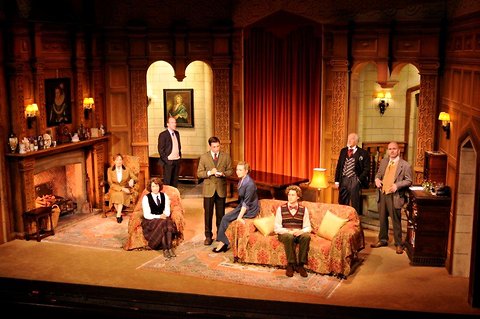
I had the good fortune to speak on Kemper Donovan’s podcast, All About Agatha, about my experiences directing Christie. At the time, I regretted not having brought up this example from The Mousetrap of Agatha proving her worth as a playwright by creating these stage directions. It’s early in the play, and all the audience really knows is that 1) Mollie is married to Giles, and 2) there’s a serial killer on the loose.. Here Christie enjoys dangling a certain possibility before our eyes; later, she will have more fun with another stage direction calling attention to the row of dark overcoats, light scarves, and soft felt hats that now represent nearly every member of the closed circle at Monkswell Manor.
THIRTEEN
- “’I see you’re looking at the fireplace.’
- “’Oh. Was I?’ . . .
- “’Yes, I wondered –‘ She leaned forward and lowered her voice. ‘Was it your poor child?’

The correct answer is that this chillingly prosaic display of madness comes from the opening scene of By the Pricking of My Thumbs. Give yourself a half a point if you said it was from Sleeping Murder. Give yourself an extra three quarters of a point if you also guessed The Pale Horse. Either these earlier manifestations of the same event (one of them published after Christie’s death) were either auditions for the main event, or Christie was simply trying to milk a good story for all it was worth. I like to think, given the circumstances in Thumbs, that each example is a different chapter from the life of the same woman, traveling from senior home to senior home and rattling the nerves of each listener!
FOURTEEN
- “He was about to pass it to her when his movement was suddenly arrested. Looking more like a stuffed frog than ever, Major Palgrave appeared to be staring fixedly over her right shoulder – from whence came the sound of approaching footsteps and voices. ‘Well, I’m damned – I mean -.’ He stuffed everything back into his wallet and crammed it into his pocket.”
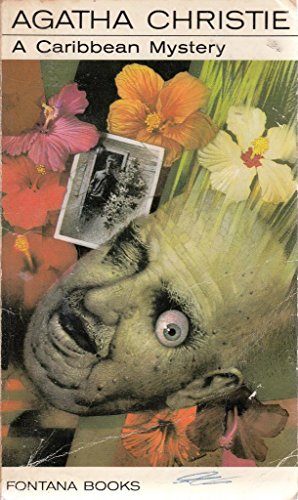
The action of a character spotting something significant while looking over another person’s shoulder is one of my favorite gimmicks in Christie, one I’m sure she adored as well because she used it so often and in such a wonderful variety of ways. We see it used beautifully over and over again, sometimes by a victim and sometimes by the murderer. I’ve included my two favorite uses from the canon in this quiz. This was my first encounter with the trick as A Caribbean Mystery was my first Miss Marple novel and probably my fourth or fifth Christie overall. She couldn’t be clearer about the significance of Palgrave’s staring over Miss Marple’s right shoulder. But like the poor doomed Major, we are unable to see the truth.
FIFTEEN
- “The girl laughed softly, a laugh of pure happiness. ‘We’ll wait three months – to make sure you don’t get the sack – and then – ‘
- “’And then I’ll endow thee with my worldly goods – that’s the hang of it, isn’t it?’ . . .
- “’ I wonder. Will it be as marvelous to you as it is to me? Do you really care – as much as I do?’”

Spoilers abound here:
Death on the Nile is one of my Top Five Christies. I consider it something of an epic: a murder mystery wrapped inside a journey out of Agatha’s own world travelling experiences. The steamer Karnac floats down the Nile, bearing the doomed Cleopatra, Linnet Doyle, along with sixteen other characters rotating around her who might have killed her. All of them are beautifully rendered (well, not the crewman Fleetwood . . . I always forget about Fleetwood!), and they include two jewel thieves, a terrorist, an embezzler, a blackmailer, and a drunk. (How can Sondheim not have gained inspiration from this book for The Last of Sheila?) I have a friend who argues that the book is too long and has too many characters, that Chapter One can be cut with no negative effect to the novel. I have learned to simply not engage when my friend goes on this tear; I simply sit in silence, complacent in the knowledge that he’s wrong.
The passage above occurs in the long first chapter that introduces many (but not all) of the people we’ll be hanging out with for a while. Hercule Poirot has gone out to dine at Chez Ma Tante and overhears a conversation between a young couple who turn out to be Jacqueline de Bellefort and Simon Doyle. They are celebrating the fact that Jackie’s friend, Linnet Doyle, has hired Simon to manage her estate – it’s a job that will ensure the couple has enough money to finally get married and set up house together.
As happens in some of Christie’s best books, the timing of this passage is all-important. At this moment, Jackie is suffused with love for her man and happiness at the prospect of their future together. But Simon is thinking, “Oh, if only I could get my hands on Linnet’s money!” That’s what Poirot senses when he wonders if Simon loves Jackie as much as she loves him. What happens next is hidden from us until the end: Linnet makes a play for Simon, he feigns interest and suggests he marry and bump off his wealthy bride, and Jackie, realizing her man is more about looks than smarts, makes the decision to help him. This early scene goes a long way toward supporting our faith in her love but also makes us think twice before we would consider her the culprit. And the plot she hatches to provide them both with alibis does the rest.
SIXTEEN
- “I had just finished carving some boiled beef (remarkably tough by the way) and on resuming my seat I remarked that, in a spirit most unbecoming to my cloth, that anyone who murdered Colonel Protheroe would be doing the world at large a service.”

It’s not quite the opening line, but this first narrative passage by Leonard Clement, the vicar of St. Mary Mead who tells the story of Murder at the Vicarage, establishes his wit and his essential humanity. No wonder he’s my favorite narrator in the canon!
SEVENTEEN
- “She slipped out of her coat, dropped her overnight bag, pushed the sitting room door farther open and went in . . . Then she stopped dead. Her mouth opened and then shut. She stiffened all over – her eyes staring at the prone figure on the floor; then they rose slowly to the mirror on the wall that reflected back at her own horror- stricken face . . . Then she drew a deep breath. The momentary paralysis over, she flung back her head and screamed.”

Spoilers abound here:
Third Girl is not a book I have ever taken much interest in, although Gray Robert Brown and Mark Aldridge make a good case for it on The Swinging Christies. I love the major role Mrs. Oliver plays in the investigation, but the over-complicated plot feels like a rehash of three or four better Christie puzzles and features one of my least favorite tropes: the unconvincing impersonation. I don’t care how many Calmos or Purple Babies or belladonna cocktails Norma Restarick imbibes: I can’t believe that she could live with Frances Cary and not recognize the woman as her own stepmother Mary with a new wig and some heavy eye make-up!
There is a murder late in the proceedings, and Frances is the one who “discovers” it. (Quotations because she helped commit it!) I love the way Christie disarms our suspicions here: Frances seems so shocked and horrified by the dead body she has found. Of course, before she screams, notice how she checks her expression in the mirror. Every good actor does that before they make their entrance.
EIGHTEEN
- “So, Hastings – we went hunting once more, did we not? Vive le sport.”
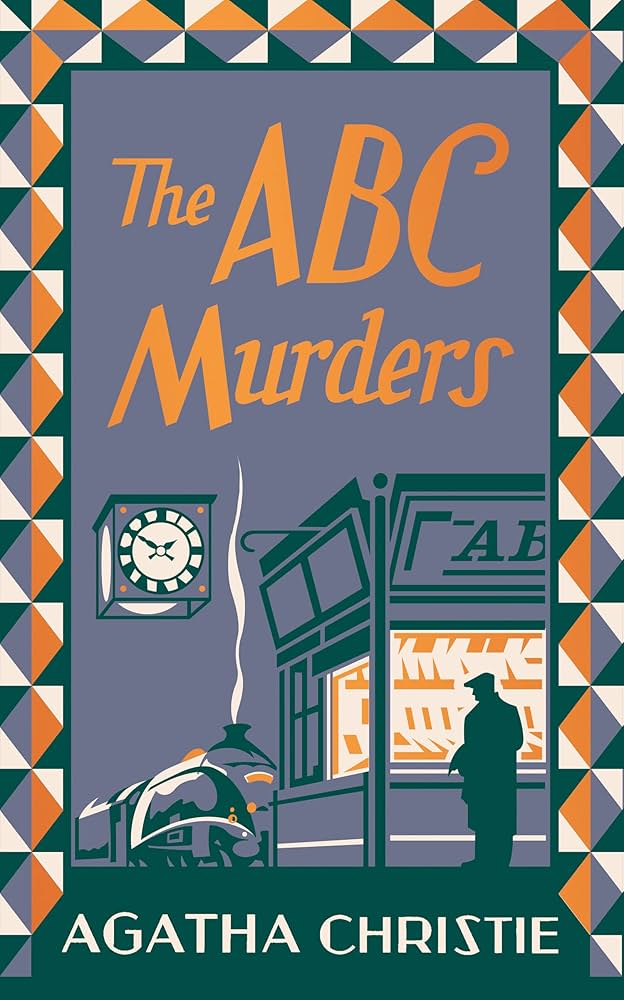
It’s no secret to friends of the blog that I am not a stalwart Captain Hastings fan. I like my Watsons to be intelligent and/or wise-cracking. (Oh, what I’d give to see a pairing between Hercule Poirot and Archie Goodwin!!) Hastings’ best attribute is his loyalty and friendship with the Belgian sleuth. Thus, my favorite moments in the canon that include the ex-pat from Argentina are 1) his introduction of his old friend Poirot in The Mysterious Affair at Styles, 2) his dark night of the soul in Curtain . . . and one more. My favorite case, the one that epitomizes the best of this classic pairing, is The A.B.C. Murders.
Much as he loves his Cinderella, Hastings seems more than willing to leave her for weeks or months at a time to visit his favorite sleuth. True, when he and Poirot battling The Big Four, the stakes were high. Still, the trip to England that coincided with the investigation of the A.B.C. murders seems much more in keeping with a happily married man. And the reunion between old friends could not be more sentimental than it is depicted here. Still, these pals are never happier than when the game is afoot – it’s the blessing and curse of detectives and their Watsons everywhere – and this is probably not only the best case they ever tackled together but the one where they were most evenly matched. It’s a cross-country manhunt that plays to Hastings’ strengths, courage and fortitude; he actually helps Poirot here, right down to making the best of those slips that point Hercule in the right direction (“You don’t think that it was done on purpose?”) And at the end, there are no sad goodbyes, just this crisp, pithy acknowledgement by Poirot indicating that he values the time spent with his friend. Vive le sport!
NINETEEN
- “I meant to go up this morning, but Wonky Poo was missing – that’s my cat, a Persian; such a beauty, only he’s had a painful ear lately – and of course I couldn’t leave home till he was found!!’”

Murder Is Easy (1939) is one of those Christies where the quality of the beginning and the ending slightly outweigh the chewy center. Luke Fitzwilliam’s accidental encounter with Miss Lavinia Pinkerton is a delight! The macabre story told by this fluffy old lady with china blue eyes (Miss Marple without the crust!) propels Luke into a bizarre mystery, gives the retired policeman a new purpose, and introduces him to the future love of his life.
As she tells her story, Miss Pinkerton mentions her cat Wonky Poo. Now, I am most definitely a cat person –
– and so I’m as excited to meet Wonky Poo as a dog fan looks forward to bouncing a ball with Bob the terrier. But it’s the cat’s ear I want to talk about here: that poor painful ear is filled with poison. It kills the local doctor and would’ve killed Bridget if her instincts had let her down. Thus, Wonky Poo is my favorite murder weapon in all of Christie.
TWENTY
- “’Cover her face; mine eyes dazzle; she died young.’ Gwenda screamed.”

Spoilers will abound:
Sleeping Murder was published posthumously in 1976, the year I was a senior at the University of California, Berkeley. Our theatre department was intensely classical – no musicals, few 20th century plays even. Just that spring, the Drama department had staged a stunning production of The Duchess of Malfi. Obviously, I knew that play and the character relationships in all their stunning perversity. Thus, when I read the scene in Christie’s book where Gwenda Reed attends the theatre and runs out of the hall screaming when she hears this quotation, I said aloud, “I don’t know what’s going on yet, but the brother did it!”
From there, all I had to do was wait . . .
TWENTY-ONE
- “’ I’ve never had any chance of displaying my talents as a sleuth. I think I might be rather good at it.’
- “’Now, Ann.’
- “’Darling, I’m not going to trail dangerous criminals. I’m just going to – well, make a few logical deductions. Why and who. And what for? That sort of thing. I’ve come across one piece of information that’s rather interesting.’
- “’Ann!’
- “Don’t look so agonized . . . Only it doesn’t seem to link up with anything . . . Up to a point it all fits in very well. And then suddenly it doesn’t.’ She added cheerfully, ‘Perhaps there’ll be a second murder, and that will clarify things a little.’
- “It was at exactly that moment that Miss Chadwick pushed open the Sports Pavilion door.”

Spoilers will abound:
My three favorite tricks of Christie’s trade are 1) the clue dropped innocuously into general conversation (see After the Funeral above), the variations on the over-the-shoulder stare (see A Caribbean Mystery above, with another to follow), and the “plainly written scene” that obfuscates the truth, often due to Christie tricking us in terms of character or when the scene takes place (see Death on the Nile above). Here, in Cat Among the Pigeons, a book I find endlessly charming, we don’t know yet that there are two completely separate murderers in the novel. Ann Shapland, another one of those young professional women whom Christie has trained us to like, is actually the evil spy in search of the jewels of Ramat. There’s nothing to say, at this point in the novel, that she couldn’t be the killer – until she has dinner with her boyfriend Denis at exactly the same time that a second murder is discovered on the Meadowbrook School campus.
Despite this obvious surefire establishment of an alibi for Ann that knocks her out of the running (but only for the one murder!), notice how Christie nurtures our sympathies for her as an efficient beauty and a budding Nancy Drew. She’s not a danger nut, she tells Denis – she’s just going to apply her brain in aid of the investigation. Good girl!!
Notice another cleverness in the final line of the passage/chapter, suggesting that Miss Chadwick is about to discover Miss Vansittart’s corpse, when what she’s actually about to do is fall victim to opportunistic rage and jealousy. Clever Mrs. Christie!!
TWENTY-TWO
- “The letter had been brought in at twenty minutes to nine. It was just on ten minutes to nine when I left him, the letter still unread. I hesitated with my hand on the door handle, looking back and wondering if there was anything I had left undone.”

Spoilers will abound:
This passage from The Murder of Roger Ackroyd may be the most famous example of Christie’s narrative legerdemain in the canon, and its reputation is justifiable. Dr. Sheppard begs Roger Ackroyd to spill the name of Mrs. Ferrars’ blackmailer; Roger’s refusal to do so seals his doom and creates a brilliant locked-room puzzle – all in the space of the ten minutes between the arrival of the letter and the Doctor’s exit, wondering, like any murderer, if he has completely and satisfactorily staged the scene.
TWENTY-THREE
- “She looked back from the door, and she laughed. Just for one moment, Mr. Schuster, who was a man of more imagination than Mr. Broadribb, had a vague impression of a young and pretty girl shaking hands with the vicar at a garden party in the country. It was, as he realized a moment later, a recollection of his own youth. But Miss Marple had, for a minute, reminded him of that particular girl, young, happy, going to enjoy herself.”
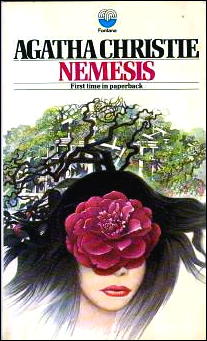
Sleeping Murder may have been the final published Christie novel, but it most certainly is not the last case for Miss Marple. For that, we have to turn to Nemesis, an elegiac novel with lots of problems but just as many rewards. Chief among the latter is the tangible reward the elderly sleuth earns for finding justice for Verity and freeing Michael Rafiel from prison. The final description of Miss Marple clutching a check for twenty thousand pounds and walking into the sunset with dreams of marrons glacès is the best ending for our favorite sleuth that we could have asked for.
TWENTY-FOUR
- “George, George! . . . Oh, do come here! I’m afraid there’s been the most dreadful accident . . . Poor Mr. Evans! . . . “

Spoilers will abound . . .
As wonderful as the 1925 short story “The Witness for the Prosecution” is, the later (by four years) tale “Accident” is just as terrific. Mrs. Anthony, alias Mrs. Merrowdene, has killed to be with the man she loves and gotten away with it. Here, she does it again – and we are completely on her side.
TWENTY-FIVE
- “She looked past me – over my shoulder – as though she saw someone coming along the path – but there was no one – there was no one there.”

Spoilers will abound . . .
Another variation on a favorite Christie trope! In Death Comes as the End, it seems that Nofret’s evil knows no bounds: murdered by someone in the family, her ghost appears to haunt Imhotep’s household. Ever since her death, the bullying Satipy has become timid and fearful. And then, on a cliffside walk, she looks over her husband’s shoulder and sees “Nofret!” In a blind panic, she falls to her death.
This is when I knew the truth – sometimes you just see things the way they ought to be. I asked myself, “What if she wasn’t looking past Yahmose? What if she was looking directly at him??” That would explain the change in Satipy’s behavior, from a nagging wife to a cowering one. Faced with her husband’s act, Satipy’s nerves grew more fragile each day until she stared into his eyes on that cliffside trail and saw murder in them.
The speaker of this quote is Yahmose himself, intentionally misinterpreting events to his sister Renisenb in order to foster the idea that the killings were at the instigation of a ghost!
TWENTY-SIX
- “’The date on that wall calendar, has it remained like it is since the murder?’
- “Tressilian turned back. ‘Which calendar, sir?’
- “’The one on the wall over there.’
- “. . . The calendar in question was a large one with tear-off leaves, a bold date on each leaf. Tressilian peered across the room, then shuffled slowly across till he was a foot or two away. He said: ‘Excuse me, sir, it has been torn off. It’s the twenty-sixth today.’”
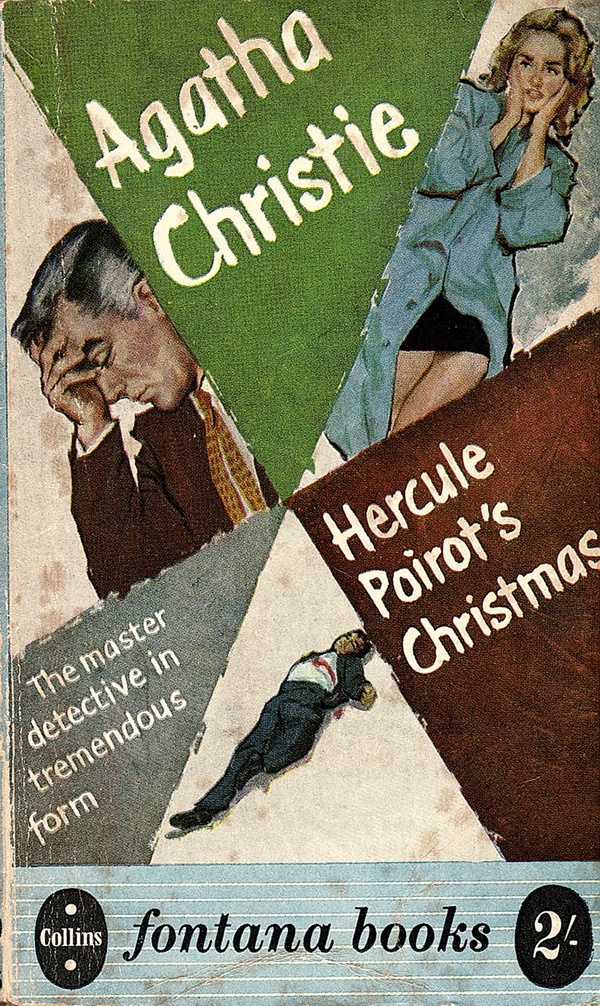
Good God! Who tore off the calendar page? And why on earth did they do so???? The answer, of course, is that it was done because the date had changed, and the person who performed the act . . . well, it makes no difference at all.
I’m not looking to be original here: this is one of the most classic examples of Christie’s skill at misdirection. The date matters not, the calendar matters not. The significance lies in the elderly butler’s inability the large, bold lettering on the leaf from far away. Tressilian’s poor eyesight will matter a great deal before Hercule Poirot’s Christmas is over.
TWENTY-SEVEN
- “Your left-hand little finger is short, but your right hand one is much longer. And your left hand is what you were born with and the right hand is what you make of your life. So that means that you were born unselfish, but have become much more selfish as time goes on.”

Spoilers will abound . . .
In Towards Zero, elderly Mr. Treves tells the story of a child murderer – and pays for this with his life. He says, “I would know my little murderer anywhere” because of a physical imperfection that they had. Christie has paraded a host of imperfections before us: Mary Aldin’s lock of white hair, Ted Latimer’s oddly shaped skull, Audrey Strange’s scarred ear, Thomas Royde’s crooked arm. But the imperfection that Christie weaves more subtly into ordinary conversation (Kay Strange is telling everyone’s fortune) is the weirdest of them all: Neville Strange’s baby fingers are two different sizes. Very Strange!! (And I didn’t spot it at all!!)
TWENTY-EIGHT
- “’Here we are!’ she exclaimed with a kind of beaming boisterousness, meant to cheer and enliven the sad twilight of the aged. ‘I hope we’ve had our little snooze!.’
- “’I have been knitting Miss Marple replied, putting some emphasis on the pronoun, ‘and,’ she went on, confessing her weakness with distaste and shame, ‘I’ve dropped a stitch.’
- “Oh dear, dear,’ said Miss Knight. ‘Well, we’ll soon put that right, won’t we?’
- “’You will,’ Miss Marple said. ‘I, alas, am unable to do so.’”

There is much to love about The Mirror Crack’d from Side to Side, including the murderer’s motive and underlying tragedy, and the excellent use of the “over-the-shoulder-gaze” trick. But as I’ve written before, much of the essential plot of the novel is under-developed. Where Christie really scores is in her examination of Miss Marple’s life in St. Mary Mead after so many years and so much change. Like any practical old woman, she views the passing of much beloved people and places with a bit of nostalgia and a firm understanding that all things must pass. It’s a delight to read about her amblings around the drastically redecorated St. Mary Mead.
Equally delightful is to see Miss Marple truly annoyed by the icky and patronizing “kindness” of her latest caregiver, Miss Knight. It’s a subplot that often outshines the book it’s in. We are all on pins and needles waiting for the odious Miss Knight to get her comeuppance – and she does!
TWENTY-NINE
- “But I, she thought, I am not a whole person. I belong, not to myself, but to something outside me. I cannot grieve for my dead. Instead, I must take my grief and make it into a figure of alabaster. Exhibit N58 Grief, Alabaster. She said under her breath, John – forgive me – forgive me – for what I can’t help doing.”
Spoilers abound:
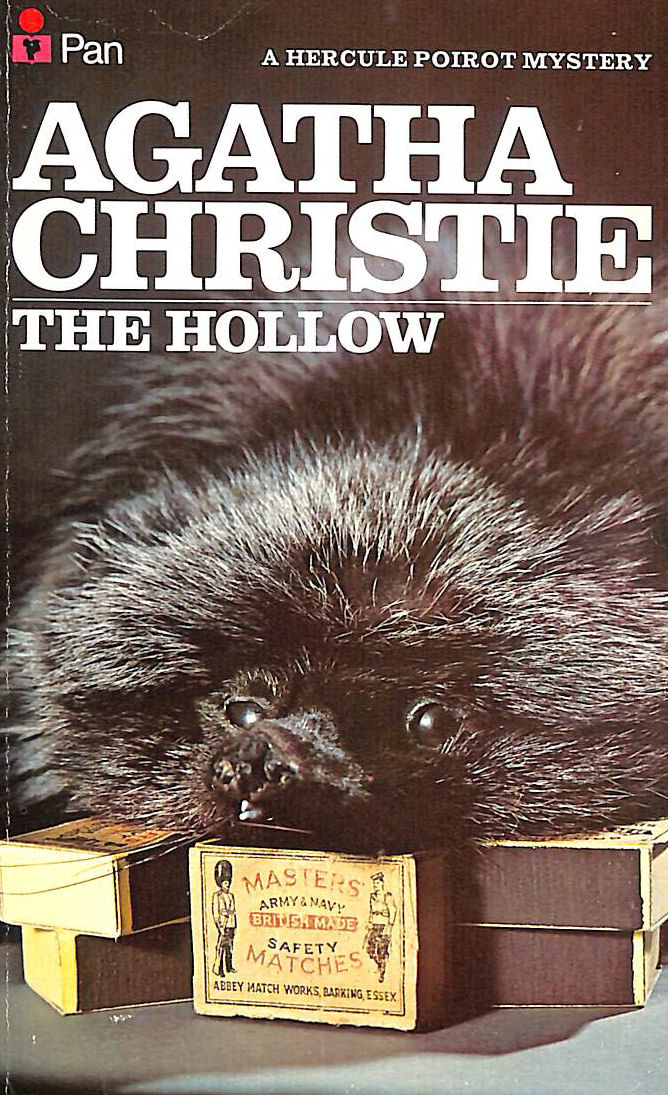
The Hollow is one of my favorite Christie novels and can easily be seen as a companion piece to Five Little Pigs, with its central triangle between a difficult man and two women (although everything about these triangles is differently plotted) and its emphasis on the power of art. Henrietta Savernake loves John so much that, at his dying insistence, she protects his killer. In the end, though, she cannot merely grieve her loss. In that way, she is the opposite of Elsa Greer, who withered the day her lover died. Henrietta turns to her art as she transforms John’s killer – and all the pain and loss of his death – into a beautiful, abstract statue. Amyas Crale, too, couldn’t stop painting, couldn’t keep from finishing the portrait of his own murderer, even as the poison was coursing through his veins. Christie is commenting here on the life of the artist – and perhaps revealing something about her own thoughts.
Oh, and folks – Hercule Poirot belongs here! Very much so! Those of you who disagree are very very wrong!!
THIRTY
- “’What about (her)? Wedding bells there, too?’
- “’Perhaps,’ said Miss Marple. ‘I shouldn’t wonder.’
- “’Which of ‘em is she going to choose?’ said Dermot Craddock.
- “’Don’t you know?’ said Miss Marple.
- “’No, I don’t,’ said Craddock. ‘Do you?’
- “’Oh, yes, I think so,’ said Miss Marple.
- “And she twinkled at him.”

I end with a mystery that has supposedly been solved – but I disagree with the author as to the solution. In 4:50 from Paddington, Miss Marple may be the sleuth, but it’s Lucy Eyelesbarrow who does the legwork and attracts the eye of most of the men in the novel. The question arises: will Lucy choose the earnest but somewhat lost Brian Eastley or the caustic but creative Cedric Crackenthorpe? (Another mad artist!)
Christie herself surmised that it would be Cedric, but I have always held that Lucy chooses Inspector Dermot Craddock, the handsomest policeman in the canon. For proof, I offer – Miss Marple’s final twinkle!
And with that, my quiz is done. How well did you do? Listen: if you want to quiz me back – you know, for revenge or anything – I’m ready for you!
As for the future of this blog, well . . . I plan to keep on chugging along. After all, my Carter Dickson Celebration is only half done. I have about 1,257 more Erle Stanley Gardner novels to read. The new Knives Out movie is out in November, and early reviews say it contains the best mystery yet! And I’m mulling over a new idea about Mrs. Christie . . .
Finally, I want to thank you for following my meanderings through this favorite genre of ours. The greatest gift you could give to me is to keep on reading – and to throw in a comment or two when the feeling moves you.
Lots to read . . . lots to do!

 Ah Sweet Mystery!
I never submitted my results to you Brad, so you will just have to take my word for it when I say that I went 30 for 30!
In all seriousness, this blog has brought me much reading joy over the years and I am thrilled to be a humble contributor. Here’s to ten more years!
LikeLiked by 1 person
Thank you, Nick! And because you are our only contributor who scored a perfect 30 out of 30, you will receive our grand prize of a set of Ginsu steak knives! They have been mailed to your home at 221B Baker Street, and you should receive them shortly!
LikeLike
Congratulations on ten wonderful years, Brad! Even British Christie fans like myself now recognise that “that American guy from California might actually be the person to talk to now” 😊 Wishing you another ten years of great writing and happy upcoming 70th birthday 😊
LikeLiked by 1 person
That’s very sweet of you to say, Michael! Thank you for putting up with all the opinions stated
In my strongly accented English for the past few years. I have no intention of stopping: as my British friends in Book Club like to say: “Hoy! He’s a talker!”
LikeLike
I hope I haven’t mentioned this on this blog before….
Besides the reasoning mentioned for the addition to the ending of Witness for the Prosecution when Christie turned it into a play, there’s a very practical justification: Theaters provide playbills, which include complete cast listings. And if a playgoer were to study that list of characters beforehand, the absence of one important character would give away the surprise. The creation of a final character described in print as “The Other Woman” takes care of that problem neatly.
LikeLiked by 2 people
Terrific quiz! I got 25/30 because some were just hard. But I realized my mistake with Murder is Easy right after I sent it to you, and have been kicking (scratching?) myself for it. Thanks again for the quiz, and the whole blog. Happy anniversary!
LikeLike
Congratulations Brad! I’ve been lurking for years and your blog is one of my favorites. Please keep the posts coming!
LikeLike
I got 29. I guessed that I had number 3 wrong, because Hercule Poirot’s Christmas appeared later again. But I had no what else it could be.
LikeLiked by 1 person
Well, as you now know, Christmas only comes once a year in my quizzes! Congrats on your terrific score!
LikeLike
Really good quiz, Brad. I drafted my answers, planning to come back and fill in the gaps later but never got round to that – sorry!
LikeLike
Just to echo – an excellent quiz. I got 23/30 and was pleased with a couple of those I managed to winkle out of the depths of memory. A lot of those book covers brought back happy memories too. Thank you
LikeLike
Here, she does it again – and we are completely on her side.
Not me. I felt very sad for the poor inspector who was only doing his duty.
Congratulations on your blog’s anniversary.
LikeLike