The spirits of R. Austin Freeman and Baroness Orczy and E. C. Bentley may eternally wonder why the year 1920 is used to mark the start of the Golden Age of Detection, since they had been publishing detective stories since 1907, 1908, and 1913, respectively. But these writers have faded into obscurity, while 1920 marked the debut of one of the most prolific and popular mystery authors of the era – so popular that their debut became, to GAD historians at least, something of a starter pistol.
I’m speaking, of course, about Freeman Wills Crofts.

In his analysis in Masters of the Humdrum Mystery of the work of Crofts, a railway engineer turned mystery novelist, author Curtis Evans discusses the technical mastery of his plot construction, which overcame his “less than felicitous prose style” and had Crofts outselling the other author who debuted in 1920, a lass named Agatha Christie. Funnily enough, Christie went on to become one of the most popular authors of all time, while Crofts spent a good part of the last sixty years on board the Obscurity Express.
Early on, Evans hones in on the aspect of Crofts’ work that set him apart from the rest:
“In terms of theme . . . Crofts’ most important quality is . . . his religious Puritanism. Of the famous mystery novelists who began writing in the Golden Age of detective fiction, Freeman Wills Crofts is the one most clearly and strongly influenced in his work by a rigorous moral sense grounded in evangelical, Low Church spirituality. His books often can be read as moral parables of murder, warning readers of the dangers offered to the human soul by worldly temptations, most notably avarice.”
Well . . . that sounds like fun! We know that Dorothy L. Sayers was a Christian scholar, and it impelled her to turn away from mystery fiction to focus on more weighty spiritual writing. And yet Agatha Christie, though deeply religious, was moral without being preachy. Why, her clerical characters were some of my favorites, warm and amusing rather than severe. The team of cousins who wrote as Ellery Queen were Jewish, and one of them, Frederick Dannay, became obsessed with the spiritual aspects of murder, incorporating his ideas into many of the later Queens, like Ten Days Wonder, The Player on the Other Side, and And On the Eighth Day.

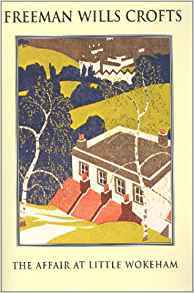
The main difference between these writers and Crofts – at least, the difference that concerns me – is that I have read these other writers but had yet to pick up one of his mysteries. Until now: our Book Club chose one of the final cases of Inspector Joseph French, 1943’s The Affair at Little Wokeham (U.S. title, Double Tragedy) to be our October read. We picked this one largely because it was one of the only titles that Jim Noy, perhaps the greatest proselytizer of Crofts’ work that I know, hadn’t read yet.
JJ has been a fan of the author since 2015. And reviews of Crofts’ novels pop up regularly at The Invisible Event. While they haven’t all been successful reads, JJ is quick to extol the “detailed detection and the inexhaustible efforts of Detective Inspector Joseph French as he chases down criminals responsible for some frankly brilliantly-conceived crimes.” French is the hero of what might be the genre’s first procedural mysteries, and while this is not really my sweet spot when it comes to picking what I want to read, I was more than happy to acquiesce to reading Little Wokeham and getting intimate with Inspector French.
Some of Crofts’ novels are whodunits, but he also wrote four or five inverted mysteries. Little Wokeham happens to be one of these – also not my favorite sort of thing. Thus, I made my beginning of Freeman Wills Crofts with an inverted procedural, and the question remaining as I read was whether the name “Little Wokeham” would turn out to be prescient!
It starts out well: although the book is written in the third person, each chapter is told from the point of view of the various characters involved in the intrigues surrounding the manor house at Little Wokeham, which has been recently bought by Clarence Winnington, newly retired governor of the West Indian island of Trinaica (a mash-up of Trinidad and Jamaica, I suppose). After moving back to England, he settles down to write his memoirs, hiring an efficient secretary named Horne to assist him. Then he invites his only living relatives – nephew Bernard, and nieces Bellissa and Christina – to live with him. Their reward for lifting an old man out of his loneliness is that he will bequeath them twenty thousand pounds each after his death. That’s over $795,000 pounds in modern currency!

Uncle Clarence is a sarcastic and difficult man, leaving Bernard, who is always short of money, wishing the man would kick the bucket already, and the nieces both considering marriage just to get out of Uncle’s house. Bellisa accomplishes this by marrying Guy Plant, a successful accountant for the Yellow Star Line but a morose and occasionally offensive personality. And Christina, who recently was jilted by a beloved beau, has set her sights on the kindly local doctor, Anthony Mallaby, whom she doesn’t love but who adores her. While the emergence of a killer is not presented as a surprise here, I’ll kindly leave that revelation to those of you who wish to pick up this story.
The first third of the novel sets up this whole situation that culminates in murder in a thoroughly readable way. Crofts is skillful at characterization, and I started to settle down and have the kind of fun one does when watching an episode of Columbo. Even better, the murderer is a more well-rounded villain than the ones you find on the series: killing does not come naturally to them, and we are given a strong sense of how hard hit their conscience is before and during the act and how screwed up their moral compass becomes as their plan goes awry. Plus, moving back and forth between characters’ points-of-view makes the whole inverted aspect of the book feel less-single-minded.
And that is where Inspector French enters the scene. Once he does, the bulk of the final two thirds of the novel, told from French’s point of view, becomes a detailed procedural following how the police will identify and capture the murderer, whose plot has been complicated by the actions of another person. Inspector French is as meticulous and plodding in his detection as JJ and other Crofts fans have claimed him to be. And this is where, for me, the novel becomes less Columbo and more like the earlier TV series, Dragnet.
I was not a fan of Dragnet.
Curtis Evans points out Crofts’ penchant for snobbery, and it becomes evident here. I make no judgments about this – perhaps the conclusions drawn were sound for the times. Here’s an example: one important piece of evidence concerns footprints found in and around the scene of the crime. At one point, the space between the prints is measured to determine the assailant’s stride. Much math is done. (No wonder JJ loves Crofts!) And what does the result indicate? That the killer must have been upper class!! And how can French tell this? “A working man usually walks with a smaller angle because in this way he uses less energy and time in getting along. The upper classes have plenty of both for their walks and don’t carry weights. So the chances are in favor of our man being well-to-do.”
Was this actually true? Did working class parents teach their children how to conserve energy in their stride? Was it a Mendelian genetic trait in the poor? Did real policemen ascribe to this deduction? Inquiring minds want to know!
In the end, alas, sometimes a man’s fears are justified: I worried that Crofts was not an author I would get along with, and my first attempt indicates I was correct. There is nothing wrong with this book: French does an expert job of sifting through the evidence in a way that I imagine procedural fans will find thrilling. And when Crofts returns to the point of view of other characters, including the killer, to show how their plan goes awry and how they attempt to fix it, things pick up. The ending provides a dash of suspense over the solving of the case and the murderer’s fate. It was all perfectly . . . fine. To my tastes, however, it was also boring.
I approach Book Club knowing that our opinions will be divided. I look forward to asking fans of Crofts how they would rank this title compared to his others they have read. Not too long ago, JJ ranked the first fifteen mysteries from Croft’s own “Golden Age,” and I happen to own his #1 pick, Inspector French and the Starvel Hollow Tragedy. So, depending on Jim’s answer, I’ll probably get to that one sooner or later. Probably later.
For a happier experience with this book, here is Aidan’s review from Mysteries Ahoy.
 Ah Sweet Mystery!
I think you should give Starvel, McGill and some of the earlier ones a read before dismissing him – this may be a little like judging Christie by her last few books. To his credit, he did experiment more in his later books, not always totally successfully.
I wouldn’t be surprised, though, if you end up admiring rather than loving them.
You may also find the moral aspects of his 1930s books easier to deal with. Anyone attempting to defraud creditors or commit financial fraud on shareholders or leave employees in the lurch was regarded in the same way most GAD writers viewed blackmailers.
On the stride stuff, I am as puzzled as you, although the bot carrying the tools of their trade does seem reasonable. In addition, my recollection is that every ten years or so in the early half of the twentieth century, someone would notice how small the working class was in comparison with the upper and middle classes. Regularly having enough food to eat makes a difference. Famously, during the Boer War, many recruits had to be rejected on health grounds, and commissions were appointed to investigate the whys and wherefores.
LikeLiked by 1 person
I suspect you’re right about admiration rather than love. I lay much of this at Inspector French’s door: I will always prefer the outsized personality of a Poirot or Dr. Fell or the emotive intuition of a Miss Marple to the straightforward meticulousness of French. This is just a matter of taste.
And no, I don’t want to be unfair: I shudder to think of the life led by a person who decided to give Agatha Christie a try and picked up Postern of Fate.
LikeLike
Well you are not alone in not enjoying this read. By the sounds of it, you got more out of it than I did!
I love this part of the review especially: ‘Was this actually true? Did working class parents teach their children how to conserve energy in their stride? Was it a Mendelian genetic trait in the poor? Did real policemen ascribe to this deduction? Inquiring minds want to know!’ I did chuckle to myself a while after reading your review, remembering this passage.
LikeLiked by 2 people
Pingback: The Affair at Little Wokeham (1943) by Freeman Wills Crofts – crossexaminingcrime