“’Someone, you know, someone had shoved her head down into the water with the apples. Shoved her down and held her there, so that she was dead, of course. Drowned. Drowned. Just in a galvanized iron bucket, nearly full of water. Kneeling there, sticking her head down to bob at an apple. I hate apples,’ said Mrs. Oliver. ‘I never want to see an apple again . . .’”
One of Agatha Christie’s strengths – and a good argument against her all-too-frequent dismissal as a cozy writer – is the realistic way she dealt with children. In her books, kids are interesting, bright, difficult, obnoxious, dangerous, flawed creatures, just like the older people who begat them. Sometimes, tragically, they are victims, which poses special challenges in the crafting of a puzzle mystery. The killing of a child requires sensitivity and the occasional moment to put aside the focus on ratiocination and deal with the horrifying ramifications of a life snuffed out near its start.

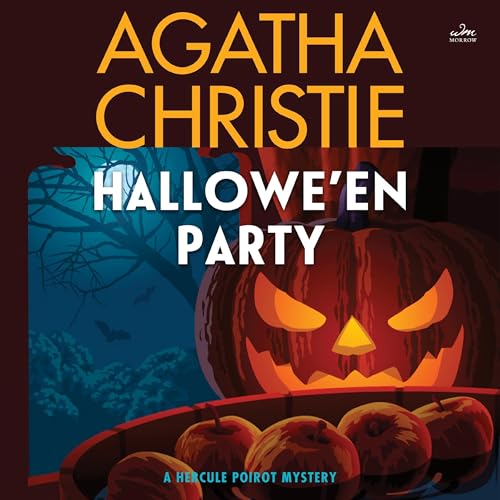
In 1966, Christie toured America with her husband Max and came upon the lavish American celebration of ghouls and ghosties known as Halloween. The idea of taking something as prosaic and joyously spooky as a Halloween party and juxtapose the horrific murder of a child – a murder committed in a ghoulishly humorous way! – is a terrific one. And the opening of the 1969 novel Hallowe’en Party embraces this idea to perfection. It is the best part of the novel.
But at 78, the author didn’t have a clear idea as to where to go from there. According to John Curran, the pages and pages of Notebook 16 covering the planning of this book are muddled with competing ideas; only that opening sequence is clear, written practically verbatim on the notebook’s pages. From there, Christie begins to steal from the best – meaning herself. The central plot here is an amalgam of two other Poirot/Oliver pair-ups, 1952’s Mrs. McGinty’s Dead and 1956’s Dead Man’s Folly. Frankly, at this point in my life as an Agatha Christie scholar, a comparison of these three novels is more interesting to me than a full-on analysis of Hallowe’en Party. I’ve got a job to do here in terms of ranking, but you can expect a slightly different approach this time.
There are other past inspirations as well: the all-important past murder comes straight out of a 1935 Poirot short story, “How Does Your Garden Grow?” Christie also makes use of the over-the-shoulder look, the third time this decade, and it’s interesting to compare how the trick is used here with its employment in The Mirror Crack’d from Side to Side and A Caribbean Mystery).
Mostly by happenstance, this title drops into the Poirot Project right after my re-read of Elephants Can Remember, a much weaker story than this one. The setting here is more evocative, and there are strong passages that deal with, among other things, parental grief and lesbianism. Most of the adult characters are forgettable, but the children come to life throughout the book. Is it enough to raise Hallowe’en Party to a higher place on this list? Let’s find out.
* * * * *
The Hook
- “’I saw a murder once,’ said Joyce . . .
- “’Did you really? asked Cathie, gazing at Joyce with wide eyes. ‘Really and truly saw a murder?’
- “’Of course she didn’t,’ said Mrs. Drake. ‘Don’t say silly things, Joyce.’
- “’I did see a murder,’ said Joyce. I did. I did. I did.’. . . . .
- “’Why didn’t you go to the police about it?’ asked Cathie.
- “’Because I didn’t know it was a murder when I saw it.’”
The book’s opening drops us, just as it does Mrs. Oliver, in the midst of preparations for a children’s party to celebrate Hallowe’en. Games are being set up, some of which I remember (bobbing for apples) and others, like snapdragon and the mirror game, I’ve never heard of. There’s nothing particularly hair-raising or mysterious about the opening pages; rather, we are treated to a comforting and rather funny domestic scene, with famous author Ariadne Oliver bombarded with strange people and activities.

Lots and lots of people are mentioned: there’s no telling who is about to become important to our story – except Joyce, a girl eager for attention who can’t figure out the right way to go about it. She makes her pronouncement about seeing a murder and is dismissed. With great economy, Christie covers the ensuing festivities and leaves us at the end of Chapter Two with a big mess (the party and, eventually, the ensuing plot) for the planning committee to clean up. There’s no mention of murder, but I would venture to say that none of us expect to see Joyce again.
Score: 8/10
The Closed Circle: Who, What, When, Where, Why?
Who?
“So far they were really only names to Mrs. Oliver. There was a Nan and a Beatrice and a Cathie, a Diana, and a Joyce, who was boastful and asked questions. ‘I don’t like Joyce much’, thought Mrs. Oliver. A girl called Ann, who looked tall and superior. There were two adolescent boys who appeared to have just got used to trying out different hairstyles, with rather unfortunate results.”
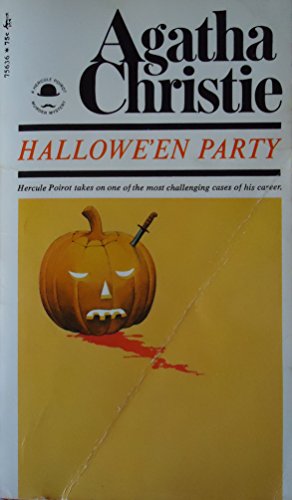
The “Cast of Characters” in my Pocket Books edition from 1970 includes twenty-five, and that list is incomplete. Most of these people, on or off the list, are negligible to the plot. Plus, if one is going to include the missing Olga Seminoff, there are other names of importance from the past, like Mrs. Llewelyn-Smythe and Leslie Ferrier, who have been left off. I imagine this was done to preserve some mystery – but then why include Olga?

With few exceptions, the characters are here to serve a function to the plot – and that’s all. Their physicality, their psychology, their inner lives . . . very little of any of this is revealed to the reader. It hearkens back to the early days of murder mysteries – but Christie herself had evolved beyond this, beginning in the early 30’s and continuing well into the 50’s. Here, she sketches out her characters with her accustomed shorthand:
- Rowena Drake is “a handsome middle-aged woman”
- Joyce Reynolds is “a sturdy thirteen-year-old”
- Dr. Ferguson is “a man of sixty, of Scottish extraction, with a brusque manner.”
Some characters receive even less description than this.
And then we come to Michael Garfield. He is a pivotal character, although he doesn’t appear until Chapter Eleven. I wonder if Christie was inspired by a gardener she knew or a handsome man she had seen, or whether she was simply doing that thing she does too often – the act of paying closer attention to her murderer than to other characters. Whatever the reason, Michael is the first character to come to life on the page:
“His youth seemed the most characteristic thing about him yet, as Poirot saw, he was not really young. He was past thirty, perhaps nearer forty. The smile on his face was very, very faint. It was not quite a welcoming smile, it was just a smile of quiet recognition. He was tall, slender, with features of great perfection such as a classical sculptor might have produced. His eyes were dark, his hair was black and fitted him as a woven chain mail helmet, or cap might have done.”
Soon after we meet Michael, Miranda Butler appears to guide Poirot home to tea. The children in Hallowe’en Party are the most interesting characters in the book: boastful Joyce and her greed brother Leopold, those teenaged rascals Nicholas and Desmond, and, above all, Miranda. She comes straight to us out of Shakespeare; with her description, Christie leaves us in no doubt about that: “Her voice was clear, almost bell-like in tone. She was a fragile creature. Something about her matched the sunk garden. A dryad or some elf-like being.”
On a roll, Christie then introduces us to Miranda’s mother, Judith. Except – we met Judith on Page One, and only now, 83 pages later, are we getting this description:
“Judith Butler was a woman of about thirty-five, and while her daughter resembled a dryad or a wood nymph, Judith had more the attributes of a water spirit. She could have been a Rhine maiden. Her long blonde hair hung limply on her shoulders, she was delicately made with a rather long face, and faintly hollow cheeks, while above them were big sea green eyes fringed with long eyelashes.”
I question why we don’t get this description earlier, nor why Christie doesn’t fill us in on Judith’s relationship with Mrs. Oliver until they both relate their meeting to Poirot. Up to this point, we view Judith as “just a friend,” someone who provides the lodging where Mrs. Oliver can stay in order to get involved in another murder. Miranda is just her daughter, spending the Hallowe’en party sick in bed. But as soon as Miranda meets Poirot, she tells him, “Joyce and I used to tell each other all our secrets.” This, combined with the over-repeated evidence that Joyce was a show-off and a liar, should make it immediately clear to everyone just who saw a murder in the past!
This is not very mysterious, but it’s fine. What isn’t fine is how this central trio – the only three people who merit some description – ultimately connect with each other. Once in a while, Christie likes to drop a last-minute revelation on her readers, with mixed results. Here, we discover that Judith and Michael were lovers, and that Miranda is their daughter.
The fact that Michael is willing to murder his own child in order to secure his investment (and buy an island) reduces him to another psychopathic crank, like Michael Rogers or Lewis Serrocold. What’s more intriguing is Miranda’s acceptance of her impending death. After she is rescued, Nicholas Ransom says to her, “You bloody Little, idiot . . . Coming up here with a barmy murderer. You should have known what you were doing.” Miranda’s response reminds me of the thought processes of many children I’ve known: “I did in a way. I was going to be a sacrifice, I think, because you see it was all my fault. It was because of me that Joyce was killed. So it was right for me to be a sacrifice, wasn’t it? It would be a kind of ritual killing.” Nicholas’ response to that is a welcome slap in the face to this romantic nonsense, and one can imagine that after this Miranda will begin to leave the “wood nymph” behind and begin to grow into womanhood.
What?
Hercule Poirot receives a call from Ariadne Oliver expressing her concerns over a party full of strangers, one that leads to the murder of a teenaged girl who had boasted of knowing about a murder (a murder that she co-opted from the true witness!) Poirot leaves London to investigate. Oh, wait! That’s the plot for 1956’s Dead Man’s Folly. The earlier book has a more interesting setting (Greenway!) and an ostensibly better closed circle of suspects, but Joyce and her family are more interesting than Marlene Tucker and her kin, most of whom make a brief, perfunctory appearance at the end of the book. It is noteworthy that the second murder victim is a relation of the dead girl: in Folly, old Merdle is the actual witness to the death of the real Lady Stubbs, while Joyce’s brother, Leopold, who is one of the nastiest children in the canon, tries a spot of blackmail, with deadly results.
Bath to the plot: Hallowe’en Party deals with the search for a successful murderer who kills again to protect their secret. With assistance from Mrs. Oliver and Superintendent Spence, Poirot must investigate several unsolved past deaths and figure out which one is the significant event and which member of the community committed the past murder. Oh – but that’s actually the plot of 1952’s Mrs. McGinty’s Dead. The four past murders in that book have wonderful associations to past true crimes, including the case of Dr. Crippen. Although one of these possibilities is crossed off almost immediately, Christie mines the other three for a juicy game of “pass-around-the-suspicion.” In the end, more than one person is unmasked as having been connected to a case.
Hallowe’en Party gives us several local deaths and then ties most of them together into one, which severely curtails the possibilities. I would argue that the case I really want to know about, the death of schoolteacher Janet White, leaves us hanging. It doesn’t take long for Poirot to focus on the other three deaths, which are linked: the conveniently dead Mrs. Llewellyn-Smythe, the savagely killed Leslie Ferrier, and the disappearing au pair, Olga Seminoff.
What am I saying? Hallowe’en Party actually concerns a man who manipulates and murders in order to obtain his dream proper- oh, shoot! That’s Endless Night. (With a dash of They Do It with Mirrors!!) I must be talking about the tale where Poirot investigates an old woman who changes her will to disinherit her relations and leaves her fortune to her Eastern European au pair . . . You know what I’m going to say here, don’t you? That’s the plot for “How Does Your Garden Grow?” a short story originally published in 1935!
The adage is true that, in this case at least, there is nothing new under the sun! Christie always borrowed liberally from her own work to create something else, and sometimes this worked beautifully. Yet, despite drawing elements from at least four past works here, there is something amiss. Hallowe’en Party may or may not work as a puzzle mystery – we’ll get to that in a minute – but there’s a draggy, piecemeal quality to the bulk of the text. Joyce’s declaration and murder is a brilliant set piece, but most of the investigation is routine. Michael and Miranda, the richest characters in the book, don’t even enter the story until the halfway mark. Rowena Drake is prominent enough – too much so, perhaps, for ultimately she seems the only person at the party who merits serious consideration for the role of murderer.
When and where?
Christie was nearly always circumspect in her description of setting, and for much of the novel this remains true. The suburban town of Woodleigh Common is vaguely sketched, and so are most of the houses and buildings Poirot visits. But then we come to the garden that Michael Garfield created for Mrs. Llewellyn-Smythe. Like her description of the man himself, Christie digs deep to convey both the visual and the temperamental aspect of this place. In fact, Christie describes two gardens: the one in Woodleigh Common and a garden in Ireland that both Mrs. L-S and Poirot had visited and from which the late owner might have drawn inspiration.
For me, the garden is probably the best clue in the book – better even than the clue we will discuss in a minute – even if it reveals far too much. As Poirot sits on a bench that overlooks the quarry where the garden has been laid, he is struck by a certain disparity:
“. . . everything that grew here had the appearance of having grown by its own will. It had not been arranged or forced into submission. ‘And yet’, thought Poirot, ‘that is not really so. All has been arranged, all has been planned to this tiny little plant that grows here and to that large towering bush that rises up so fiercely with its golden and red leaves. Oh, yes. All has been planned here and arranged. What is more, I would say that it had obeyed.’ He wondered, then whom it had obeyed.”
Christie rarely toys with the concept of the murderer as a self-conceived god, something that Ellery Queen spent the 1940’s through 60’s contemplating. When she does, as in And Then There Were None, she can be brilliant. I wouldn’t even try to compare the quality and effect of that book to this, but the description of both the garden and its architect lays the foundation for a sort of Greek myth concerning the hubris of a gifted mortal. The beautiful Michael seeks to bend nature to his will and is, in fact, unscrupulous about it.
One other point which contributes to that rare book where time and place have more of a positive effect than plot is that, while most of the suspects – and there are far too few of them – are old hat, in the young people who populate the book, Christie has created a group that passes muster in the swinging 60’s. Miranda is a flower child, pure and simple, while Nicholas and Desmond are strapping teenage boys experimenting with their clothes and hairstyles, “with rather unfortunate results.” They give a rather stodgy old plot cobbled together from the past feel lighter and more modern whenever they appear on the page.
Score: 6/10
The Solution and How He Gets There (10 points)
- “’It was simple as soon as I got the vital clue.’
- “‘What do you call the vital clue?’
- “‘Water.’.”
It’s really that simple. Joyce was drowned in an apple bobbing bucket. She struggled mightily before she died, and so the killer would have had to be wet. And here is Rowena Drake, utilizing the “strange-look-over-the-shoulder” device that Christie has used many times before. Here she allows the schoolteacher, Miss Whittaker to see her appear startled when gazing through the open doorway into the library. Really it’s just an excuse to drop the vase she’s carrying over her already sopping dress.
After that, we no longer have to worry that, as is sadly common in many later novels, Christie doesn’t spend much time fashioning effective red herrings to take us down the, er, garden path. With Rowena Drake having a clear motive of wanting to get her hands on her aunt-in-law’s money, all the other deaths are easily linked together. The man who created a “forged” will and had to be silenced . . . the au pair who wouldn’t let the matter go . . . the husband who got in the way of the very odd affair between Rowena and Michael. Sadly, there’s almost nothing left out that could have served as obfuscation in the case. Add the garden clue from above, and you can link Michael and Rowena as one of the less satisfying Deadly Couples in the canon.
Score: 4/10
The Poirot Factor
As he did in Mrs. McGinty’s Dead, Poirot spends the bulk of a novel in the country, questioning the townsfolk and uncovering old secrets. In that earlier book, the darkness of the villagers’ deeds is leavened with a brilliant amount of humor. Here, we are treated to “Dark Poirot,” someone who would be well at home in the final seasons of the Poirot series. Not that this isn’t fitting: this is, after all, a book about the murder of several young and vulnerable people. Poirot is deeply ruminative throughout and strongly attuned to the Greek mythology of it all. In the end, he actually mourns the loss of the beautiful Michael and the future gardens he might have created.
Even Mrs. Oliver is less funny than usual, although she gets a few good moments in. Her ruminations on Hallowe’en at the start reflect Christie’s own from her recent trip to the U.S.A.. And there’s a wonderful moment where Ariadne talks about a writer finding inspiration from the people she meets. She recalls seeing “a fat woman sitting in a bus eating a currant bun and her lips are moving as well as eating . . .” Mrs. Oliver expands on that vision and suddenly has a character and a hook for a novel: “The whole sequence, what she’s going back to say, whether it’ll run her into danger or somebody else into danger. I think I even know her name. Her name’s Constance. Constance Carnaby.”
How I wish the pair had worked closer together on this. At this point, Poirot needs Mrs. Oliver as a Watson or fellow sleuth of bouncer of ideas in order to make the investigation more interesting. Good Lord! Could I have actually been spoiled by the likes of . . . Elephants Can Remember?!?
Score: 7/10
The Wow Factor
I don’t want to hurt the feelings of my friends Mark Aldridge and Gray Robert Brown, who hold this novel in high esteem indeed. I think there are plenty of interesting things to be found here: the opening sequence is terrific, the death of Leopold, the face-off between Poirot and Michael, the climactic moments of near-sacrifice. Even better are the sketches of ordinary people – pathetic Mrs. Reynolds, the benevolent “witch” Mrs. Goodbody, the sad (and sadly unfinished) story of Janet White.
Alas, though, there’s little here to truly wow this reader.
Score: 4/10
FINAL SCORE FOR HALLOWE’EN PARTY: 29/50
We have our first tie, with Hallowe’en Party earning the same number of points as Hickory Dickory Death. Each book has its problems, but it’s easy in my viewpoint to place HP above HDD.
THE POIROT PROJECT RANKINGS SO FAR . . .
- The Murder of Roger Ackroyd (48 points)
- The A.B.C. Murders (46 points)
- Three-Act Tragedy (42 points)
- Cards on the Table (36 points)
- Death in the Clouds (35 points)
- One, Two, Buckle My Shoe (34 points)
- Murder in Mesopotamia (30 points)
- Hallowe’en Party (29 points)
- Hickory Dickory Dock (29 points)
- Dead Man’s Folly (28 points)
- The Mystery of the Blue Train (26 points)
- Elephants Can Remember (22 points)
- The Big Four (21 points)
Next time . . .
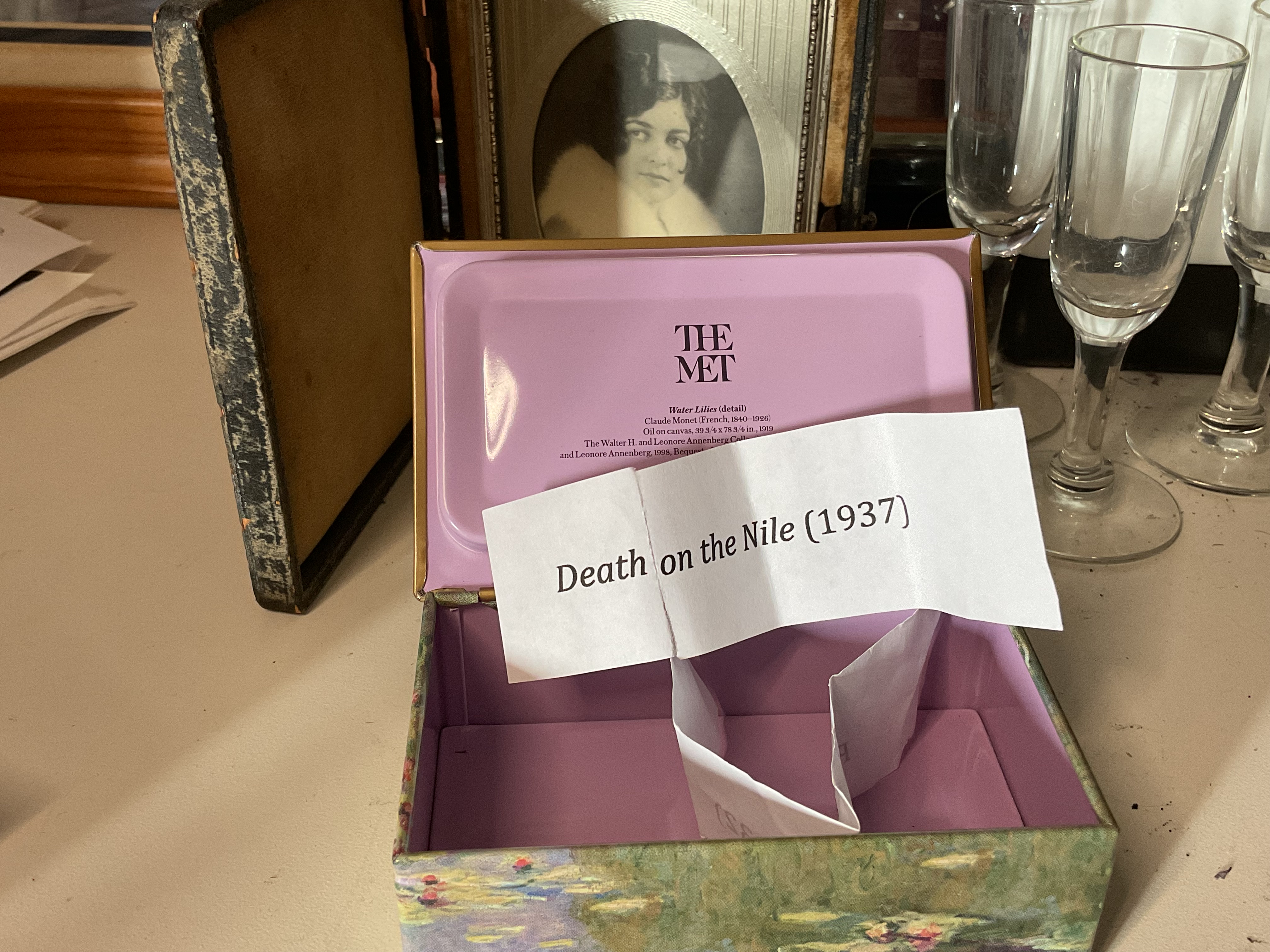
We move from the mediocre to the sublime, and I am full of Thanksgiving!
 Ah Sweet Mystery!
Pingback: MY AGATHA CHRISTIE INDEX | Ah Sweet Mystery!
As a serious gardener, I must point out that ALL gardeners do their darnedest to bend Nature to their will. If you don’t, you get a wilderness of buckthorn, Virginia creeper, Norway maples, wild grapevine, and similar, opportunistic plants. The animals, from microscopic to huge, adapt or die. That whole “forest progression theory” is both a crock of soil amendments and takes a century or more and in the end, the plants do what they want. Michael Garfield may be better at forcing Nature to obey than most of us but he’s not unique.
Gardens are art in four dimensions and the plants do what they want; rarely do the plantings do what you want.
Of the three films, the Poirot adaptation is really outstanding. That topiary garden! Wow! It’s a stunner. Sadly, it’s private so you can’t visit it while in England without really good connections.
The Les Petits Meurtres was flawed as always but I really enjoyed the political infighting and discovery, at the end, that you need to closely inspect those public art projects in grand new public gardens and not just to see how your elected officials are burning tax payer dollars.
Sir Kenny’s adaptation turned Agatha gothic and worked surprisingly well for me; so much better than his two previous efforts! I HATED his Ariadne Oliver’s justification at the end. Wrong, wrong, wrong, wrong. But otherwise, the film worked and what a great rooftop garden!
LikeLiked by 2 people
I thought the Suchet adaptation had some nice spooky touches, but I wish they hadn’t given Rowena Drake children. Haven’t seen the French version – does it have the hated Avril? I think I saw all the Larosiere episodes. And I am very fond of Branagh’s version – except, like you, for the derisive treatment of Ariadne Oliver at the end.
As for gardens, I never had a green thumb, unlike my father. But after he died, I became better with plants. He might be watching over me and have something to do with that.
LikeLiked by 1 person
When watching the Suchet version, I really wondered how Rowena Drake’s adult children felt about the revelations about their mother and the gardener.
The Les Petits version is jam-packed with incident; way too much plot for 90 minutes, much of which goes nowhere even though it could have tied up nicely with other random plot elements. Commissaire Laurence develops psychosomatic blindness from a gang-related shootout so Avril must become his seeing-eye girl while infiltrating the local gang of JDs and take her bra off to prove her JD bona-fides. These ridiculous, cringy scenes COULD have tied up together, but no.
Those scenes also have NOTHING to do with the central murder plot.
It’s one damned thing after another, but the episode does make crystal clear why you should attend municipal meetings. It’s the only way to stop grandiose public projects when you’ve got acres of bombed-out ruins begging for public money to rehab them.
LikeLiked by 1 person
This was probably the easiest murder mystery of all time. The murderer had to explain being wet and the dropped vase gave it away. Apart from that, I thought H Party was a weak story.
LikeLiked by 1 person
It’s a weak use of one of my favorite Christie tropes, which she employs over and over and over again to a wonderful array of effects. This one is weak because the murderer lacks a convincing excuse to keep what she has “seen” a secret, and the reader needs to care about these party guests and understand their relationships enough to care about what the murderer might have “seen” in order to buy the red herring.
Did I hopefully make sense???
LikeLiked by 1 person
Yes, indeed. She was absolutely expert at misleading readers. LOL. I remember being quite certain I knew who was the bad guy/gal in several stories, only to be fooled. But HParty seemed obvious, particularly because of the drowning. As for the motive? Eeew…. I always thought Michael was creepy. You?
LikeLiked by 1 person
I always thought that I liked Hallowe’en Party more than I did. I reread it for the season a few years ago and was left wanting. It’s one of those titles that, for me, improves in my memory. Memory tells me that it’s clever and creepy (again befitting the season), but on the page it drags. It is certainly evocative of the time and place in which it was written, but I am starting to think that if I want to read a Swingin’ Christie with dashes of witchcraft, I should just stick to The Pale Horse, and if I want to see Poirot delve into a past murder with Mrs. Oliver, Mrs. McGinty’s Dead is the way to go.
Even mediocre Christie is still good Christie.
LikeLiked by 4 people
You mentioned a pair of books that I love so much more than this. I enjoy her audacious cruelty concerning children here; they are, ultimately, the best characters in the novel. But no one else is really developed, nor are the past cases developed very well. There’s not much mystery as to where this will lead us. And the relationship between the two murderers doesn’t feel natural. As you say, there’s nothing wrong with a good mediocre Christie novel. This one has a great beginning and Mrs. Oliver and Hercule Poirot. There are just so many novels that have done all of this better.
LikeLiked by 1 person
A fairly recent re-read made me downgrade this one considerably, must admit. Hadn’t read it in about 30 years – nice you think I’ve become a little wiser in the intervening decades 😁
LikeLiked by 2 people
PS That was “nice to think” before autocorrect … 🙄
LikeLiked by 2 people
As a Christie loyalist, while I liked it in my initial reading, when I reread it, like others who’ve commented here, I was forced to downgrade it considerably. Nope, I’m afraid I’m NOT a fan of Hallowe’en Party. It falls into the category of Third Girl and others where she’d started using a dictaphone. It just RAMBLES on and on and on. Moreover, I didn’t at all like the utterly unsympathetic way she treats Joyce’s mother as someone who’s ”clearly prepared to dissolve into tears”. No, Ma’am Christie, that somehow is not how you portray a bereaved parent, never mind that Joyce herself isn’t an attractive character, being such an incorrigible liar. But then you aren’t really known for your portrayal of your characters expressing grief upon bereavement, are you? I guess we have to put up with this one, whether we like it or not.
Brad, your analysis is brilliant as usual and it was an aha moment for me to see you expressing so well, what I’ve felt about Hallowe’en Party!
LikeLiked by 2 people
We talk a lot about a sort of sag in quality once Christie started dictating her manuscripts. However, once the stenographer had completed her work, it makes no sense to me that the draft wouldn’t have been thoroughly vetted, first by the author herself and then by her editor! There’s really no excuse for the excesses and illogic of the last half dozen novels – except for either a crazy clause in Christie’s contract about making changes to her work, or a cynical belief on the part of the publisher that it didn’t matter because we’d buy anything by her.
As a fellow Christie loyalist, I would suggest that she does an excellent job portraying parental grief in The Body in the Library.
LikeLiked by 2 people
Must agree. Brad, you pretty much hit the nail on the head here.
LikeLiked by 1 person
Pingback: THE POIROT PROJECT #14: Death on the Nile | Ah Sweet Mystery!
Pingback: THE POIROT PROJECT #15: Peril at End House | Ah Sweet Mystery!