Every year, when Kate Jackson presents us with the list of republished classic mysteries and tells us to “pick our pair” for the annual Reprint of the Year contest over at Cross-Examining Crime, some of us play jump ball with the “big noise” titles in the hopes of coming up with the year’s winner. By “big noise,” I mean those books that have remained out of reach for so long that they have attained mythic status – think C. Daly King’s Obelists oeuvre or Bristow and Manning’s The Invisible Host – or maybe books by authors who, by all rights, should be reprinted in their entirety every ten years or so, like Christianna Brand or John Dickson Carr.

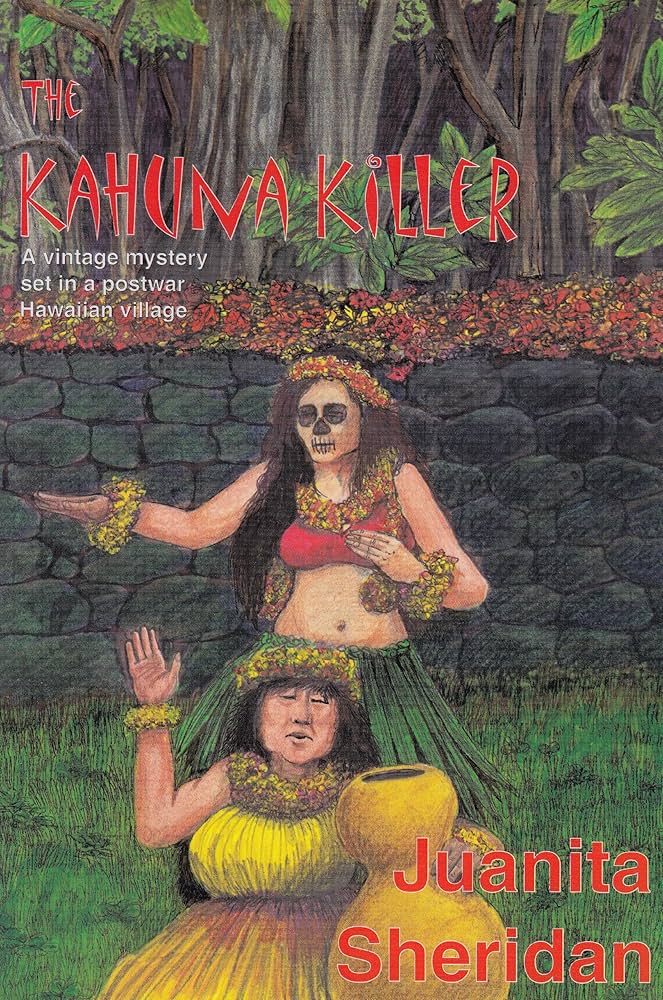
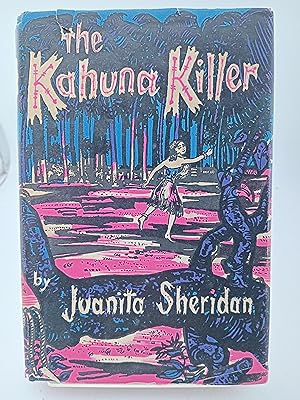
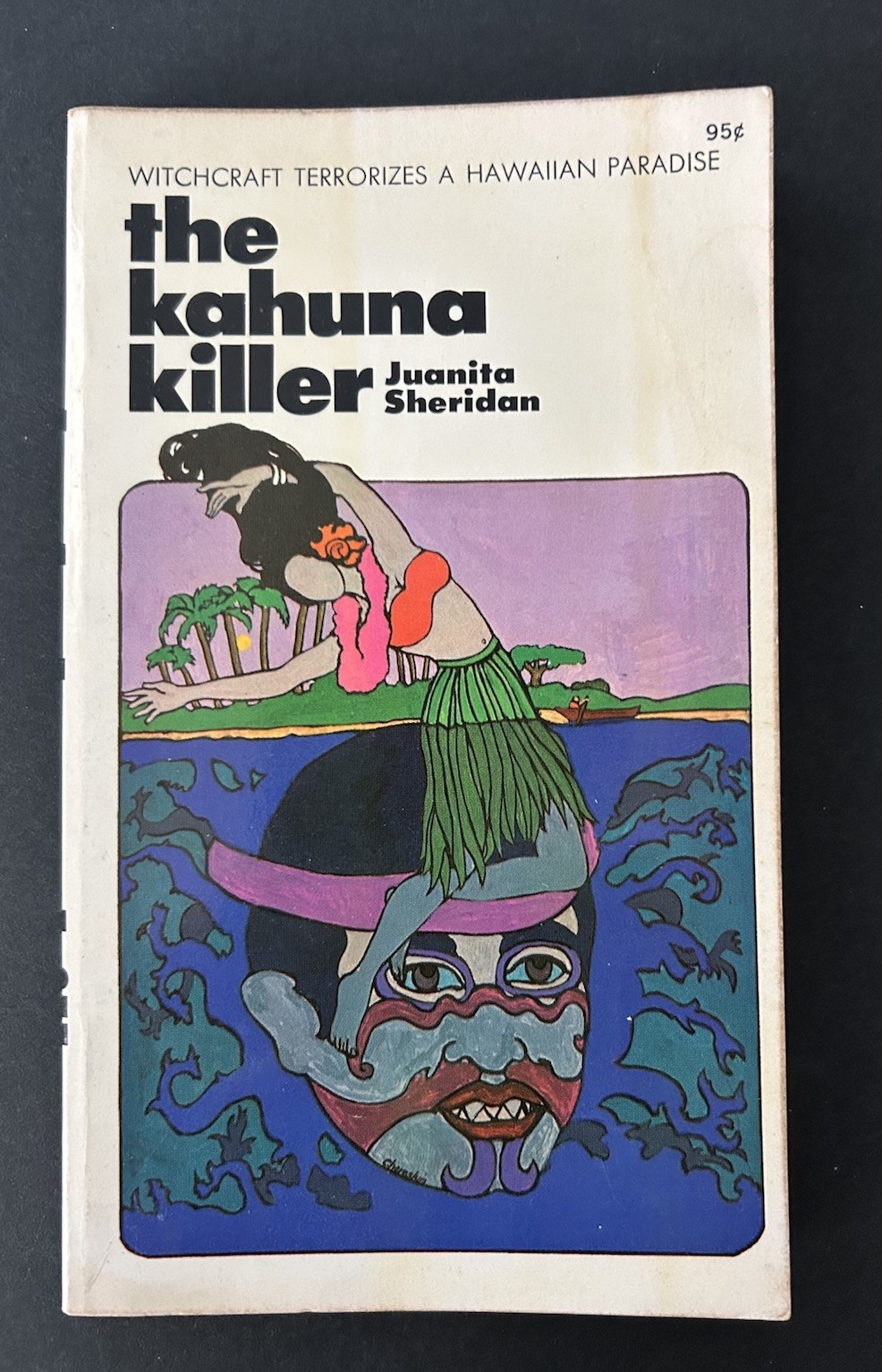
Last week, I got to share one of those big noises – but this week, I’m going for something different. Actually, I originally had a new honkaku translation all picked out, but after a middling experience with it, I decided to switch my selection, especially after Kate dropped us a message that the small press known as Classic Mayhem had reissued The Kahuna Killer (1951),the second in Juanita Sheridan’s four-book series featuring Lily Wu, one of the earliest Chinese female sleuths to appear in print.
Earlier this year I got along well with Lily’s debut in The Chinese Chop, a New York City-set post-war mystery, and I remembered that the introduction remarked that the series really took off once Lily and her Watson/chronicler Janice Cameron returned home to Hawaii. Janice had turned a tragic romance into a romantic novel and had come to the Big Apple to consult with a publisher, only to find herself in the midst of a real-life murder mystery. Luckily, her new roommate, Lily Wu, managed to solve the case and become Janice’s foster sister and best friend.
Now Janice’s novel is about to be released, and Hollywood is already beckoning. Our novice author figures that an adaptation has to be filmed in Hawaii by somebody interested in finally getting her beloved home right onscreen. Janice thinks she knows the perfect spot: architect Luther Avery is an old friend of her late father’s whose large and beautiful property contains the ruins of an ancient temple. Luther has allowed a group of native islanders to transform this spot into an accurate representation of a Hawaiian village. It is a place that Janice knows well from her childhood, and she hopes that Luther will give his permission for the film to be made there.
In order to discuss this (and because her family home is being rented out to a soldier and his wife), Janice is invited to stay within the Avery household. Right away, a sense of menace surrounds our heroine, and Sheridan supplies us with a fascinating list of suspects, any one of which might bear ill will against Janice. The Averys are a dysfunctional lot; their servant girl Malia is beautiful, sly and vicious; their neighbor is a luscious beauty who harbors a grudge against Janice over an old school slight; and the handsome charmer who swept Janice off her feet on board the ocean liner that brought her to Hawaii has stuck around, possibly with some ulterior motive.
Janice hopes to turn to the Hawaiian natives who live in the village and used to be her friends, but they are now hostile toward her. What’s more, mysterious doings seem to be afoot in the village, and they may be the work of an evil kahuna, or witch doctor.
Having had the advantage of going into this blind, I don’t want to give a lot more away about the plot. (In fact, I would caution you about reading the back cover blurb before you tackle the book!) Suffice it to say, Janice runs into murder more than once, and these are not the sanitized “murder in the study” you find in a 30’s GAD mystery. Each event is horrific in a different way, and if the killer’s identity doesn’t come as a total surprise, the motive for their actions is staggeringly cruel.
For a novel written in the early 50’s, Kahuna is surprisingly frank about societal and sexual manners. At one point, Janice witnesses a shocking sight, a special hula dance that has been presented not to evoke something beautiful and culturally special but to appeal to the baser carnal instincts of the audience: “The senator sat glassy-eyed, the drink in his lax hand forgotten in the taste of a stronger intoxicant. The famous radio star watched . . . like a man seeing in flesh incarnate for the first time the substance of his most ecstatic dreams. Walter Benson was there, sitting forward in his chair, both hands pressed hard on his knees.”
Sheridan also takes a frank approach to the inherent prejudices between native Hawaiians and the white “interlopers” who, in their development of grand hotels and beachfront properties, have wreaked havoc with the original culture and habitat of the islands. One character is developing a luxury swimming area at the beach by destroying the entire coral reef. Another works for a magazine that wants to write an “exposè” on the village on the Avery’s property, and the way this “journalist” wants to depict the native islanders reminds me of the demonization of non-white citizens going on in America today. Here’s a description of the journalist’s employer that might strike you as familiar:
“(It was) a digest magazine with mighty influence and international circulation (that) printed stories, dramatizing faith in God and in God‘s children and especially in God‘s country. At the same time it distilled warmongering in subtle form, made devout obeisance to Big Business, and waged unremitting attack on unions and liberal political factions.”
Lily and Janice risk life and limb to solve the case and come up against actual danger in many different forms. In the end, though, Lily figures things out, and Janice must pull the mask off a supposed friend and expose a particularly nasty sort of evil. For, as her late father reminds her, “if an itch for power is dormant in a human being at one hour, it may become active ruthlessness in the next, providing the means of gratification is sighted.”
I’m so sorry that there are only two more adventures of Lily and Janice that Juanita Sheridan wrote before turning her energies to other pursuits. The republication of The Kahuna Killer may not make the “big noise” that a reprinted Carr or Brand is likely to emit, but all four Lily Wu mysteries deserve far more attention than they normally get. I strongly urge you to give them a try – and while you’re in the mood, why not cast a vote for the book once Kate drops the ballot in a day or two?
 Ah Sweet Mystery!
I am glad this one was nominated for the ROYs as it is a series worth sharing. You hit the nail on the head with how it approaches attitudes towards race. In some ways this mystery has an ecological aspect as how the land is being used/should be used is one of the motives for the crimes.
LikeLike
Pingback: Reprint of the Year Award 2025: The Second Nomination – crossexaminingcrime
Pingback: BECAUSE YOU LIKE THE LISTS . . . Brad’s Top Ten Reads of 2025 | Ah Sweet Mystery!