I mentioned last year that John Curran’s latest book, The Murder Game, had revived those ancient armchair detective instincts that turned me into a serious mystery reader in the first place. Folks, I used to take notes when reading Agatha Christie!!
Every generation has something to use as “training wheels” for exercising the little grey cells. For me, it was Encyclopedia Brown, created by Donald J. Sobol, whose exploits taught me how to deduce guilt from basic scientific facts, like the properties of helium or how heat melts chocolate. The generation before mine owed its training to Professor Fordney, the hero of 1945’s Minute Mysteries. And before that, Lassiter Wren and Randle McKay bestowed upon eager amateur sleuths The Baffle Book in 1928. (I have a banged-up first edition of this, but if you’ve never heard of it get ready: Otto Penzler’s American Mystery Classics is republishing it in February!)
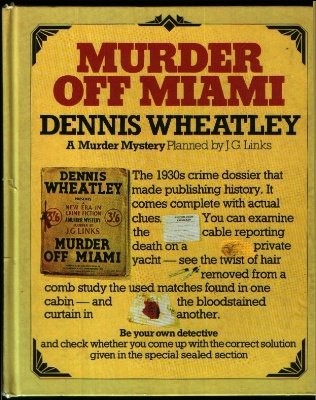
For even richer fun, there were the Crime Dossiers created by various authors, the most famous of which are the four cases published between 1936 and 1939 by Dennis Wheatley (Murder Off Miami, Who Killed Robert Prentice, The Malinsay Massacre, and Herewith the Clues!). These gave readers a more hands-on murder mystery, with the police reports, interviews with suspects and witnesses, and even actual evidence (buttons, matchsticks, pieces of torn fabric, and so on) right at their fingertips. Mayflower Books reissued beautiful editions of these beginning in 1979; although my copies contain the physical clues, sadly subsequent reissues merely printed pictures of these objects.
In a more disappointing category, millennials have the Choose Your Own Adventure series, created by Edward Packard, who is credited with having invented the “interactive fiction” novel. Between 1979 and 1998, 184 Choose Your Own Adventures were published. They cover a variety of genres, from adventure to science fiction, horror to western, but in all cases the reader is the protagonist (the books were narrated in the second person “you” format). Instead of reading in a linear fashion, at certain points in the narrative “you” must make a choice as to the direction you would like to take; your decision affects the outcome of the narrative. Sounds fun, right? So why do I call this a “disappointing category?” Because, as far as I can tell, only one of these 184 damn titles was a whodunit!!! (I covered that title, 1981’s Who Killed Harlowe Thrombey? on this blog.)
British author Antony Johnston, who has science fiction, adventure and mystery novels to his credit, was inspired by Edward Packard to write a Choose Your Own Adventure for grown-ups, and Can You Solve the Murder? is very much a whodunit. This book seems made for former kid sleuths like me – it even advises you to take notes! The publishers provide a space at the end of the book for these, but it’s a sparse four pages, and I needed much more room. Therefore, I created a digital “notebook” in order to keep track of my journey. Everyone starts on Page One, but by page eleven have to make your first decision – and you’re off!
Like most interactive fiction, I guess, this is written in the second person, present tense – something I will never train myself to enjoy. It definitely takes me out of the feeling that I’m reading a book and puts me in mind of playing a game. And, of course, that is the point: this is a game – but is it a good game? And, sorry, but since this is also a book, we must tackle its literary merit as well.
On Page One, “you” are a nameless police detective, (I gave myself the moniker Gideon Kane, which is an identity I had created long ago for an online mystery game), and you find yourself heading to Finchcote Manor, a crumbling country mansion which has been transformed into a posh spa called Elysium. A real estate developer named Harry Kennedy has been found dead on the grounds, having fallen – or was he pushed?!?!? – from a balcony on the top floor. The circumstances of his death are indeed suspicious, and the police have been summoned to investigate.
YOU – or I, as perspective demands, but for these purposes, we’ll stick with “you” – are the detective. You come equipped with a new partner – a sassy lesbian detective from Scotland – and a young and beefy, but vaguely incompetent, constable. One cool thing about the book right off the bat is that the Sergeant’s brashness and the constable’s inexperience will both figure into the story and make your choices even more crucial.

You quickly establish a half dozen or so characters lurking around who may have had a serious beef with the victim. Harry Kennedy turns out to have been a rather awful character, impossible to trust in either business or personal relationships. Of course, as you interview the suspects, they tell as many lies as truths, and it’ll take you a while to dig past the lives and uncover the secrets each of them are carrying. And then you must figure out which of them were self-protective enough about their secret to kill!
Johnson is effective at making sure that your choices do matter! You may find something of value wherever you go, but some people and places are better sources of information – and you may be rewarded for your choice with a Clue Number (although, as you discover if you try and score your performance at the end, earning some of these numbers result in your having to subtract points.) Don’t worry about this, however: collect all the clue numbers you can because they often impart more information than you might have gleaned from a thread of investigation.
There are also consequences for your choices. This might be the most fun aspect of the game: you might choose between questioning one suspect and tailing another and find yourself dead, or causing another person’s death, or botching up the case so badly that you are placed on desk duty for the rest of your career. THE END. More often than not, however, a choice may lead you down a rabbit hole and simply delay your success at reaching the conclusion, which takes the classic form of a gathering of the suspects together. And then, at the point where Hercule Poirot would unmask the killer – YOU must make your choice and turn to the number you think will reveal the killer.
I managed to do this, but not out of any particular brilliance on my part. I’m not sure how well-clued the case ultimately is; I just chose the person who seemed indicated to me by the time my investigation started winding down. The solution revealed a hidden relationship that frankly made no sense to me – I figure there’s a clue somewhere that I never got to read!

So . . . as a game, this one was pretty fun. Yet this is also a book with a plot that runs nearly three hundred pages, so while we ask the question, “Is it a good mystery?” it might also benefit us to ask, “Is it a good story?” Plot-wise, it reminded me of a fairly humdrum episode of Midsomer Murders. It was easy to imagine myself as Inspector Barnaby riding around the countryside with my sergeant. (It would have been nice to have a map of the grounds of the manor and the surrounding community included). Johnson is more successful when it comes to the characters, who are pretty well rendered, especially the members of the investigative team. The secrets and motives are nothing special, but unlike, say, a Dennis Wheatley crime dossier, I did feel something for certain characters after the solution was revealed.
As a detective, it is important for you (and for me) to trust their instincts about people. Clearly I have some work to do on that, but I acknowledge the cleverness Johnson has of making it necessary for you to figure out the best ways to utilize the strengths and weaknesses of your team members. I suspect some people will consider Can You Solve the Murder? too long to be a game and not literary enough to be a book. As a hybrid of both, however, I acknowledge that it was a pretty fun experience, if a slightly humbling one, and that I would not be averse to trying more like it in the future.
 Ah Sweet Mystery!
If you’re branching out into not-quite-a-book-mysteries, I would highly recommend trying Cryptic Killers, who produce murder mystery dossier games.
Instead of just a bland bunch of witness statements, you also get a rich brew of bus tickets, coffee shop flyers, swipe cards, bank records, autopsy reports, photo negatives, and social media posts.
They grade their cases on a 5 point difficulty scale, and in my experience, all of the ones graded 4 or higher have been hugely satisfying, with some very clever (often non-textual) clueing. If you do get stuck, the hints system is excellent and comprehensive.
My only caveats would be that the cases don’t shine as brightly if you are short of time and rush through them, and the ones graded 3/5 or 3.5/5 can be a bit meh.
LikeLiked by 2 people
Wow! I just checked, and there are a dozen of them listed on Amazon! I will have to give these a try! As you have a handle on their range of quality, can you recommend a title that you particularly enjoyed?
LikeLike
I think I’d suggest Murder at Merivale Manor, as (I think) it’s the only one set in the Golden Age so offers the most cross-over with your known tastes.
I also immensely enjoyed Murder in Miami, which features a death on a production of a TV show which feels a lot like Miami Vice – however, I’m a Brit, and the writers are Brits, so I can’t guarantee how well they’ve captured the American voice,
LikeLike
Are they video games or physical?
LikeLike
Physical: they are a collection of mocked-up documents of very varied types. Each case does additionally have a few documents stored on an online database where you have to figure out the password to access them, but the bulk of the material (and the most appealing material) is physical.
LikeLiked by 1 person
I think I would like this! I loved the Choose Your Own Adventure series. I know a lot of people knock them, but I devoured them as a kid. There were so many, and they were so many different adventure genres. The good ones were consistent from happentrack to happentrack, and the really good ones had only one possible path where you didn’t die. Some of them kept up a generic “you” that could be either a boy or a girl, but occasionally they would assign you a character with a name and identifiable characteristics. I liked that better, because it made for a richer story.
LikeLike
Pingback: BRAD SOLVES A MURDER!! Cryptic Killers: Murder at Merivale Manor | Ah Sweet Mystery!
Pingback: THE FESTIVAL! THE FESTIVAL! THE QUEEN (OF CRIME’S) FESTIVAL! | Ah Sweet Mystery!