An upcoming project for my Book Club has meant moving around my TBR pile. (I had to rent a forklift!) This is actually good news, for it means I finally get to tackle Home Sweet Homicide by Craig Rice. My buddy JJ has been singing Rice’s praises for a long time over at The Invisible Event. After he positively warbled about Homicide, I immediately ordered myself a copy and planned to settle back and enjoy it.
That was in November.
November 14, 2019.
In fact, on the strength of JJ’s enthusiasm, I went out and bought a half dozen other titles by the same author . . . and didn’t read them either. Yes, I’m duly ashamed, and every time JJ teases me about my “habit,” I take it like a man. But now I’m making the first dent in my collection with what many consider Rice’s best book of them all.
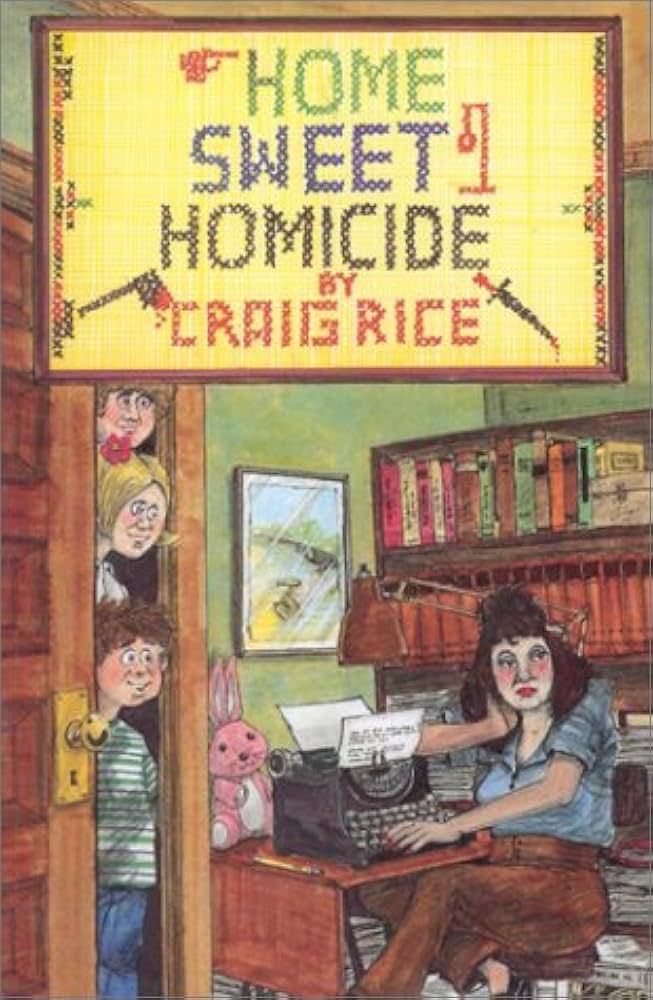
There was a time when Georgiana Ann Randolph Craig, alias Craig Rice, was famous across the United States. On January 28, 1946, she became the first mystery author of all time to be on the cover of Time magazine. Her life was short and colorful. Between bouts of alcoholism and bad health and at least two suicide attempts, she wrote twenty-three novels, numerous short stories and some screenplays. Her work was adapted for film, radio and TV. She was married at least four times, had three children and numerous affairs and sadly died at the age of forty-nine of a barbiturate and alcohol overdose. One critic summed up her turbulent life and career, calling her “the Dorothy Parker of detective fiction, she wrote the binge and lived the hangover.”
Writing is not a profession for sissies; it seems to grab hold of some folks and chew them up, although it’s likely that many a tormented soul has used writing as a way to expunge their demons – and it didn’t work! Unlike Patricia Highsmith, Cornell Woolrich, David Goodis, Jim Thompson and other tortured writers of her day, however, Rice found a way to transfer her dark side onto the page in pleasing hilarious forms. The thirteen novels and many shorter works featuring boozing attorney John J. Malone are the literary equivalent of screwball comedies; indeed, several of them have found their way onto the screen in just that format.
Home Sweet Homicide is not a screwball comedy – although it did make it onto the screen (more about that below.) It is a domestic farce, a semi-autobiographical family portrait that is both grounded in realism and rapturously idyllic. In her dedication, Rice gives all of the credit for the book to her kids Nancy, Iris, and David in an ode of love so sweet that it makes the fact of Rice’s short life all the more heartbreaking.
Marian Carstairs is our stand-in for Rice, a successful author who writes various mystery series under aliases such as Clark Cameron, Andrew Thorpe and J.J. Lane. She is also a mother of two girls, 14-year-old Dinah and 12-year-old April, and a boy of ten named Archie. From the first page, where the three kids hang out on their front porch discussing the fact that their mother, distracted by her current novel, seems to have misplaced the dinner turkey, these three establish themselves as among the most delightful and realistic kids ever committed to fiction. They adore their mom and find things like the missing turkey endearing (“Mother isn’t really absent-minded,” says Dinah. “She’s just busy.”). Their two greatest wishes are would that she would 1. solve a murder and use the publicity from that to sell more books, and 2. meet a marriageable man.
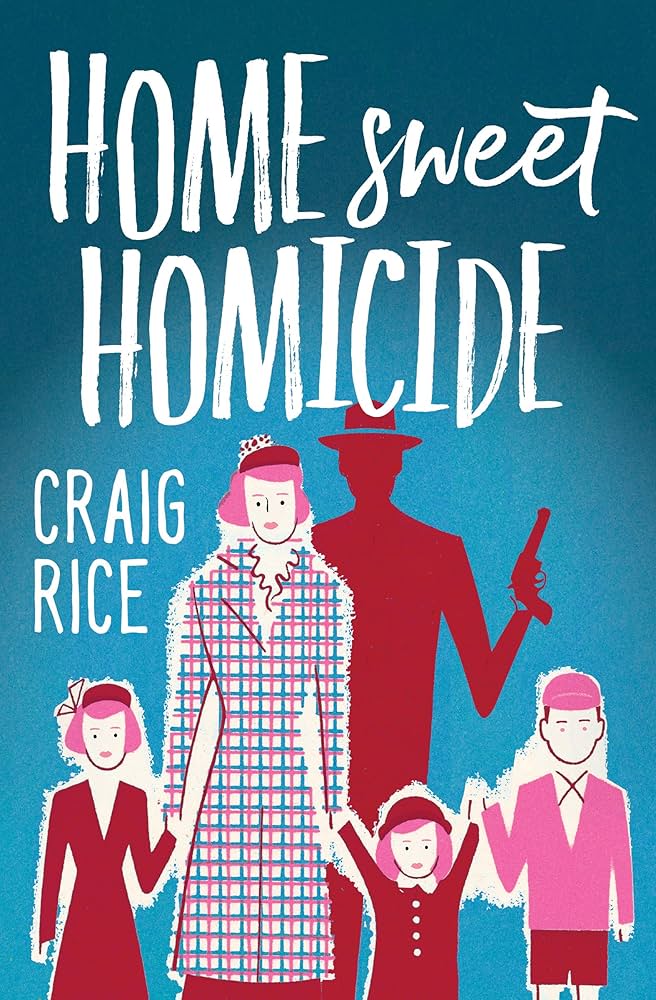
Before anyone can step forward and tell them how unrealistic they’re being, the kids hear gunshots coming from the direction of the house next door. And wouldn’t you know it? The lady of the house has been shot dead. If this seems like fate, the next incident seals the deal: a Homicide detective shows up at the scene, and his name is Bill Smith – the same moniker as the detective hero in Mother’s books!
I won’t go into any more detail about the case that follows. The circumstances are pleasing and by no means inconsequential, but the whodunnit here is almost beside the point. What matters is watching the brilliant April, the comely Dinah, and the holy terror that is Archie go about solving the case (and giving their mother the credit) and uniting her with the handsome Lieutenant Smith. Along the way, we are taken on a lively nostalgic wallow through the suburbs of 1944 Los Angeles, where mobs of kids (Archie’s pals are actually called The Mob) run around slurping malteds, making mischief, dancing, and talking in slang. (Rice thankfully provides a glossary to explain the King Tut Alphabet that the kids use. By the end, you should have no trouble figuring out what the hash-e-lul-squared the kids are saying to each other!
This was a halcyon time, when neighbors – even the ones you suspected of murder – said howdy, freely shared the prize roses from their gardens, and made extra batches of cookies to hand out to hungry children. Dinah, April and Archie consumes massive amounts of food here to keep up their strength (I’m off sugar these days, but man, was I craving a slice of maple fudge cake!) It’s hardly a spoiler to tell you that they achieve both their goals in the end. What spoils this for me just a touch is that Home Sweet Homicide is all we get from Rice about the Carstairs family. I’ll get to the Malone books at some point – frankly, I never laugh much at alcoholic humor – but I’ll lay you eight to three that this will always be my favorite Craig Rice novel.
* * * * *
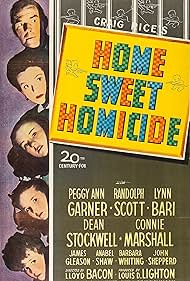
The 1946 20th Century Fox film adaptation of Home Sweet Homicide is available to watch on YouTube. It was directed by Lloyd Bacon, who will always be dear to my heart for helming the 1933 Busby Berkeley musicals 42nd Street and Footlight Parade, but by the 40’s his films were far less snappy. It doesn’t help that it was written by prolific screenwriter F. Hugh Herbert, creator of Corliss Archer, a sort of idealized teenage girl who appeared in short stories, a play, a radio program and a 1945 film called Kiss and Tell, starring Shirley Temple as Corliss. Herbert replaces the natural rhythms and snappy humor of Rice’s kids with a sticky, idealized portrait of 40’s children – the sort of family dynamic that was popular on radio and would become the staple of 50’s family sitcoms.
The opening credits promise something screwball-y and wonderful: the song “No Place Like Home” plays but keeps being interrupted by gunshots and screams. Unfortunately, the film that follows, while pleasant enough, doesn’t live up to that promise. Lynn Bari and Randolph Scott are okay as Marian and Bill. The three kids are fine too – Dean Stockwell is a standout as Archie – but none of them come to life the way they did on the page, and their relationship as siblings is mucked about in order to add some unneeded conflict. The simple murder plot of the book is simplified even more: characters are dropped, and others are changed for the worse. It’s a cute movie, but it doesn’t hold a candle to Craig’s delightful confection of a book.
Home Sweet Homicide is readily available through Otto Penzler’s American Mystery Classics.
 Ah Sweet Mystery!
So glad you enjoyed this; I’m avoiding the film because there’s simply no way it could live up to the brilliance of the book. I love the Malone books, but I’d give every single one of them back for five more novels about Archie Carstairs 🙂
LikeLiked by 1 person
It reminded me of growing up with my brothers and all the adventures we would have with other kids in the neighborhood: riding our bikes to this isolated little candy store to buy wax lips, digging holes in a friend’s backyard, covering them up, and trying to get people to step into them, playing alien invader, eating the baked pie dough that the lady next door gave us! Sadly, we never got to solve any murders . . .
LikeLiked by 1 person
I am happy to read that your first Rice was a success. I have been pecking away at her oeuvre over the years and there are quite a few good ones. I recently picked up a copy of The Double Frame a.k.a. Knocked for a Loop. I also really enjoyed Jeffrey Marks’ biography as it really helped to understand how early child hood events played into her life choices as an adult and her approach to writing. Marks writes that ‘in retrospect, Craig’s abnormally prodigious output can be attributed to bipolarity, frequently called manic-depressive syndrome.’ He also suggests she suffered from separation anxiety due to the way her parents dealt with her when she was baby/toddler.
LikeLiked by 1 person
What is sadder to me than her bipolarity, which could not be helped, or her parents’ possible neglect (?) is that casual references refer to her as a promiscuous drunk, when she was probably dealing with her condition in the only ways she knew how. I hope she also knows enjoyed her well-deserved fame and her children.
LikeLiked by 1 person
Yes alcohol definitely became a crutch which then really impacted her career as she became known as unreliable and dishonest, as she didn’t fulfil contracts, missed deadlines and sometimes made stuff up when doing reporting such as a conversation she imagined she had with Gardner.
Days after she was born her mother left her with relatives so she could join her husband in Europe. They returned three years later and ripped her out of the family unit she knew. Then when she was 6 they dropped her back off again so they could go travelling. Later when her parents split up, her mother rocked up again but this time Rice was old enough to say get stuffed. They never really patched things up. You can kind of see that the cards she was dealt with as a child didn’t set her up well in life.
LikeLiked by 1 person