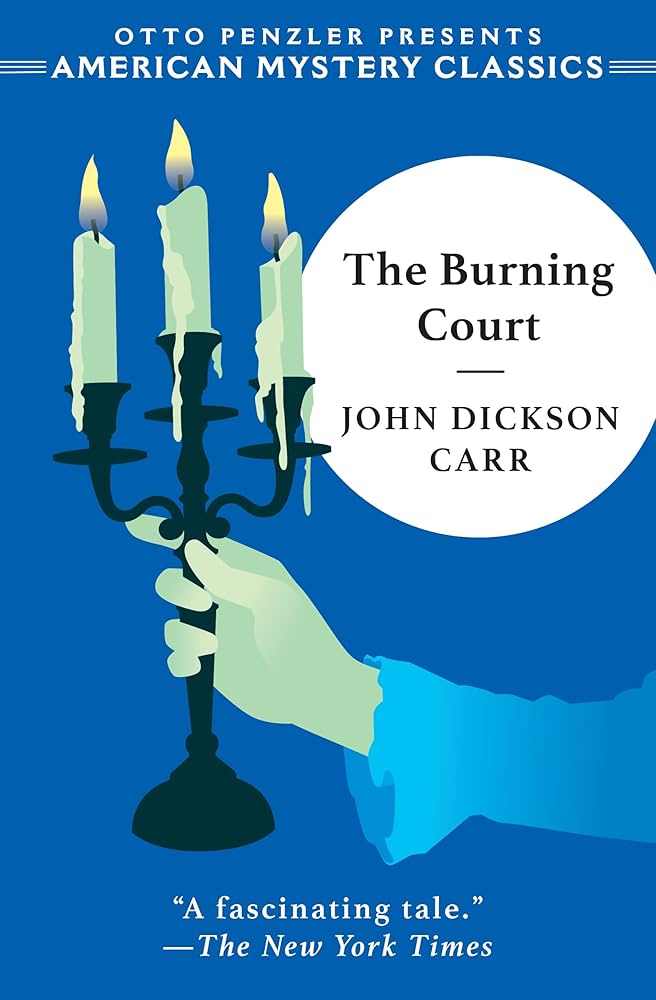
This past weekend, my Book Club tackled a title I have referred to in the past as “John Dickson Carr’s Roger Ackroyd” – this would be 1937’s The Burning Court. I have spoken at length about the book before, but I have to mention that this month’s meeting offered us the rare treat of having a guest speaker. Dan Napolitano is a fellow member of the Golden Age of Detection page on Facebook, an author and one of the foremost living Carr scholars today. He wrote the Introduction to the recent re-release of the book by American Mystery Classics, and it was a delight to hear his thoughts and share our own regarding one of the most singular books Carr ever produced.
Naturally, we talked about Carr in general, and a great many titles were mentioned and discussed. It occurred to me that I have not yet presented my top ten favorite titles by the author. There’s a reason for that. My antecedents for reading and studying and loving Agatha Christie have been made abundantly clear many times in this space. Not only was she the first Golden Age author I read, but she became the gateway to my discovering dozens of others. For a long time, a number of years in fact, that auxiliary reading was confined to two names: Ellery Queen and John Dickson Carr. These two authors proved over and over again that they were capable of the same sort of stunning puzzle work and surprise twist that I enjoyed reading Christie.
I became a Queen completist and have returned to many of my favorites. The many faces of EQ have always fascinated me, and I confess a particular fondness for that most ridiculous of Queenian specialties, the dying message. My dive into Carr has been less complete and is harder to explain. As a kid, I made a clear (if unfathomable) decision that I would stick to the titles by Carr but avoid those written by Carter Dickson. For some reason, I had gotten it into my head that my world was not big enough for two gargantuan sleuths like Dr. Gideon Fell and Sir Henry Merrivale.
It was an ignorant decision, but it provided a happy ending: as a grown-up, I have found myself with a whole slew of Carr whodunnits that I can enjoy for the first time. I’m halfway through my Carter Dickson Celebration, and I admit I have slowed down the pace. Part of this may have to do with the opinions of many of my fellow mystery lovers that the final few Merrivale titles are just no good! I know there are still some great reads ahead of me; maybe I just want to savor what lies ahead.
The other quandary I find myself in when reading Carr is that I actually have little interest in impossible crime mysteries. They’re fun to read, but I don’t think I have the intellectual make-up, the Rube Goldberg mentality, to sort most of these impossibilities out. Nor does it ever make much sense to me that a murderer would stoop to these lengths to kill someone. Clearly I’m not getting into the proper spirit about this subject, and I assure you I would never try and convince a Carr fan that all his brilliant tricks are just so much hoopla!
There are other things I like about Carr, some of which only show up periodically. There’s his delight in the way he challenges his readers to solve a case, the way he promises that what he is telling you is absolutely true – and then by the end he has found a loophole that reverses everything. (And yet he accomplishes this while still telling us the truth!!!) There are also some titles that simply move me, whether it’s to laughter or to tears. Granted, some of Carr’s humor is unbearable, particularly toward the end of his career. But at his peak, there were few authors who could be funnier.
The list I present here are deeply personal. It includes a title that I know most people think is one of the bottommost Gideon Fells, and it’s missing another case of the Doctor’s that I have a feeling would definitely make the top of this list – if I had only read it! (That would be 1944’s Till Death Do Us Part, which I hope to tackle in the near future.) With the knowledge in mind that I am presenting a list of favorites and not a ”Ten Best” list, here we go in ascending order . . .
My memories of this are admittedly vague. I know people complain about it, saying the baseball stuff is interminable. I don’t even remember the impossibility at hand here, and I’m kind of afraid to reread it and discover that the book is indeed terrible. What I do recall was how Carr set up a scenario of relationships between this group of Southern Americans and then completely pulled the rug out from under us, not once but twice. I love when that happens!
I include a short story here featuring Sir Henry Merrivale because I think it’s one of the best short stories that any Golden Age mystery author has ever written. It shows that Carr doesn’t need twenty chapters and two hundred pages to accomplish everything he does in a longer work. Read it for yourself (the story can be found in the collection The Third Bullet and Other Stories) and see how right I am.
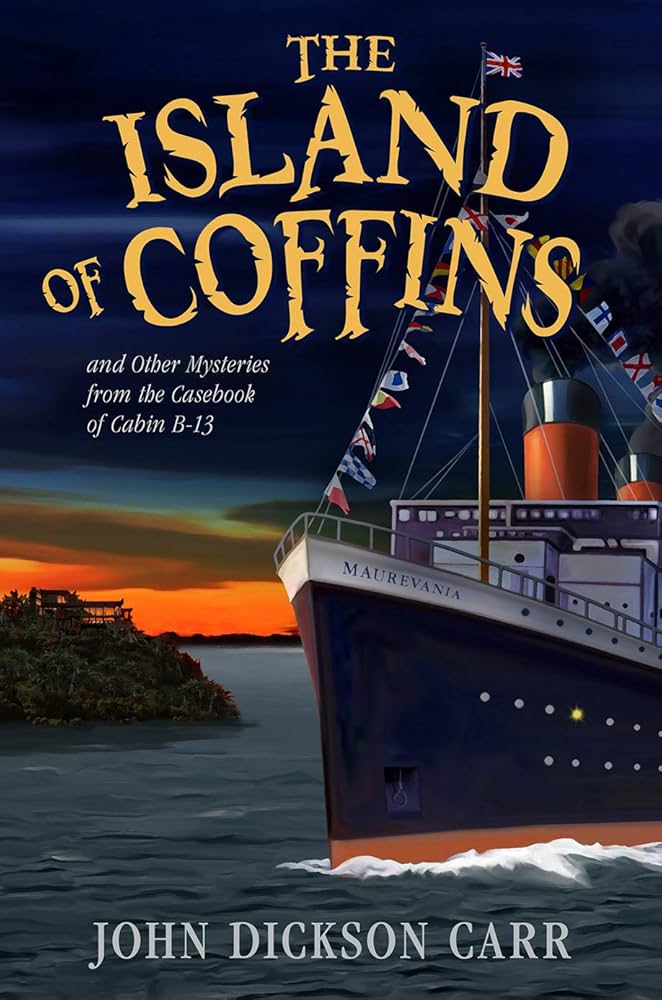
This is a collection of scripts from the CBS radio series Cabin B-13. Carr was a master writing for the radio; just listen to the first season of Suspense, all or most of which was written by him. The atmospherics for which he is so famous in his books are even more successful when aired out of a radio studio. I will always love Christie more than Queen or Carr, but both those gentlemen could run rings around her when it came to the short form, particularly of the scripted variety. My wish to Dan Napolitano, who has the ear of Jeffrey Marx, chief publisher for Crippen & Landru, was to thank the company for all the scripts it has given us by these two authors and others and to humbly hope that someday more of the same will be coming down the pike. (I wrote of my favorites, most of them published by C&L, which you can read about if you click the title above.)
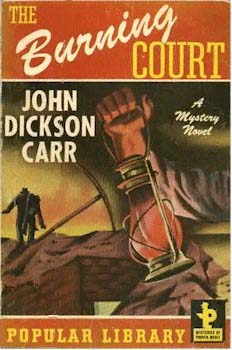
Honestly, this might not have made this list if it hadn’t been for our conversation this weekend. Things get mighty convoluted and – dare I say it? – a little dull in the middle third of this novel. But taken as a whole, it’s extraordinary what Carr accomplishes here, which is essentially giving an elegant middle finger to his publisher, who begged him to tone down the atmosphere and creepiness of his work up till then and try and write an ordinary mystery to appeal to ordinary people. And so he wrote a story about a run-of-the-mill publisher who commutes back and forth from his New York office to his suburban Pennsylvania home and who gets involved in the mysterious disappearance of his dead neighbor from a vault covered in concrete. Not only is it certain that this mystery will uncover a murder, but it looks ever more likely that the murder was committed by witchcraft and that the publisher’s beautiful young wife is a century’s old sorceress!!!
Rest assured: Carr manages to create a convoluted but completely rational explanation, as he often does, that explains every detail of the murder as it sweeps away the supernatural cobwebs. And then he does other things. One of my favorite parts of our conversation with Dan was the third theory of what’s going on in this book, the one proposed by Doug Greene’s brother. (Seriously, if you are a JDC fan, you have to have read The Man Who Explained Miracles, maybe the best biography of a mystery writer ever written!)
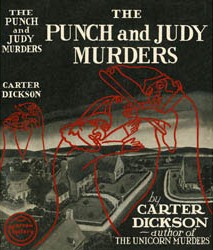
There are two titles on my list where I laughed out loud as I read – and neither of them is The Case of the Constant Suicides, which is the title usually trotted out when someone wants to prove that Carr was funny. Both titles feature Kenwood Blake, one of those innocuous sort-of-Watsons who accompany Sir Henry Merrivale on his cases so that The Old Man has someone to whom he cn pontificate and lecture. Ken was introduced in The Unicorn Murders, which I enjoyed but didn’t place on this list, where he managed to meet the girl of his dreams (as these innocuous sort-of-Watsons usually do). At the start of Punch and Judy, Ken is heading to his own wedding, but he is detoured by a series of events that reminds me of Martin Scorsese’s crazy 1985 black comedy After Hours. What’s amazing is that Carr is able to mix this Marx Brothers madness with a truly twisty mystery and a startling solution!
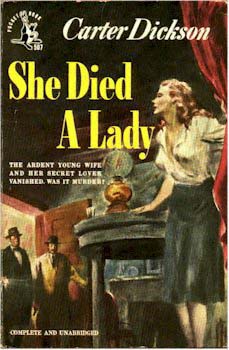
To love this one, you have to ignore the attempts at humor: HM racing around in a wheelchair in a toga (don’t ask) goes on too long and isn’t a bit funny! But this is a tale that packs a punch. The narrator, Dr. Luke Croxley, is a rare older storyteller, and his relationship to the tale is different from all those young lads who usually cross paths with Sir Henry. The puzzle is good, but the emotional effect is grand and earns this one a high place on my list.
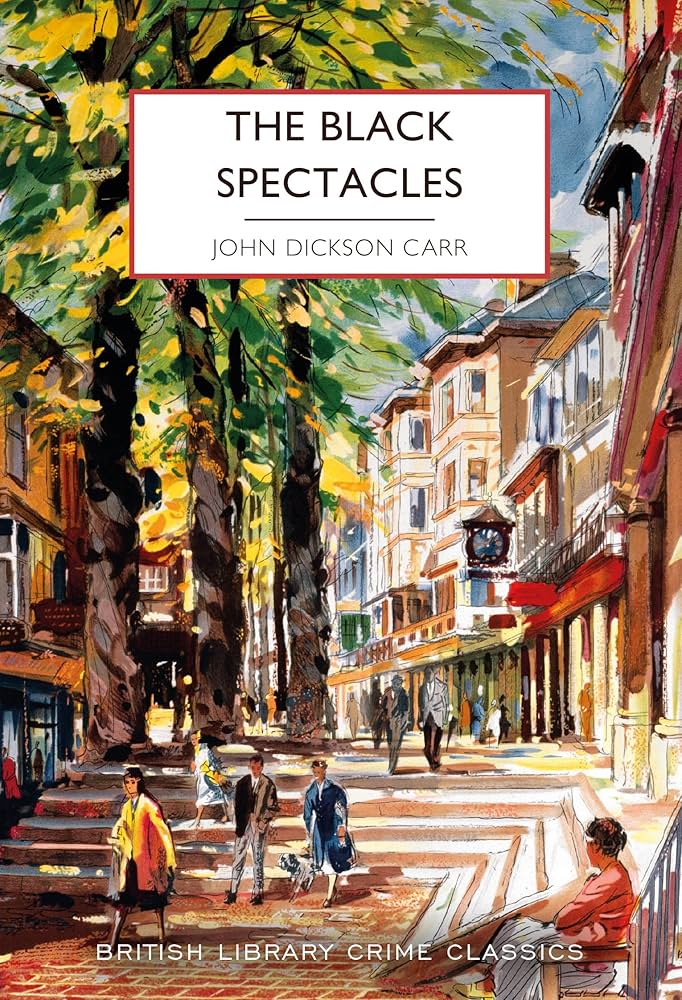
Of all the titles I have chosen, this may be the one that I picked most completely for how ingeniously clever it is. A wealthy man seeks to prove to his family and friends that there’s no such thing as a reliable witness. His evidence, involving a homemade movie that is filmed before everyone’s eyes, leads to more than one death. Meanwhile, his beautiful daughter is suspected of being the village poisoner. There’s so much going on, and a couple of things don’t quite work – like the final death – but in the hands of Dr. Fell it is all sorted out in a most entertaining way.
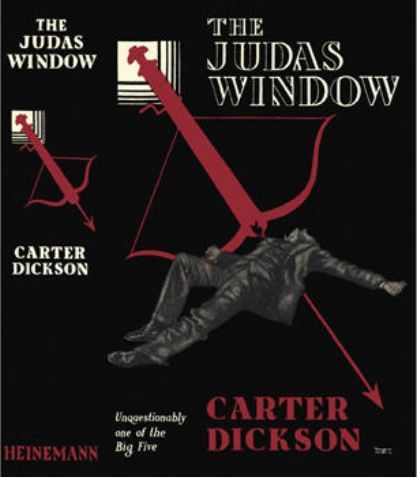
This might contain the best opening hook in any Carr novel and in most novels by other writers. James Answell seems at first glance to be the next sort-of-Watson to grace Sir Henry Merrivale’s presence. But after an extraordinary meeting with his future father-in-law, James becomes a defendant on trial for murder. His lawyer is the Old Man himself! Ken Blake and his wife return to watch HM cavort in court, and those trial scenes are laugh out loud funny. The biggest twist comes, not at the end, but in the middle, and to this day I probably couldn’t explain to you exactly what a Judas window is, but the whole affair is one of Carr’s finest.
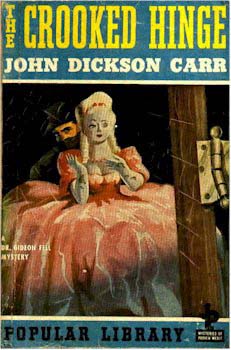
This was a favorite of mine when I was a kid, and after reading some less than kind remarks from various Carr fans, I decided to risk a rare re-read of a non-Christie work (so often the second time is not as enjoyable). To my delight, I loved and appreciated this one even more. The connection to the sinking of the Titanic, the variation on the Tichborne claimant, the rumors of witchcraft in the countryside, and the mysterious monster roaming the garden that may or may not be a chess-playing automaton . . . whew! There’s a lot of stuff, and it all comes together beautifully in the end. Atmosphere, trickery, humor! The Crooked Hinge has it all! (I got to talk about this one with Flex and Herds on their late lamented podcast, Death of the Reader, which you can find out about if you click the title above.)
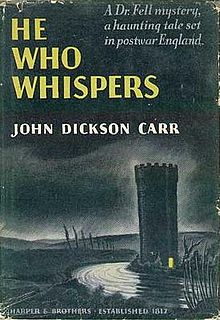
Is Fay Seton a beautiful and brainy librarian, or is she a vampire who preys on children? This begins at a dinner at Carr’s affectionate rendition of The Detection Club and ends with one of the most startling final lines in the canon. If it doesn’t contain the author’s greatest impossibility, it is one of his most emotionally devastating novels, amazing for the frank way it deals with its subject matter in a 1946 novel. The women here are some of Carr’s best (and that’s saying a lot for an author who could be extremely problematic in his portrayals of the superior gender).
And there you have it – my ten favorite Carr reads. If your top pick(s) are not on my list, let me know, and I’ll tell you whether or not I’ve read them! I own them all, so I would be most appreciative if you want to sell me on one title or another.
Do you think Dr. Fell should be on the Twenty Best Literary Detectives Draft that Sergio Angelini, Nick Cardillo and I are creating next month? What about Sir Henry Merrivale? Or Bencolin? Is there room for all three??? You still have time to affect our list by adding your nominations to the comments section HERE!! Please get involved!!!
 Ah Sweet Mystery!
Been rereading Carr in chronological order this year (up to He Who Whispers) and basically agree with the Top 5, if not the specific order of them and I’d probably sub Hollow Man for Crooked Hinge, (Whispers > Spectacles > Judas > Hollow > Lady) probably. Other standouts for me so far are Burning Court, Ten Teacups, Reader is Warned, Nine And Death, and Constant Suicides.
LikeLiked by 2 people
I completely agree about your last 4. It has to be a top 15, that’s it!!
LikeLiked by 1 person
It has been a very long time since I read Constant Suicides, and I’m not sure when or if I will re-read it. But it’s a much beloved title! I agree with you on Nine – And Death Makes Ten. The Reader Is Warned is extremely clever – and oh so problematic these days. I was not as thrilled with Ten Teacups, but you’ll be happy to know that Dan Napolitano agrees with you on that one!!
LikeLike
She died a lady is a masterpiece, IMO. And Carr’s very deliberate answer to a famous Christie novel.
LikeLiked by 3 people
Oh, God, I feel so stupid! Which one? (You can ROT-13 it!!)
LikeLike
Gur Zheqre bs Ebtre Npxeblq. Obgu obbxf ner aneengrq ol n qbpgbe va n ivyyntr/yvggyr gbja, jub sbe irel qvssrerag ernfbaf vf na haeryvnoyr aneengbe.
LikeLike
Well, of course, when you put it that way . . .
LikeLike
Dude …
LikeLiked by 1 person
My reading of Carr is far from complete but I love a good top ten. Therefore, submitted for your consideration:
LikeLiked by 2 people
We differ in four. As I said, I will no doubt bump Dark of the Moon and put in Till Death Do Us Part after I’ve read it. I enjoyed The Plague Court Murders, but I can’t rank it as high. The Red Widow Murders was marred for me by my spotting the killer THE MOMENT THEY MADE THEIR FIRST ENTRANCE!!! Sooooooooo obvious!
That leaves The Three Coffins, which I’ll bet most responders will include. Full of atmosphere, undeniably clever – and, for me, slow as molasses to get through. Not as difficult as The Eight of Swords, which I despised, because I do admire TTC – I just don’t like it much.
LikeLike
I love your list Brad – bravo! So glad you included a radio series in here. My list would probably be 70% identical and my other selections incredibly similar. I would replace DARK OF THE MOON with PANIC IN BOX C and would maybe include one of the historicals somehow … but a lovely 10. But of course, it should be a top 15 or top 20 …
LikeLiked by 1 person
Maybe the Three Amigos will have to take that on someday!
LikeLiked by 1 person
Music to one’s ears!
LikeLiked by 1 person
You know how much I enjoyed The Burning Court, which you kindly gifted me a short while back. Now I need to read He Who Whispers. Of course, I only dabble in GAD novels. (Demon Copperhead was very good. Now I’m reading a contemporary Polish horror novel – The Empusium by Olga Tokarczuk.) So thanks to your recommendation via this post, I will order He Who Whispers from Fabulosa on Castro Street. That is, of course, if there’s been a recent reprint. I’m going to look it up and see.
LikeLiked by 1 person
There has, through the British Library.
LikeLike
Yes, just saw that British Library did one of their usual reprints. I’ll order it on the way home from work tomorrow.
LikeLike
Carr was brilliant at locked rooms and impossibilities … but they’re not actually ends in themselves. Think of them as stage effects: in his early books, they’re deployed to create memorable images and atmosphere, a sense that the world is wonderful and spectacular and terrifying and irrational, that dark forces are at work; in his later ones, to dramatic ends: to implicate characters, create emotional situations, drive conflict. Carr was first and foremost a theatrically minded, Romantic writer of imaginative stories who used detective fiction as his medium. (Incidentally, the tricks in things like The Judas Window, Till Death Do Us Part and The Dead Man’s Knock are pretty unexciting.)
Yes. Absolutely Dr Fell and HM belong in a list of 20 detectives.
LikeLiked by 1 person
As I like lists, here’s my top ten.
LikeLiked by 1 person
This isn’t the first time I’ve heard good things about He Wouldn’t Kill Patience, so it gives me something to look forward to!!
LikeLike
PATIENCE is a classic, Brad. I must have mentioned that a few times before …
LikeLike