In Curtain Up: Agatha Christie, A Life in the Theatre, Julius Green recounts a wonderful story about the actor Francis L. Sullivan, who had entreated his friend Agatha to adapt her novel Death on the Nile with him in the leading role. Let’s remember that Sullivan had played Poirot several times – but Agatha was through with having her most famous sleuth appear onstage. She was amenable to adapting Nile for the theatre and having her friend star in it, but as she explained to her husband Max in a letter, she was insistent on “leading him gently to the idea of Death on the Nile without Poirot – suggested instead a retired Barrister – a solicitor – a diplomat – a clergyman – canon or bishop. And suddenly he bit! His eyes half closed – ‘oh yes – purple silk front and a large cross.’ He saw it, you see. Not the speaking part – the appearance! I bet you whoever played Hamlet argued a good deal as to whether to play it in a hat or not!”
Agatha loved actors, but she also embraced an impression of them as egotistical, sometimes shallow or single-minded. They made for lively and enjoyable characters in her books – and they were also a sizable presence in the dark, secret world of Christie’s murderers. In fact, there was a noteworthy period of four years, from 1933 to 1936, where an actor was unmasked as the killer every year!! The theatricality of each killer’s plan is evident (or becomes so at the end), and yet the characters and plotting are so variable in these cases that I honestly never realized in all these years of reading Christie how close together in time these stories were published.
* * * * *
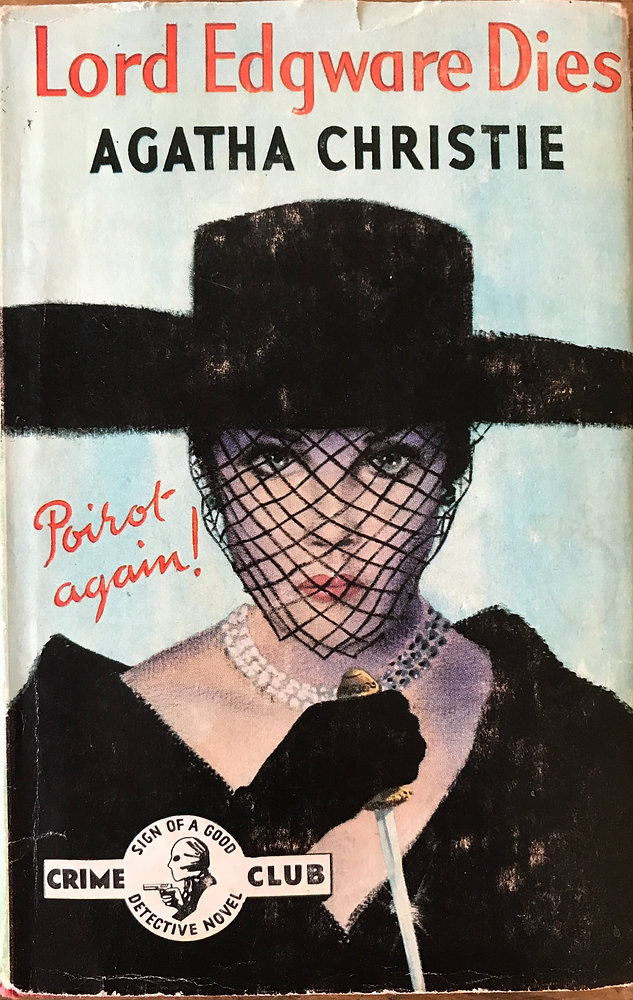
Lord Edgware Dies (a.k.a. Thirteen at Dinner) (1933)
“Then there are the plots that tease my mind, that I like to think about, and play with, knowing that one day, I am going to write them. I had (an) idea that came to me after going to a performance by Ruth Draper. I thought how clever she was and how good her impersonations were; the wonderful way she could transform herself from a nagging wife to a peasant girl kneeling in a cathedral. Thinking about her led me to the book Lord Edgware Dies.” (Christie, An Autobiography, p. 424)
Lord Edgware Dies may have the most theatrical setting in the canon, taking place in the West End and other high society spots in London and including no less than four members of the acting profession amongst its cast. Ruth Draper was an American actress who is said to have invented the modern monologue and toured the States and all over Europe, bringing her original characters to life and impressing a wide range of famous people. This included Agatha Christie, who was inspired by Draper to create the character of Aspasia Glen in the 1929 Harley Quin story, “The Dead Harlequin.” Draper inspired Christie again three years later, in the form of Carlotta Adams, an up-and-coming impersonator who figures strongly in the plot of Lord Edgware Dies. Carlotta is an unwitting accomplice to murder and one of the victims, along with the titular baron and, later, an actor named Donald Ross who had the misfortune to be an intelligent man. We also meet Bryan Martin, “a tall, extremely good-looking man of the Greek-god type (and) the hero of the screen most popular at the moment.”
But the focal point of this novel is Lady Edgware, a.k.a. Jane Wilkinson, star of the London stage and American cinema, who begs Hercule Poirot to help her get rid of her odious husband, who has refused to divorce her, so that she can marry again. I’m not aware of any real-life antecedents for the character, but in December 1929, in the short story “The Blue Geranium,” (later part of the collection The Thirteen Problems) Christie introduced another actress named Jane – Jane Helier, who is blue-eyed and beautiful, somewhat vapid and certainly self-involved, possibly a little dumb until she reveals hidden depths in another story, “The Affair at the Bungalow.” Jane might have become another item on the actor/murderer list if she hadn’t received excellent advice from Miss Marple.
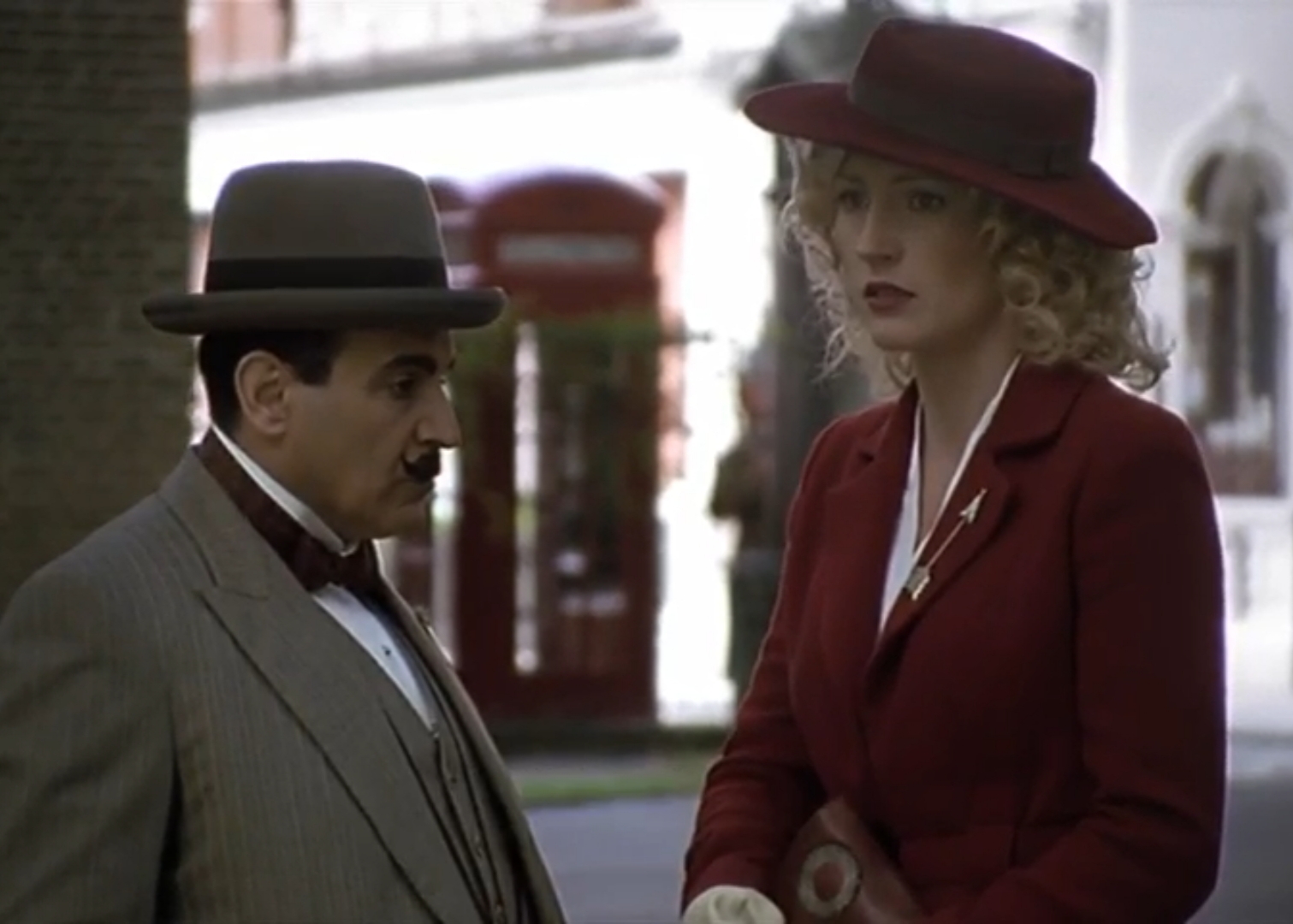
In the opening chapters of Edgware, we learn all we need to know about Jane Wilkinson, and it starts with Poirot himself. While he admires her beauty, Hastings asks if Poirot agrees that Jane is a fine actress. To which the sleuth replies, “I think it would depend on the setting, my friend. If she is the center of the play, if all revolves around her – yes, then she could play her part. I doubt if she could play a small part adequately, or even what is called a character part. The play must be written about her and for her. She appears to me of the type of women who are interested only in themselves.”
A party guest, Mrs. Widburn, calls Jane an egoist but excuses it: “An actress has got to be, though. That is, if she wants to express her personality.” Bryan Martin goes even further: “Taboos have no meaning for her. No morals, whatever . . . Just sees one thing only in life – what Jane wants. I believe she’d kill somebody quite cheerfully – and feel injured if they caught her and wanted to hang her for it.” All of this is confirmed by the actress herself when she attempts to hire Poirot: “Of course if we were only in Chicago, I could get him bumped off quite easily, but you don’t seem to run to gunman over here.”
Thus, Christie sets us up to accept how Jane could be a murderess – or, at least, a suspect in the inevitable murder of her husband. Bryan Martin even provides a pithy description of how Jane would murder Lord Edgware: “Her idea of a murder would be to drive up in a taxi, sail in under her own name, and shoot.” And that is exactly how it happens: a woman whom witnesses insist is Jane Wilkinson is seen entering and leaving her husband’s London home, after which the Baron is found murdered in his study. Case closed! Except . . . Jane Wilkinson was seen by the titular thirteen guests at a posh dinner party, thus providing herself with a perfect alibi.
When I read this novel as a teenager, it seemed clear to me that what had happened was a result of theatrical impersonation: Jane Wilkinson had hired Carlotta Adams to impersonate her at the dinner party, while the real Lady Edgware went to her husband’s home and killed him. However, Christie works very hard to try and convince us that the places were switched, that while Jane was out to dinner, it was Carlotta who drove to Lord Edgware’s place. Why on earth would she do that? Poirot supplies an answer early on when he refuses to provide Hastings with as in-depth an analysis of Carlotta’s character as he did for Jane; instead, he only says, “She is shrewd, and that makes for success. Though there is still one avenue of danger – since it is of danger we are talking . . . Love of money might lead such a one from the prudent and cautious path.”
For most of the book, the police and, more seriously, Poirot himself, proceed on the theory that it was Carlotta whom everyone saw at Lord Edgware’s house. When she dies, the police believe that she has committed suicide due to her shock and guilt at having been party to a murder. Her belief might have been that she was being hired to pull a joke on Lord Edgware, not to abet his death.
To tell you the truth, this theory annoyed me from the first time I read the book till today! Why wasn’t anyone considering it the other way around – the way that made more sense?!? When Donald Ross is killed, I’ll admit that I was too young (and ignorant of the story of The Iliad) to understand the clue he left behind about “the judgement of Paris” – but it is a lovely clue that finally spins Poirot in the right direction. Still, the common sense of this adolescent, which seemed to match the native intelligence of our actress/murderer, managed to beat Hercule Poirot to the punch!
As we shall discover, Christie let the actor be the killer many times. And yet, as she herself said, she must have liked actors a whole lot because none of them are particularly evil. Bryan Martin makes the distinction of Jane being “amoral” rather than “immoral.” Even those most charmed by her concede that Jane would do anything to get what she wants. Christie ends the novel with a letter written by Jane to Poirot. It is a literary delight in the way it embodies the woman’s character even as she confesses to murder and faces her impending execution. Her idea to use Carlotta as a tool for killing her husband was impetuous and inspired – like a suggestion for an improvisation. She expresses annoyance at Carlotta for breaking a promise and spilling the beans to her sister. (Perhaps Carlotta would express annoyance at Jane killing her – if she only could!) She is particularly piqued at the “Judgment of Paris” comment that tripped her up because Paris is “a silly name for a man, anyway.” And she’s thrilled by her appearance on the dock, looking “paler and thinner, but it suits me somehow.” Her letter ends with the perfect P.S.: “Do you think they will put me in Madame Tussaud’s?”
That is our first actor-murderer under consideration: an amoral egoist whose impetuosity and native intelligence nearly gets the better of Poirot. She remained indelibly etched in Poirot’s memory. Twenty years later, he would be involved in a murder case where one of the suspects was an aspiring actress very similar in nature, if not in success, to Jane Wilkinson. When he receives information from Mr. Goby in Chapter 12 of After the Funeral, Poirot reveals exactly what he thought of Jane: “Do I not have cause toknow it? Never shall I forget the killing of Lord Edgware. I was nearly defeated – yes, I, air Hercule Poirot – by the extremely simple cunning of a vacant brain. The very simple-minded have often the genius to commit an uncomplicated crime and then leave it alone.” Maybe I solved this case because, at fifteen years of age, I possessed a similarly simple mind!
Next we will consider a woman who appears in the very next Poirot novel after Lord Edgware Dies and is the antithesis of Jane Wilkinson in every way.

Murder on the Orient Express (a.k.a. Murder in the Calais Coach) (1934)
“’There remains Mrs. Hubbard. Now Mrs. Hubbard, let me say, played the most important part in the drama. By occupying the compartment communicating with that of Ratchett, she was more open to suspicion than anyone else. In the nature of things she could not have an alibi to fall back upon. To play the part she played – the perfectly natural, slightly ridiculous American fond mother – an artist was needed. But there was an artist connected with the Armstrong family – Mrs. Armstrong’s mother – Linda Arden, the actress . . .’
“He stopped. Then, in a soft rich dreamy voice, quite unlike the one she had used all the journey, Mrs. Hubbard said: ‘I always fancied myself in comedy parts.’”
From the moment he arranges with his old friend, M. Bouc, to board the Orient Express on his journey back to England, Hercule Poirot senses that something is off. It is winter, the off-season, and yet the Calais carriage is full. The passenger list represents a rainbow of nationalities and classes, from servitude to royalty. The murder of Mr. Ratchett, with its dozen stab wounds of varying strengths, its plethora of physical clues strewn about the cabin, and its absence of not one, but two mysterious strangers – the small womanish man in a Wagon-Lits uniform and the woman in the scarlet kimono – might strike Poirot as it strikes the reader: not real life at all, but something out of a Golden Age mystery novel!
This was my second Christie experience and, in fact, my second Golden Age mystery novel, after And Then There Were None. I read it when I was twelve. At the climax, Poirot gathers all the suspects together, reviews the facts and concludes: “I said to myself, ‘This is extraordinary – they cannot all be in it!’ And then, Messieurs, I saw the light. They were all in it.” I distinctly remember tossing the book in the air with a gasp. I never imagined a mystery could end this way!
What is so extraordinary is that here we have a conspiracy among thirteen people that, after months of planning, requires them to essentially stage a play and perform it for a week. This is not a company of actors used to playing roles: we’re talking about a nurse, a secretary, a valet, a soldier, a chauffeur, a princess! They are connected by blood, by loyalty, by love, and they must pretend to be strangers. At the last minute they discover that they must do this in front of the most brilliant detective in their universe, who now resides in the same small train car that they do. Poirot’s presence forces them to abandon long-developed aspects of their plan and improvise others.
In order for their plan to have a chance of success, they need – a director. Having been a stage director myself for nearly fifty years, I know the multiple departments working side by side to create a performance and the responsibility that lays on the director’s shoulders to provide solutions for any problems that arise. Fortunately for the Armstrong group, an appropriate director exists: Linda Arden, a lifetime veteran of the New York stage. She is the consummate professional theatre person, insisting on rehearsal of each step in their plan. She is a brilliant actress as well: at our first sight of her playing her role of “Mrs. Hubbard,” she is described like so: “. . . a stout, pleasant-faced, elderly woman, who was talking in a slow clear monitoring, which showed no signs of pausing for breath or coming to a stop.” In addition to putting herself, as Poirot says, in the most precarious position during the murder, she has also given herself the most lines and the comic relief part!
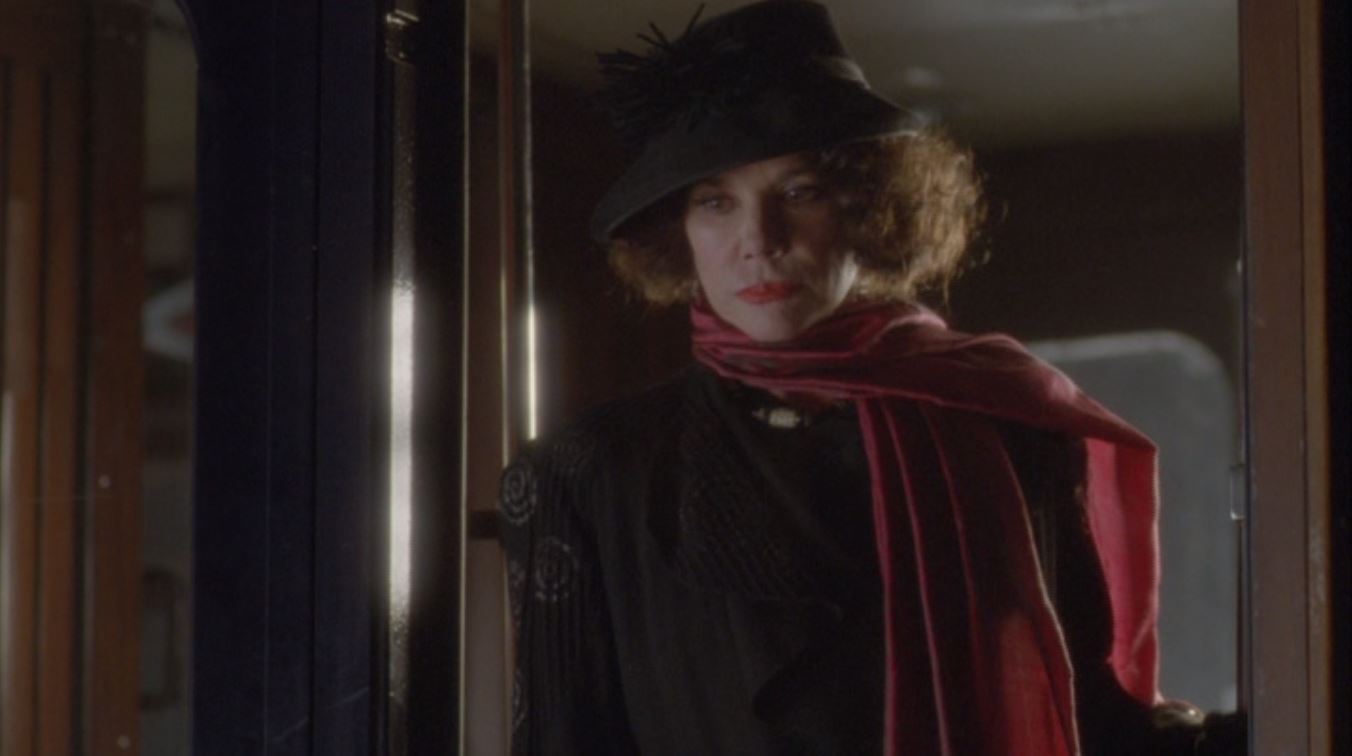
This is not an act of ego, however, for Linda Arden may be the most selfless actor in the canon. She is protective of everyone in the group to the point of self-sacrifice. “You know everything now, M. Poirot. What are you going to do about it? If it must all come out, can’t you lay the blame upon me and me only? I would’ve stabbed that man twelve times willingly. There have been other children before Daisy – there might be others in the future. Society had condemned him; we were only carrying out the sentence. But it’s unnecessary to bring all these others into it. All these good faithful souls . . .”
The inherent theatricality of the killers’ plan has made Murder on the Orient Express an easy novel to adapt. The 1974 film, directed by Sidney Lumet, is a sumptuous feast for the eyes and maybe my favorite version, but it makes a couple of mistakes. One is the glamorizing of Lauren Bacall in the role of Mrs. Hubbard. Throughout the film, she looks every inch the Broadway star. In the end, the group of conspirators looks too polished, too satisfied with the success of their plan. Their murder is performed as a solemn ritual. After they are unmasked and set free, the music swells as thirteen movie stars clink their champagne glasses and smile at each other. It all misses the point of the book’s climactic moments, by being too theatrical!
The version shown on the series Agatha Christie’s Poirot in 2001 misses the point of the book entirely, preferring to allow star David Suchet to wallow in character introspection. The actor makes the decision that his character’s Catholicism is too strong to allow him any moral leeway in his search for justice. This requires the characters, all of them sympathetic in the book, to resort to threats of violence against Poirot and his friends. As a result, a satisfactory denouement is impossible.

I will go out on a limb here and announce that, whatever its other problems, I enjoy the final act in Kenneth Branagh’s 2017 film best of all. We have seen the crime played out in flashback as a horrifying moment where a dozen people who have never murdered a man are faced with the dreadful task. They gasp and fumble as they do the deed. After they are “exonerated”, the mood in the carriage is solemn, even tense, as each character must face the personal ramifications of their act.
For a fascinating contrast, I recommend the Japanese adaptation that played in two parts on television in January 2015. Part One is an essentially faithful reenactment of the 1974 screenplay, although it takes place in Japan and the Poirot character is played too much for laughs. Part Two, however, is an original story that begins with the series of tragedies in the Armstrong household and follows the conspiracy from its beginnings through the last-minute changes that are forced upon the passengers after Poirot comes on board.
I grant you, none of these endings are in the book. Linda Arden makes her plea to Poirot. He turns to M. Bouc and Dr. Constantine for their opinion. Both men concur that the sleuth’s earlier theory of a stranger entering the train, once dismissed as preposterous, is now the correct solution. Without a word of concurrence or comment, Poirot retires from the case. It’s all accomplished in half a page. Christie leaves it to our imaginations as to the rest of these people’s lives. Still, given the author’s embrace of justice, I think she would prefer the quiet introspection of these characters over a jovial celebration or an outbreak of gangster behavior.
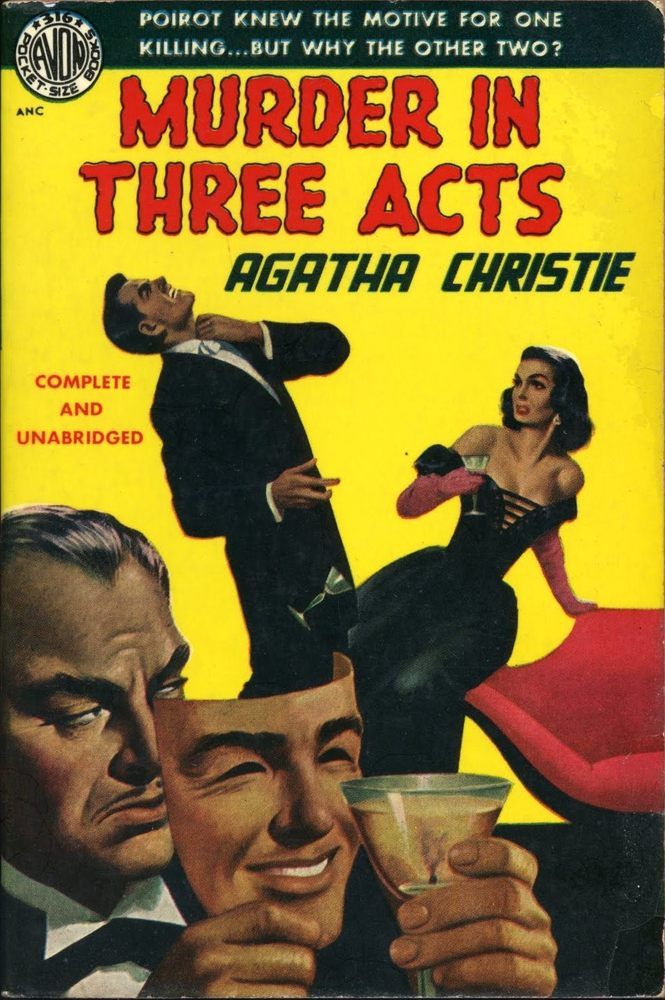
Three Act Tragedy (a.k.a. Murder in Three Acts) (1935)
“Idea for book: Murder utterly motiveless because dead man and murderer unacquainted. Reason – a rehearsal.” (Agatha Christie, “Ideas for 1931,” found in Notebook 41)
From its title to its themes, its characters to its solution, Three Act Tragedy is Christie’s most playfully theatrical of her books. Before the text even begins, the author inserts a page that is both highly amusing and deeply clever:
Directed by Sir Charles Cartwright
Assistant Directors – Mr. Satterthwaite, Miss Hermione Lytton Gore
Clothes by Ambrosine Ltd
Illumination by Hercule Poirot
A reader in love with both Agatha Christie and the theatre will have a field day with this – after they have read the book. Sir Charles Cartwright is given the top billing, a fitting place for a star of his magnitude, and Mr. Satterthwaite and Hermione Lytton Gore (hereafter referred to as “Egg”) are listed as his assistants. Since most of the book is taken up with Charles, Egg and Satterthwaite investigating the murders of the Reverend Babbington and Sir Bartholomew Strange, most readers will equate the word “directed” with “detecting.”
However, if one uses a theatrical event as a metaphor for a murder, the director – the one in charge of everything – has to be the murderer. The detective represents the audience, interpreting the information they observe until they’ve figured out the meaning of this “play” – the solution to the murder. “Clothes by Ambrosine Ltd” is a stroke of wit, encouraging us not to find too much meaning in this list beyond a clever joke. And “Illumination by Hercule Poirot” is a charming double entendre: all plays have a lighting designer, and all detective stories have an illuminator who sweeps our minds of darkness by the end.
Dr. John Curran, who makes it possible for Christie scholars like me to quote from her notebooks, notes that “Three Act Tragedy has ideas in common with Lord Edgware Dies from two years earlier. Both are set firmly among the glittering classes; both feature a murderous member of the acting profession involved in a deadly masquerade; both featuring a clothes designer and an observant playwright among the suspects; and both feature Hercule Poirot.” I’ll add a couple more qualities both books share. The murderer is part of that rare breed of killers who directly invite Poirot into their scheme: Jane Wilkinson hires Poirot to convince her husband to divorce her, knowing full well that a divorce will not satisfy her piously Catholic new fiancé, and Sir Charles invites the detective to a party as a witness – although Poirot has a one in twelve chance of becoming the killer’s first victim!!! Both murderers conceive their plans for the purpose of freeing themselves to marry someone they love. And yet, there are few killers who are more morally unscrupulous than these two; neither one of them could care less how many people they must kill to get what they want.
That’s actors for you!
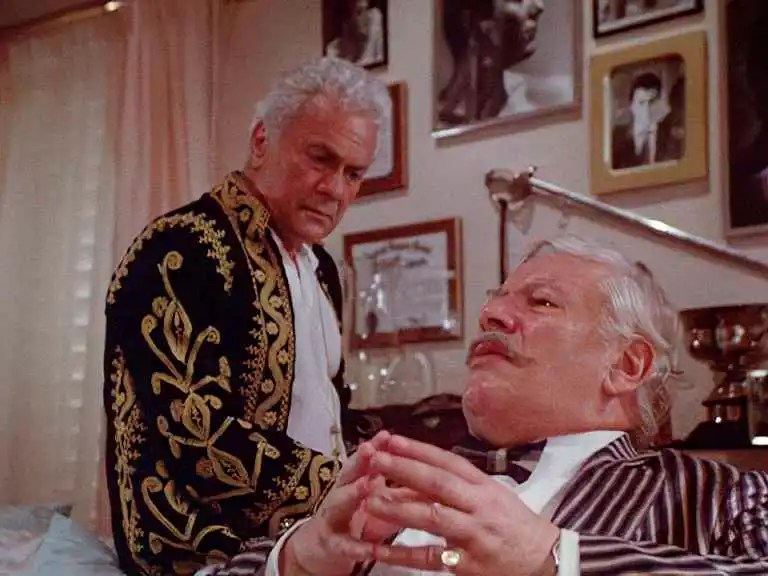
One other rather brilliant aspect of both Jane and Sir Charles is that Christie flaunts the qualities that would make each of them a great killer in our faces and challenges us to interpret them in the proper manner. I will admit that, proud as I am that Christie could not sway me from naming Jane Wilkinson as the killer, she had me completely fooled when I first read Three Act Tragedy! This probably has a lot to do with Sir Charles’ placement in the novel as the amateur sleuth, along with the sense of bonhomie Christie establishes between our central sleuthing trio. But then – in how many of her books does Christie pick her murderer out of such a sleuthing group? Think about the titles from between 1929 and 1939 alone, and you’ll realize that this is one of the author’s favorite tropes.
Sir Charles Cartwright’s scheme relies on his skills as an actor, abilities he has attained through a long, successful career. The moment he is introduced, Christie flaunts his capacity to assume any role he pleases:
“Nine people out of ten would say, ‘Retired Naval man – can’t mistake the type.’ The tenth, and more discerning, would have hesitated, puzzled by something indefinable that did not ring true. And then, perhaps a picture would rise, unsought: the deck of a ship – but not a real ship – a ship curtailed by hanging curtains of thick rich material – a man, Charles Cartwright, standing on that deck, light that was not sunlight streaming down on him, the hands half clenched, the easy gait, and a voice – the easy, pleasant voice of an English sailor and gentlemen, a great deal, magnified in tone . . . And swish fell theheavy curtains, up sprang the lights . . . The first act of The Call of the Sea, with Charles Cartwright as Commander Vanstone, was over.”
One page later, Christie doubles down on Sir Charles’ capacity for artifice and impersonation. Mr. Satterthwaite sits on the actor’s terrace, talking about him with Bartholomew Strange, Charles’ oldest and dearest friend, and the Doctor says – fondly, mind you, for he has no idea he will be dead at Charles’ hand in a matter of weeks:
“I’ve known Charles since he was a boy. We were at Oxford together. He’s always the same – a better actor in private life than on the stage! Charles is always acting. He can’t help it – it’s second nature to him. Charles doesn’t go out of a room – he makes an exit – and he usually has to have a good line to make it on.”
Moments like this pervade the text – really, this book is as much fun to re-read as Roger Ackroyd! – after Reverend Babbington is murdered, Sir Charles announces that he’s selling his seaside estate, prompting a cry of shock from Mr. Satterthwaite and “a kind of melancholy pleasure at the effect he had produced showed for a minute on Charles Cartwright’s face.” Christie then describes, albeit for comic effect, how deliberately Charles uses speech to sway people: “’It’s the Only Thing To Do,’ he said, obviously speaking in capital letters. I shall sell this place. What it has meant to me no one will ever know. His voice dropped, lingeringly . . . effectively.” There’s also a delightful running bit where Satterthwaite observes Charles in detecting mode and is reminded of a role the actor played with great acclaim on the stage: “An elusive resemblance teased Mr. Satterthwaite – then he got it. Aristide Duval, the head of the Secret Service, unraveling the tangled plot of Underground Wires. In another minute he was sure. Sir Charles was limping unconsciously as he walked. Aristide Duval had been known as The Man With a Limp.” Indeed, at various moments, Sir Charles dives so deeply into character that he actually limps!
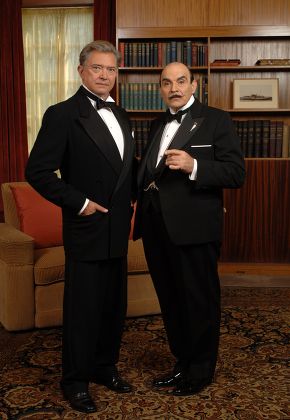
One can only expect so dramatic a character as Sir Charles Cartwright to imbue his murder plot with a deep sense of theatricality. The murder of Reverend Babbington is committed for one of the most singular motives in the canon: as a dress rehearsal for the crime against Charles’ main victim, Dr. Strange. This is such a technical motive, so coldly lacking in any sense of humanity, that Charles’ actions must strike the reader as insane. In the British version of this novel, however, the murderer is clear-headed. He needs to kill his childhood friend because Bartholomew Strange alone possesses the knowledge of Charles’ mad wife locked in an asylum, the only impediment to his marrying Egg. In the U.S. edition, the motive is changed, but not because we Americans can’t swallow Charles’ cold-blooded attitude toward life. No, we have different divorce laws!
Strange’s murder involves a favorite trope of Christie’s that we’ll be tackling at great length in the next chapter: the adoption of a disguise. At least in this case, the trope is used brilliantly and rewards the mystery fan on several levels. First, it highlights Christie’s depiction of actors as egocentric – Sir Charles has enormous confidence in his power to pull the wool over the eyes of a roomful of people who are his good friends, even his incipient lover, in the intimate setting of serving them dinner. That murder, described only in retrospect, has all the earmarks of a crime scene in a London stage play. It is made even more special through Christie delightfully embracing two of the most foundational tropes in classic detective fiction: first, fulfilling the cliché that “the butler did it,” and second, utilizing the Chestertonian concept that people do not notice the help.
Two final points: in the last section, Sir Charles conspires with Poirot to stage a little play by faking his own death in order to allow Poirot to observe the reactions of the other “suspects”. It is an act of extreme cleverness on Poirot’s part, for he is looking for reactions from a specific character, the playwright Muriel Wills. And isn’t it the height of theatricality that it is Miss Wills who brings down the great actor/murderer? Like Agatha Christie, her creator, Miss Wills as a writer is possessed of great powers of observation and sees through the disguise he wore on the fateful night that Strange was killed. As Poirot explains:
“I was fairly sure that Miss Wills had certain suspicions. When Sir Charles did his death scene, I watched Miss Wills’ face. I saw the look of astonishment that showed on it. I knew then that Miss Wills definitely suspected Sir Charles of being the murderer. When he appeared to die poisoned like the other two, she thought her deductions must be wrong.”
“Problem at Sea” (a.k.a. “Poirot and the Crime in Cabin 66”) (1936)
“Colonel Clapperton . . . came in and sat down next to General Forbes. He looked like a man bewildered by sorrow – not at all like a man conscious of great relief. Either he was a very good actor, or else he had been genuinely fond of his disagreeable wife.”
I wanted to mention this singular story because of the way theatricality plays a part not only in the murderer’s plan but in Hercule Poirot’s exposure of the culprit. The tale first appeared in The Strand Magazine in February 1936 and was published in the 1939 American collection, The Regatta Mystery and Other Stories; it was not collected in the U.K. until 1974 as part of Poirot’s Early Cases. Based on the timing of the tale, there is every reason to believe that Poirot solved this earlier murder as a sort of hors d’oeurvres before he boarded the steamship Karnak in Egypt. Our poor sleuth is suffering from the mal de mer at the start of this ocean voyage, so it’s clear he should stick to river cruising!
There are three theatrical elements to take into consideration here. First is Colonel John Clapperton, our actor-murderer, upon whom Christie piles on tons of suspicion until we are stopped dead by his perfect alibi for the murder of his wife. Everyone loves the handsome Colonel, particularly the ladies – everyone, that is, except General Forbes, who pooh-poohs Clapperton’s military record to anyone who will listen: “Guards? Guards? Pack of nonsense. Fellow was on the music hall stage! Fact! Joined up and was out in France counting tins of plum and apple. Huns dropped a stray bomband he went home with a flesh wound in the arm. Somehow or other got into Lady Carrington’s hospital . . . Fellow played the wounded hero. Lady Carrington had no sense and oceans of money. She’d been a widow only six months. This fellow snaps her up in no time.”
For the first half of the story, we watch Adeline Clapperton behave like a tiresome shrew and the Colonel wax attentive and loving to her every need. His devotion is unbelievable – it must be an act, and he seems to have the training and talent to pull such an act off. But then Mrs. Clapperton is murdered in her cabin, after her husband has gone ashore with several young cuties. Everyone, even Hercule Poirot, witnessed him talking through the cabin door to his wife before setting off.
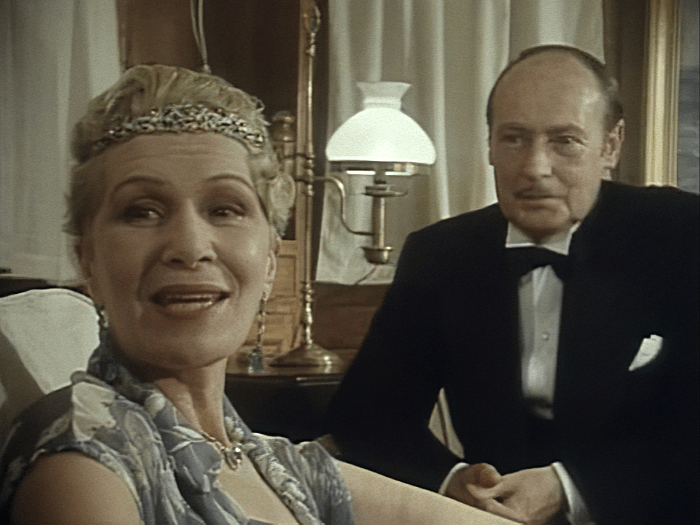
This is not the first or last time that a killer has used the ventriloquism to give the illusion that the corpse behind the door is having a conversation with them. In a moment of unfair play, Christie doesn’t mention this as one of Clapperton’s talents; she asks us to accept Poirot’s supposition that, as a music hall performer, the man was likely to be able to throw his voice. Since he doesn’t have any actual proof, however, Poirot must lay a trap to test his theory and hopefully catch a killer.
And here is where the story embraces theatricality almost to the point of lunacy. Poirot gathers all the passengers together in the main lounge to reveal a secret witness to the crime. He then whisks away a cloth to reveal – a ventriloquist’s dummy! And then, to top that off, Poirot goes into his act: first he assumes a British voice as the dummy’s interrogator (which feels almost as ludicrous as Miss Marple throwing her voice in the perfectly duplicated guise of a murdered woman at the end of A Murder Is Announced), and then he manipulates the dummy as a stewardess behind the screen impersonates the late Mrs. Clapperton.
The response is stunning: Colonel Clapperton rises with a cry, grabs his heart, and drops dead!!! Poirot had previously come upon a torn prescription for digitalin, deduced that it was a medicine for the Colonel rather than his hypochondriacal wife, and then staged this “act” in order to both expose Clapperton’s guilt and hopefully dispense justice in a more merciful way. After the way Poirot has decided the fates of the killers in both Murder on the Orient Express and Three-Act Tragedy, a reader should be cued in on the detective’s unorthodox representation of the law.
In the third and final part of our discussion about actors, we will discuss the final – and, in some ways, most singular actor-murderer of them all. I will also provide an index of actors in Christie that I hope you will help me complete.
 Ah Sweet Mystery!
Good heavens! I never noticed EITHER that she had four actor murderers in four years!
We’re rewatching all the Agatha adaptations in chronological order by intellectual property. I’m really looking forward to watching these three novels again.
And number four? I can’t think which one that is!
LikeLiked by 2 people
Yes, Teresa, I’m as certain that you have no clue as I am that my drag name is Margot Bence! But you’ll found out everything in ten days!!!
LikeLiked by 1 person
Ha! 😉
LikeLike