Let’s talk about the public domain. Because, frankly, I’m confused.
“Every year when the clock strikes midnight on January 1, while most people are singing Auld Lang Syne and partying with their loved ones, copyright lawyers and librarians celebrate a different occasion: the annual expansion of the public domain, AKA Public Domain Day. All copyrights expire on December 31, and this year, works that were published in 1929 or earlier (other than sound recordings, which follow their own rules on duration . . .) are now in the public domain. This includes novels like A Farewell to Arms by Ernest Hemingway, movies like The Coconauts by the Marx Brothers, and musical compositions like ‘Ain’t Misbehavin’. Hurray!”
These are the words of Stephen Wolfson, Assistant General Consul and Copyright Advisor at Penn State University. This was published on the Penn State Libraries website last March; as of this year, all works published in 1930 or earlier are now in the public demain. Wolfson himself, however, goes on to say the situation is complicated. If you wrote anything before 1978 – a novel, a story, a screenplay, a poem – and applied for and were granted a copyright for it – then your work is protected for 95 years after publication, after which it passes into the public domain. But works created on or after January 1,1978 are subject to a newer law – The Copyright Act of 1976 – which protects creative works, whether they have been published or not, for 70 years after an author dies.
Recently, I’ve been wondering how this idea of public domain extends to the characters that authors created – specifically famous detectives like Sherlock Holmes, Hercule Poirot and Miss Marple. My interest was raised by the appearance on my Spotify interest list of a group called Warm Pages, which seems to be AI-generating complete Miss Marple novels and Poirot novellas nearly every day! They have abominable titles like The Case of the Cursed Cookbook and Lady Bantry’s Secret Door Behind the Bookcase. These are horrific cozy travesties, completely un-Christie like in skill or style. I keep asking myself what right this company has to perpetrate this literary crime!
But let’s stick to Holmes, who has fared much better in this regard than Miss Marple seems to be doing. It was only in January of 2023 that the character of Sherlock Holmes became free and clear, and this was because the final story collection, The Casebook of Sherlock Holmes, had entered the public domain. But what exactly does this mean? Over the past 130 years, a massive industry has sprung up of Sherlock Holmes pastiches and parodies written to honor, joke at, explain and extend the life and career of the world’s most famous detective. This began in 1893, after Doyle sent Holmes and Professor Moriarty over the Reichenbach Falls and called it quits on his greatest creation. Author and playwright J.M. Barrie, of Peter Pan fame, wrote a skit called “The Late Sherlock Holmes” that spoofed the detective’s dramatic (and, it turns out, temporary) exit. As the years went on, these new adventures exploded onto the scene, appearing in many countries and presenting stories in all seriousness and stories that made us laugh.
And then there’s the theatre and the movies! In 1900, the first film to feature the character was Sherlock Holmes Baffled. It was silent and very short! I can’t tell you how many films and television shows have been shown that feature Holmes, but they number in the hundreds. In 1916, William Gillette starred in Sherlock Holmes, a film adapted from Gillette’s own play. This was actually based on a drama about the early years of Holmes and Watson that Doyle himself attempted to write in order to make some money. According to the internet, Sherlock Holmes has appeared in well over 25,000 stage productions!!!
I assumed that, prior to 2023, every original story we’ve read or film we’ve seen that included the character of Sherlock Holmes must have received some sort of approval from Doyle’s estate However, I have it on good authority that this isn’t true! My pal Nick Cardillo has been writing and publishing original Holmes stories for about a decade and assures me that neither he nor his publishers have had to gain permission to do so.
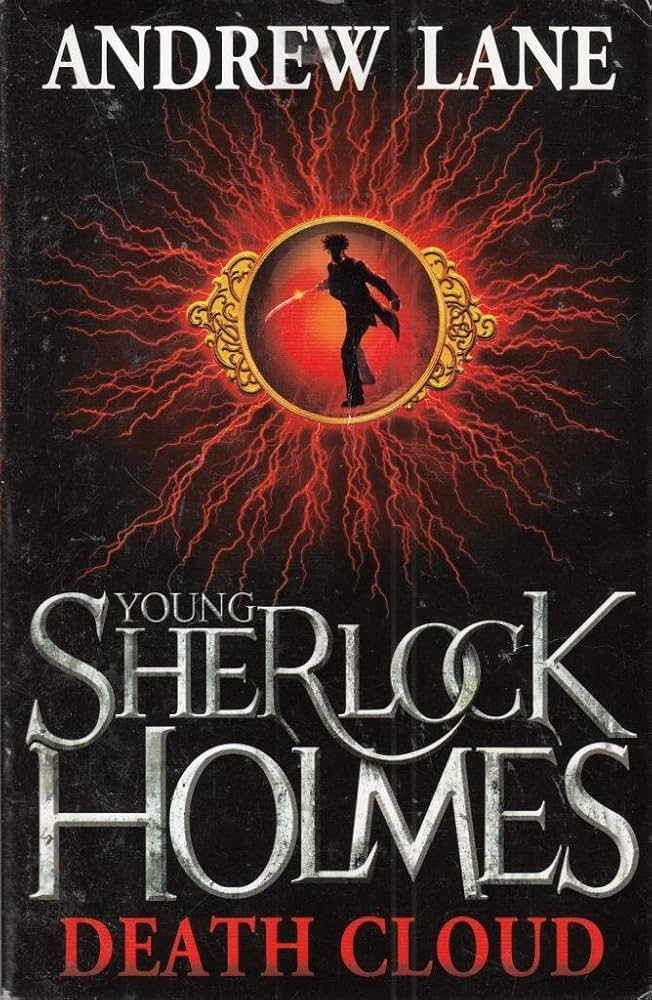
One author who did get approval from Doyle’s estate was British journalist and author Andrew Lane who, between 2010 and 2015, wrote a series of eight novels chronicling the exploits of young Sherlock Holmes. (The whole idea was prompted by the success of a similar series about young James Bond written by Charlie Higson.) The series begins with a teenaged Sherlock, now orphaned and sent to live with his aunt and uncle in Hampshire where he has to solve a bizarre mystery. The accent throughout the series is on adventure, with young Holmes traveling to Russia, China and Ireland, exposing massive conspiracies, rescuing his brother Mycroft from a murder charge, and so on. There’s nothing wrong with that – Doyle’s Holmes stories are adventures rather than puzzle mysteries, and from what I can tell (I haven’t read any of these), Lane steeps his tales in the Holmes canon wherever possible.
In early March, Amazon Prime dropped a new series called Young Sherlock. Creator Matthew Parkhill was inspired both Doyle’s original canon and by Lane’s books, but the story seems to be wholly original. This young Holmes has both a father and a mother, as well brother Mycroft – and a sister!! Her name is Beatrice, and she tragically drowns when Holmes is six years old. Whether or not this background story is different from Lane’s, the motivation is the same: to more deeply explain this complex character that is Sherlock Holmes. And to aid in the sense of action and adventure that Parkhill clearly wants, he has partnered with none other than Guy Ritchie, the director of two stinky Holmes films from fifteen years ago that starred Robert Downey, Jr.. I am no fan of Ritchie’s work, but he clearly loves the characters he’s playing with, and his direction propels this Victorian story forward with a distinctly modern editing style.
The Young Sherlock we meet here has been aged up to probably twenty, and he is still haunted by the disappearance and death of his younger sister, for which he feels partly responsible, since he rejected her plea that he play with her on that fateful day. That moment has shattered the Holmes family: mother Cordelia has been shuttled off to an insane asylum, father Silas is mostly away on business, and brother Mycroft is trying hard to find a respectable position within the British government, even as he looks after a very mischievous Sherlock who has a tendency to land in jail for a variety of pranks and offenses.
Finally, Mycroft whisks his brother off to Oxford – not to study but to serve. And it is here that our mystery truly begins: Sherlock Holmes, working as a scout, meets two intriguing students: Princess Gulan Shou’an, a scholar with many secrets, and a fellow from Scotland, a scholarship student named . . . James Moriarty.
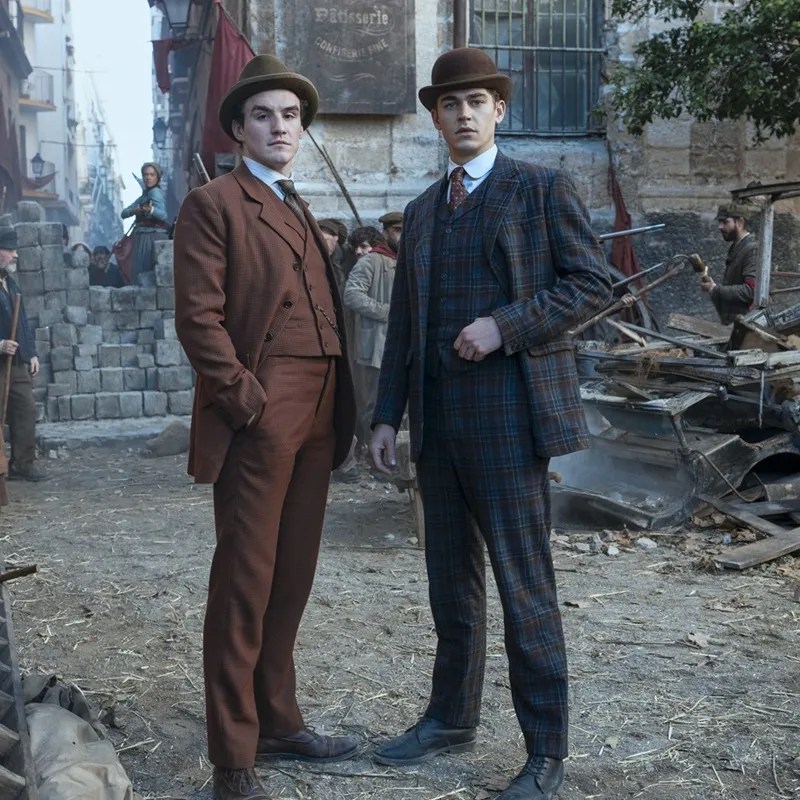
The story that ensues is full of twists and turns, some more interesting than others, but all of them expanding from a simple case of theft and murder at Oxford to expose a horrific conspiracy involving the higher levels of the British government. It’s not an entirely original plot, but it is fun, and the cast is mostly terrific. At the top of the list are a couple of scions of British acting royalty: Sherlock is played by Hero Fiennes Tiffin, the nephew of Ralph and Joseph Fiennes, and his brother Mycroft (not heavy yet, merely handsome) is Max Irons, the son of Jeremy. In a clever bit of stunt casting, Joseph Fiennes plays their father (and plays him well!), and Natascha McElhone is wonderful as their mother.
The best casting, however, is that of Moriarty: Dónal Finn is someone I only have only seen in Amazon Prime’s abandoned adaptation of Robert Jordan’s The Wheel of Time. Here, he is a charmer as James, making us laugh even as he taps hidden depths. It’s intriguing to see the faint dark hints of the person Moriarty will become take hold and blossom. Rounding out the main cast are Zine Tseng as the Princess, a role that becomes more complex with each episode, and Colin Firth as a pompous businessman. Tseng is great, and I think Firth is having a good time, even if Sir Bucephalus Hodge isn’t much of a stretch for him.
Young Sherlock doesn’t bring anything particularly insightful to the story of Sherlock Holmes, and I doubt many of the twists will surprise you, but it trades on elements of this iconic character and the Holmes canon in ways that both entertain and keep things moving forward. The series will either reward or irritate true Holmes fans, depending on how you feel. I, for one, had a good time and am happy to hear that a second season is likely to be produced.


Bill has collected and annotated hundreds of Sherlock fan fiction pieces from between 1888 through 1930; 10 volumes to date. He also annotates Agatha Christie (six volumes) and is working on the entire Dorothy Sayers Lord Peter Wimsey series. Two books, to date, for Dorothy.
Along the way, we’ve learned that copyright is VERY complicated. NOLO has a wonderful guide to copyright. Look for https://store.nolo.com/products/the-copyright-handbook
It answers most of the questions that non-legal people like us have.
It is VERY important that you understand where your books are legal and where they are not. This is why our Sherlock Holmes series, the 223B Baker Street (so called because it’s next door to 221B) is available worldwide but our Agathas and Dorothys are not.
Copyright enforcement ALSO depends on whether or not someone will enforce it. That is, if anonymous — extremely prolific — wrote a good Sherlock Holmes pastiche in 1929 for a newspaper that stopped publishing in 1965, who’s going to complain if you reprint that story?
LikeLiked by 1 person
I do want to have a look at this, despite the Ritchie factor, as Andy Lane is a good writer. Thanks Brad. Of course, here you are only discussing copyright in the US. In the UK for instance the rule of thumb is 70 years after the death of the author for literary works or the main contributors for a film (director, writer, composer). And then there’s Trademarks, a slightly different beast …
LikeLiked by 1 person
Full disclosure: Nick said I should talk to you about this! I still don’t understand how Warm Pages can use the characters of Poirot and Miss Marple in their crap!
LikeLike
They shouldn’t really be able to publish these but … in the US the appearances by Poirot and Miss Marple up to and including 1930 are considered PD. Character rights are usually treated separately, especially when trademarked, but they are relying on a certain level of confusion in the market place to get away with it. Adaptations of those soecific works would be considered acceptable but … well there you are. Long stories abound …
LikeLiked by 1 person