- “’We are in a nucleus here, and I just get the feeling something is colliding. We’ve got a dead body in Byron, two hours’ drive from here, a police raid a year ago that resulted in another dead body, a missing banker, a vault that can’t be opened, a bank robber who doesn’t seem to care about money, and a guard who doesn’t care about protecting it, plus a priest who can’t talk and a bird that won’t shut up.’ I took a deep breath. Juliette looked momentarily buried under the avalanche of words . . .
- “’Did you say a talking bird?’
- “’Is that what you got from all that?’
- “She wrinkled her nose. ‘It is the coolest bit’.”
Truth to tell, I don’t read a lot of modern mysteries. Most are either too cozy or too gross, and while I appreciate good characterization more than the next mystery reader, I also crave a good puzzle and some adherence to the classic rules (or very clever breakage of same!). On that score, frankly, most of today’s mystery writers don’t deliver the goods.
Still, there are a few authors whom I look forward to seeing in print. Chief among these is Anthony Horowitz, (I am waiting excitedly for the next Hawthorne to land on my doorstep), Janice Hallett (ditto The Silent Appeal, her upcoming sequel to my favorite novel of hers), and Benjamin Stevenson, author of the series Everyone in (Insert Group or Place here) Is/Has (Insert Criminous Verb or Noun Here) that features middle-aged nebbish Ernest Cunningham, who stumbles into real life murders wherever he goes and solves them (eventually) by employing every trope he ever learned reading classic detective stories: “I’m an expert in crime novels. Specifically detective ones. I follow the tropes. You’d be surprised how much of the genre actually applies to real life.”
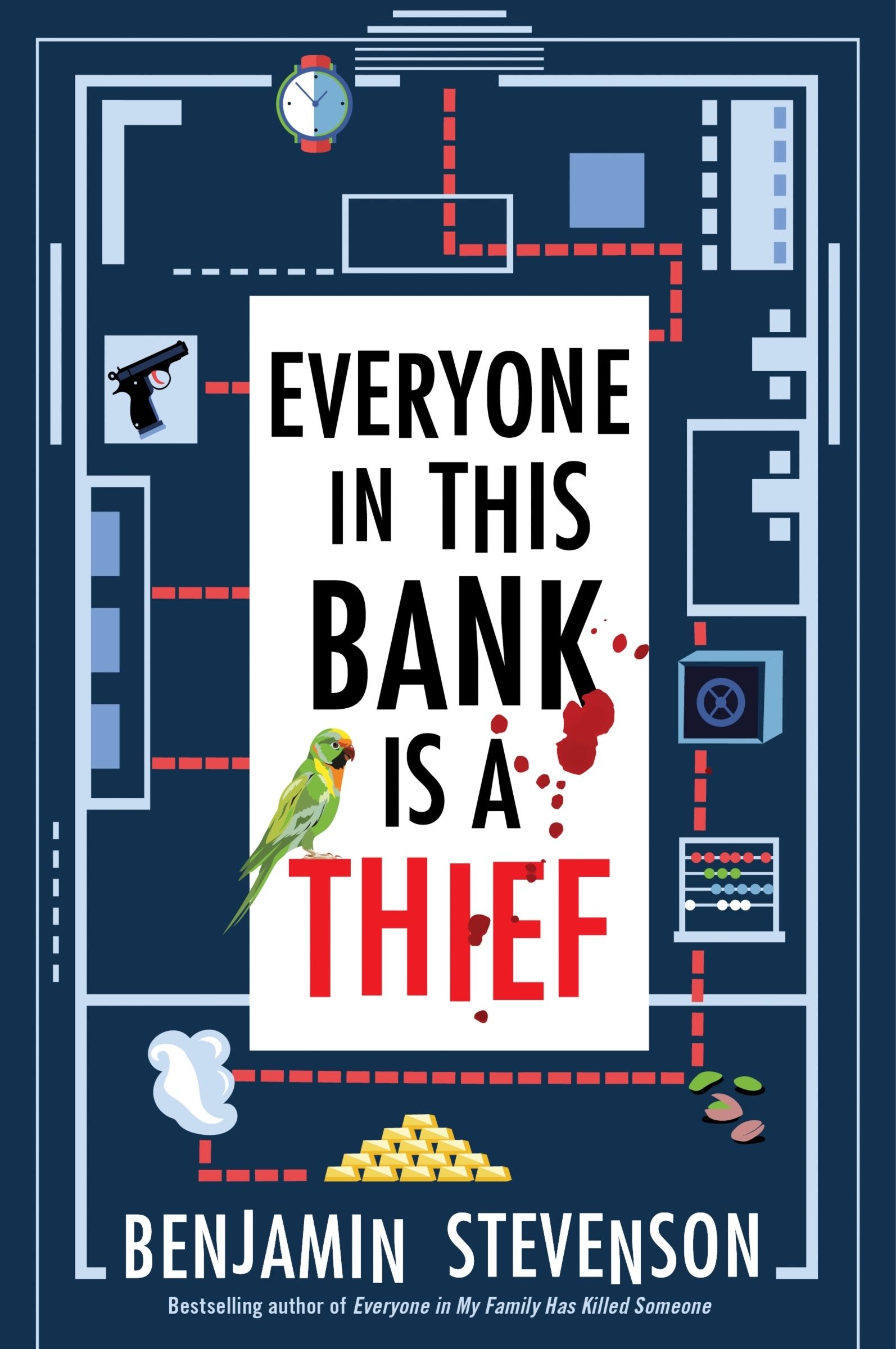
Now I don’t believe this philosophy for a second. Most of us read mysteries to escape the mundane grunt work it takes to actually solve a crime. Murder victims rarely mumble dying messages about Dresden shepherdesses (or was it the shepherd?). Real life murderers rarely goof up over wax flowers on a green malachite table. But in Everyone in This Bank Is a Thief, the fourth case for Cunningham and his long-suffering fiancée Juliet, Ernest’s constant response to somebody’s exclamation, “How did you figure that out??” is “Just read your Golden Age crime fiction because it’s all in there.” And while all a reader is required to do when reading this stuff is to accept the rules of the author’s game, sometimes those rules will go on and on and leave you feeling exhausted.
That’s not how I felt about Ernest’s first adventure, Everyone in My Family Has Killed Someone, because who doesn’t love a good reunion of a dysfunctional clan and because the newness of Stevenson’s gimmick was like a shiny Australian dollar: our narrator/detective was determined to follow the credo of Golden Age authors of yore: “I’ve always prided myself . . . on being a reliable narrator. Everything I show is the truth, exactly how I saw it. The reader and the author solve the mystery together. There are no hidden facts or deliberate omissions. That’s how ‘fair play’ works.”
Nor did I get restless during the second case, Everyone on This Train Is a Suspect, where I feel Ernest toned down the gimmick of spotting a clue on every page, dangling it before our eyes and daring us to find the significance. Instead, Stevenson pushed our meta-fictional buttons by including a vibrant cast of writers and a terrific setting (a train hurtling across the Australian continent). There’s a third case as well, a yuletide novella (Everyone This Christmas Has a Secret) which I paid a novel-size price for and then didn’t read out of pique! (I’ll get to it by next Hanukkah.)
Solving three murder mysteries has resulted in big changes in Ernest’s life. He has achieved a modicum of fame from chronicling his successes, and he has found the love of his life in former suspect Juliette (although he nearly blew that relationship on the train!). They are now planning their wedding and arguing constantly about the cost. Meanwhile, Hollywood has come a-calling, hoping to adapt the first case into a mini-series (this is really happening, by the way!) – although the recent mysterious death of the actor playing Ernest might put a crimp in their plans! Most important, our hero has decided to open his own detective agency and put the sleuthing skills taught to him by Christie, Carr and Queen to the test. To accomplish this, however, he needs a loan.
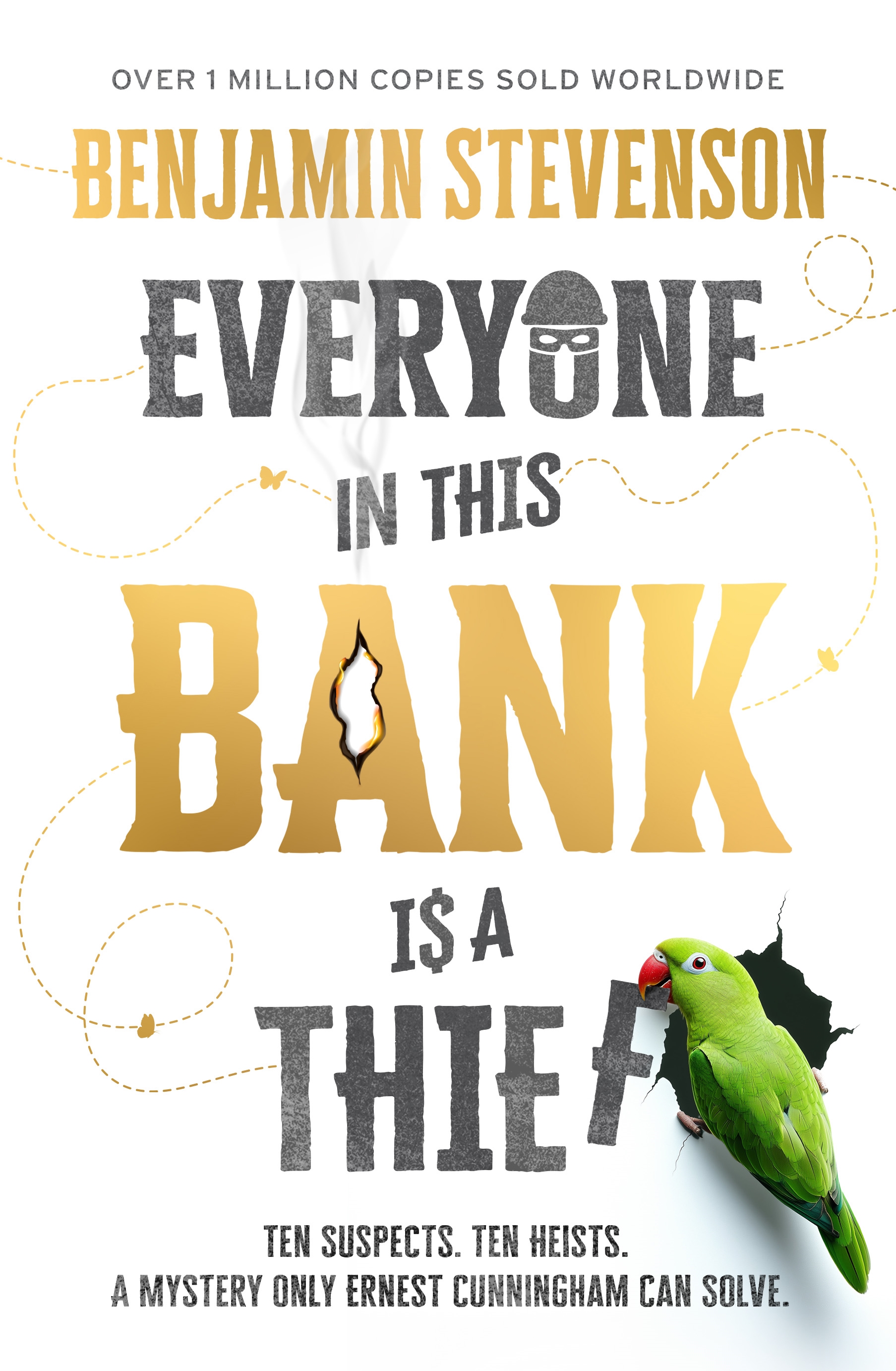
It’s gratifying to know that most of the legitimate banks of Australia have laughed Ernest out of their establishments, clearly feeling that his training to detect amounts to little more than a bit of Wimsey. But finally a bank in the remote Queensland border town of Huxley contacts Ernest and offers him a full loan – in exchange for a little detective work. It seems that the manager’s brother, the head of security, has disappeared, taking with him the newly changed code to the bank’s vault. If Ernest can find the brother and open the vault, he can have his money.
If only it were that simple. Things go quickly wrong, and Ernest and Juliette find themselves trapped in the bank with ten other people who also have various reasons for wanting money and who each seem to possess a terrible secret that must and will be uncovered by the end. When murder strikes, it is a particularly shocking and gruesome one, and it’s not the only death that will baffle our sleuth. As I may have intimated with that quote at the top, there is an awful lot going on here, and Ernest needs to solve it quickly because . . . well, I’ll leave it for you to discover the fix he’s gotten himself into this time because it’s a doozy.
It’s an extremely complicated set-up . . . but sometimes you can have too much of a good thing. The clue-pointing flies fast and furious on nearly every page and with so many people engaged in so many nefarious activities, Stevenson has a mountain to climb – or, at least, four stories of bank wall – in order to put it all satisfactorily together. And when the solution finally comes? Well, yes, it all comes together and it is clever – too clever, perhaps. Some of the more sensational aspects of the events here are explained by science that even Stevenson, in his Afterword, admits is “theoreticallypossible.” And while the horrible things that these characters do are interesting, the characters themselves are not particularly so. I actually managed to identify the principal miscreant without recognizing the significance of twenty or so clues (and I have a hard time believing that Ernest possesses all the knowledge of bizarre facts it took to find the significance, no matter how many GAD mysteries he has read.)
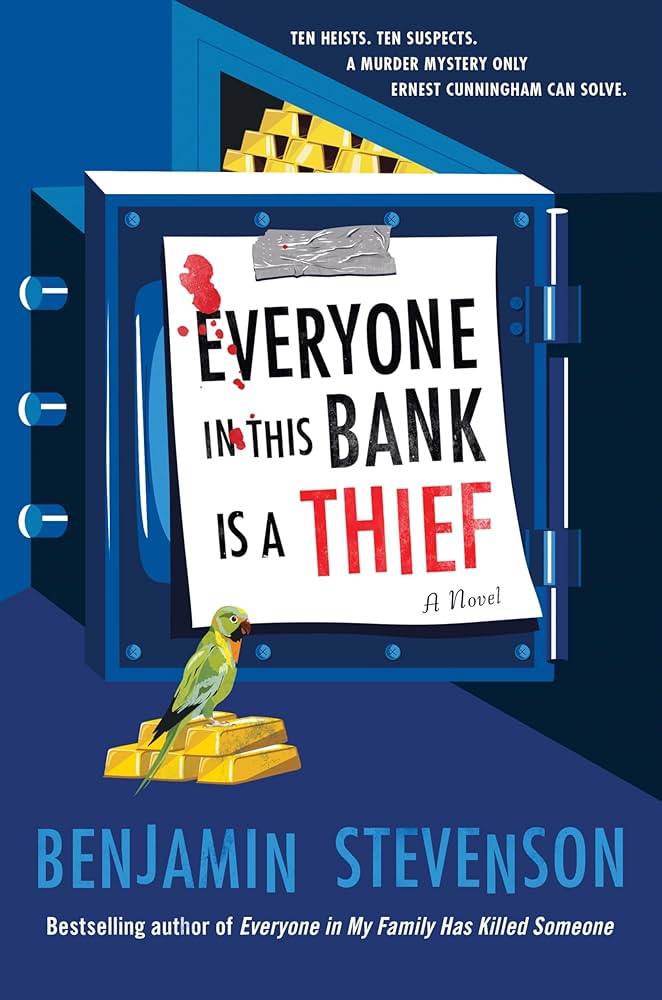
I still think that Stevenson is a clever and witty writer, and there are lovely touches throughout. The town of Huxley is under siege from a species of ugly butterfly that is described as “a moth with a good agent;” one of the characters sprouts a bushy hairstyle that contains “a widower’s peak with mistresses.” And Ernest himself is an endearing character, a flawed Everyman whom you can’t help rooting for. But my favorite person of all here is Juliette, who deserves the appellation of a saint after all her fiancé puts her through. I quote here The Big Speech that Juliette makes to Ernest that proves she’s a keeper and that he might want to reassess his crime-solving priorities:
“I know you think this is all you’re good at. But that’s not true. I didn’t agree to marry you because you solve murders. I agreed to marry you because you’re funny and kind. A little bizarre, a little clever. Because you care about people and you care about me. Life doesn’t have to follow any set of rules. Spend as much as you want on a wedding. Accept that a dead body might be unexplainable. Or . . . maybe sometimes there is an answer, but it’s not worth dying to find out what it is.”
Ernest has a habit of getting shot, maimed and otherwise sorted out while on the job. This time around, the odds are stacked even worse against his survival. Will he manage to solve the mystery and still have a breath of life in him? If so, will he get his loan and hang up a P.I. shingle in downtown Melbourne? And if that happens, will he patch things up with Juliette? All I will say is – should there be a fifth case for Ernest Cunningham, I wouldn’t be surprised if the title went something like Everyone at This Wedding Takes the Cake!

