My experience with mystery writer Patrick Quentin, the pseudonym of . . . oh, so many people, but mostly Hugh Wheeler and Rickie Webb, is sketchy. Many years ago, Avon published six catchy paperbacks comprising the first six cases for Peter and Iris Duluth, who had perhaps the most fraught marriage of any romantic sleuthing team in the genre. They meet anything-but-cute in a sanitarium, where Iris, an actress, is suffering from depression, and Peter, a producer, has committed himself to deal with his alcoholism. They fall in love and solve murders . . . at the sanitarium, during the run of one of Iris’ plays, on leave in San Francisco after Peter becomes a sailor, and on vacation in America’s divorce capital, Reno, foreshadowing the near dissolution of their marriage in Book Six!
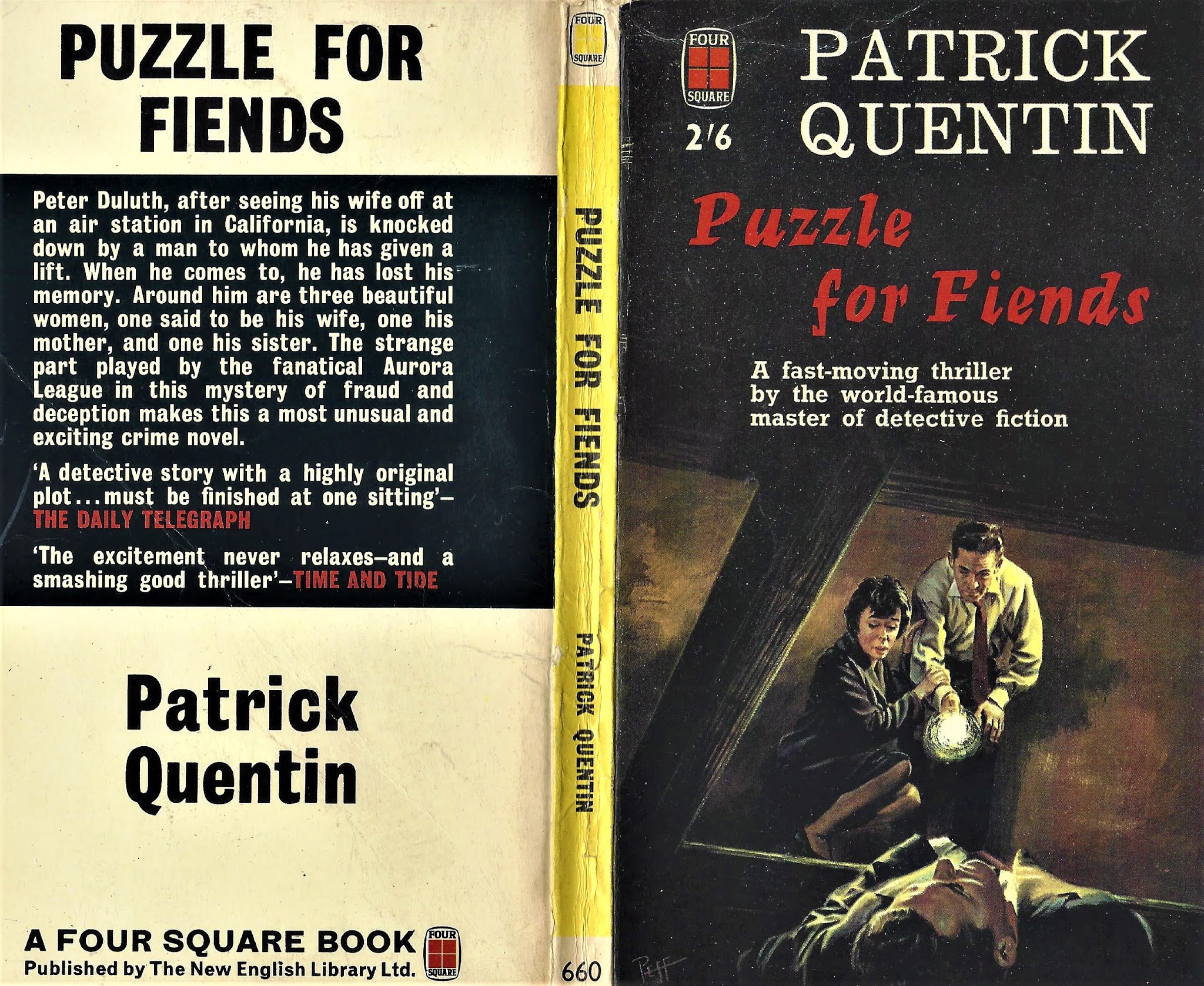
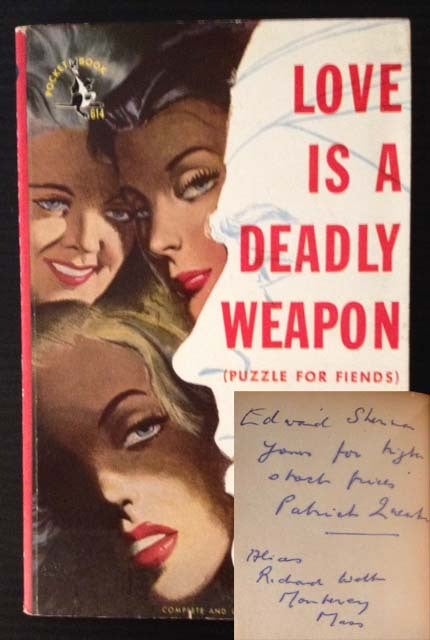
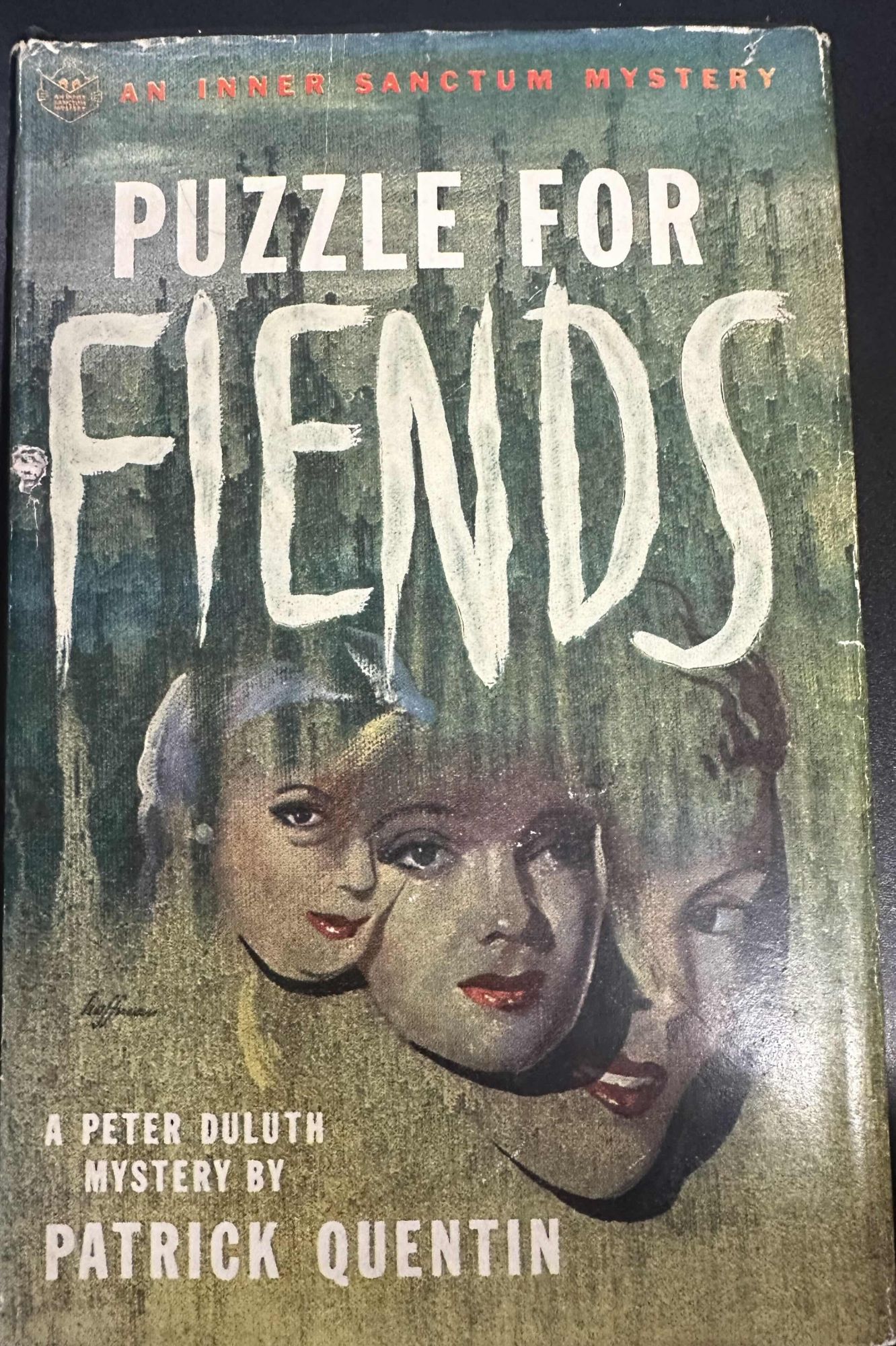
The fifth novel is something of an outlier, more of a bawdy thriller than a whodunnit, although murder and an unknown killer eventually come into play. This book also happens to have been my first brush with Quentin all those many years ago, and now it’s the title my Book Club has chosen for a collective toe dip into the author this month. 1946’s A Puzzle for Fiends (a.k.a. Love Is a Deadly Weapon or even Puzzle for Fiends, sans the “A”) gives us the briefest cameo of Iris at the beginning: she is off on a three-month junket in Japan to entertain the troops, and the timing couldn’t be worse, for Peter has just been discharged from the Navy and can’t go overseas with her. After their tearful parting, Peter hops in his car a homeward drive down the California coast. But first he makes the dubious decision to pick up a hitchhiker, “a rather unprepossessing boy with a thin, narrow face, close-set eyes and an untidy mane of black hair.” This will be Peter’s first mistake of many before we reach the end.
The man whom we know to be Peter Duluth wakes up in a strange bed in a luxurious bedroom, with casts on an arm and a leg, and no memory of how he got there – or of who he is. A buxom woman sits beside his bed, devouring a box of chocolates and insisting that he is Gordon Renton Friend III, that he has been in a terrible auto accident, and that she is his mother. Before long, he will meet a beautiful brunette who says she’s his sister, a gorgeous blonde who insists she’s his wife, and a hot young doctor who informs our hero that a bump on the head seems to have given him amnesia.
Clearly, Peter is in trouble – but the tone throughout the novel is breezy and fun, like a fractured fairy tale, an inverted version of “Goldilocks and the Three Bears” with a lot of sexual tension thrown in. Mrs. Friend is Mama Bear, kid sister Marny is Baby Bear, and wife Selena is . . . well she’s Mostly Bare and quite the dish of porridge for “Gordy” to feast on while sitting in his wheelchair or lying in his bed. But life isn’t “just right” for Peter, who quickly figures he’s being lied to about his identity and what the Friends have in store for him.
As one attempt after another by Peter to gain the upper hand fail and the nature of the conspiracy begins to take shape, all the twists and turns this story takes can’t prevent us from realizing that, as a mystery, this book is – not much. It’s always fun to read, but the humor and the sheer bawdiness of the environment in which Peter is stuck tend to make even the most life and death moments here seem oddly free of danger. There’s also no detection going on, no clues, no cleverness on Peter’s part. He stumbles onto the truth at the very end and escapes death because . . . well, he has to, or the series can’t continue. Granted, the suspense ratchets up toward the end, as Peter leaps out of the frying pan and almost literally into the fire before the truth is revealed. Even the restoration of memory is a matter of chance – one that Quentin seizes upon in order to insert a bit of the Peter/Iris magic that is, by unfortunate necessity, missing throughout this story:
“The sense of relief that rushed through me was indescribable. It wasn’t that memory of my whole life came tumbling back in one instant. It wasn’t as wholesale as that. It was just that every detail of that moment, caught in the photograph, sprang into life for me. Seeing someone off on a plane . . .Peter . . . Iris . . . The way the wind from the propellers tugged at Iris’s skirt. The feel of the sunshine. Iris’s voice: Peter, darling, miss me.“
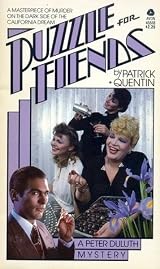
What may or may not be the issue with Patrick Quentin’s oeuvre is that he is highly enjoyable to read, but most of his books lack a satisfying mystery. I own a lot of them, partly because I kept picking up cool used copies in bookstores and wanted to re-read the Duluth saga, most of which I’ve forgotten; also, there was a proposed biography of the author(s) by Curtis Evans in the works, the publication of which has sadly stalled. (I wish the books written under the alternate alias of Jonathan Stagge got better reviews from my friends because then I might start reading them.) I researched the early S.S. Murder for my talk on Cards on the Table at the 2024 Agatha Christie festival, but I did not read it. I’ve heard it’s quite a good puzzle mystery.
For the most part, however, Quentin seems adept at creating the aura of mystery and develops a wonderful sense of drama that grips you when you read it. He’s just not much of a clue-master! Still, I recommend the dark perversity of The Grindle Nightmare and the highly enjoyable Black Widow, with its show-biz milieu and a genuine sense of menace surrounding Peter Duluth that is missing in Fiends. (Also, the movie adaptation of Black Widow, starring Ginger Rogers, Van Heflin, and Gene Tierney, is terrific!)
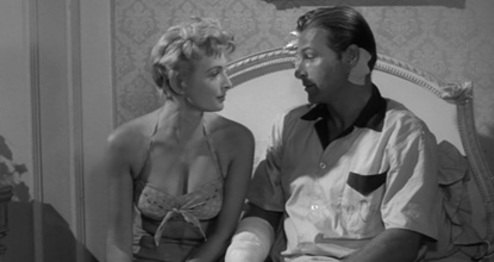
Speaking of which – someone liked Fiends enough to make a movie of it, a British production called The Strange Awakening (it had an alternate U.S. title, Female Fiends, which sounds a bit like a John Waters movie.) The film stars Lex Barker as Peter Chance and seems to have been made for thirty pounds with a cast of British, American and Italian actors. Evidently the reviews were pretty good for a “cheapie,” but it apparently can’t be streamed anywhere. The “coming attraction,” available on YouTube, looks low budget indeed but seems promisingly faithful to the novel.
I have a feeling that, at best, my Book Club will be split on this one, but I had a good time with the humor and the sexual frankness that Quentin was known for. Whether you take Peter’s troubles here seriously or not, there’s no doubt in my mind that Wheeler and Webb know how to tell an entertaining story. The question I will be asking myself as I explore the eighteen other novels that are sitting on my shelf is . . . can any of the various iterations of Patrick Quentin craft a good mystery?
 Ah Sweet Mystery!
It’s the naturalistic and realistic characterisation that really draws me to Quentin, though I always find the plots solid enough. And here, I like the Stagge books a lot. Or did, when I read then 30+ years ago 😁
LikeLike