We are only a couple weeks shy of the seventh anniversary of the first time I posted about shin honkaku on this site. Since then, those of us who are extremely grateful for the Japanese obsession with the Golden Age of Detection have reveled in one release after another of both classic honkaku novels from the likes of Soji Shimada and Seishi Yokomizo, and the modern shin honkaku by authors like Alice Arisugawa and Mashiro Imamura. (I’ve already got the new Imamura on my TBR pile, and the latest translated Kindaichi mystery by Yokomizo will arrive next month!)
It all began, for me at least, with Yukito Ayatsuji’s The Decagon House Murders (1987). Translated into English in 2015 by the wonderful Ho-Ling Wong, who has made it possible for all of us to read many of these books, Decagon is the first in Ayatsuji’s ten-book “Bizarre House/Mansion Murders” series. It seems, you see, that there was once an architect named Nakamura Seiji who liked to build crazy houses . . .
The Decagon House was actually one of two crazy houses that featured in that novel; the other one, the Blue Mansion, was where Nakamura himself lived until he perished in a mysterious fire. Now it seems that murder haunts all the houses he built: killers seem drawn to these places and like to take advantage of the special hidden features the architect installed in each of them to satisfy some weird artistic whimsy. It has taken seven years for the second in the series to appear to us, but thanks to Wong and Pushkin Vertigo, we can now all enjoy The Mill House Murders (1988). In fact, my Book Club chose this one for its June read, and I’m sure you’ll be reading a number of their reviews in a couple of weeks.

I had to start early because I had the great good fortune last month to be invited Down Under by my buddies Flex and Herds to guest on their podcast Death and the Reader and discuss the book over a three-week period. I actually got to play armchair detective along with Herds as Flex barked out questions and tried to look superior just because he knew the answers. It’s a spoiler-filled discussion, so either read the book before you listen or – and this can be fun – read along with Herds and me and see how well you do in comparison. My guest stint debuts on June 25 – I’ll try to remember to remind you. Meanwhile, I offer my spoiler-free review here.
I enjoyed many aspects of The Decagon House Murders when I read it, especially its abiding love for Christie (the novel is an overt homage to And Then There Were None), Carr (in the myriad impossibilities it provides) and Queen (in the super-bizarre quality of its mystery). I found its sleuth Shimada Kiyoshi (named, I assume, in honor of the great Soji Shimada himself) charming . . . well, as charming as a character can be in a book where characterization is basically nil. And the solution delighted in both its elements of surprise and absurdity. Sure, there were problems, but all in all it was a fine introduction to shin honkaku, and I looked forward to hanging out again with Shimada and touring more of Nakamura’s wacka-doodle mansions.
Shimada is back in form in this second venture, and his interest in felonious architecture is bordering on obsession. This time he has traveled to a remote mountainous part of the Chugoku region to visit the Mill House, a death trap, er, lovely estate built by Fujinuma Kiichi as a refuge from the world. Many years ago, Kiichi went for a drive with his best friend Masaki Shingo and Masaki’s fiancée. The car crashed, the fiancée was killed, and Kiichi’s face went up in flames. Now he wears a blank rubber mask to hide his hideous features and lives in near solitude with his much younger wife Yurie and a couple of servants.
The world of art figures importantly here: Kiichi is the son of the great Japanese artist Fujinuma Issei and has managed to track down all of his father’s paintings from around the world and display them on the courtyard walls of his mansion. Issei had mentored two students: one of them was Yurie’s father, who has also died, and the other was Masaki, who has not painted since the night of the accident. In fact, he disappeared for many years and has only recently returned where he prowls about the halls and plays a mean piano.
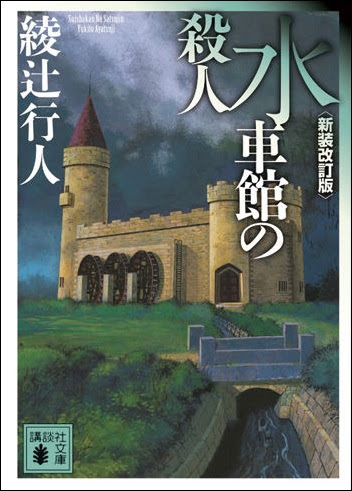
No one else is allowed to view the artist’s work except for once a year, when three men close to the family are invited to spend the night and peruse the collection. One is an art dealer, the second an art professor, and the third is the doctor who attended to Kiichi after the accident. These men covet Issei’s work, especially his final painting, The Phantom Cluster, which nobody has ever seen. It is on one of these visits that a series of horrific events takes place during a terrible storm, resulting in a two deaths, a disappearance, and the theft of one of Issei’s paintings.
Despite the terrors visited upon the group in ’85, the survivors gather together a year later. This time, however, their numbers have increased: Shimada Kiyoshi has asked permission to attend in order to investigate the disappearance of an old friend, who happens to be the man who disappeared from the Mill House a year earlier and who is suspected of being the thief/murderer. Even as the others fill the detective in on past events, another storm blankets the area, and more murders occur.
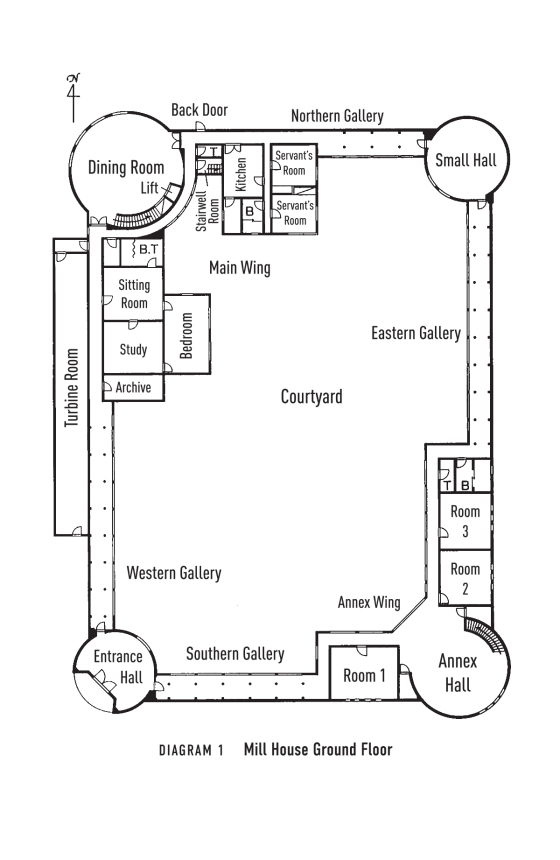
Ayatsuji plays with narrative structure here, as in Decagon, where he alternated his chapters between what happened at the Decagon House and what was occurring on the mainland. Here he tells us the story of past and present events, alternating chapters between one period and another. There’s a reason for this structure, and discussing it might explain why I’m really torn as to how I feel about this novel, which contains many wonderful homages to the Golden Age. It comes complete with a cast of characters, a map of the house, impossible occurrences, and some classic clueing, including a dying message. And while Ayatsuji pays homage to the great GAD writers (even if this time there are no characters named Christie, Van Dine and the like!), he also honors the honkaku of old: having a major character wear a mask reminds us of Yokomizu’s The Inugami Curse.
It’s that mask that really hangs me up here, although I won’t go into any more detail as to why. I do like the other clues, which hearken back to classic mysteries in a variety of ways. I think part of the “how” comes out of nowhere and doesn’t play fair – although if you listen to us talk about it on Death and the Reader, Herds managed to spot this bit where I failed miserably. This is more than made up for with the clueing that surrounds the motive: after you have read the whole book, take a look at it again to see how marvelously the author weaves certain clues about this into the fabric of the novel.
In the end, I don’t think The Mill House Murders comes close in outrageous ingenuity to what Decagon accomplished, and yet it strikes me as a more emotionally satisfying book than its predecessor. Granted, there is a sort of coda at the end that takes us into completely different territory; it is something that Flex, Herds and I were torn over, and I’ll be interested in what you think after you read that final page. I’m grateful as always to Pushkin Vertigo, for making all these books available to us, and to Ho-Ling Wong for a thrilling translation that made the pages fly. Ho-Ling, I sincerely hope you’re sizing up The Labyrinth Mansion Murders for us as we speak!
 Ah Sweet Mystery!
Liked the Decagon House a lot, thought this was less successful. Seemed to be trying to for a big surprise that was telegraphed a bit too clearly.
LikeLiked by 1 person
SPOILERS: Absolutely! I’m too well steeped in my Christie to ignore how people are identified on the page by names and pronouns! That was obvious from page one! And then there’s the issue of the mask: if you’re going to have a masked character, you need to use that mask more cleverly than it is used here.
LikeLike
You beat me to it in reviewing this one. My review will hopefully be up later this year. So you will no doubt have several sleepless nights waiting to see if I liked/disliked the book as much as you.
LikeLiked by 1 person
I’ll probably wait until after Book Club to read your review. I have a feeling I know what you’re going to say!!
LikeLiked by 1 person
Intriguing! I am wondering what you think I will say now lol
LikeLike
Thanks for the review. Looking forward to your stint on Herds’s and Flex’s show. Love that podcast!
M.
LikeLike
Glad you enjoyed it and really hope Pushkin Vertigo is planning to translate the entire mansion series, but, until then, I’m looking forward to Futaro Yamada’s The Meiji Guillotine Murders and Akimitsu Takagi’s The Noh Mask Murder.
LikeLiked by 2 people
Whoo whoo! So many Japanese authors are as prolific as their Western counterparts! I need a way to upload all this material!!
LikeLike
Nearer is The Devil’s Flute Murders by Seishi Yokomizo
LikeLiked by 1 person
Pingback: The Mill House Murders (1988) by Yukito Ayatsuji (Trans. Ho-Ling Wong) – crossexaminingcrime
Pingback: PERRY WALKS THE PLANK: The Case of the Substitute Face | Ah Sweet Mystery!
Granted, there is a sort of coda at the end that takes us into completely different territory; it is something that Flex, Herds and I were torn over, and I’ll be interested in what you think after you read that final page.
Personally, that final scene was my favorite part of the novel. I really enjoyed the plot (and thought the characterization was better than in Decagon), but, as you said, I think Decagon was better as a mystery. The final scene though, as slightly strange in na bgurejvfr engvbany qrgrpgvir fgbel as it is, added grandeur to the novel. Though very different, it reminded me of the feeling you get when you finish one of the more experimental Ellery Queen novels. I suppose that as I’m a huge fan of those, it’s unsurprising that I liked this too.
Look forward to hearing your Death and the Reader discussion of the book!
LikeLike
Pingback: DO YOU WANNA KILL A SNOWMAN? Book Club Reads The Sittaford Mystery | Ah Sweet Mystery!
Pingback: The Mill House Murders (Yukito Ayatsuji) – The Grandest Game in the World