I know, I know! I promised a bit less Agatha Christie this year! Let’s just call the next two posts “Christie Adjacent!” First things first: in an act of kindness (which he regarded as cruelty!), my friend Scott from overseas made it possible for me to be one of the first Americans to watch the latest Christie adaptation, Murder Is Easy. Please forgive the massive spoilers that follow, both of the novel and the film.
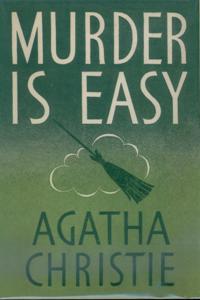
The 1930’s was a most prolific decade for Christie. True, she couldn’t top the forty-three novels that John Rhode published, but she did manage to scrape out 18 mysteries, two Westmacotts, six short story collections, a novel in tandem with other mystery writers, four radio plays, and her first stage play. And the year 1939 provided a perfect exclamation point to her prowess: the two novels she produced both centered around serial killers, as heavy on body count as they were remarkably light on cluing – but that is where the similarities end. One was a charming village mystery with a knockout hook and one of my favorite murderers; the other was quite simply the most successful mystery novel ever written.
Together, these books demonstrated the transformation Christie was undergoing as a writer. Murder Is Easy contains many of the author’s favorite tricks and reversals. It also has that weakness often found in her earlier books, an uneven cast of characters. The central figures of Honoria Waynflete, Bridget Conway, and Lord Easterfield are interesting and fun. The rest of the suspects are a mixed bag, and Luke Fitzwilliam, the ostensible “sleuth,” is a bit of a dullard. With And Then There Were None, things were about to change for Christie, and the next dozen or so years would see more of a balancing act between puzzles and personalities.
If ATTWN has been notarized as my #1 Christie, Murder Is Easy never cracked my top ten. In a draft with my friends Sergio and Nick, I tried to play it in the top twenty and was vetoed. People have mixed feelings about the book, but I have always been transported by its charms. Its first chapter is easily one of the best in Christie: lately retired from his job as a policeman in the Mayang Straits, Luke Fitzwilliam has returned to England “honorably retired on a pension.” Judging by my own experience, I imagine Luke is bored stiff. On a train, he meets a sweet spinster named Lavinia Pinkerton, who tells him she is on her way to Scotland Yard to report a murder – several murders in fact! “It’s very easy to kill, so long as no one suspects you,” she tells Luke. “And, you see, the person in question is just the last person anyone would suspect.”
The story Miss Pinkerton relates is something Christie does so well – that combination of sweetness and menace that makes us both smile and shiver. Many of the best examples of this center around middle-aged and elderly women, and that is how this novel both begins and ends. For in Christie, an old woman can be a mighty detective, a tragic victim . . . or a murderer.
Where the book Murder Is Easy falters for me a little is in its depiction of the village, Wychwood-Under-Ashe. The place never really comes to life for me in the way that some of Christie’s best villages – St. Mary Mead, of course, but also Lymstock, Chipping Cleghorn, and Broadhinny – do. Some of this has to do with the populations of these towns; too many of the residents of Wychwood, like the vicar and the lawyer, are simply forgettable. But none of it can take away the power of that ending as Bridget, feigning a drug-induced stupor, follows along behind “a lean gray woman whom nobody loves” toward certain death!
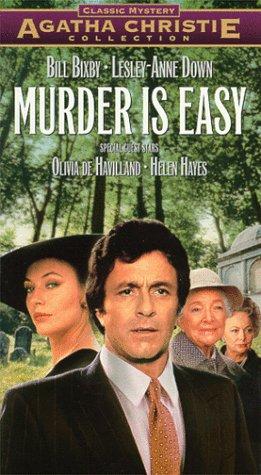
The novel was adapted into a film twice. (It was also turned into a play by Clive Exton in 1993! How I would have loved to see that!) In 1982, CBS Television gathered a pretty remarkable cast together, including Helen Hayes, Olivia de Havilland, Jonathan Pryce and Timothy West, stuck network stalwart Bill Bixby (who went to high school with my mom! No, really! She called him Bill!!) in the role of the now-American Luke, and created a film that was honorably faithful to the book and quite remarkably dull.
In the 2009 adaptation, Miss Pinkerton (Sylvia Syms) boards the train for Scotland Yard and runs into . . . Miss Marple. At least Luke Fitzwilliam is played by Benedict Cumberbatch, but as the police chief of Wychwood, he is just as helpless to solve the murders as any other stupid cop, and it’s up to Aunt Jane to get the job done right. This time it’s Bridget who’s the outsider, running around town asking, “Are you my mother?” Which brings us to the killer’s motive, transformed from the original into something dirty and disgusting and un-Christie-an. In short, this movie is a mess.
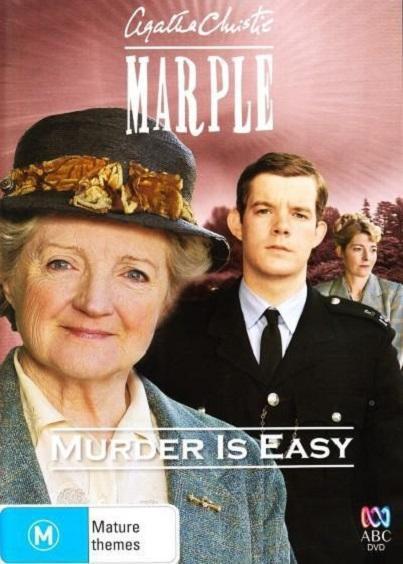
Now . . . think about these two adaptations. The first tried to be as faithful to the original text as it could. Maybe it went awry in trying to be a vehicle for Bixby, but the net result is that the film is faithful . . . and terribly dull. The Agatha Christie’s Marple project came about because Christie only wrote twelve novels about Miss Marple, but the series wanted to keep on going and someone thought of the bright idea of inserting Miss M. into non-series novels. The results, in most cases, were mixed; here, they are horrible because screenwriter Stephen Churchett had no faith in the original text’s ability to entertain. He wanted dark, and he got dark.
So here we are in modern times, and the BBC has assigned Sian Ejiwunme Le Berre, who has had a long career as an actress and producer, to write a new adaptation of Murder Is Easy, and Meenu Gaur, a veteran British-Indian director and screenwriter, to helm the production. What is this pair to do to provide a fresh perspective on this – let’s face it – middle of the road Christie mystery that hasn’t had the best of luck with adaptation?
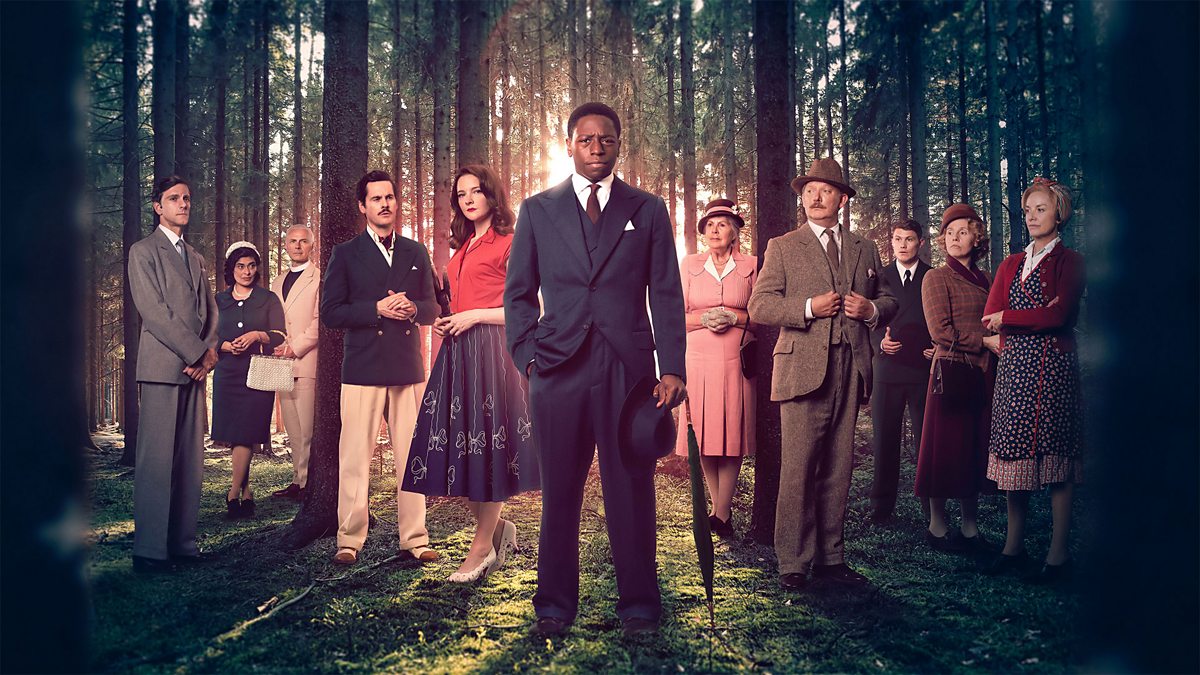
What Le Berre has done is, to my mind, really interesting. She certainly has not abandoned the basic structure of Christie’s text. Most of the characters are there – except incipient warlock and all around “queer chap” Mr. Ellsworthy, the novel’s main (and unconvincing) red herring, and the lawyer I mentioned earlier. The vicar has been combined with Dr. Humbleby and given greater prominence in the story. The basic beats of the original are there: the meeting on the train between Luke and Miss Pinkerton, her death which leads Luke to investigate Wychwood, his bond with Bridget, the unmasking first of Lord Easterfield as an egomaniac and then of Miss Waynflete as his utterly insane self-appointed executioner.
More interesting is Le Berre’s decision to layer the story with some social commentary. Here is where things get controversial on the social media, where purists resent the insertion of ideas or plot points that Christie did not originally present. Ah, but here we have a bit of a way in to Le Berre’s intentions: Miss Waynflete is presented in the book as a highly intelligent woman who was thwarted in her desire for a university education just for being a woman. True, she desires revenge on Gordon Easterfield for having jilted her, but her approach to the whole scheme of bringing him to his knees is decidedly intellectual.
In the 2023 adaptation, Le Berre invents a new motive for Miss Waynflete’s anger that capitalizes on this plot point: Gordon played an actual part in having her sent down from Cambridge by ratting on her to her disapproving father. We still have the bit with the bird, only now it comes as a result of Honoria’s thwarted ambitions rather than her love for Gordon, who from start to finish is a silly ass not worth such a grand passion. All the rest is the same, right down to the utilization of hat paint and the weaponizing of Wonky-Poo the cat (here renamed Algernon, the only change to the original text that really upset me!), but Miss Waynflete’s insanity is now more understandable and – dare I say it? – pitiable.
And while she’s at it, Le Berre triples down on this theme of social inequality. I’ll admit what follows is probably nowhere to be found in the book, but it works in conjunction with this story. First, Luke is played by a Black actor, David Jonsson, who is easily my favorite Luke so far. This Luke is Nigerian, and rather than represent the Empire as a British policeman, he has been at the receiving end of the Empire’s largesse, leaving his native country to accept a job as attaché to Whitehall. As proud as Luke is of his accomplishment, he is continually made aware, both by various citizens and even his own Nigerian expat friends, that in England he is considered an “other” and is viewed with suspicion and a sense of superiority by many of the people he meets.
Since the setting of the novel has been moved up to 1954, the power of the Empire is cracking and the nation sees the stirrings of social change. Thus, we get a wide degree of reactions to Luke, from young Dr. Thomas, who is made more villainous here, extolling the advantages of eugenics and the right of superior folk to wipe out the inferior, to Major Abbott, who, to Luke’s surprise, spent enough time in Nigeria to learn the language and appreciate the beauty of Luke’s culture and who becomes a good friend.
Throughout, the women here are more open to accepting Luke than the men, particularly those in power. The police are depicted as brainless bully boys who would love to hang any charges they can on Mr. Fitzwilliam, and Lord Easterfield is patronizing. The vicar is welcoming, but then he is married to an Indian woman. Meanwhile, the women are far more capable of seeing Luke as an equal. Miss Pinkerton trusts Luke with her secrets (and shares her fudge) the moment she sets eyes on him. Bridget is romantically drawn to him. The landlady at the inn welcomes his money. There’s a nice moment when Luke walks into a pub and is immediately met with hostile vibes from the working-class population – until he chips his tooth on a pork crackling and swears, and you can see the women’s faces soften as they recognize the shared humanity in a figure they had earlier dismissed as beneath them.
The screenplay delves quite a bit into class difference as well. Lord Easterfield is a poor boy who raised himself to millionaire status through war profiteering and then promptly rejected his roots. It is his desire to rise in status at any cost that led him to betray Honoria Waynflete’s trust, which set the whole murderous ball in motion. I admit this is not found in the book, but it gives Gordon more urgency as a character by strengthening his responsibility for Honoria’s state of mind.

Actor Tom Riley is younger and more attractive than the character in the book, but he does a nice job of portraying Lord Easterfield’s silliness in ways that make him gross and sinister. He surrounds himself with servants who used to be his equals – and who include the relatives of Harry Carter, Tommy Pierce, and Amy Gibb, all victims who had crossed His Lordship before their deaths. This leads to one of the most problematic scenes in the screenplay: Lord Easterfield having confessed within her hearing that all the deaths are divine intervention on his behalf, Bridget runs to the pub and assembles all the servants to return to the manor and hand him his just desserts. This “Revenge of the Cleaning Women” is undeniably silly, plus it doesn’t gibe with the fact that Bridget never truly believes Gordon would hurt her. Immediately after summoning the women, she heads to Miss Waynflete’s, full of doubt.
The climax plays out pretty much as it does in the book, but it all feels too rushed. How convenient that at the moment where Luke has convinced the police to arrest Gordon that we have the discovery of Bridget’s letter telling Luke exactly where to find her, along with the finding of the empty knife case and the information that Miss Waynflete has taken the deadly weapon away “for cleaning.” My friend who lent me this video complained that the confession which follows comes out of the blue. By and large, I guess this is true, but actor Sinead Matthews plays the climactic scene so convincingly in a chillingly low-key way that I had no problems with this. Still, it contributes to the sense that the creators were intent on wrapping up the story in just under two hours.
The whole thing is beautifully photographed. Outwardly, it evokes an almost picture-perfect image of Britain in the 50’s – and then Gaur uses camera lenses and angles to lend a sense of unease to the point of nightmare. In the shooting of the story and the performances of the actors, Gaur captures the sense of how Wychwood has been poisoned, not just by hat paint, arsenic, strychnine and sepsis, but by social injustice and the insane machinations of one of the victims of that injustice.
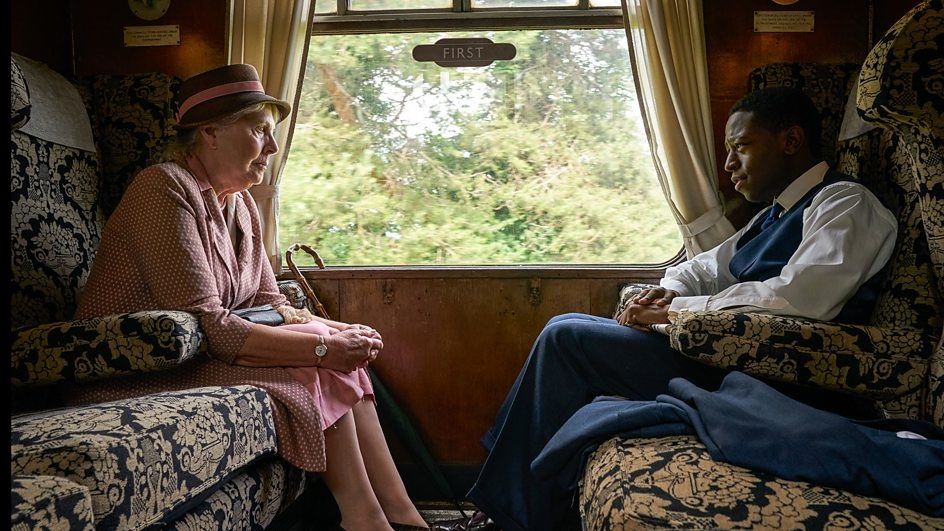
The main problem for me was one of pacing. The opening sequence is easily the best because of Penelope Wilton. Her Lavinia Pinkerton captures something essentially “Christie-an,” probably because the author spent a great deal of time perfectly encapsulating the lives of older women and Wilton taps into this perfectly. She imbues Lavinia with the energy of a Christie character and grounds it in reality. The scene on the train leading to Miss Pinkerton’s death is warm and interesting and ultimately sad. It’s the only death that garners a strong emotional reaction in us.
Once Luke gets to Wychwood, the atmosphere gets strange, probably to accentuate how “off” things are in this town. The pacing slows down to capture this strangeness, and while I was never bored it felt like the whole production could be goosed a bit. Still, there was always something interesting to look at, and Jonsson made an appealing guide as Luke, He’s still a pretty poor sleuth, making the same mistakes as he did in the novel, but here his status as an outsider connects him to others who are sensitive to the wrongness of the village. Thus, he performs an important function that is not found in the book, even if it’s Bridget who solves the case.
The film’s ending departs from that of the book. Luke does not accept the hand of the girl or the job at Whitehall. He recognizes what his expat friends told him at the beginning, that Nigeria needs its sons to remain at home and work for its benefit, not for the invaders who consider themselves its lords and masters. I know some of you are reading this and shaking your heads: Agatha Christie never wrote this, and it’s not clear that, with her own colonial attitudes, she would have even bought into it.
I look at it this way: Murder Is Easy illustrates how a modern storyteller can be inspired by a classic novelist, can honor the original mystery and yet expand upon it to say something personal about the world they see around them. It’s an interesting new take on an 85-year-old story by a favorite author. I think even Agatha would be pleased by that.


After reading your review, it looks like you enjoyed this more than I did. Perhaps I’ll watch it again in the future and have a different opinion, but I came away disappointed with this adaptation.
While an imperfect book for the reasons you state, this is still a favorite that I have re-read many times. The best first paragraph of any Christie novel, the fiendish culprit with the unique motive, plus the creativity of doing away with the victims made a thrilling impression on my young brain when I first read this so many years ago.
Thus, I think that I hold adaptations of my favorite Christies to a much, much higher standard than those that are not. For example, I like the Suchet adaptations of Five Little Pigs, After the Funeral, and Sad Cypress. Those portrayals of favorite books were well done and did not deviate significantly from the original novels. Whereas when a middling Christie such as Hallowe’en Party is transformed to the screen as A Haunting in Venice, I didn’t mind the changes and liked the production given I was not invested in Christie’s source material.
Trying to jam into two hours both the social commentary on colonialism with the murder mystery meant that neither was done justice. The first hour pacing was too slow, and the second hour then rushed too quickly through the who-, how- and why-dunit with bodies falling every few minutes with no tension or suspense build-up. I also thought the cinematography was off as the colors seemed 100 times brighter than they needed to be giving a washed out look to the production.
LikeLiked by 1 person
I like your point about our raised investment in adaptations of our favorite books. I don’t disagree with any of your criticisms. This is a film I probably won’t return to. That said, I’ve seen so many adaptations where the writer’s ego overrode the basic tenets of the script (Sarah koff koff Phelps) and for whatever reason it didn’t bother me so much here. If they had added an hour to beef up both aspects, it would have probably been a tedious affair. But Christie herself is on record commenting on village life in an age of change. Switching this setting to the same time period as A Murder Is Announced was a smart move to justify the social commentary. It made me ignore flaws in the moment that loomed larger for you.
LikeLiked by 1 person
You are way kinder to it than I could ever be – really glad you thought it stands up as an adaptation of a book you are so keen on. I do think the inclusion of a basic critique of Colonialism as part of an end of Empire relocation to 1954 (though 1958 might have been even better probably in terms of what happened in Notting Hill) is perfectly sound. And I like Jonsson as the leading man and the scene with Wilton works as it always does. But for me that is about it – so about to sharpen my fangs, I warns ya! As you say the pacing is seriously off and I found it very dull. It really lacked dramatic momentum for me and in fact the writing and acting was mostly so strident and cliche-ridden as to feel quite amateurish in many ways. Apart from Doug Henshall, Wilton and Jonsson I though the acting was very poor and hackneyed. I don’t think the production team displayed any real aptitude for this type of material (the writer and director have very few TV credits between them and none in this genre). Did you really think it was well-shot? It mainly reminded me of a student film frankly, trying things out for the sake of it but mostly lacking in any subtlety. And I thought the finale with the confession was really laughable. It felt completely shoehorned in and was delivered in such an OTT fashion. The friend I was watching it with, and I, were both reading THE CHRISTMAS APPEAL at the time and we both thought it felt like a production by the Fairway Players 🤣 In fact, I concluded that the last shot could have come from a cruel fifth season Twilight Zone episode, indicating that Luke is not leaving but coming back again, caught in a Flying Dutchman time loop, endlessly repeating two of the worst TV hours imaginable. I will say, I don’t often disagree with you Brad and, frankly, I find it very weird to be going with the consensus view as I’m usually on the other side of the fence! I reckon it’s just a blip, normal service will be resumed shortly!! Happy 2024 😁
LikeLiked by 1 person
Well, I’m certainly not heartbroken by your opinion. I see the sense of it. I wonder if I was helped by watching it on my laptop. The smaller screen meant it didn’t have to fill things so much. I know it was slow, but the off-kilter mood (and the steady stream of deaths, most of which are simply related in the novel) alleviated that problem. I thought it looked pretty, but then you compare everything you see to Ernest Lehman. 😜
LikeLiked by 1 person
🤣
LikeLike
I really want to know what you make of Hugh Laurie’s WHY DIDN’T THEY ASK EVANS? I know it’s not a favourite novel but I thought the leads had genuine chemistry, it was often very atmospheric and tonally was much more controlled and satisfying.
LikeLiked by 1 person
I haven’t seen it. I still have to sign up for Britbox.
LikeLiked by 1 person
I’ll wait!
LikeLiked by 1 person
I object to political issues being thrust into Christie’s or anyone’s stories if the author herself didn’t put it in there to begin with. I’m sick of it. The 80’s adaptation was a bit corny but likeable. There is no good substitute for the original story though.
I thought the very creepiest old lady appeared in the last Tommy and Tuppence mystery — By the Pricking of My Thumbs. Like Honoria Waynflette, Mrs. Lancaster also is empowered with giant-like strength. LOL. Yeah, creepy old ladies are very … creepy.
LikeLiked by 1 person
Pingback: MY YEAR WITH BRITBOX: Why Didn’t They Ask Evans? | Ah Sweet Mystery!
Pingback: MY AGATHA CHRISTIE INDEX (The Blog-iography!) | Ah Sweet Mystery!