Let’s talk about novellas – specifically, the Nero Wolfe novellas by Rex Stout. In my admittedly limited range of knowledge and experience, no mystery author has better demonstrated that you can accomplish the same thing in 20,000 words that most writers take 80,000 or more words to do than Stout did.

Beginning with 1934’s Fer-de-Lance, Nero Wolfe and his assistant Archie Goodwin, the best Watson ever, appeared in thirty-three novels and thirty-nine novellas. It was in the shorter form that I first discovered this pair, back when I was a mali dječak (that’s “little boy” in Montenegrin, the language of Wolfe’s birth). The book was Black Orchids, and the only things I can remember about it was that the black orchid is a flower, not a girl (like the Black Dahlia), that there was some intense cooking of corned beef, and . . . nothing else.
Which is great because my Book Club decided to read Nero Wolfe, and then we decided to read novellas instead of a novel because, quite frankly, Rex Stout is not Kate’s šalica čaja (cup of tea), and we all thought in this case that shorter might be better. And after several moments of discussing Trouble in Triplicate vs. Three at Death’s Door vs. Trio for Blunt Instruments, itd. itd. itd. (etc., etc. etc.), we landed on Black Orchids, maybe because it contains only two novellas, and we are always considerate of Kate’s feelings. Besides, I thought it would be lovely to revisit my first taste of Fritz Brenner’s saucisse minuit and all the other pleasures to be found during this visit to West 35th Street.
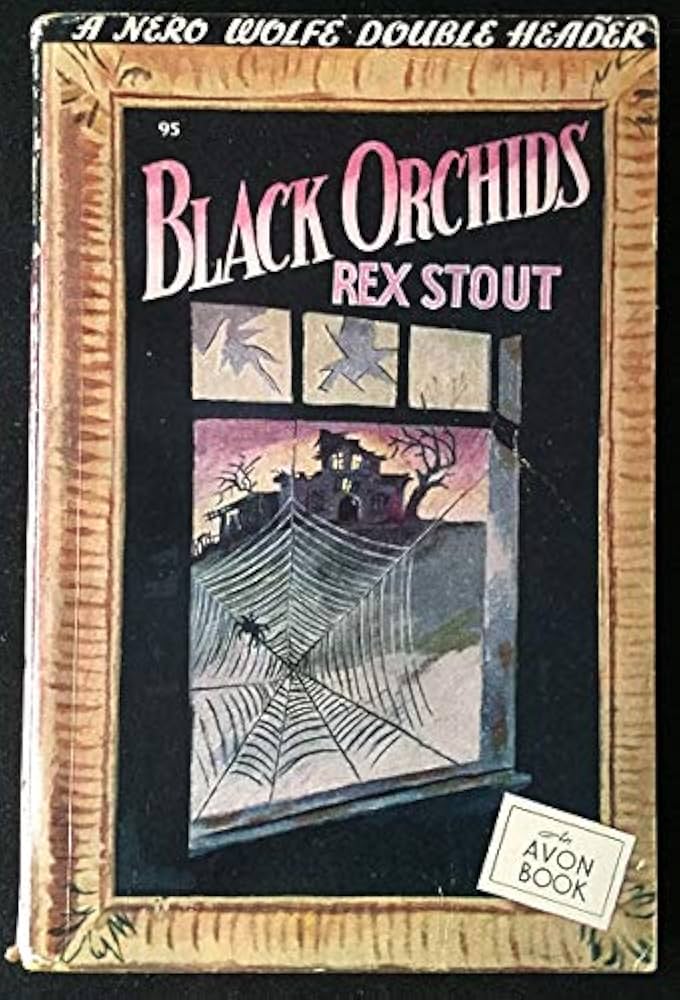
A Rex Stout aficionado named Robert J. Schneider has ranked all thirty-nine novellas, and this can be found at The Wolfe Pack, perhaps the single best resource for all things Nero Wolfe. “Black Orchids” (1941) is one of six titles that earned an A rating (well, two of these are A+ and two rate an A- – I hope to cover these other five novellas on my own in the future). Schneider describes the story as “Top notch early Wolfe. Evocative of Emma Lathen at her best and a bit of Gladys Mitchell.”
The volume’s companion piece, “Cordially Invited to Meet Death” (1942) ranks nearly as well, coming in at a B+. Schneider describes it thusly: “Leisurely paced Christie-like story. American version of the English Manor house setting featuring unusual household.” Unique to any of the novella collections is the fact that these two stories are linked, albeit on the most tenuous level, by the titular rare blooms. As Archie himself describes it in his introduction:
“. . . here in this book are two separate Nero Wolfe cases, two different sets of people. The first is the lowdown on how Wolfe got the orchids. The second tells how he solved another murder, but it leaves a mystery, and that’s what’s biting me. If anyone who knows Wolfe better than I do – but wait till you read it.”

As far as I’m concerned, “Black Orchids” more than proves the initial thesis of this post that Stout could deliver the whole hog in 20,000 words. (Of course, Fritz would slow roast that hog on a spit, basting it in a marinade of Worcestershire sauce, soy sauce, orange juice, lime juice, olive oil, minced garlic, sliced onion, fresh cracked peppercorns, and – of course – beer!) It delivers everything: an interesting setting (the New York Flower Show at the Grand Central Building), a dramatically staged murder (in front of hundreds of fanciers, and with a neat trick of how it’s done), an interesting cast of characters (including two beauties, one of which Archie is set on marrying), witty repartee between the series regulars (this time including Fritz Brenner in the kitchen, Theodore Horstman up in the plant rooms, the NYPD’s Inspector Cramer, more frustrated than usual, and Saul Panzer, the best operative on the East Coast), and a tense and twisty denouement with some real danger built into it and a shocking way of dealing with the killer.
Plus, we get an endless supply of laughs, due to Archie Goodwin’s narrative voice, so brilliantly funny that it nearly always makes me forgive Stout’s weaknesses when it comes to puzzle plotting. The truth is that you don’t really read Rex Stout as much for the puzzles as you read in order to enter the world of Wolfe and Archie that he has so perfectly created. But, as I said, the plot here is good:

Wolfe is fuming because a rival orchid fancier, Lewis Hewitt, has invented a new breed of orchid and is displaying the only three plants in existence at the Flower Show. After sending Archie repeatedly to view the flowers and report back, Wolfe’s jealousy gives him the all-too-rare impetus to leave his house and view the orchids himself. Archie knows his orchids pretty well, but what keeps him a-tingling in his multiple visits is the display by Rucker and Dill, a renowned seed and nursery company, of a man and woman basking all day in a manufactured woodland glade. Archie has set his sights on the woman, even though he has seen her stepping out with Mr. Hewitt and catching the eye of several other men at the show.
Sounds like the lady is just asking to be killed – and yet it is her scene partner who ends up lying in an unnatural position, shot through the head by a missing weapon in full view of a huge audience of people who admire woodland glades and the pretty girls who enjoy them. Since Archie is the man who discovered the crime, Wolfe is drawn into the case, and his reluctance flies away as he sees an opportunity to grab those black orchids for himself . . .
The rest of this mini-saga takes place at Wolfe’s brownstone, and it’s all a delightful reminder that the differences between a thriller and a farce are narrower than you might think. The number of suspects hiding from Inspector Cramer behind various doors in definitely farce-like, and the exciting denouement set in Wolfe’s plant rooms on the top floor make full use of some wonderful thriller elements. In the end, though, we’re treated to a fine whodunnit with several twists before the truth is revealed.
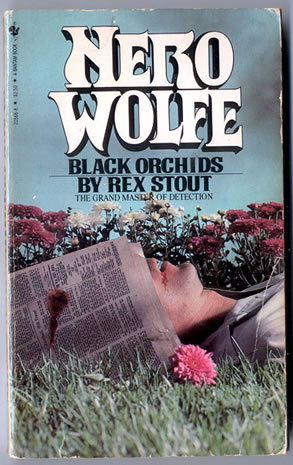
In the second case, “Cordially Invited to Meet Death,” one of the features that stumps Archie is the bunch of black orchid blossoms sent by Wolfe that wind up on the coffin of the murder victim:
“I put this case here with the other one only on account of the orchids. As I said, it’s a totally different set of people. If, when you finish it, you think the mystery has been solved, all I have to say, is you don’t know a mystery when you see one.”
Joseph Schilling referenced Agatha Christie in this story’s ranking. And for the second time in a row, I find myself with a story that concerns anonymous letters. Just like Miss Marple, or for that matter Miss Silver, Wolfe considers an investigation into anonymous letters to be a distasteful business. “Nothing but greed could induce me to tackle it,” he tells his client.
Luckily for us, the care and feeding of Cypripedium Calceolus or Dendrophylax Lindenii costs a fortune, as does the amount of food and beer Wolfe takes in on any given day.
The recipients of the nasty notes are all wealthy clients of Bess Huddleston, the most celebrated party-planner in New York. Somebody has been spilling secrets in these people’s lives and saying that the source of their information is Bess herself. Miss Huddleston is certain that the true source is a member of her household, and she feels certain that she can name which one: her personal assistant Janet Nichols. Janet does an exceptional job that earns her an annual salary of $10,000 a year (that’s over $192,000 in 1942 dollars!) But Bess believes Janet harbors ill-feelings against her employer, although she dismisses Janet’s grievance as “a private matter.”
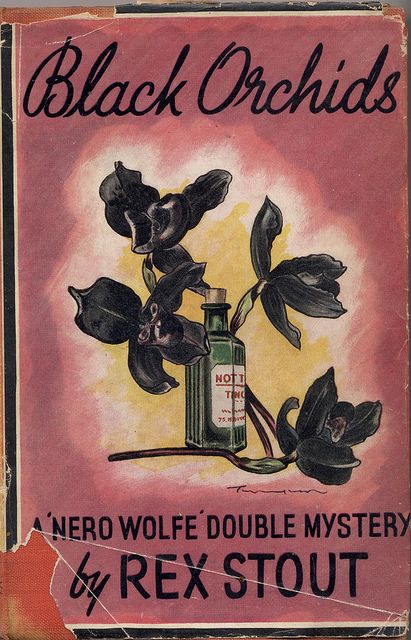
Wolfe sends Archie upstate to investigate the strange household that surrounds Beth, which includes a brother, a nephew, two female employees, one of them destined to go dancing with Archie, and the family doctor, a dashing sort named Alan Brady! (Shout out to The Dick Van Dyke Show, the best sitcom of all time.) The group is tense and the surroundings are screwy, since the closed circle also contains a pair of bears, some alligators, and a mischievous chimpanzee named Mister. Archie witnesses a lot of events, including some portents for murder that Christie fans will definitely recognize ahead of time.
Once again, Archie’s commentary is nothing short of delightful, and so is his attitude, which can, at times, be downright childish, like the jealousy he feels over Wolfe’s friendship with Bess’ young Southern secretary, sparked by her culinary skills:
“There’s no point in being demure unless there’s something on your mind to be demure about. Besides, there was her accent, Cawned beef ha-a-sh. I am still not fighting the Civil War, and anyway my side won, but these Southern belles – if it sounds like a deliberate come-on to me then it does. I was bawn and braht up in the Nawth.”
There’s also the usual sparkling repartee between boss and employee:
“‘There is nothing in the world,’ (Wolfe) said, glaring at me as if I had sent him an anonymous letter, ‘as indestructible as human dignity. That woman makes money killing time for fools. With it she pays me for rooting around in mud. Half of my share goes for taxes which are used to make bombs to blow people to pieces. Yet I am not without dignity. Ask Fritz, my cook. Ask Theodore, my gardener. Ask you, my – ‘
“‘Right hand.’
“‘No.’
“‘Prime minister.’
“‘No.’
“‘Pal.’
“‘No!’
“‘Accomplice, flunkey, Secretary of War, hireling, comrade . . .’ He was on his way out to the elevator.”
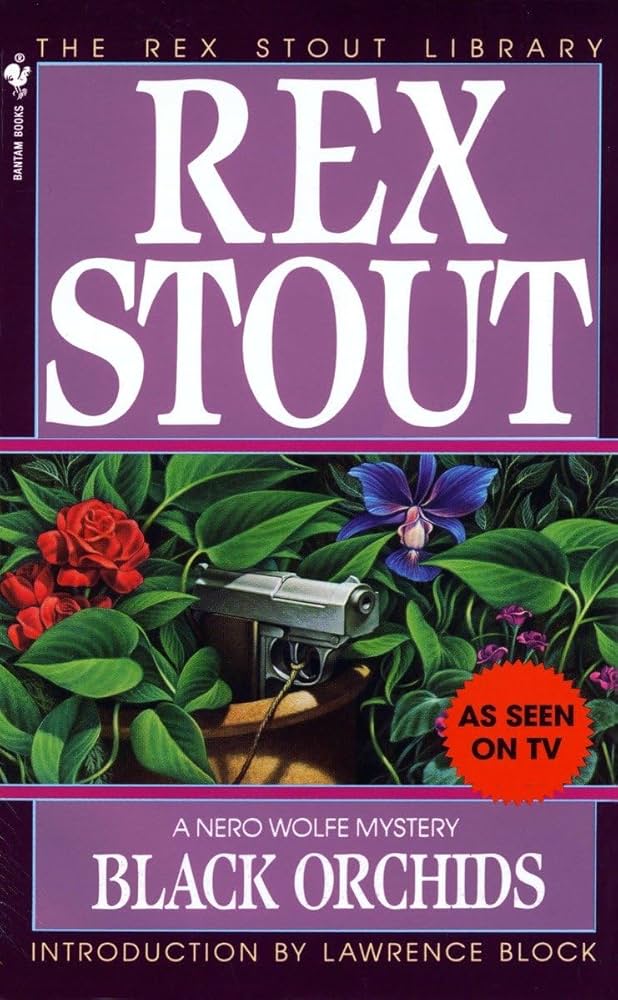
Back to the story: a second murder attempt occurs, and then we have the requisite gathering of the suspects in Wolfe’s office, where a double twist ending brought about by a solid clue (a mistake made by the killer) will also remind folks of Christie, even if Christie is cleverer. In the end, “Cordially Invited to Meet Death” is a solid companion piece to “Black Orchids,” even if it just misses the overall excellence of the title story. Frankly, I can’t imagine Kate not changing her mind entirely about Rex Stout after she reads this. As for me, this has been my third visit to West 35th Street this year, and I’m already ravenous for more.


I also started off with the novellas and I agree, Stout does especially well in the form. I would say that CURTAINS FOR THREE is my favourite collection (BTW am fairly sure that the two titles included here are longer than most of those found in other collections). Really hope you turned Kate around – so hard to imagine a GAD fan not loving the Archie and Nero saga!
LikeLiked by 1 person
Yes, I harped on the number 20,000, but these might just as easily been twice as long. (I’m certainly not going to count!!!)
LikeLiked by 1 person
Hard to imagine? Really? What precisely does Stout have to offer a ‘GAD fan’? His puzzle construction (as Brad acknowledges) was weak; the solutions (bar two or three early works) are depressingly empty.
Moreover, he was a dull writer: the stories are formulaic; there is little sense of place or atmosphere; and they are static: very little happens. Nor, frankly, do I like either the gargantuan gourmand Wolfe or the wisecracking Archie Goodwin.
Edmund Wilson was wrong about Christie and Sayers, but he was certainly right about Stout: “The real secret that Author Rex Stout had been screening by his false scents and interminable divagations was a meagerness of imagination of which one only came to realize the full ghastliness when the last chapter had left one blank.”
LikeLike
But Nicholas, how can you live with yourself, being so wrong about this. I feel for ya buddy 🤣 I think the plotting is better than you say (some of the best novels are from the 50s and 60s, as in PRISONER’S BASE, THE GOLDEN SPIDERS and THE DOORBELL RANG and many of the novellas are superbly constructed). And like Brad, I love the crackke of the dialogue and think that Archie is the best “Watson” from the GAD. It does help I suppose if you’re a big fan of the hardboiled style as a lot of the fun us derived from its eccentric approach to GAD styles.
LikeLiked by 2 people
Wrong? Pfui! (As Nero Wolfe would say.)
I’ve tried, honestly; I’ve read about half of Stout’s works (including Prisoner’s Base and The Doorbell Rang, neither of which I liked much). I get that the main appeal of Stout is the Wolfe/Archie dynamics, just like the Jeeves/Bertie dynamics in Wodehouse (a fan of Stout’s).
LikeLiked by 1 person
Fair enough Nicholas, sometimes it’s just a question of wgwther it does or does not do it for you (like humour). I love GAD fiction on the whole but really don’t enjoy the likes of Ngaio Marsh and Patricia Wentworth for example. Stout’s great contribution isn’t through breathtaking plot twists like Christie or descriptive prose a la Chandler but through a singular amalgam of the two approachesto detective fiction. You have clearly given Stout more than a fair shake. Really sorry you don’t like his work more – I think his books are marvellous and incredibly entertaining. But as we say in Italy, not all ring donuts come with a hole in the middle (loses something in translation … but I guess that’s kind of my point).
LikeLike
Well, I do seem to have enjoyed some of the novellas: https://grandestgame.wordpress.com/list-of-authors/rex-stout/trouble-in-triplicate-stout/
But the novels didn’t satisfy me. (Except for things like Too Many Cooks, which takes Wolfe out of his usual brownstone, and The Hand in the Glove, which isn’t a Wolfe.) There’s a lot of filler (finding witnesses, shadowing people) and serial interviewing, and the solutions are often disappointing.
So maybe Stout works better in slimmer form?
LikeLiked by 1 person
I’m not falling for that! Assuming facts not in evidence m’lord 😁 What you call filler is usually highly amusing – plus it is standard in any GAD novel, surely … On the other hand, the novellas are certainly more compact compared with the longer Woldfe novels from the 1930s.
LikeLike
Thanks for the tips!
LikeLike
Pingback: Black Orchids (1942) by Rex Stout – crossexaminingcrime
My review of Black Orchids has just gone up. Apologies for being a bit too predictable in how I found it – however it was a useful reading exercise as I know now what specifically what doesn’t work for me in Stout’s writing style.
LikeLike