For the past six months, we’ve been looking at Perry Mason mysteries, specifically those with a title that conjures up matrimony – both its pros and cons. One of the highlights for me has been how the seven titles in this mini-series are spread throughout author Erle Stanley Gardner’s career. And now we have hit the Swinging Sixties, with the previous title (The Case of the Spurious Spinster) and today’s novel, both of them written in 1961.
The question arises: how well – or even how much – did Gardner keep up with the times? Even Agatha Christie imbued her 60’s novels with commentary on issues of the day, including the youth revolt, fashion and music. In 1961, Christie published her 52nd mystery, The Pale Horse, producing at the age of 71 one of her best thrillers ever, a book that managed to straddle nostalgia for the entire Christie universe that had come before with an up-to-date depiction of young people in a rapidly changing England and a muder method vstraight out of the laboratory.
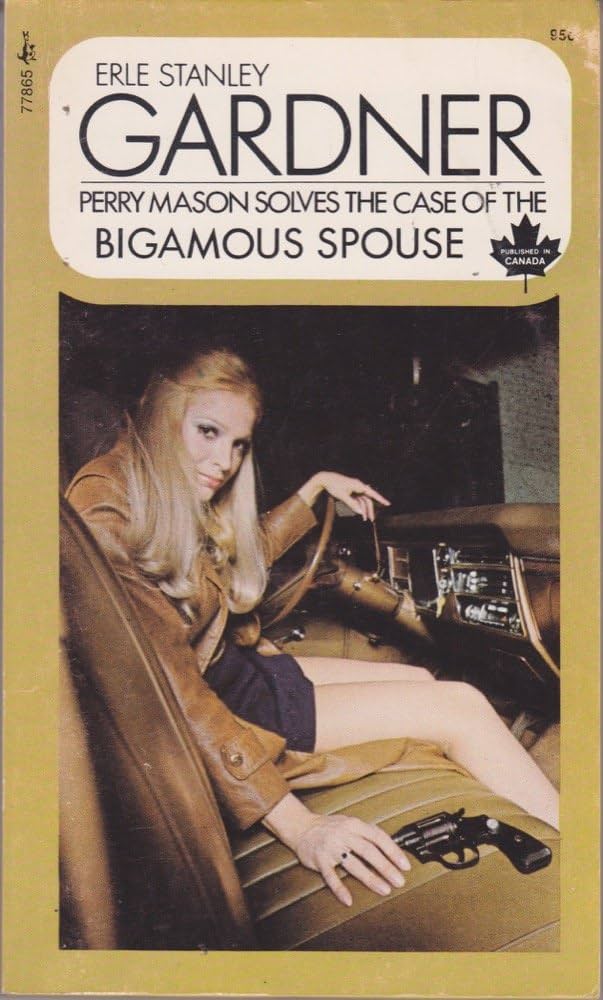
And Gardner? Well, there’s not a Beatle in sight in the two 60’s novels I’ve read for this project. Looking at every element of Spurious Spinster and especially Bigamous Spouse, Gardner was more than happy to stick to formula. In 1961, he was a year older than Christie and far more prolific: in addition to both Masons, he published two Cool and Lam books. I can’t be sure, but Bigamous Spouse is probably his 99th or 100th novel!
Where Gardner’s seemed to keep up with the times was in his enthusiasm for the innovations being made to forensic science and medicine. In his foreword here, he extols progress in the field of blood and blood grouping and dedicates the book to his friend, Dr. Mitsuo Yokoyama. Even so, there are elements of stuck-in-its-time-ness in his praise for Dr. Yokohama’s abilities:
“The Japanese scientist is particularly gifted in this field, because he combines the patience of the Oriental with his inherent powers of observation, his passion for detail with the zealous devotion of a dedicated scientist.”
Um . . . okay, you meant well, I’m sure, Mr. Gardner. Now, what about the novel? Is it fresh and new, or have you been spinning the same plot wheel one too many times?
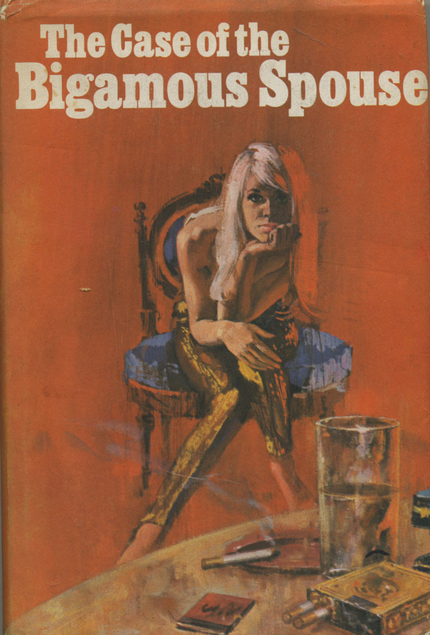
It turns out that Perry Mason himself must have been wondering the same thing, as his perfect secretary Della Street reminds him on the first page:
“You were complaining only a short time ago that the practice of law tends to become routine; that just as the newspapers feature murder, robbery and rape, day, after day, the only difference being the names of the persons affected, the practice of law tends to become generalized according to pattern. Now, I thought I would convince you, Mr. Mason, that here we have something new.”
What Della is referring to is a brochure on Practical Physical Facts for Parenting that serves as the business card for Perry’s latest prospective client, Gwynn Elston. Gwynn isn’t there to give parenting advice to bachelor Mason; rather, she wants to know if her best friend’s husband has tried to poison her. Of course, Mason is always happy to help a damsel in distress, and it doesn’t hurt that Miss Elston is, according to Della, “a dish! Nothing blatant or voluptuous, you understand, but plenty of this and that and these and those!” It’s odd how much pleasure Della takes in presenting her boss with a beautiful client! Not that she’s insecure: Perry only has eyes for Della, as do most of the men in this novel even though by all rights she should be pushing sixty. Anyway, Della’s evaluation of the people who come into Mason’s office is always sharp, but where women are concerned, it still seems mired in the sexism of the past. I would more expect that attitude to come from private detective Paul Drake – and I’m not disappointed:
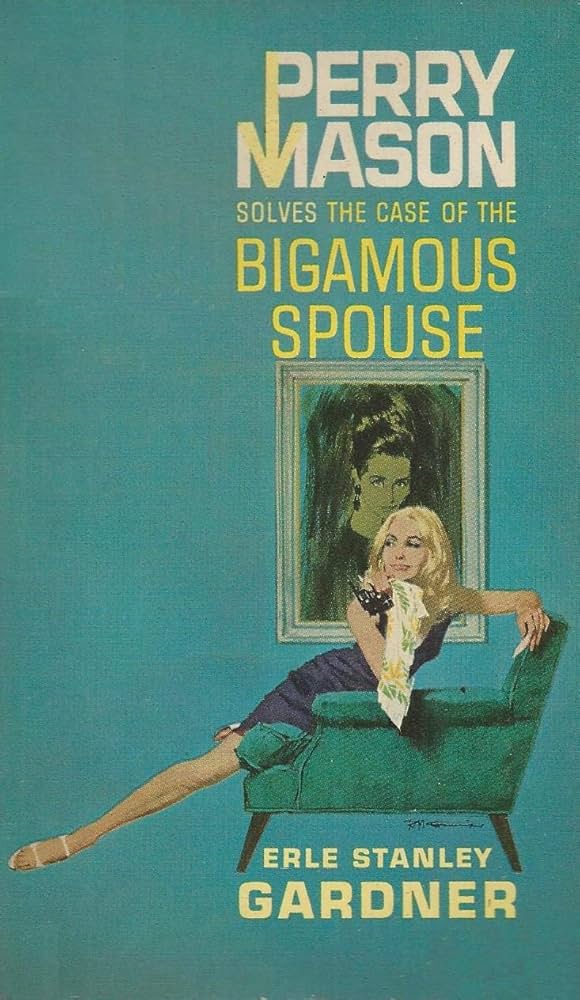
“’Darn it, you always get the class,’ Drake complained. ‘Some woman calls me up and wants me to do a shadowing job, or investigate something, and she’s always some flat-chested biddy with delusions, hallucinations and frustrations, or a sack of cement gone sour. The gals that you represent have upholstery, are easy on the eyes and – ‘
“’And you always get in on the act in the long run,’ Mason said, ‘so quit crabbing.’”
Gwynn’s job is selling books that help parents answer their kids’ questions, which might seem modern until you remember that Dr. Benjamin Spock’s book on baby care came out in 1946. And the problem that Gwynn brings to Perry Mason is at least as old as Ellery Queen’s 1936 mystery, Halfway House. She has been invited to live with her best friend Nell and Nell’s too-handsy husband Felting Grimes because Felt is frequently away on long business trips. On a sales call to an upscale Los Angeles suburb, Gwynne discovers that the lady of the house, Mrs. Frankline Gillett, is Felton’s other wife and the mother of his son! And now Gwynn suspects Felt knows that she knows – and is trying to poison her to keep Nell in the dark about his bigamous status.
Twenty-four hours later, Gwynn must be relieved that she paid Mason that five-dollar retainer because Lieutenant Tragg arrests her for the bigamist’s murder. And that is where everything takes a detour, as Mason tracks down a lead to Gillett’s past which takes him to one of those hick mountain towns populated by codgers whom Mason has been visiting since the series began. It’s clear that Gardner enjoys places like this – I believe he went fishing in small mountain lakes like this town contains – but we end up getting to know these codgers better than the two wives or any other of the very small group of suspects who populate the case.
Ultimately, this is a small story that might have worked better as a novella. It’s not like it feels padded, as it’s always fun to watch Mason drive hither and yon and think things through. But there’s not a lot of business to take care of this time and no real sense of urgency here. Even Perry seems more settled: no obstacle that arises seems to phase him, and in the courtroom climax, he guesses his way through one witness examination after another and pulls the guilty party right out of a hat.
So, all in all, this felt like a minor but enjoyable entry. At least the names were customarily fabulous! In addition to Felton Grimes, we get George Belding Baxter, Gorman Gillett, Corley L. Ketchum, Ezra Honcutt, and Collington Halsey! We also have a quite faithful adaptation of the book in the seventh episode of the seventh season of Perry Mason. As I have previously said, by this time Gardner seemed to be writing his novels for the show. The episode premiered on November 14, 1963, a mere two years after the book was published – and a week before the United States would be plunged into a nightmare. President Kennedy’s assassination followed the Bay of Pigs crisis and preceded Lyndon B. Johnson’s escalation of the Vietnam War. The rest of the decade would bring violence, protest, and tumultuous change. Through it all, I imagine that millions of fans were grateful that the Perry Mason novels and the series remained stuck in a halcyon golden past.
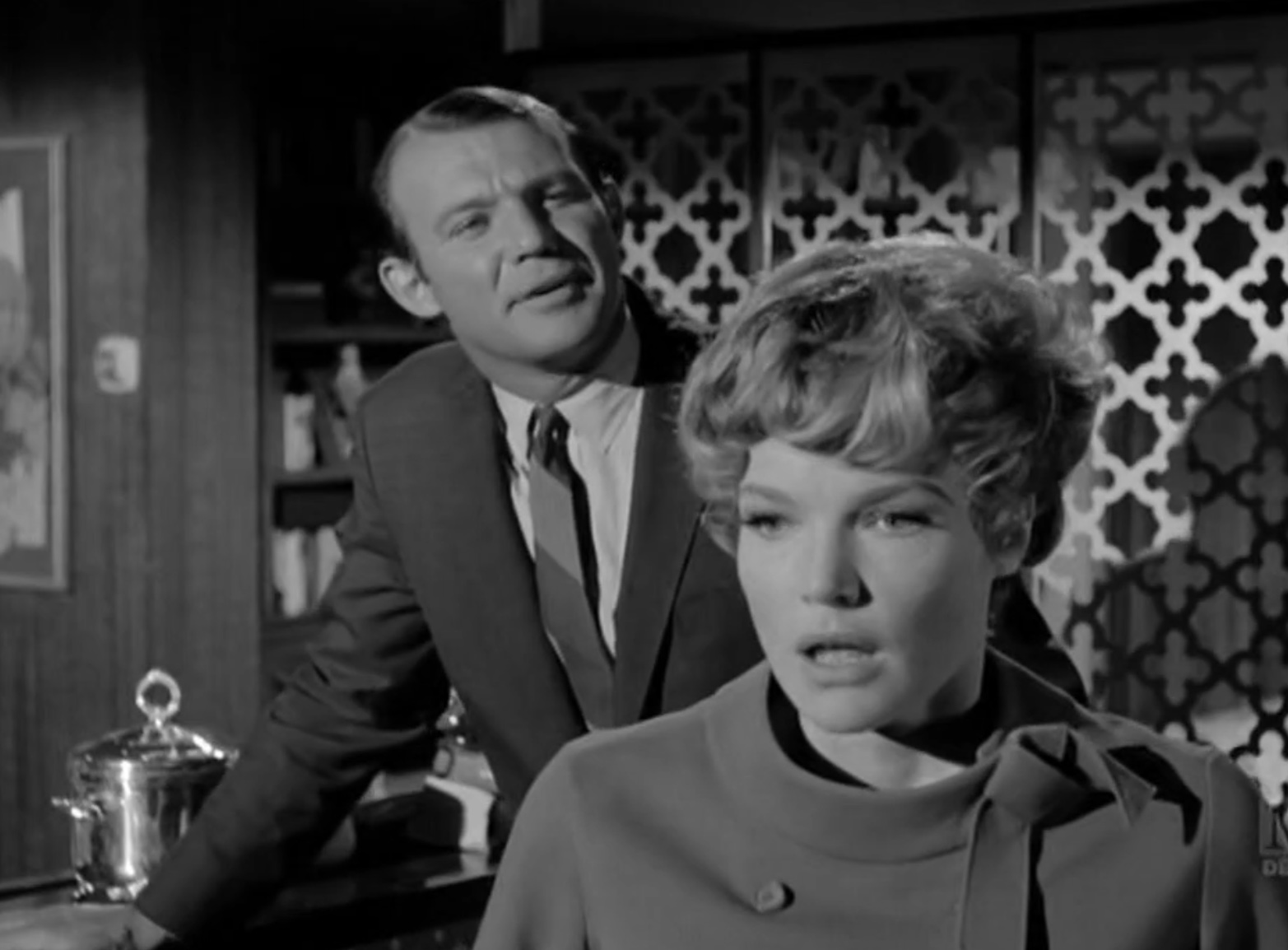
But that’s a matter for our next – and final – discussion.


No question Gardner found a formula that worked and never saw any reason to change it. I suspect the speed with which he worked had something to do with it as well. Innovation takes time and by this time he was almost completely focused on the television show, evaluating scripts, writing and editing many of them, managing some of the production. The books were secondary and they do have that feel to them.
LikeLiked by 3 people
Bigamous Spouse is a favorite, particularly for the very funny bit in the small town, where the mayor/coroner/sheriff invites Mason to move there.
LikeLiked by 1 person
Pingback: THE ERLE STANLEY GARDNER INDEX | Ah Sweet Mystery!