“Attached is an application form for the new MA course I’m running from this September to May next year. It’s designed to bridge the gap between creative work and the commercial world. I aim to create a safe space for students to develop unfamiliar skills and practice those they already possess. As you said, artists are notoriously shy when it comes to selling themselves. I promise to bring you out of your shell! Wherever and however you decide to spend your retirement, MMAM (FTP) will help you navigate the demands of a small creative business.”
I spent thirty-one years teaching high school drama, so I was excited to learn that Janice Hallett had set her new book in the world of arts education. It turns out that she has a lot to say about it. Most of this is overtly explained in her acknowledgements at the end of the book, but since these acknowledgements come with their own spoiler warning, I’m going to tread warily here.
If you’ve been hanging around this blog for a while and you still aren’t aware of Janice Hallett, a brief tutorial is in order: having cut her teeth in journalism and government communications, she began producing novels in 2021. Her debut mystery, The Appeal, remains my favorite and is, I think, the closest thing to a traditional murder mystery: set in a contemporary village that is a bit too uncosy to fit on Midsomer Murders, it focuses on the events surrounding the latest production by a local community theatre. I would describe Hallett’s writing style as “modern epistolary,” consisting primarily of e-mails, texts (on phones and the internet), and documents. This creates a breezy reading experience, and yet The Appeal manages to be a complex mystery, with a large cast of well-realized characters. Plus, the book was hilarious.
The books that followed are harder to describe without giving away their secrets. The Twyford Code (2022) is possibly a spy thriller and possibly a treasure hunt adventure that centers around an Enid Blyton-type children’s author who might have left coded messages in her books. The Mysterious Affair of the Alperton Angels (2023) is the most unsettling of the books, with a bonkers plot that skirts the supernatural in a most unsettling, Rosemary’s Baby-type way. And last year ended with a special treat – The Christmas Appeal, a novella that revisited the (surviving) cast of the first book, may have been light on mystery, but it was full of the joyful holiday spirit one gets when revisiting old and very funny friends.
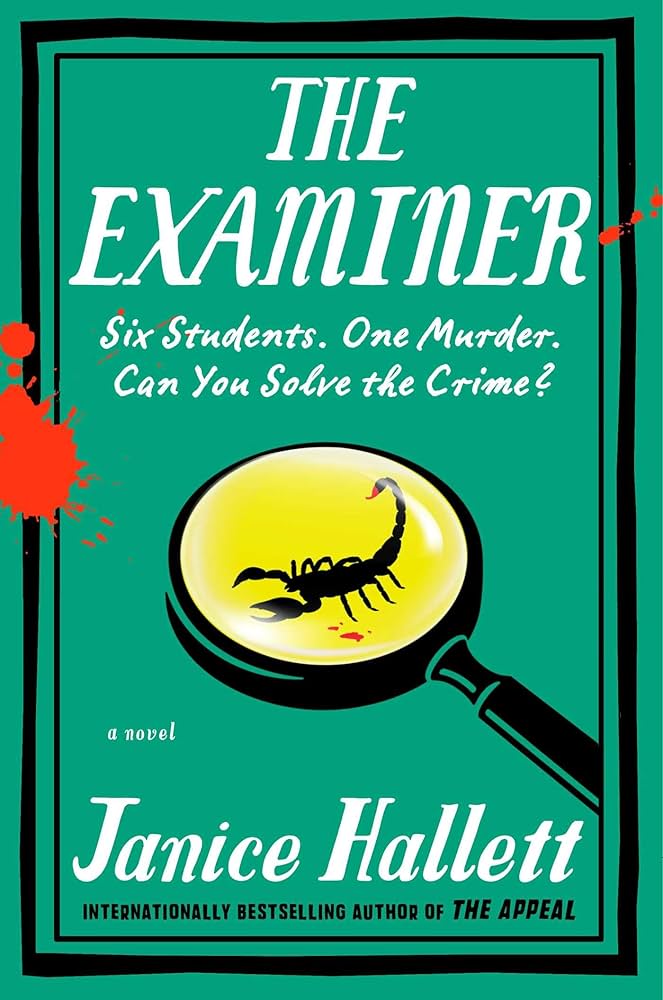
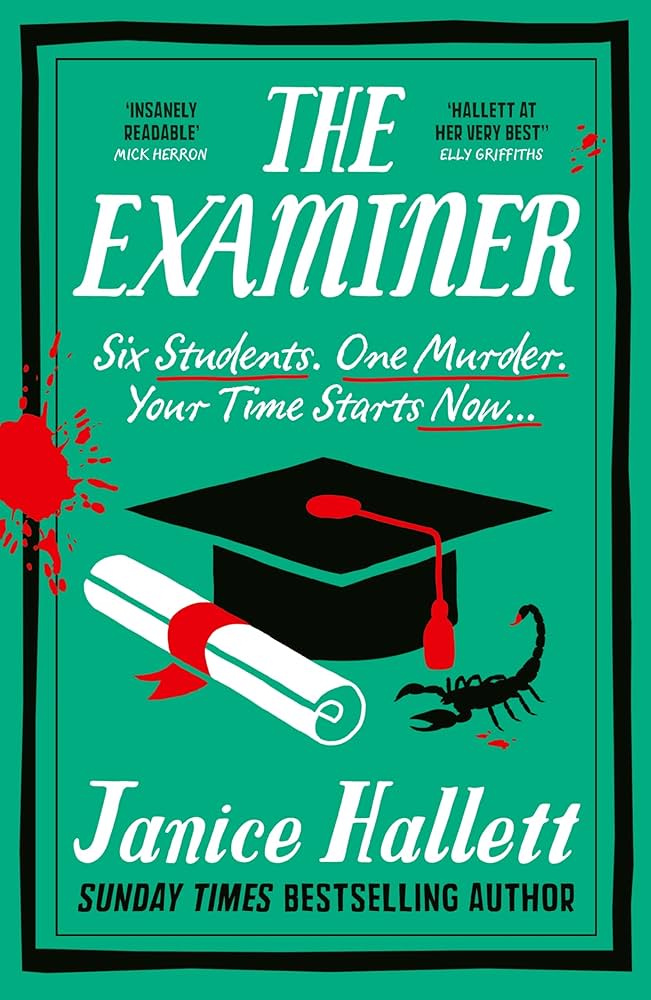
And now comes The Examiner, with the tag line: Six Students. One murder. Your time starts now . . . I’ve been carrying this book around me for a couple of weeks, and whenever a friend or barista or sales clerk catches sight of the title, they ask me what the book is about. When I tell them it concerns a group of graduate art students who might be killing each other, they look me up and down, smile knowingly, and ask, “Are you a teacher?” What this says about the current state of education I’m not sure. Make of it what you will.
I must be sparse with details about the plot, but as a teacher I couldn’t help but relate to the obvious sympathy Hallett feels for arts education. Art, music, drama and dance comprise some of the most inspiring coursework in schools around the world, keeping students in school who might otherwise find their way to the streets. And yet, the arts is the first to have its budgets stripped, the first curricular subject to be cut. At Royal Hastings University, the fictional setting of the novel, administrators admit early on to the drastic measures that have been taken with a once thriving arts program: “We’ve had to overhaul our arts courses and qualifications, make them workplace-relevant, employer-friendly, etc. . . . Promote logical problem-solving as well as creative solutions.”
If I may continue my personal tirade for a moment, this is what we arts teachers have had to do for ages: we stand before school boards and defend the teaching of our courses, pointing out that music make better math students, that dance makes just as effective physical education as football, that drama makes you a better public speaker at business meetings. Let them continue to study the arts, we promise, and they will be much more successful at the really important aspects of life.
This is the reality that Royal Hastings arts instructor Angela Nathaniel faces at the start, and her solution is to create an MA program that fosters creative synergy between artists and industry. For her pilot year, which must be successful if the university is to give the course its final approval, Gela has hand-picked six students: 20-year-old Jemisha, who has just earned her BA in Art; Alyson, a talented and well-established artist, Ludya, a graphic designer and single mother; Patrick, a middle-aged arts supply store manager with a yen to draw; Jonathan, whose father owns a distinguished gallery; and Cameron, a corporate burn-out.
A calendar is provided to show the breakdown of assignments that the students will face throughout the year, and everyone is registered on Doodle, the school’s intranet program, where they will learn to bond as a cohesive group – because in business, if not in art, cooperative work is the name of the game – and where they can chat together or in pairs and keep private diaries that will serve them well in drafting their final essays.
Except almost immediately we can sense that something’s wrong. Each member of the class brings their own fractious personality – and potential secrets – into the mix, and it becomes clear that artistic harmony is the last thing on any of their minds. As they scrabble and fight and sabotage each other, Hallett drops hints of ever more sinister situations, including inappropriate relationships among students and staff, borderline psychopathy, domestic terrorism, technology that transcends science fiction, and, of course, murder.
The problem for me with The Examiner is that, while the cumulative effect is certainly dramatic, and the secrets – one in particular – offer diverting twists, the hinting seems to go on forever. As an educator, I enjoy school-based stories for obvious reasons. Think Bel Kaufman’s novel, Up the Down Staircase, Terence Rattigan’s play, The Browning Version, or Ronald Neame’s film, The Prime of Miss Jean Brodie. All of these are great; none of them is a mystery. A mystery has to grab you pretty quickly as a mystery, not just as a piece of fiction, but The Examiner takes way too long to begin revealing its cards.
As for the characters, Jemisha Badhuri is the clear standout, slightly reminiscent of the equally complex Izzy Beck in The Appeal, and someone about whom it is all too easy to make erroneous assumptions. She strikes up an odd friendship with Patrick Bright, the oldest member of the class, and their relationship becomes a stark relief from all the negativity that dominates every conversation. Through conversations, school assignments and correspondence alone, Hallett does a great job assembling a portrait of school bureaucracy and student life. And as ever, she is without a doubt a master at engendering comic effect between her characters while dropping unsettling hints that something is amiss. But this time she is almost too coy with her clues, and the plot takes its own sweet time parsing itself out.
Once the veil is lifted . . . well, each reader will have to decide for themselves how satisfied they are with the ending. All the secrets and narrative threads are tied together, and the effective is certainly entertaining. But this time some issues stretched my credulity, especially regarding the gullibility of certain characters (even if they are under tremendous stress). I will add, though, that the arc that young Jemisha goes through, from beginning to end, is well worth the time you spend with The Examiner. God knows I am glad to have had very few students like her, but she exemplifies one of the happiest truths about teaching, that you can never assume from observing a student’s educational journey that you can accurately predict where they will land.


You’ve definitely convinced me to read this sooner than later, especially as someone who is currently a double major in music performance and mathematics (my primary major, thankfully, is the music.)
LikeLiked by 1 person
Let me know what you think when you’re finished. Hallett discusses her feelings about arts education far more openly in her Acknowledgements than in the novel itself, but just the premise of having to justify teaching art by aligning it with business rankled with me for obvious personal reasons!!
LikeLiked by 1 person
Pingback: The Examiner (2024) by Janice Hallett – crossexaminingcrime