Reading Seishi Yokomizo’s work, you’d think you would know, seven volumes in, what to expect of this most famous of honkaku authors: a seemingly cursed and highly dysfunctional family, a series of bizarre and bloody murders, a lot of history about post-war Japan and inter-family dynamics woven into a lengthy opening chapter, frequent meta-fictional allusions to classic crime fiction, and a fiendishly complicated impossible crime mystery solved by that antic national treasure, private detective Kosuke Kindaichi.
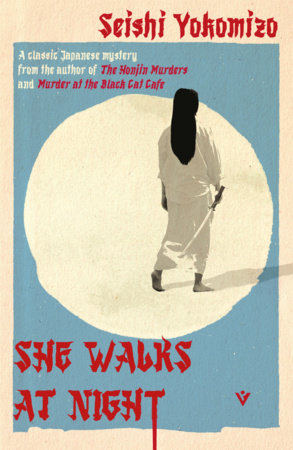
It comes as almost a relief when our eighth translated work, 1948’s She Walks at Night (original title: Yoru aruku, or Woman Walks at Night) begins with a sprightly conversation between two friends. Naoki Sengoku is pouring out his heart to his friend, Torata Yashiro, about Naoki’s beautiful half-sister, Yachiyo Furugami, and while this opening chapter is crammed with information, the banter and underlying tension between the two old college pals, beautifully rendered in a fine translation by Jesse Kirkwood, is a welcome alternative to the dense exposition so typical of previous entries in the series.
However, this is as light-hearted as we’re going to get, for Yashiro, a struggling mystery writer, issues a warning to the reader: “The tale I am about to recount is that of a series of murders so ghastly they defy comprehension. Perhaps, in this day and age, you will laugh at such a claim – but these bizarre and fiendish crimes are steeped in an atmosphere so nightmarish they resemble something from a macabre old picture book. You may even detect the musty scent of an ancient hereditary curse.” So, yes, the cursed and dysfunctional families (three of them, actually), the post-war connection and the gruesome murders with impossible elements are coming. Not so much the allusions to classic crime fiction; Yashiro isn’t secure enough in his own vocation to bring up Carr or Christie or Queen. And if you’re a huge fan of Kosuke Kindaichi . . . well, you’ll have to be patient.
Yashiro sets out to recount the horrific set of crimes that occurred on two estates owned by the Furugami family, who have seen better days and whose fortunes are now inextricably linked with the Sengoku family, formerly the servants who have tended so loyally to their masters. What happens to this small group of people on the old Furugami estate is bizarre and, frankly, ludicrous, like . . . well, someone compares it to the plot of a bad mystery. Late in the novel, Yashiro comments about another character, an artist who he suggests has assumed a completely outrageous personae as “a deliberate ploy to appeal to the bizarre tastes of post-war society.” And perhaps this is exactly what Yokomizo and many other Japanese authors were attempting with their fantastical homages to Poe and Carr and Christie and the rest.
For me, this felt like too much stuff: two families suffused with inherited curses, possibly through some incestuous hanky-panky: on the Furugami side we get a surplus of hunchbacks, while the Sengokus seem to have inherited (?) the trait of sleepwalking. The beautiful Yachiyo has fortunately foregone the Quasimodo gene, but a soothsayer has foretold that she will marry a hunchback! And she has choices!!! Will it be her own brother Morie? Or the sardonic artist Koichi Hachiya? And since Yachiyo is also prone to incidents of sleepwalking, could the rumors be true that Tetsunoshin Sengoku, her mother’s lover, is actually the girl’s real father? And what does that mean for Naoki, whose feelings for his half-sister are anything but pure?
It all culminates in a weekend of horror – and let me just say that it truly is horrific and that Kirkwood’s translation makes it, if not easier, then more fun to swallow every horrific moment of multiple hunchbacks and multiple sleepwalkers and multiple decapitated corpses popping up around the estate without dwelling too much on the ridiculousness of it all. And I mentioned an impossible element to the crimes – the murder weapon could not have been used because it was locked in a safe and guarded all night – that I will admit is pretty satisfactorily explained at the end.
Kosuke Kindaichi doesn’t appear until over halfway through the novel, when we move from one troubled estate to another and the whole horrific mess begins again. Once he shows up, Kindaichi is trotted out sparingly and while, in a way, I prefer his fairy-tale personality in small doses, he really doesn’t have much to do here except tie up a few loose ends after the murderer explains the whole plot in a confession scene tinged with madness.
There’s a strong element of sick eroticism going on here that may make you roll your eyes at “the bizarre tastes of post-war society.” A lot of it revolves around hunchback fetishism: one woman talks about how turned on she gets sleeping with a character and, um, utilizing his hump. All the younger people hold their noses at the highly sexual nature of the relationship between the still-beautiful mistress of the house and her old but hunky former-servant-turned-lover, but none of these younger folk seem able to muster a healthy relationship of their own.
It also doesn’t help that . . . well, there’s a major element that pretty much ruins any chance of “fair play” but which I can’t talk about here without ruining things for you. So after you’ve finished the book, come back and read this ROT-13 message:
V’z abg fher ubj znal Xbfhxr Xvaqnvpuv zlfgrevrf ner aneengrq ol n punenpgre va gur obbx, ohg vg qvqa’g gnxr ohg n zbzrag sbe zr gb fhfcrpg gung gur aneengbe urer jnf tvivat bss cbjreshy “Qe. Furccneq” ivorf. Jul qvq Gbengn Lnfuveb srry fhpu fgebat srryvatf nobhg nyy gurfr crbcyr ur jnf bfgrafvoyl zrrgvat sbe gur svefg gvzr? Jul ba rnegu qvq ur unat bhg jvgu Anbxv Fratbxh, jub gerngrq uvz yvxr fuvg?!?
Vg frrzrq pyrne gb zr gung ol gur raq jr jbhyq yrnea gung Lnfuveb jnf vaqrrq n aneengbe-xvyyre, ohg gura gur aneengvir gbbx n ghea naq ur frrzrq gb or jvgarffvat guvatf naq ehzvangvat nobhg gurz nf na vaabprag zna jbhyq. Naq gura ng gur pyvznpgvp zbzrag, jr trg fbzrguvat abg pyrire rabhtu sbe Npxeblq snaf, ohg va gur erny Tbar Tvey irva: Lnfuveb erirnyf gung gur jubyr aneengvir jr’ir ernq vf n yvr va gung ur cerfragf uvzfrys nf vaabprag fb gung jura ur snxrf uvf bja qrngu, gur “obbx” ur unf jevggra jvyy freir nf qbphzrag bs gur “gehgu” nf ur unf znahsnpgherq vg.
Va n frafr, guvf vf n pyrire inevngvba ba gur Ebtre Npxeblq gevpx, V thrff, ohg vg’f nyzbfg pbzcyrgryl hasnve gb gur ernqre. Xvaqnvpuv cerfragf n pbhcyr bs snpgf gung vaqvpngr jul ur fhfcrpgrq Lnfuveb sebz gur fgneg, ohg fbzr bs gurfr, yvxr gur qlvat zrffntr, ner abg “snve cynl”.
In the end, the murder plot is so full of loose ends that it barely holds up, and the killer’s motivations are unfairly hidden till the final pages. Still, the storytelling is more concise than usual, which after some of the other recently released Yokomizos is a blessing. With so many powerful moments of horror, I think we have to accept this entry into the series as more of a creepy entertainment than an effective mystery. But this you’ll have to decide for yourself.
What’s the buzz on the next Yokomizo translation? Well, in February 2027, Pushkin Vertigo will bring us 1952’s Jo-ō-batchi, translated as The Queen Bee Mystery. More family curses, another series of murders, but honestly, the premise for this one sounds fun: Kosuke Kindaichi meets a young woman who must journey to Tokyo to fulfill the requirements of her late mother’s will, but an anonymous letter predicts a “reign of blood” and informs her that any man who gets close to her will die!!
Wanna bet the family curse involves hives???
 Ah Sweet Mystery!
I’m still trying to work out how much interest I have in Yokomizo after the titles we’ve gotten in English. The first two were fun, and Devil’s Flute was madness in extremis…but the others haven’t done much for me — indeed, Little Sparrow left me so confused I had to give up on it.
I see that this is about half the length of the more recent translations, back to Honjin Murders word-count, and that bodes well. But, not fair play? Hmmm. Might have to think about this some more.
LikeLiked by 1 person
Too bad – because I’m aching to tell you, what bugged me about this one! However, I think that if you read it, you’d know what bugged me without my having to tell you! 🤪
LikeLike
In my mind the only good Yokomizos are Inugami and Gokumon, and then maybe Devil’s Flute and all the rest are varying shades of mid.
LikeLiked by 1 person
good to know, I’ll stay away. I have read the first 3, and went from 5 to 3 stars. I’ll try Gokumon though
LikeLiked by 1 person