Hollywood cemeteries are strewn with the graves of thousands of forgotten actors and, for most of us, John Lasell is one of them. He had a respectable twenty-five year long career, mostly on television where he hit the ground running in 1960 and made single appearances on a wide variety of classic shows. One of his first appearances was as John Wilkes Booth in an episode of The Twilight Zone, and then he appeared in Wagon Train, Gunsmoke, Mission: Impossible, Lassie, Flipper, The Mod Squad and dozens more. He played four different characters on The Fugitive and six in The F.B.I..
Lasell’s greatest claim to fame of a sort was his appearance for twenty-five episodes of Dark Shadows during its first troubled year. The big star on that show was Joan Bennett, a genuine movie star, and after almost a year of fretting about the Collins mansion as Elizabeth Collins Stoddard, the family matriarch, I assume she wanted the first of what would be many vacations. And so the producers put her in a coma and sent her to Boston for several weeks.
On a regular soap opera, the coma would have been induced either by a car accident or by a greedy relative pushing Elizabeth down the stairs. But creator Dan Curtis, tired of the show’s low ratings, took a risk and had Elizabeth fall into a trance caused by her evil sister-in-law, Laura Collins (Diana Millay), who happened to be a mythological Phoenix. Nothing was going to stand in the way of Laura reclaiming her young son David for all eternity, and so Elizabeth had to go! In order to figure out what had caused this peculiar malady, the family lawyer sent for Dr. Peter Guthrie, a noted student of the occult, who arrived at Collinwood and got the family up to all sorts of odd doings, like seances and gravedigging.
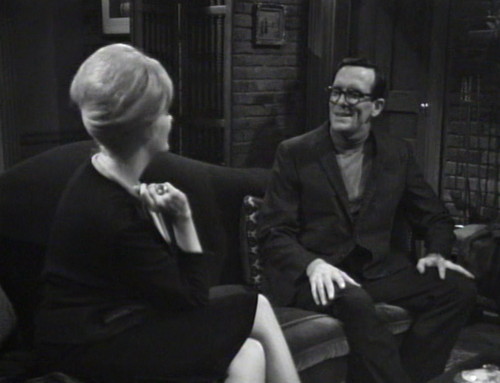
John Lasell looked more like an ad man from Mad Men than an eccentric psychic, which probably helped the family and the audience accept this lunacy more quickly. Dr. Guthrie helped bring down the Phoenix, but it cost him his life and – unlike most of the other actors on the show, when Guthrie died, he stayed dead. Lasell never returned to Dark Shadows but continued to guest star on TV until 1985. He went on to enjoy a long retirement and passed away in 2024 at the age of 95. He had been married three times, including to actress Patricia Smith, who played my very favorite murderer on Perry Mason.
What a nice segue: I mentioned last time that three actors from the early days of Dark Shadows made multiple appearances on Perry Mason. First we looked at the three episodes featuring Diana Millay, and now we’ll examine the trio of original teleplays in which John Lasell appeared.
From Season Five comes “The Case of the Promoter’s Pillbox,” the twenty-ninth episode which debuted on May 19, 1962. If the title suggests that you’re in for a tale of a lady fight manager’s hat, rest assured: this is a Hollywood story. True, the characters and situations are hackneyed, but there are some clever modern touches, and the cast brings a great deal of verve to the episode. (Maybe that’s because six of the guest stars appeared in twenty-five Perry Mason episodes between them!)

Naïve pharmacist Herbert Simms (Linden Chiles/4 eps) dreams of leaving the family drugstore behind and becoming a famous Hollywood screenwriter. He sends a script called “Mr. Nobody” to shady film producer Charlie Corby (Lasell) and hears nothing back – only to learn that Corby has taken credit for the script and is producing it himself. What neither Herbert, nor financial backer Nelly Lawton (Dianne Foster/4 eps), nor her lawyer Davis Crane (Ben Cooper/5 eps), nor washed up director Mike Flint (George Mathews, who only made this one appearance but actually had a day job on Dark Shadows as Amos Fitch, a disgruntled fisherman!) – what none of these people know is that Charlie is using “Mr. Nobody” as a means of setting up his own film company in Spain.
Herbert is arrested for Charlie’s murder, but luckily his mother (Geraldine Wall/six episodes!) used to make chicken soup for a neighborhood lad studying for the bar! Mason looks into all the above suspects, as well as a mortgage company executive (Edmon Ryan/3 eps) and the secretary who was unbelievingly in love with Charlie.
Lasell is as sleazy and awful here as he is forthright and good in Dark Shadows, even if with that accent he belongs in Guys and Dolls. As I mentioned, some of the show biz stuff is a bit much – the director is so furious that he belts back drink after drink while he is on set directing – but it’s great fun, and suspicion passes back and forth among the suspects until the final twist. (Not the best twist, but still a good one.)
Lasell returned to the series in “The Case of the Latent Lover,” the eleventh episode of Season Eight, which debuted on December 3, 1964. It begins with a complex and unusual situation that unfortunately resolves itself by using one of the oldest tricks in the Golden Age of Detection playbook. Seriously, the murderer will be painfully obvious to anyone who has read Agatha Christie, or anyone else for that matter!
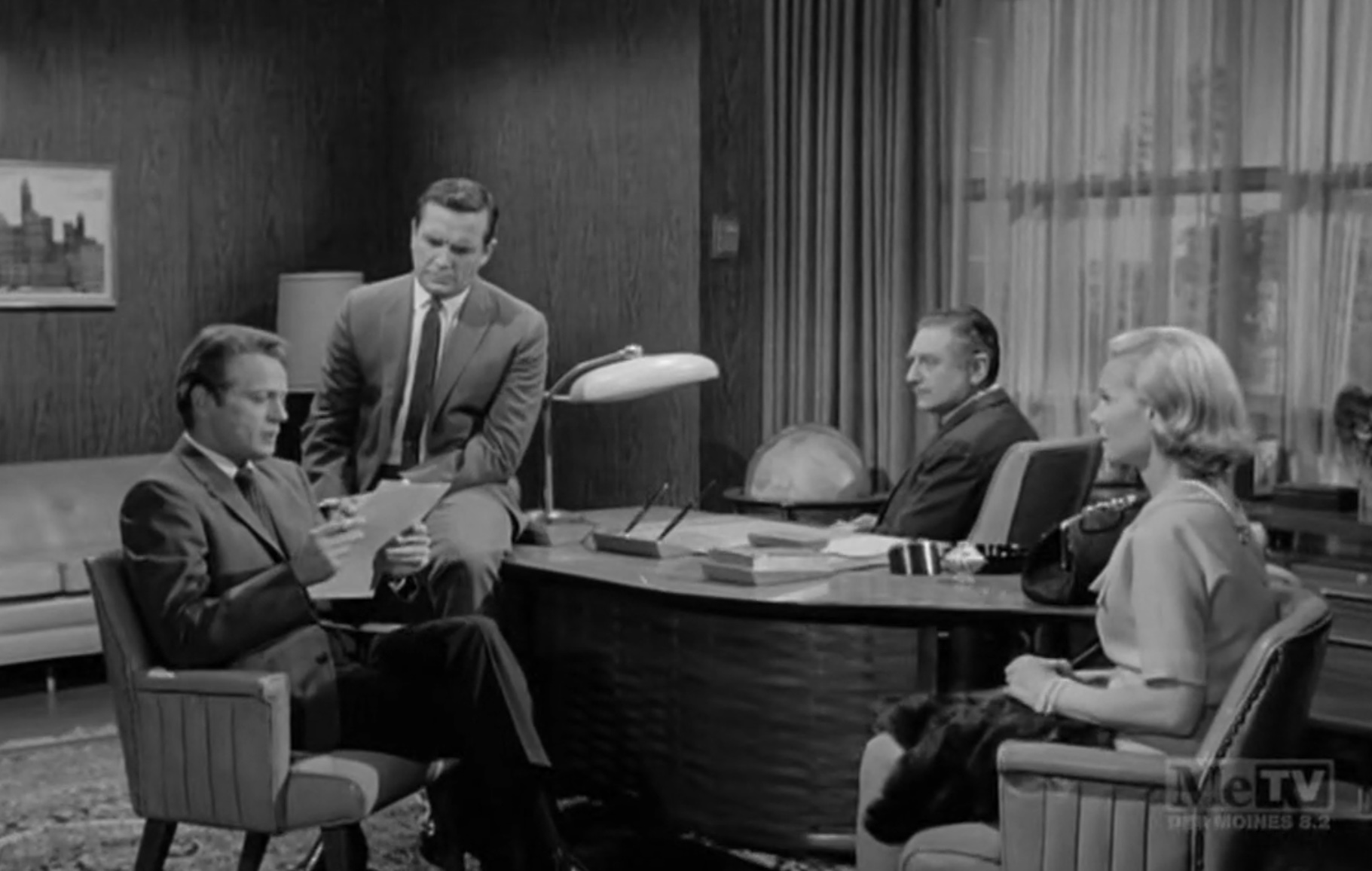
Eric Pollard, a businessman whose marriage is falling apart because he insists his wife Sibyll is having an affair. At the same time, Eric seems to be losing his mind, and he winds up under arrest for attempting to rob a bank. Due to an understanding judge, Eric is put on probation under the guidance of Roy Galen – until Pollard accuses Galen of being his wife’s lover. And then, when Sybill is murdered, it is Galen who is found in the study next to her dead body.
The good news is that the show features a trio of fine actors in pivotal roles. Lloyd Bochner, one of those actors who might have been in every TV show, plays Eric Pollard. Jason Evers, who did nearly as many shows as Bochner and even appeared as a regular in some odd series, like The Guns of Will Sonnett, plays Roy Galen. And veteran character actor Douglas Dumbrille whose career goes back to the silent era and who could play both distinguished and sinister (and sometimes a combination of both) roles, is the sympathetic judge. John Lasell has an important role as a company lawyer who – well, if you can’t figure out that he’s the victim’s secret lover, then you actually might be fooled by the overly obvious trick ending. But Lasell is perfectly fine in this role
Lasell gave his final Perry Mason performance in “The Case of the Crafty Kidnapper,” the penultimate episode of the series, which debuted on May 15, 1966. He plays the victim, gossip columnist Danny Shine, and after one drunken opening scene he is found shot dead in his car. A year later, he showed up on Dark Shadows, and our curtain falls on John Lasell. Still, this is such an interesting episode that I want to discuss it some more – and I will also be SPOILING the solution, so if you haven’t seen it, please go watch it first and come back.

First, a note about casting: this episode featured at least four actors who would go on to make their mark in television. Richard Anderson had been a contract player for MGM for six years and then 20th Century Fox when he made two appearances in the seventh and eighth seasons of Perry Mason and ended up being hired to replace the late Ray (Lieutenant Tragg) Collins as homicide detective Steve Drumm. He would have an illustrious career in various series, most especially as Oscar Goldman in The Six Million Dollar Man and The Bionic Woman.
Handsome Gary Collins also had a nice career in as an actor and TV-host, most notably hosting the Miss America pageant for eight years. Sometimes he worked with his wife, former Miss America Mary Ann Mobley. I remember him for a short-lived series called The Sixth Sense, which debuted on Night Gallery.
Pat Priest had a so-so career, most notably as the second Marilyn Munster in The Munsters. I remember her as Sue Ann Nivens’ kid sister in The Mary Tyler Moore Show. Universal Studios planned on turning Pat into a movie star, but sadly that never happened.
The most prestigious name here is Cloris Leachman, who trained at New York’s Actors Studio, did a lot of theatre and then hit the movies and TV. She opens the classic film noir Kiss Me Deadly with a bang, and she earned an Academy Award for her brilliant turn in The Last Picture Show. On TV, she was one of the most unusual mothers: first, she nurtured little monster Billy Mumy on the classic Twilight Zone episode, “It’s a Good Life.” Then she fed little Timmy on the first season of Lassie before leaving due to a contract dispute. Her most famous role, of course, was as Bess Lindstrom’s insane mother, Phyllis, originating on The Mary Tyler Moore Show and then moving to her own short-lived series. She won nine Emmy awards for her career in television. And let’s not forget her subtlety in Young Frankenstein in the role of Frau (“neeeiiiggghh”) Blucher!!!
It’s no surprise then that John Lasell gets a little lost here, but at least he goes out with a literal bang. At a party given by Greg Stanley (Douglas Henderson/6 PW episodes), to honor the arrival of Alex Tanner, the projected new CEO of a newspaper publishing company, everyone is harassed by the inebriated Danny Shine: Stanley, who is both Shine’s assistant and rival for a new promotion, Stanley’s wife, Lola (Mary Foskett), who has secrets of her own, Norma Fenn (Priest), Danny’s secretary and mistress, whom he strikes, bloodying her nose; and even Danny’s wife Gloria (Leachman) who is not actually at the party but is jealously sitting outside in her car. Also present, but not suspected, are attorney Perry Mason, looking ready to assume the role of Ironside, and his secretary Della Street, with a very high hairdo!
Danny makes a lot of threats (and the wording is important to armchair detectives!) before he is rushed out of the party. Norma intends to drive him home, but after Danny hits her, it’s Greg who gets the honors. But when they arrive in front of Danny’s house, Greg discovers that he has been chauffeuring a corpse. He also handles the gun and gets blood all over his suit, so of course, he is arrested for murder, and Perry agrees to defend him.
And that’s where the show’s formula begins to deviate. The prosecution contends that Greg was going to lose out on a new job to Danny Shine and therefore had a motive. But both Alex Tanner and his wife Patricia (Anne Whitfield), the daughter of the paper’s owner who stayed home to take care of their baby, know that Tanner was intending to give the job to Greg. His testimony will therefore destroy the prosecution’s case, but then tragedy strikes. Patricia calls her husband to tell him that their son Bobby has been kidnapped; what’s more, the kidnappers want no ransom, just the promise that the Tanners will not testify in Greg’s trial.
We do get a trial – in fact, it is that rare thing for the series, a jury trial – so we get to see much speechifying by D.A. Hamilton Burger and some excellent testimony from Priest and Leachman. There’s also a subplot about exposing construction fraud that incorporates three new characters, but this is included to confuse the main issue, the gist of which is the attempt to recover Bobby Tanner so that Mason can get the testimony he needs to save his client. At the climactic moment when it’s time to present his defense, Mason has to rest his case in order to keep the baby alive. And then, in the first part of a shocking finale, Mason goes with Tanner and Steve Drumm to a playground to collect Bobby, only to find a message scrawled in the sand: “YOUR SON IS DEAD.”
I wonder if you know where this is going. I’m afraid I saw the truth at the very first moment when Gary Collins is rushing out of his house to get to the party and his wife stands in the door begging him to say good night to their son. The truth is – there is no baby. He was drowned accidentally in his bathtub when the couple lived in Japan, and Patricia has manufactured a fantasy baby to stave off her grief. The casting of Collins is perfect here: he is so good-looking and comes off as such a nice guy. The truth is that Danny Collins had discovered what happened to Bobby and was going to expose the Tanners’ secret in his column, threatening Alex’s new job and Patricia’s sanity – so Alex killed him.
I’m sure this ending was a shocker to some viewers, but after early 1960’s films like Psycho and most of the William Castle thrillers, I’ll bet many audience members noticed that we never met Bobby and that something was up with Collins’ behavior throughout. But hey! the series was coming to an end, and I’m sure that screenwriter William Bast, who created four episodes for the final season, had been given permission to mess about with the formula.
I hope that John Lasell’s descendants appreciate our appreciation of his fine work on both Perry Mason and Dark Shadows. I have one more DS actor connection to make before we move on to a world of little known but greatly talented character actors on the show. See you soon!

