I’ve been having so much fun exploring all the actors who appeared on multiple episodes of Perry Mason. Since I’m covering the adaptations of the novels as I read them, here I’m focusing on the 144 episodes created from original teleplays. The bonus is that I get to shine a light on actors who you may only recognize by their faces or voices but who popped up all over the TV shows that I used to watch. We started with Dark Shadows, and now we move to another favorite series of mine.

Batman has always been my favorite comic book character, partly due to the mythology surrounding him but also simply because he was, first and foremost, a detective. Now, I was a kid in the 60’s, two decades before writers like Alan Moore (The Killing Joke), Frank Miller and Grant Morrison got their hands on the Caped Crusader. The legendary crimefighter of Gotham City was still darker in tone than his fellow heroes, like Superman, the Flash, or Green Lantern, but he was far from the tragic anti-hero into which these writers transformed him for the 21st century..
Still, the 60’s comic book Batman was Oedipus Rex compared to his depiction by Adam West in the ABC series that ran from 1966 – 1968 (the first two seasons gave us biweekly episodes, reduced to one in Season Three; there was also a feature film produced between Seasons One and Two.) Batman was colorful and camp, and it featured a vast array of stars, many from Hollywood’s Golden Age (Burgess Meredith, Cesar Romero, Vincent Price and many more), who created the panoply of villains challenging Batman and Robin, the Boy Wonder (Burt Ward). Wikipedia describes the show as “an American superhero comedy television series,” and the emphasis from first to last was on the comedy.
But I didn’t care: each week the heroes and villains I adored from the comic books would appear, same Bat-time, same Bat-channel. I would tune in on Wednesdays to find out which miscreant our heroes were facing this week, and the episode would end on a terrifying cliffhanger (well, not so terrifying, mostly funny) that would resolve itself the following night. In that way, the series was tapping in to the hugely popular (but cheap as all get-out) Batman movie serials of the 40’s.
To my delight, many of the series regulars had also appeared on Perry Mason. I wish I could cover them all, but some, like “Batgirl” Yvonne Craig, appeared in only one case, an adaptation of The Case of the Lazy Lover. And Stafford Repp, who played Chief O’Hara of the Gotham City Police in all 120 episodes, played very small roles in four episodes that I’m covering elsewhere. Have no fear, though: over the next three-part serenade to the Batman/Perry Mason connection, we’re going to look at four actors who shared credits in both series.


We begin, most appropriately, with Batman himself – Adam West. With his boyish good looks, easy-going manner and limited abilities, I’m not sure West was ever destined for theatrical greatness. But he had the drive and the looks to get some decent work in films and television. He performed with Paul Newman in The Young Philadelphians and starred in a kiddie sci-fi film called Robinson Crusoe on Mars that I remember watching many times on TV. Mostly, he guested on Westerns, until the developers of a new TV-series based on the exploits of the Caped Crusader saw West playing a James Bond-like spy in a Nestle’s Quik commercial. (West was actually considered – and rejected – for the role of Bond in the movies.) He beat out Lyle Waggoner for the role of Batman and became a popular star during the series run.
And then, as often happens, West found himself typecast as Batman, and it took a long time for him to find steady work after the show ended. Foolishly or wisely, he leaned into the fame the role had brought him by repeating it in commercials and a steady stream of public appearances. He guest starred on a lot of TV series and made some very bad movies, until he found new popularity in voice-over work on animated shows. The apex of this period was his rendition of Mayor “Adam West” in Family Guy; it was inspired lunacy.
West appeared in two episodes of Perry Mason. The first, “The Case of the Barefaced Witness” debuted on March 18, 1961, the twentieth episode of Season Four. He plays Dan Southern, a hotheaded young journalist who is trying to dig up the truth about a past crime and save the girl he loves. Actually, he’s pretty ineffectual throughout, so mostly he glowers in the background and waits until the girl is acquitted of murder to sweep her into his arms.
The story feels like something we see a lot of in Perry Mason: Fred Swan (Russ Conway, who appeared in three episodes of the series) worked at the bank in Pinon City, another “old West” suburb of Los Angeles. He embezzled money and tried to make it look like a bank robbery but ended up getting caught and sent to prison for three years. Before he left, he all but implicated a young woman named Iris McKay (Enid Jaynes). The whole town assumed Iris was guilty, even her elderly Aunt Sarah (Josephine Hutchinson, a grand old actress whose career goes back to the silent era, and who appeared in four episodes), so Iris moved to L.A.. Hearing that Fred is back, Iris also returns to force him to clear her name. Of course, she ends up on trial for his murder.

This is all standard issue Mason. Four or five other people serve as suspects, and the final confession is played exactly like the courtroom confession we saw in The Case of the Tarnished Trademark (discussed last time) – with the same actor confessing!!! The only interesting factor is that this one provides something of a showcase for William Hopper as Paul Drake: he is the first one hired by Iris, comes to meet her in Pinon City, and makes sure Perry defends her after she’s arrested. Otherwise, this is pretty ho-hum.
West’s second episode was in the premiere episode of Season Six, “The Case of the Bogus Books,” which debuted on September 27, 1962. This time, he plays – get ready for it! – a passionate young writer who tries ineffectually to save the girl he loves from being convicted of murder! He also strums the guitar!! This is a much better episode than the last one, set in a more interesting milieu with a surplus of eccentric suspects. The owner of a used bookstore is running a large-scale book forging business with a group of accomplices, some known to the audience and others unknown. Our heroine is salesgirl, Ellen Carter, (Phyllis Love, playing the most soft-spoken defendant I think I’ve ever seen on the series!) who is trying to appease her temperamental boss when he accuses her gambling-addicted brother (Joby Baker) of stealing from him. (The brother is stealing, but his sister doesn’t know this.)

The boss ends up dead from gas poisoning in his office, and it’s a genuine impossible crime. In fact, Lieutenant Tragg comments, “Well, it’s the granddaddy of all the locked room puzzles that I’ve ever heard of!” Of course, Perry Mason figures out HOW-dunit and then sorts through the suspect list to finger the killer. For just a minute, a piece of information is dropped that could lead us to Adam West’s character and a true surprise ending. Unfortunately, even though suspicion isdoled around nicely, the casting here makes the murderer’s identity pretty darn obvious from the start.
The folks who cast Batman had a ball selecting some talented women to play the various molls of the villains who plagued Gotham City. Jill St. John was the first, playing Molly and assisting the Riddler (Frank Gorshin) in his various crimes. Of course, she developed a soft spot for the Caped Crusader and ended up being the first character to die on the show. (Not many did die on this kid-centric series!) My favorite moll has to be Pussycat, played by singer Leslie Gore, who helped Catwoman (Julie Newmar) bewitch Robin and then serenaded him with her hit song, “California Nights.”
Today, we’re going to focus on another guest female – Leslie Parrish. A talented pianist by her teens, Parrish studied at the Philadelphia Conservatory of Music and supported herself by giving lessons and working as a maid. Her mother suggested she pause her studies for a year and become a model to make more money. Eventually, she gave up her dreams of being a musician when Hollywood beckoned, figuring that as an actress she could better provide for her family.

She appeared in a number of films, and out of a largely undistinguished resume, two roles emerged that I have to mention. The first was Lil Abner, one of those charming musicals that, in casting and design, are pretty much the original New York stage production slapped onto film. Parrish plays Daisy Mae, Lil Abner’s true love, and she’s wonderful in the part. The second role is that of Jocelyn Jordan in one of my all-time favorite films, 1962’s The Manchurian Candidate. Parrish isn’t in the film for long, and she might get lost in your memory between the powerhouse villainy of Angela Lansbury and the subtle heroism of Janet Leigh. But Parrish is lovely here, and her sweet character is used to great tragic effect.
Most of Parrish’s career was on television. She actually appeared in two separate roles on Batman. First, she was glamorous movie star Dawn Robbins, who was kidnapped by the Penguin (Burgess Meredith) and ended up falling for Batman. She also got her turn as a moll, returning to Gotham City as Glacia Glaze, a renowned ice skater, who, in reality, was Emma Strunk, assistant to the notorious Mr. Freeze (Eli Wallach).
Before all that, Parrish made three appearances on Perry Mason, and we’re going to talk about two of them today. Her first role was on Season Three’s twenty-second episode, “The Case of the Madcap Modiste,” which debuted on April 30, 1960. It opens in a fun way: a television interviewer is welcomed into the office of the wildly popular fashion designer Flavia Pierce (Marie Windsor) who is preparing to unleash her spring fashions at a new show and is celebrating on the air her wedding anniversary to her husband, Charles, who runs the business end of the company. But Flavia double-crosses her hubby in front of twenty million viewers when she announces that the deal he signed to lend her name to a big conglomerate run by Henry De Garmo (David White) was null and void.

Why did Flavia pull the rug out and humiliate Charles? It might have something to do with Hope Sutherland (Parrish), the beautiful model who seems to be involved with Charles (kinda grossly, since Parrish was twenty years younger than Conte). Add to this mix Flavia’s ne’er-do-well brother, who runs a gold mine and was in love with Hope, and Leona Durant, a designer who works for Flavia and is devoted to her, and the stage is set for murder. It’s Flavia who gets done in, and that scene is fun: she collapses after drinking champagne poured by her husband from a bottle given to him by Hope. As Leona enters and watches in horror, Flavia points to her husband and says, “Charles gave me poison,” – and dies. Charles is arrested, and then the case gets more complicated.
This could have been a great episode, hinging on a misdirection that may be old hat to mystery fans but might have fooled some of the audience some of the time! The cast is packed with old-time Hollywood “B” stars: Windsor is terrific as Flavia, never overdoing the qualities that make you want to kill her, and even though Ray Collins, at 71, was far too old to play Lieutenant Tragg, it’s still early days on the series, and he’s full of pep. But the rest of the cast overacts like crazy, including Les Tremayne, whose radio voice makes him perfect as the D.A. but whose sneering and eye-rolling is over the top. Leslie Parrish is frankly terrible in her role: her voice is too high-pitched and she over-emotes every dramatic beat.
Parrish’s final performance on Perry Mason was in Season Five, Episode Eleven, “The Case of the Left-Handed Liar,”premiering on November 25, 1961. She plays Veronica Temple, an exercise instructor at Health House, the most unconvincing health club I think I’ve ever seen on TV (they must’ve spent five dollars on the set!) It doesn’t take long to see what a nasty person Veronica is: she’s blackmailing her fellow employee Ward Nichols (Ed Nelson) for mysterious reasons, she’s having affairs with two other men, and she’s incredibly dismissive of the club’s overweight female clients.
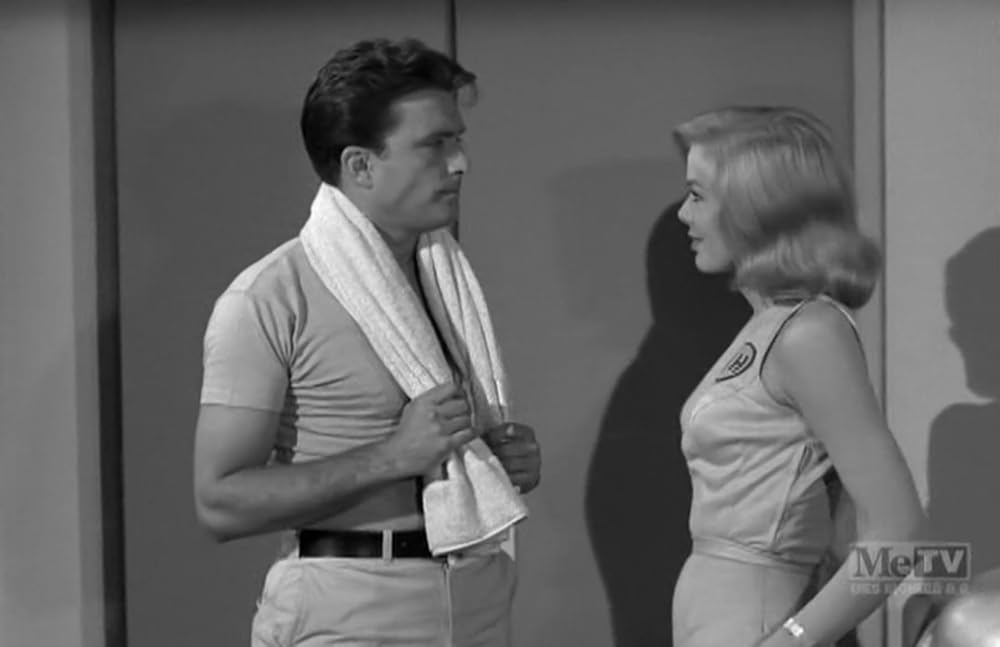
But it’s not Veronica who gets murdered; the victim is Bernard Daniels, the club’s owner (Les Tremayne is back, proving that he should have stuck to radio announcing rather than acting). He leaves behind a loving niece who’s engaged to Ward and hires Perry Mason to defend the poor shlub on a murder charge.
The list of suspects is high and, once again, extremely overwrought: in addition to Veronica, there’s the club’s doctor who is also her lover, Buzz, the locker room attendant (Dabbs Greer, who did eight Masons and who we’ll talk more about another time), who was cheated out of a partnership in the club; Clara, the bookkeeper, who’s in love with Buzz; Eugene, the CFO, who is shocked to learn that he has put his signature to over $75,000 in forged checks; and Rhonda, Eugene’s jaded but loyal wife.
The script is by Jonathan Latimer, one of the series’ stalwarts, but it stinks, and the cast has a hard time putting it over. Even Raymond Burr seems muted this time around. Leslie Parrish has more fun being a meanie than she did in her first episode, but her range is limited, and I kind of understand why we stopped seeing much of her after the mid-1970’s. (I did enjoy her on Star Trek in the episode, “Who Mourns for Adonais?”)
For our next installment, we’re going to look at an actor whose stage and screen career spanned over fifty years with over 250 film credits, who played one of Batman’s staunchest allies in every episode, and who appeared on seven episodes of Perry Mason!


