It is a truth universally acknowledged that in a murder mystery everybody lies. They lie about their motives, and they lie about their alibis because they don’t want to appear guilty in the eyes of the police. Naturally, the lies of the innocent make them appear guilty, and it is up to the sleuth to sort around this parliament of liars in order to find the culprit.
In real life, it’s harder to get away with lying than one would think. I’m not foolhardy enough to believe that I could never be pushed to kill someone, but I am equally certain that I would be caught right away because I would never be able hide my guilt! Monsieur Poirot or dear Aunt Jane would see through my lies, pat me on the head, and send me to the dock.
In the world of murder mysteries, a killer can look others in the eye and say, “I’m innocent,” and they will be believed for any number of reasons:
- they are practiced liars (i.e., Evil Under the Sun);
- they’re psychopaths (i.e., Murder Is Easy);
- they find a way to tell the truth and still lie (The Murder of Roger Ackroyd).
- what else are they going to say? (And Then There Were None)
None of this prevarication is necessarily theatrical, although, as we have discussed, many of the most successful liar-murderers have trod the boards. But what if there are two killers? What if a pair of lovers, or a husband and wife, or even a group of family members or close friends decide to commit a murder together? How much harder would it be to lie in concert? How would they get away with it? In Murder on the Orient Express, Linda Arden, the ringleader of a group of thirteen conspirators says, “. . . you should always rehearse properly.” That may be true if you want to shoot your playmate to death with a bow and arrow and make it look like an accident, but when it comes to lying, Christie proves several times that practice not only doesn’t make perfect, it tends to give the game away.
In Evil Under the Sun (1941), Hercule Poirot looks for a pattern beyond the killing of Arlena Marshall and realizes that the killers, a practiced team of con artists, keep working the same scenario. An even more delicious example occurs in one of my favorite stories in my favorite story collection, The Thirteen Problems. In “The Bloodstained Pavement,” told to the members of the Tuesday Night Club by artist Joyce Lemprière, a husband and wife’s holiday is interrupted by the arrival of an old friend in a chintz poinsettia dress. “Carol,” cries the husband, “in the name of all that is wonderful. Fancy meeting you in this out-of-the-way spot. I haven’t seen you for years. Hello, there’s Marjorie – my wife, you know. You must come and meet her.”
After Miss Marple hears Joyce’s story, she deduces from a number of clues that “Carol” and the husband are in cahoots to murder Marjory and get her money. At the end, however, Joyce explains how she discovered the truth: she had taken another painting holiday and happened to see the same woman in the chintz poinsettia dress, and the same husband – albeit with a different wife – run up and say: “Carol, in the name of all that is wonderful. Fancy meeting you after all these years . . . “ The fact that the killers have rehearsed their lines ironically gives them away!
The presence of a pair of killers has happened so often in Agatha Christie’s work that a term has sprung up for the concept: “the Deadly Duo.” Working in concert, this pair manages to commit a murder or two (or three) and nearly absolve themselves of guilt in the eyes of the investigators, sometimes despite appearing very guilty indeed. (In The Murder in the Vicarage, the lovers double down on their guilt – and nearly get away with their crime!) Christie is brilliant at taking this basic scenario and weaving multiple variations that spice up the trick and obfuscate the truth. The Deadly Duo may hide the true nature of their relationship or they may flaunt it. They may appear together seldom to never, or they might interact constantly. It is in the best of these relationships that something theatrical happens – a shared public scene where the conspirators reach down into their greedy little souls and exhibit extraordinary dramatic abilities.
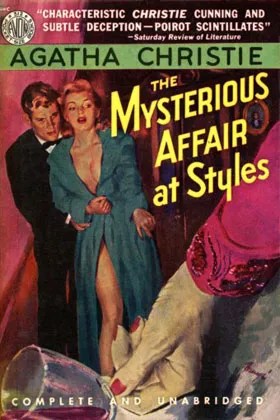
By far, the most common deadly duo consists of a pair of lovers. Sometimes they are even married, but whatever their status, the true nature of their relationship is hidden from the rest of the characters and from the reader. Christie employed this trick at the very start of her career, in The Mysterious Affair at Styles. As she explains in her Autobiography:
“The whole point of a good detective story was that it must be somebody obvious, but at the same time, for some reason, you would then find that it was not obvious, that he could not possibly have done it. Though really, of course, he had done it.” If she could successfully pull off this trick, Christie felt she could present as simple and obvious a problem as a husband killing his wife for her money – and still fool her readers.
Although he cuts a rather dramatic figure with his enormous black beard and obsequious manner, Alfred Inglethorpe has no theatrical practice on his resume. He is an unprepossessing member of the middle class who managed to fool Emily Cavendish into believing he loved her, something Emily herself helped pull off by reveling in his unctuous flattery. He plays the role of “most likely suspect” to the hilt and then switches to rescued martyr when his alibi is revealed. At the time he was supposed to be buying the poison that killed his wife, he was dallying with another woman! This means that someone else must have put on a big black beard and impersonated Mr. Inglethorpe in order to frame him.
At least, this is the conclusion – the trap – into which the police and the family fall. In the end, however, Poirot unmasks a secret relationship between Alfred and his cousin, Evelyn Howard. They are lovers, but they have successfully pretended to despise each other. What’s more, Evelyn, with her “large sensible square body, with feet to match” and “a deep voice, almost manly in its stentorian tones,” only has to don a suit and false beard to expertly impersonate the cousin she already resembles and supply him with the perfect alibi.
The deadly duos we’ve mentioned so far, and many others, rely on a theatrical “double bill” of role playing and impersonation/disguise. The female partner in both “The Bloodstained Pavement” and Evil Under the Sun impersonates the victim to provide the male partner with an alibi. As we’ve seen in The Mysterious Affair at Styles, impersonation sometimes involves a gender switch on the woman’s part (evidently Christie believed that female impersonation was a step too far!). The killer’s accomplice in The Mystery of the Blue Train is a noted male impersonator who affects her escape from the crime scene by disguising herself as a boy.
“The Stymphalian Birds,” one of my favorite stories from The Labors of Hercules, trades on Christie’s understanding of English travelers as linguistically helpless and instinctively prejudiced. Harold Waring, a rising politician fits this bill exactly, and his upright British soul makes him a prime target for a pair of blackmailers who may, or may not, be a mother-and-daughter team. The younger one, Elsie Clayton, plays to the hilt the old-fashioned damsel in distress; as Poirot explains, “she appeals, not to sex, but to chivalry.” She tells Harold that her jealous husband has followed Elsie to this vacation spot in Herzoslovakia, and it is only natural for Harold to come to the lady’s aid; that this would lead to the man’s accidental death puts him in a terrible spot.
Harold has the sensitivity to notice evil all around him and the short-sightedness to assume it emanates from a pair of Polish ladies whose flapping cloaks and long, curved noses make them look like ugly birds. He fails to notice the implications of Mrs. Clayton’s “deep voice and . . . masterful manner.” Fortunately, Hercule Poirot is also present (Christie introduces him very late so that Harold doesn’t have the time to let his prejudices against the Belgian take too deep a hold), and he unmasks the true blackmailers (and informs us that Mrs. Clayton is yet another successful male impersonator.)

Another pair of clever criminals who combine acting and disguise are the Skinner sisters from the 1942 Miss Marple story, “The Case of the Perfect Maid.” In Christie;s world, people ignore servants to their peril, but Mary Higgins, the Skinners’ new maid, is noticeable for her old-fashioned demeanor and admirably efficient service. She would be the answer to the Skinners’ prayer after the last maid was let go – if only Mary didn’t abscond with their best jewelry, as well as the jewels, silver and cash of their closest neighbors.
The truth is that there is no Mary Higgins: she is the alias of Miss Emily Skinner, the supposed hypochondriac who lays about in dark rooms where people cannot clearly see her. As Miss Marple explains, it’s a relatively easy impersonation to accomplish, and the only time that the two personalities are “together” is when Miss Marple is visiting and hears Miss Emily shout out orders just before “Mary Higgins” emerges from her alter ego’s room.
The tale perhaps is slight, with the central trick much more significantly rendered in the Poirot story “The Dream”published five years previously (which also contains a Deadly Duo). Yet, “The Perfect Maid” is significant in the ways it prefigures later stories. Set in wartime England, the English village is clearly undergoing a metamorphosis that will become a central feature of the Marple novels A Murder Is Announced and The Mirror Crack’d from Side to Side. Miss Marple is initially suspicious of Mary Higgins and indeed places greater faith in the inept Gladys Holmes, simply because the Gladys is local. And this brings us to the Skinners themselves who, despite the fact that Miss Lavinia has quickly inserted herself into local society and everyone in the village believes they have their finger on what makes these sisters tick, have only recently arrived in town.
They live in Old Hall, the Victorian mansion where Colonel and Mrs. Protheroe lived, a home that “had been proved unlettable and unsaleable” so it had been divided into four flats filled with newcomers, including a newlywed couple and a retired Indian judge (a foreigner!) and his wife. How easy for Miss Emily/”Mary” to get hold of the keys to her fellow residents’ homes and victimize them as well! It was a brilliant plan – but they didn’t reckon with Miss Marple, who was set on proving Gladys’ innocence and saving her reputation. It’s sort of a dress rehearsal for the pilgrimage she will make in A Pocketful of Rye to avenge the death of another inept maid, Gladys Martin.
The pairing of acting and disguise can prove a tricky and not always believable tactic.
The relationship between Alistair Blunt and his wife Gerda in 1940’s One, Two, Buckle My Shoe is, frankly, hard to swallow. Blunt is a financial figure who comes to represent the stability of the British government. This, in fact, is the argument he uses to try and persuade Hercule Poirot to let him get away with three murders and the framing of an innocent man. Yet Alistair’s attentions throughout his adult life have been equally centered on his marriage to Gerda, kept secret from his family because of their disapproval of her life as an actress. The pair double down on the secret so that Alistair can marry the wealthy Rebecca Arnholt in order to finance his rise in the banking world – all for the good of England.
And yet, not only are Alistair and Gerda unwilling to keep things strictly on the down low, they make an exciting game of their arrangement, with Gerda disguising herself in a variety of “roles” to affect meetings with her husband around the world. She plays three parts here, as Helen Montressor, Alistair’s cousin, as victim Mabelle Sainsbury-Seale, who knows too much, and as Mrs. Albert Chapman, the wife of a secret agent (!), whose apartment becomes Mabelle’s final resting place. It’s hard to believe that the pair would go to so much trouble – even for the security of England! – or that Hercule Poirot would not spot some similarity between cousin Helen and the fake Miss Sainsbury-Seale.
The situation in 1956’s Dead Man’s Folly is even more outrageous. We have to accept that James Folliat, younger son of the master of Nasse House, would desert his regiment during the war and then come back to his home under the guise of George Stubbs and become a lord; that he would marry a young girl, kill and replace her with his actual Italian wife who would then play the role of Hattie for years; that his mother would grudgingly comply and the local boatman, the only other person in town to recognize him, would remain silent; and that Hattie could play a double role as a foreign girl visiting the country and staying at the hostel next door and that nobody in her community, not even Hercule Poirot who met her under both guises, would recognize her.
The same scenario with variations is replayed to even more ludicrous effect in 1966’s Third Girl. This time, Andrew Restarick, the “Sir George” figure, is a complete fake, who killed the real Andrew and came back to assume the family fortune. Andrew’s uncle is too old to recognize him, and his daughter Norma is too young. Christie also has to load Norma with plenty of drugs to explain the fact that her stepmother Mary regularly changes her wig, costume and make-up to become Frances Cary, Norma’s roommate, and Norma doesn’t notice!! Once again, Poirot and Ariadne Oliver meet the woman under both these aliases and fail to make the connection for the longest time.
If you’re asking yourself whether I disapprove of this combination of acting and disguise/impersonation, I assure you I do not. I enjoy it for its entertainment value – the very outrageousness of these plots makes me smile – but I also appreciate when Christie manages to combine these tactics within a relatively realistic context. Here are three such examples:
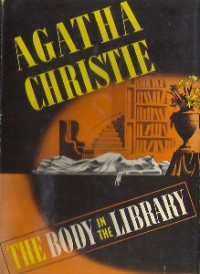
The Body in the Library (1942)
The deadly duo here is more subtle than usual. One can argue that this is a good thing, that Josie Turner, the cousin of murder victim Ruby Keene, and Mark Gaskell, the son-in-law of Jefferson Conway, are smart enough to keep their relationship under wraps by having, basically, no relationship. (One could also call this cheating, but I’m not here to litigate this matter.) This keeps the acting that the murderous pair has to do at a basic level: Mark is a guest at the Majestic Hotel, and Josie’s job is to act as hostess, bridge player, and entertainer. The pair’s interactions within the narrative are minimal and well within the bounds of realism.
When it comes to disguise, the most dramatic use of this is not with the murderers but with the two victims. In order to provide alibis for themselves and confuse the times of death, Josie and Mark destroy Ruby’s body in a flaming car and transform another dead girl, Pamela Reeves, into a facsimile of Ruby who they place in Basil Blake’s drawing room and plan to identify as Ruby Keene. The bonus they receive is that Blake finds the body and moves it to the Gossington Hall library, giving Josie a genuine surprise when she learns that her cousin has been found there.
While we are not witnesses to the murderers’ own disguise, it is also cleverly done. Gaskell impersonates a movie studio employee and convinces Pamela that she will receive a screen test. Josie, impersonating a studio make-up woman, bleaches Pamela’s hair and transforms her into Ruby’s likeness. It’s a heartless plan that results in the death of two teenagers. It’s also a believable plan.

Sparkling Cyanide (1945)
Some of my favorite moments in Christie occur when she dangles the solution before our eyes or tricks us into misreading the situation. (An example of the latter happens in A Murder Is Announced when Belle Goedler advises Inspector Craddock to trust Letitia Blacklock as a completely honest and reliable woman – which Letitia Blacklock definitely was.) Upon our introduction to secretary Ruth Lessing in Sparkling Cyanide, her thoughts give away so many things: “She had disliked Rosemary Barton a good deal. She had never known quite how much until that November morning when she had first talked with Victor Drake. That interview with Victor had been the beginning of it all, had set the whole train in motion.”
The meeting between Victor and Ruth is, plain and simple, a seduction. She can tell what a bad man he is as clearly as she can see how good looking he is, but “perhaps . . . she had overestimated her own resistance to his charm.” Victor plays expertly with her feelings, her sense of hopelessness at being loved by George Barton, her need to be adored by a man. It’s spelled out clearly in the scene, but we fail to recognize how Ruth has changed. From that moment on, she is playing a role that will help Victor murder Rosemary and inherit a fortune. And when it becomes time to murder Rosemary’s sister, Iris, Ruth continues to play her part well.
It is Victor who wears the disguise, that of a fellow guest, Pedro Morales, who then dons a second disguise, that of a waiter, in order to poison Iris’ champagne. Christie is extremely clever here in making us believe in the wrong murder, the one that never would have been except for an accidental stroke of bad luck. It makes sense that George would be killed because he’s nosing into Rosemary’s death. And naturally Ruth, no matter how she might feel for another man, would never take part in a plot to kill George. When we see her after his death, she is genuinely grief-stricken. It is, perhaps, the only way Ruth could have gotten through this scene – by truly mourning the man who was killed by mistake.
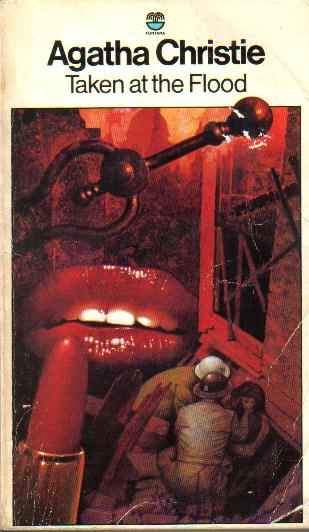
Taken at the Flood (1948)
The arguably over-complicated plot of this post-war novel begins with a clever conceit: wealthy patriarch Gordon Cloade is killed when his London home is bombed. His large family has been totally dependent on his largesse, but when he dies intestate, his new bride Rosaleen, the only survivor of the bombing, along with her brother David Hunter, inherits everything. When the siblings arrive at Warmley Vale to take over the family manse, they become Public Enemies One and Two.
It would make total sense for Rosaleen to be murdered – and she is, but not until near the end of the book, and only after two other deaths have occurred to obfuscate this plotline even further. In the end, Rosaleen turns out to have died with her husband, and David has seduced one of the maids, Eileen Corrigan, to impersonate Rosaleen in order to get their hands on the family fortune. In retrospect, we understand why Eileen seemed so nervous and uncomfortable in her role as heiress; we simply failed to understand how deep her role-playing went.
There is a second use of disguise arranged by a secondary criminal duo. Jeremy and Frances Cloade come up with the plan of having Frances’ brother, Charles Trenton, impersonate the late Robert Underhay, Rosaleen’s first husband, and show up to prove that the girl’s marriage to Gordon was invalid and to blackmail Rosaleen into retreating.
The incorporation of disguise certainly adds a colorful and entertaining element to Christie’s puzzles. Without it, the plots have a greater degree of realism – provided the secret pairing is believable.
“Triangle at Rhodes” (1936)
If you combine this story with the 1928 tale “The Bloodstained Pavement,” you get the progenitor of 1941’s Evil Under the Sun. (And if you read this one after you read Sun, you’ll probably get the whole thing wrong. Here we have two couples and what looks like the beginnings of an affair between Valentine Chantry and Douglas Gold. If we were looking for characters who seemed most likely to dissemble (or “act”), these would be the two we would pick. And yet, the true lovers are stuffy Tony Chantry and mousy Marjorie Gold, who must convince Hercule Poirot and the rest of their beach-loving guests that they are the victims and that Douglas is the one who murdered Valentine. It’s a fun but minor story in the canon – a case that Poirot solves by simply being observant.

They Do It with Mirrors (1952)
So many husbands in Christie do away with their wives that it’s a relief to be utterly assured (because Miss Marple tells us so) that Lewis Serrocold adores his Carrie-Louise. As long as the motive for Christian Gulbrandsen’s murder is to prevent the unmasking of Carrie-Louise’s would-be assassin, then Lewis must be innocent. Besides, he has a perfect alibi for Christian’s murder: at least a half dozen witnesses saw the mentally ill delinquent Edgar Lawson trap Lewis in his study and hold him at bay with a loaded gun.
My estimation for a title tends to be diminished when I easily solve it. I blasted through Lewis’ supposed alibi immediately. (When Christie describes a character as “breathing hard as though he had been running,” you should take it as fact that he has indeed been running.) The clever part of this book is the way Lewis misleads everyone as to the purpose of the murder. We foolishly ignore Carrie-Louise, who simply cannot believe that anyone wants to kill her (they don’t!) and take everything we see and hear as evidence that there’s a potential poisoner in their midst.
Lewis could not execute this plan alone. This is the only deadly duo on this final list where we’re dealing not with lovers but with a father and son. It does seem a little far-fetched that Edgar, a clever young man, would plant himself at Stonygates and play the exhausting role of a paranoid schizophrenic in order to be close to his illegitimate father (and perhaps be on call should the need arise.) But the plan is highly dramatic, and rightfully so, in a novel bursting with allusions to magical performance and theatre arts.
In her later years, Christie relied increasingly on deadly duos and conspiracies. Of the thirteen novels published between 1961 and 1973, eight depend on more than one person to enact the crimes contained therein. 1967’s Endless Night and 1969’s Hallowe’en Party both contain a deadly duo that is hidden from the reader until the end. The trick is effective in Endless Night because that book is barely a whodunnit and more of a psychological thriller, and because we see Michael Rogers and Greta Andersen interacting throughout the novel. They seem to despise each other, and the reader is led to believe that each is protective of Ellie. Although they succeed in their plan to murder her, Christie provides Michael and Greta with an extreme form of justice: fearing exposure, Michael murders his mistress and then loses his mind.
Hallowe’en Party is far less satisfying in its depiction of a deadly duo. Michael Garfield, like Lewis Serrocold, is an idealistic murderer in that he will do anything to achieve his vision of utopia on earth. Rowena Drake’s motives are money and self-protection. They hardly seem a match, and we never see them together long enough to even consider this. And yet the whole plot centers on the consequences of their passion! Rowena’s aunt disinherits her for committing adultery in favor of an au pair, which leads to multiple murders over many years. It doesn’t help matters that Christie inserts another secret pairing, that of Michael and Judith Butler, and that Miranda, the child Michael tries to murder in the end, is his own daughter.
You might conclude from all this that, for a deadly duo to really crackle in a Christie tale, disguise is a true benefit. However, the greatest duo in the canon – and, to my mind, in most of detective fiction – has no need for disguise. Christie’s brilliance with the trope here deserves a deeper consideration, so let’s look at 1937’s Death on the Nile.
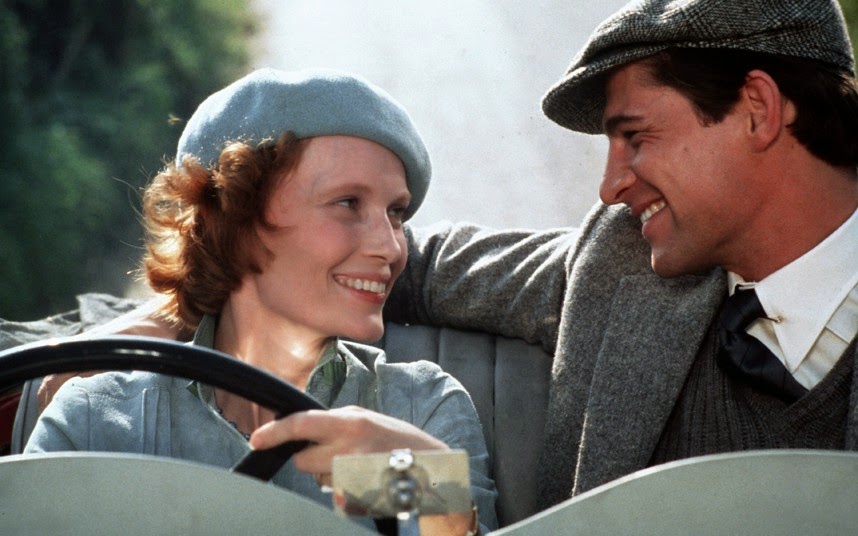
One of the most affecting aspects of this novel –I think there are elements of the book that transcend genre – is that we meet Jacqueline de Bellefort and Simon Doyle before they assume the mantle of Deadly Duo. Jackie, “the fiery little creature (who) flung herself open-armed upon Linnet” Ridgeway is impoverished, intelligent, and passionate about her friendships and her lover. She playfully describes herself as Linnet’s “trusted Maid of Honor,” – and she means it. All she needs from her old friend is for Linnet to give her fiancé a job and then they can afford to be married.
The Simon whom we meet at Chez Ma Tante, the chic restaurant where he takes Jackie to celebrate the possibility of his employment, is tall and broad-shouldered and perhaps a bit too self-absorbed for his own good. Jackie’s insecurities are strong enough for Hercule Poirot to notice from his table nearby. “Do you really care – as much as I do?” she asks her beloved, and despite Simon’s protestations, Poirot wonders the same thing. At this moment, the seed is planted: Simon may be ripe for the plucking by a woman with more grace, more power, more wealth, than his fiancée can provide. Poirot doesn’t trust that Jackie’s all-consuming love is good enough for Simon, and, therefore, neither do we. When we learn a half dozen pages later that Simon has married Linnet, we can all nod and say we expected as much to happen.
What we don’t know until the end is that Simon is torn: he loves only Jackie, but he wants “all the things you can get with money – horses and yachts and sport . . . “ Once he meets Linnet and feels her trying to hook her silky claws into him, he proposes a plan: “If I’d any luck, I’d marry her and she’d die in about a year and leave me all the boodle.” He starts to devise ridiculous schemes; he even reads up on arsenic and finally talks himself into it. Jackie confesses to Poirot, “I was terrified – simply terrified. Because, you see, I realized that he’d never pull it off. He’s so childishly simple . . . He would probably have just bunged arsenic into her and assumed the doctor would say she’d died of gastritis.”
Consumed by her love for Simon, Jackie utilizes her superior brain and comes up with a complex scheme that will require them both to do a lot of acting. For Jackie, the stalking of the honeymoon couple will require little strain: as much as she truly loved her old friend, their relationship was spoiled when Linnet made a bold play for Simon. And Simon is motivated by the reward at the end to cast off his true mate and make love to this woman he intends to kill. For most of the period before the murder, this consists of Jackie following the couple around on their honeymoon and “making a scene.”

The centerpiece of their plan, however, is a bold little play enacted before fellow passengers that will cast all of the suspicion on Jackie before exonerating her and Simon by providing them with perfect alibis. Think of what they have to accomplish here: Jackie must play drunk and work her way into a fever pitch of hysteria, after which Simon must feign physical agony in order to get Rosalie Otterbourne and Jim Fanthorp to get Rosalie out of the salon and leave him alone.
After the murder, when Jackie is coming out of a drugged stupor and Simon is truly suffering, she must feign contrition and he must show grief – and they must begin the first steps in “reconciling” with each other after months of feigned enmity. They must also improvise like mad: Simon has to deal both with Louise Bourget’s veiled threats, spoken in front of Poirot and Colonel Race, and with Mrs. Otterbourne’s revelation that she saw who murdered Louise. If I had any qualm, it would be that I’m surprised that Simon possesed the quick wits to deal with these situations so smoothly. I almost said “effectively,” but Simon’s acting doesn’t save him here. His wording to Louise “I’ll look after you,” strikes the detective as odd. He also notes the odd behavior of Simon raising his voice to speak to Salome Otterbourne minutes before she is shot to death in front of them both.
Perhaps Linda Arden was right about the need to rehearse.

