Of all the actors who we are fortunate enough to have seen on both Batman and Perry Mason, the most prolific of them all was Neil Hamilton. He played Police Commissioner James Gordon on every episode of one series and faced off against Perry on seven episodes that spanned nearly the entire series, from Season One through Eight.

Born in Lynn, Massachusetts in 1899, James Neil Hamilton went into modeling as a teenager and became a popular model for Arrow Collars. He was a favorite of commercial illustrator J. C. Leyendecker, whose drawings of Hamilton often appeared on the back covers of The Saturday Evening Post. From there, he began to perform in professional stage productions, and in 1918 he began a film career that would last for half a century.
Hamilton was a popular movie star in the 1920’s and 30’s, appearing opposite many leading ladies, including Joan Crawford, Bebe Daniels and Clara Bow. (In a 1928 film with Bow called Three Weekends, he played a character named James Gordon.) He was the first onscreen Nick Carraway in the now lost 1926 film, The Great Gatsby. And he played the snooty fiancé whom Jane throws over for the better guy in both Tarzan the Ape Man and its sequel. (In the first, Hamilton got top billing!)
For most of his career, I would venture to say that Neil Hamilton got nice little roles in prestigious pictures. The WWII classic Since You Went Away is all about Hamilton – or, at least, the family he left behind; we only see the actor in photographs around the house. He got better roles in “B” pictures – including a number of mysteries where he might play the hero or even the killer. Film work dried up in the 1940’s – Hamilton insisted that this was because he had insulted a studio executive. He never lost his looks or his elegant bearing – or his faith: a staunch Catholic, he was married to the same woman for sixty-two years until his death in 1984.
As sometimes happens to old actors, a whole new fame surrounded him when, at the age of 67, he was hired to play Commissioner Gordon on Batman. His shining of the Bat-Signal or utilizing the bright-red Bat-Phone was always a highlight of the episode. Hamilton played it straight from start to finish on all 120 episodes of the series, which was a relief when some of the goofier humor started to wear down even this twelve-year-old.
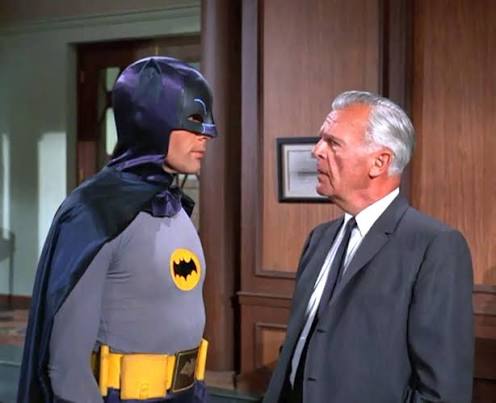
Hamilton also had the perfect resume to become something of an ensemble player on Perry Mason. His debut was in Season One’s adaptation of the novel The Case of the Lazy Lover, and he returned the following season for the adaptation of The Case of the Dubious Bridegroom. Hamilton went on to appear in original teleplays in Seasons 3, 4, 6, 7 and 8. (We’re going to discuss four of them here.) It seems clear from their chemistry that he had a friendship going on with the show’s star and that Raymond Burr liked having him around, despite the fact that they never made a film together. At any rate, Hamilton had a tendency to enliven even a less exciting episode with his presence.
“The Case of the Golden Fraud” (Season 3, Episode 7, premiered on November 21, 1959)
Hamilton’s first appearance in an original teleplay amounts to little more than a cameo appearance. He plays Henry Noble, the CEO of an investment brokerage, who has to decide which employee – Richard Vanaman (Arthur Franz, who appeared in five episodes) or Fred Petrie (Alan Hewitt, four episodes) – is going to be his new vice president.

Richard nearly falls victim to a blackmail set-up by a woman who is an old friend of Petrie’s scheming wife. He uncovers the scam in time and storms out of the woman’s apartment, only to discover that he left behind an old British gold coin. When he returns to get it, he discovers the woman is dead. Of course, he is bound over for trial, and Franz, a fine actor, keeps us sympathetic even as we wince at his every stupid move.
It’s an excellent episode, early enough in the series that it isn’t bogged down by the formula. The murder happens early on, before we even meet all the suspects. Vanaman is tricked into an arrest (and deserves it for being so stupid.) June Dayton plays his loving but suspicious wife and would play similar roles in four other episodes. Alan Hewett, who often played smarmy characters, could easily fall into type here – and doesn’t. His wife Doris is played by Patricia Huston, who really sinks her teeth into that character’s villainy. Because I’m an old hand at this, I spotted the murderer right away, but their reveal was nicely written (by Robert C. Dennis and Maurice Zimm) and performed.

“The Case of the Difficult Detour” (Season 4, Ep. 21, premiered on November 21, 1961)
A bunch of big galoots are operating construction equipment in the wilderness in order to build a rode from one side of a lake to another and reach a new land development when a police car arrives and tells Pete Mallory, the galoot in charge (Jeff York, three episodes) that he’s trespassing on another man’s land. That other man is Ames, played by Neil Hamilton, and when Ames beats Mallory in court, he’s decent enough to suggest Mallory meet a friend of his, a lawyer named Mason, and get some advice.

Pete is too much of a hothead. Seeking to discover how he could have made such an mistake about the land, he uncovers a conspiracy to defraud him that involves nearly every other suspect in the cast. After beating up his crooked partner Stuart Benton (Jason Evers), Pete learns that Benton has been beaten to death. He turns himself in to Perry, who quickly figures out that Mallory is innocent and needs a good defense attorney!
This one definitely hews to formula. Hamilton’s part is better than in the last episode; he even gets a nice grilling from Mason on the stand! But in the end, Mr. Ames is too decent a person to be the killer – plus, he’s Mason’s friend! At least there are several good possibilities for culprit that keeps us guessing a bit more than usual until the final confession.

“The Case of Constant Doyle” (Season 6, Ep. 16, premiered on January 31, 1963)
This one is a doozy! During Season Six, Raymond Burr had to take a leave from the show for health reasons. He was out for four consecutive episodes, and the producers filled his spot with the likes of Walter Pigeon, Hugh O’Brien, and Michael Rennie as guest attorneys. (Burr made cameo appearances from Mason’s hospital bed to “advise” his colleagues.) The most exciting guest star, however, was Miss Bette Davis, a huge fan of the series. This must have been a special thrill for Neil Hamilton, who had acted with many great female stars but finally got a chance to play opposite Miss Davis. But you can almost see the electricity on the screen – not of Miss Davis’ performance so much as with how excited (and maybe a little scared!) everyone in the cast must have been to have her on set.
Davis plays Constant Doyle, a corporate lawyer who shared a practice with her husband but whose business has dried up since he died. A young man named Cal Leonard is arrested for trying to climb the fence of the Otis Corporation, and he demands Joe Doyle for his lawyer because Joe took an interest in him when they met at a reformatory. Constant shows up instead and, long story short, ends up defending Cal for the murder of his cousin, a real louse who worked for the Otis Corporation, cheated Cal out of money owed to his late father, blackmailed Mr. Otis, cheated on his wife, and so on and so forth.
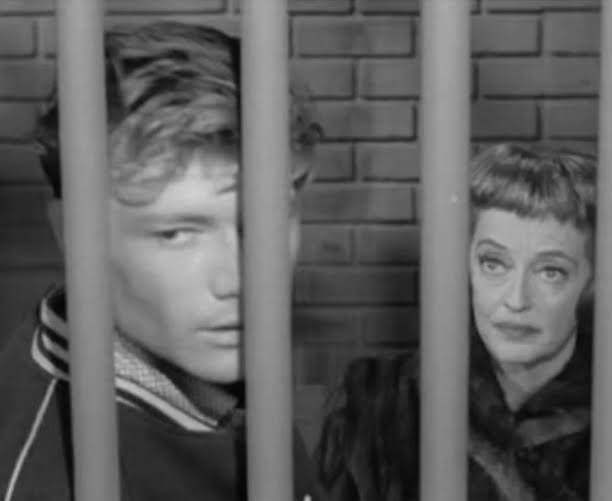
I’m assuming Miss Davis’ salary was high because this is strictly a small-cast production. That doesn’t mean that a bunch of pros weren’t brought in: Neil Hamilton gets to flirt with Davis as a shipping magnate who had also employed Cal’s dad (I’m only sorry that I could not find a picture of them together). Les Tremayne makes the third appearance I’ve seen in three days, this time as Mr. Otis, and it’s his most impressive work yet (he would end up making eight episodes, so I will surely run into him again!). Child star Peggy Ann Garner is the victim’s widow and is terrible at playing drunk; and Frances Reid shows up as Constant’s secretary just a few years before she would settle in to playing Alice Horton on Days of Our Lives for about a hundred years!
I’m a big fan of classic Bette Davis – Now, Voyager and All About Eve are two of my favorite films of all time – but series television is not her metier! Baby Jane was behind her, and Hush Hush, Sweet Charlotte was ahead. This was the year of Dead Ringer, the last (and least) time Davis played twins. Here, she’s either attempting an impression of herself or an impersonation of – Raymond Burr as Perry Mason! Still, it’s fun watching Davis suck down cigarettes and fling her arms about, and if Constant unmasks the villain using a fact I learned from Professor Fordney in Minute Mysteries, and if the surprise ending is ridiculous, at least it’s trying to say something about the tendency to dismiss women in professions and teenagers in general – especially teenagers with enormous hair and a tendency to overact. (Note that Rebel Without a Cause is NOT one of my favorite films.)
“The Case of the Drifting Dropout” (Season 7, Episode 28, premiered on May 7, 1964)
The last Neil Hamilton performance we will include here also featured character actors Malcolm Atterbury and Vaughn Taylor, who between them appeared in thirteen Perry Mason episodes and probably everything else you watched on a screen in their lifetimes. (Atterbury was in The Birds and Taylor was in Psycho if you want some prestige thrown in!) Already this week, I’ve watched Atterbury confess twice, and the main suspense for me here was which of this pair would turn out to have dunnit by the end! (Answer below.)
The plot for this one, frankly, is one big drag. Barry Davis (Carl Reindel), a hip cool cat, is always fighting with his boss, junkyard owner Mort Lynch (Ted de Corsia), who is running for mayor. It might just be that Mort is riding Barry to get the kid to stop being such a bad actor, I mean, so unsure about his future. Anyway, Barry quits one job and takes another with the local paper that is run by Malcolm Atturbury, whose secretary (Cynthia Pepper) is Barry’s girlfriend and whose brother (Vaughn Taylor) is a drunken beach bum who is “living the life.” Oh, and Neil Hamilton fits in there somewhere as the local insurance salesman.
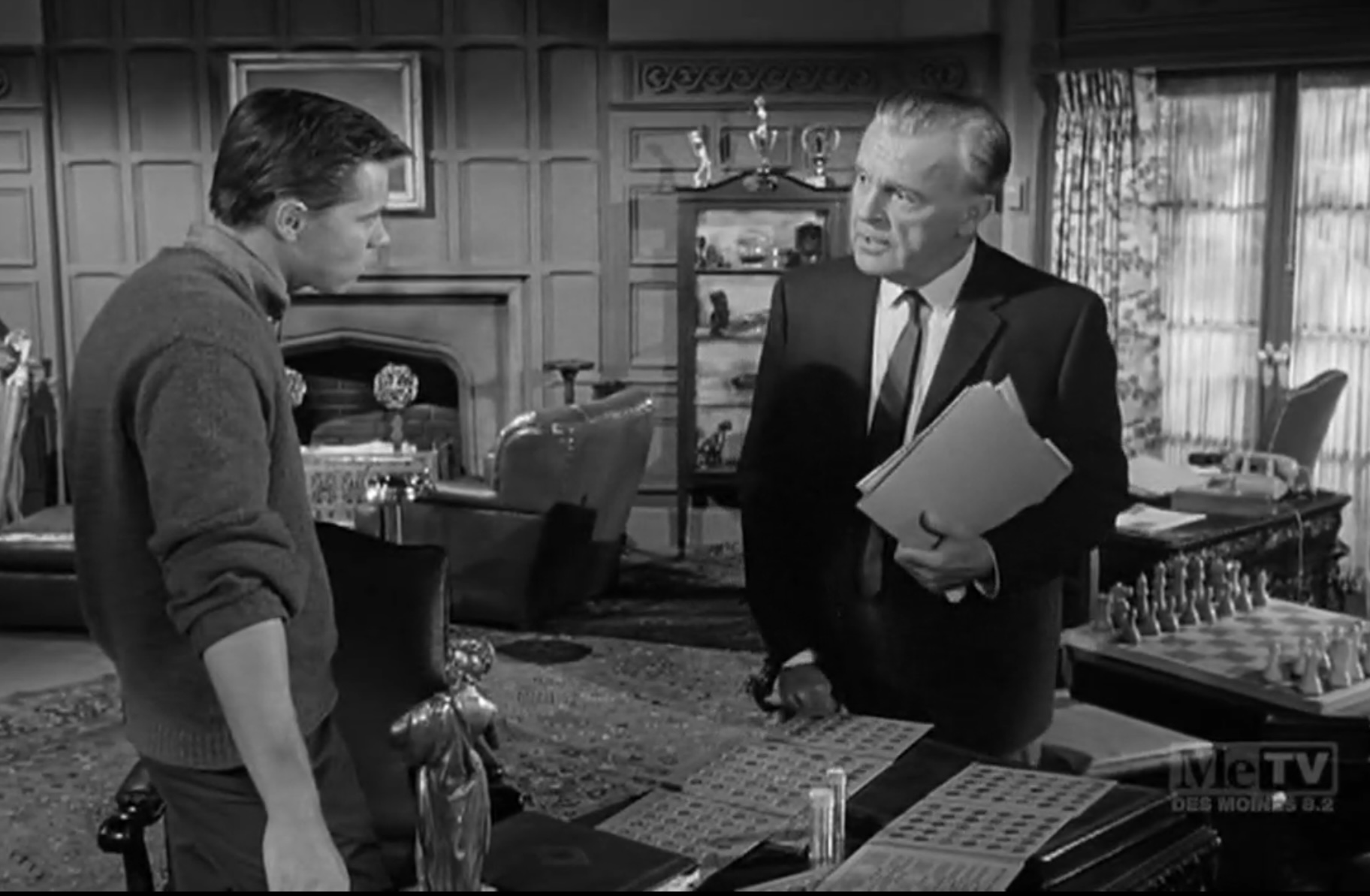
The junkyard guy gets murdered, Barry is arrested, and there’s a counterfeit plate for a ten dollar bill floating around that has something to do with Barry’s uncle. Frankly, I sort of gave up on this whole thing. Much of it has to do with the atrocious acting of Carl Reindel, who might be dealing with horrific dialogue aimed at making him look like an angry young man but who still needs to learn how to control his body. (NOTE: he gets better two years later when he plays the murderer in an episode we have already reviewed.) And Cynthia Pepper, while cute as a button, is a terrible actress, summed up by the fact that her 54-year-long career, summed up on IMDB, contains twenty-one credits. There’s also a secretary at the junkyard, played by Natalie Norwick, a woman who worked very little during her 32-year-long career but at least appeared in seven episodes of – Dark Shadows, where she played various roles like a masked ghost and for three days the stand-in for a corpse in a coffin!!!
At least we have Hamilton, Atterbury, and Taylor to entertain us. Which one of them confesses at the end? (V’z unccl gb fnl, pbafvqrevat gur gbcvp sbe gbqnl, gung vg’f bhe Arvy jub gheaf bhg gb or gur zheqrere. Gheaf bhg ur unq fbzrguvat gb qb jvgu n gjragl-lrne-byq pbhagresrvgvat evat. Vg’f avpr gb guvax gung ur, Nggreohel, naq Gnlybe cynlrq “gnt, lbh’er vg!” bire gur pbhefr bs n terng znal rcvfbqrf!)
For our final foray into the Perry Mason – Batman connection, we’re going to look at the work of one of my favorite villains, who did estimable work on both series but whose biggest claim to fame is a tour de force with two of the biggest screen legends of all time.

 Ah Sweet Mystery!
I like hearing about how famous people lobbied to get a spot on Batman because it was so popular. Otto Preminger called the producers and begged for a role because his kids were demanding it. Can you imagine how tyrannical the little Premingers must have been. Anyway, here’s Alan Napier’s take on Preminger:
“I had worked before Batman with Awful Otto Preminger in Forever Amber as the English expert and dialogue director. Otto got me mad because if anyone dried up on a close-up, he would say, ‘Why don’t you concentrate?’ Then he comes on the set of Batman. Instead of looking six foot tall, as I thought, he looks five foot tall, because it is now my territory and he is playing Mr. Freeze. It happens that I was on the set while he was doing a series of close-ups. And in every one of them Otto dried up and it was only because of the gentleman built into my nature that I didn’t say: ‘Otto, why don’t you concentrate?'”
LikeLiked by 1 person
This is a fabulous story! One of my biggest regrets doing research for this project was the discovery that Alan Napier never appeared in a Perry Mason episode! And he really should have!
LikeLike