In the early days of television, serialized programming was rarely to be found in prime-time. This might seem odd because people like long sagas with character arcs and cliffhangers. (Think of all those people waiting on the docks of New York to find out if Little Nell was alive or dead in The Old Curiosity Shop!) The rare exceptions tended to be found in, of all places, comedy: I Love Lucy gave us many stories that spanned a season, like Lucy’s pregnancy, Ricky’s starring role in a Hollywood film, and his band’s tour of Europe. For the most part, however, the episodes of both comedies and dramas were self-contained, and you could pretty much watch a season of any show in any order. For serialization, people turned to daytime – and to soap operas.
Soap operas – called that because their early sponsors literally sold soap – began on radio and extended to television, reaching a peak during the 1970’s. (There were nineteen soaps on network TV in 1970!) My grandma loved her “stories,” especially Edge of Night and General Hospital. Most people didn’t brag about watching this admittedly “inferior” fare, although why someone would put down others for watching Search for Tomorrow but not have a problem with Gilligan’s Island is beyond me. Those of us who were Dark Shadows fans never felt like we were watching a soap opera – the vampires and the werewolves made it too cool.
It was the English who, in addition to the Beatles, tea parties, and the foul mispronunciation of “secretary,” gave us prime time soap operas. Coronation Street has been going strong since 1960, followed by a host of others like Emmerdale and EastEnders. In 1964, producer Paul Monash thought he could capitalize on their popularity by bringing something serialized – and salacious – to American network TV. He chose Grace Metalious’ Peyton Place, such a best-seller when it came out in 1956 that a film adaptation was produced the following year. Despite the fact that most of the good stuff from the book couldn’t get past the censors, the film was a smash hit. For TV, Monash would also have to whitewash some of the novel’s plot: goodbye incest, hello teen pregnancy (which still got the show into trouble with conservative viewers and pundits.)
The series ran for five seasons, although its quality began to plummet after Season Two, when break-out star Mia Farrow, on the advice of then-husband Frank Sinatra, left the show to birth the spawn of Satan!! The main families during the series’ start were the wealthy but troubled Harringtons, the middle-class and troubled Mackenzies, and the working-class and troubled Andersons. We met Julie Anderson in our last crossover episode when we discussed Kasey Rogers, remember? Julie was the brutalized wife of George Anderson (Henry Beckman), the beleaguered mother of Betty Anderson (Barbara Parkins) and the secretary and lover of Leslie Harrington (Paul Langton). After a couple of years, she left town to find new happiness – with Larry Tate on Bewitched!
And wouldn’t you know it? Every one of these folks was a guest star on Perry Mason.
Let’s start with Leslie Harrington, played by Paul Langton, because he and I went to the same high school. (NOT at the same time, wise guy!) Langton was born in 1913 in Salt Lake City and moved to San Francisco to be with his father. He did some stage work, including Broadway, and began a busy but not illustrative film career in 1941, becoming a contract player with MGM. He appeared in all sorts of films – war pictures, Westerns, science fiction (he plays the brother of The Incredible Shrinking Man). Langton started working on TV in early 50’s anthology series and then in a wealth of TV shows. He had a regular role on the early soap opera The Brighter Day.
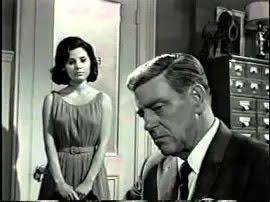
On Peyton Place, Leslie Harrington was a central character for the first part of the series, a seemingly good man who did a lot of bad things, including adultery and covering up the truth about a murder, which resulted in an innocent going to jail for years. He was the father to the show’s two heartthrobs, sons Rodney and Norman, and spent most of his waking hours disappointing them until he finally left town in disgrace.
Langton also made five appearances on Perry Mason, and since he and I share the same alma mater, Lowell High School, I’m going to present a Langton double play here. The first, the eighth episode of Season Three, was “The Case of the Bartered Bikini,” which debuted on January 5, 1960. It was another episode directed by Arthur Hiller early in his career and yet another plot based in the fashion industry.
Someone is stealing new fashion designs from John Lupton’s company and selling them to other fashion houses and wholesalers, including to Lupton’s main rival, Simon Atley (Langton). One moment in the presence of Lupton’s designer Rick Stassi (Stephen Bekassy) and you know he’s doing the stealing and selling of his own designs. He’s also running through every female in the cast, and the first fifteen minutes of the episode give us scene after scene of Stassi behaving so abominably to everyone that he might as well be wearing a t-shirt that reads “Kill Me Please!”
Someone finally does kill the guy and a young model (Terry Huntingdon, whose twelve credits on IMDB include The Three Stooges Meet Hercules) who happens to be Lupton’s beloved is arrested. Perry Mason defends her and finds the real killer. On the one hand, the culprit’s identity is less obvious than usual; on the other hand, this one’s a snorer.
We’re on much higher ground in “The Case of the Wandering Widow,” which premiered on October 22, 1960, the sixth episode of Season Four. It’s not often that a PM episode hearkens to an Agatha Christie plot, but the beginning of this one seems inspired by Ordeal by Innocence. Years ago, Morgan Riley (Dean Harens) was arrested and convicted for the murder of the husband of Lorraine Kendall (Coleen Gray, the actor who played The Leech Woman and the killer in a certain Ellery Queen adaptation) and sent to prison, despite claiming to have an alibi. Years later, a sailor named Burt Stokes (Max Showalter) shows up at the prison: after a long haul in the Far East and then Holland, he has finally seen the papers and realizes that he is Riley’s alibi! The wrongfully accused man is set free, and Kendall’s family – his widow, her brother, her late husband’s sister and her husband – all become suspects in the earlier killing.
In the Christie novel, the man who supplies the alibi is heroic: he sticks around to support the family as they go through hell and ends up marrying one of the grown daughters. Here, Seaman Stokes is a villain, who uses his knowledge to individually blackmail the Kendalls, seemingly for the benefit of poor Riley, who knows nothing about this scheme. When Stokes is found murdered in a park on an evening when Lorraine was set to meet him, she is arrested for his crime. Gray does a terrific job of seeming guilty throughout, much of this explained by her desire to protect her young son, Jimmy (played by Stephen Talbot, whose largest acting credit was as Gilbert, Beaver Cleaver’s best friend on Leave It to Beaver.)
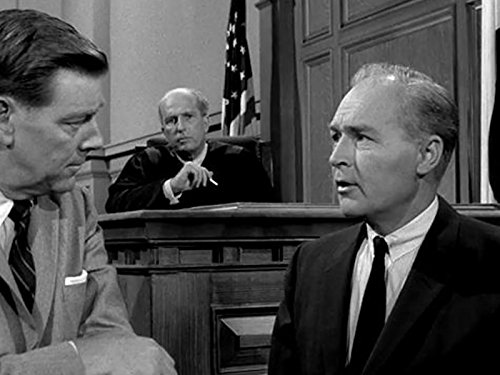
Maybe the whole set-up appealed to me because of the Christie angle, but it’s a suspenseful episode with lots of action and a nice division of suspicion amongst the four suspects. And most of these actors know what they’re doing: Harens and Miss Gray each appeared in four episodes of PM, while Max Showalter appeared in six, and their experience shows. Paul Langton plays the District Attorney who prosecutes Lorraine, and he and Burr establish a cordially antagonistic relationship. Langton made such a good substitute for Hamilton Burger, in fact, that later in the season he returned as another prosecutor in “The Case of the Cowardly Lion,” an episode we discussed when we talked about Betty Lou Gerson.
I can’t think of a better compliment to this episode than to say that, while I maintained (accurately, it turns out) a suspicion over a certain character due to the way the tropes of the show and of classic mystery have been ingrained in me, the actual confession, with its transformation from innocent protestations to admission of guilt, was one of the most chilling I have ever seen in the series.
* * * * *
Barbara Parkins was born in Vancouver, British Columbia in 1942. Even as a child, the lights of Hollywood called to her, and at 16 she and her mother moved to Los Angeles. She went to Hollywood High and also studied acting, dance and fencing, working as an usher to help pay for all her lessons. She did back-up work in nightclubs for stars like George Burns and in 1961 began making guest appearances on various TV shows. In 1964, she scored an important but short-term role on the new series Peyton Place. Parkins would play Betty Anderson, a girl from the wrong side of the tracks, whose troubled home life and passion for the unavailable Rodney Harrington would lead her to become the series’ “bad girl,” leading to her much-deserved destruction in a car accident.
Trouble was – the audiences loved her! And so the plan was changed: Betty remained in town, and in fact she was the only leading actor to be nominated for an Emmy Award and one of the few (besides Ed Nelson) to remain with the show until it ended. She would have gone on to do a spin-off series focused on her marriage to Rodney (yup! She got him!!), but her co-star (more about him below) refused to do the series, so it was scratched. At any rate, Parkins returned to make a TV-movie sequel and always spoke highly of what Peyton Place did for her.

If some thought the series was trashy, it was nothing compared to Parkins’ other major credit, the starring role of Anne Welles in the film Valley of the Dolls. Even good girl Anne fell prey to the lure of the “dolls” the uppers (or were they downers?) that everyone in show business got hooked on! This did not make Parkins an “A list” Hollywood star, but some of that was of her own choosing. She went to Europe and made movies there, returned to America for some guest spots on TV and then retired from acting to concentrate on her photography.
One of her earliest guest spots on TV was on Perry Mason, and one of her last was in a PW TV-movie, The Case of the Notorious Nun (Parkins did not play the nun). Her early appearance was in “The Case of the Unsuitable Uncle,” the seventh episode of Season Six, which premiered on November 8, 1962. Parkins more than holds her own against a cast of veterans as Paula Durham, a wealthy young woman on the verge of coming out to society. Her comfortable life with Mother and Dad and suitable boyfriend is disrupted by the arrival of her ne’er-do-well Uncle Dickie and his seafaring friend “Lord ‘Arry” Fothergill. Dickie walks around smirking as if he has a lot of secrets that could smash up the family, and it turns out that he does. It’s no surprise when he is found murdered on the docks and Harry, who has become the beneficiary of Harry’s nonsensical will – except it’s not nonsense – is arrested for the crime.
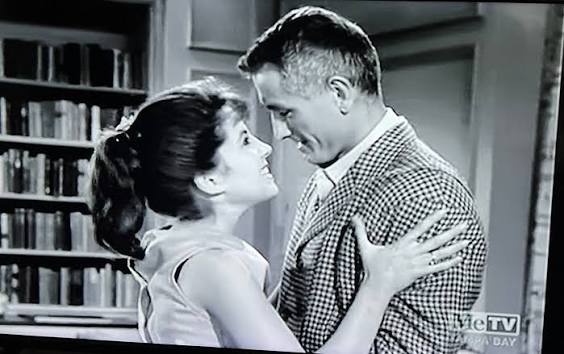
The cast here is fairly prestigious: Mother is played by Anna Lee, who had a nice little movie career in films like Bedlam, opposite Boris Karloff, before she settled into a comfortable fame as Lila Quartermaine on General Hospital. Dad is played by Ford Rainey, a fine character actor with a long list of credits, including the role of Abraham Lincoln on The Time Tunnel. Liam Sullivan plays Uncle Dickie with sort of a Scottish accent, which is odd since he was born in Bakersfield. But Sullivan was no stranger to classical sorts of roles. He, Rainey and Sean McGlory, who plays Harry, each appeared in multiple episodes of Perry Mason. McGlory has an accent that I was certain was fake – turns out he was born in Dublin, so perhaps he was an Irishman attempting a Cockney accent. Either the actor or the character drove me crazy, plus the “surprise” reveal of the murderer was of a character who had very little to do with the plot, and his unmasking seemed to have surprisingly little effect on the other members of this “close” little group. I feel bad for Barbara Parkins: she is very good here and deserved a better mystery.
* * * * *
Like Parkins, Henry Beckman hailed from Canada, but Hollywood didn’t beckon him so much as it became a part of a long and varied career on the stage and screen of both countries. He won two Supporting Actor awards for the Canadian films, Why Rock the Boat? (1975) and Blood and Guts (1978). He played a number of uncredited roles in some terrific films, like Niagara, The Wrong Man and Breakfast at Tiffany’s. Alfred Hitchcock cast him again as a detective in Marnie. Beckman was an acting veteran by the time he was cast in Peyton Place, playing George Anderson, Betty’s father. George does terrible things to his family and seems like an abusive drunk. At one point, he is sent off to an asylum, where it is discovered that he is manic/depressive or bipolar. Properly medicated, I guess, he returns to Julie and escorts her out of town and right into the arms of David White on Bewitched.
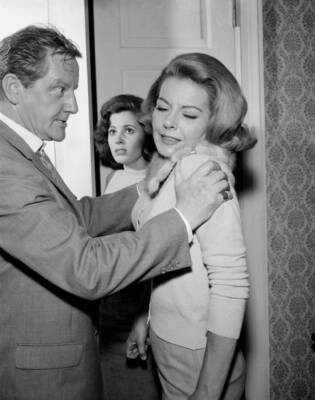
Beckman went on to do lots of television, including regular or recurring roles on McCale’s Navy and Here Come the Brides, (playing Captain Daniel Clancy, the ship’s captain who brought all the pretty girls to Seattle; Beckman fell in love with the part of Washington state where they filmed the show and moved his family there), as well as a several one-season flops: Flash Gordon (as Commander Paul Richards), Check It Out, Don Adam’s follow-up to Get Smart (Beckman played Alf Scully), and a crime drama called Bronk opposite Jack Palance.
Beckman made four appearances on Perry Mason. The first was in the twenty-sixth episode of Season Three, “The Case of the Flighty Father,” which debuted on June 11, 1960, only one week after his future Peyton Place wife Kasey Rogers appeared in “The Case of the Irate Inventor.” It’s always fun to see a take on a classic mystery trope; this one hearkens to one of my favorite John Dickson Carr novels, The Crooked Hinge.
Young Trudy Holbrook (Anne Benton, another actress with a deservedly short resume) has just buried her mother and is about to assume her inheritance of ten million dollars when a man (Hayden Rorke, three appearances on PM before he assumed his regular role as Dr. Bellows on I Dream of Jeannie) appears lurking around her home who claims to be Jay Holbrook, the father who deserted his family as a baby. Trudy takes one look at the guy, embraces him as her father and invites him to move in with her, much to the chagrin of a trio of cousins (classic silent screen star Francis X. Bushman, Berry Kroeger, and William Allyn, who have fourteen PM episodes between them).
Enter another man (Francis de Sales, five episodes), found in San Francisco, who claims to be Trudy’s father, and before you know it, Francis X Bushman has been bludgeoned with a fire poker. He was the only person who might have identified the real Jay Holbrook, except that he was blind. At any rate, it’s Trudy who is arrested for the murder, convinced as she was that Hayden Rorke was her dad and the other guy an imposter set up by her cousin. Honestly, the two actors are fine playing the man with just the right combination of earnest honesty and suspicion, but the writers are too committed to justifying Trudy’s naïve and ridiculous certainty that much of the suspense is lost.
Henry Beckman plays Trudy’s mom’s chauffeur, who is loyal to a fault – to himself. Personally, I had him pegged as the murderer from the start, but you’ll have to watch this very good episode (minus the histrionics of the defendant) to find out if I was correct.
* * * * *
We’ve focused on some of the more villainous characters in Peyton Place, so let’s examine a couple of its heroes, like Dr. Michael Rossi, who arrived in town at the start of the series, wore down the New England coldness of the townsfolk and took care of them all, even as he romanced many of the women. He was played by Ed Nelson, another handsome veteran of stage and screen. Born in New Orleans, Nelson studied acting at Tulane, joined the Navy, then tried a stint as a director before honing his focus on performing. He played roles and did stunt work for schlock producer Roger Corman, and his credits include horror classics like Attack of the Crab Monsters, A Bucket of Blood, and The Brain Eaters. His extensive list of TV credits include a wide assortment of Westerns, crime dramas and medical series; he had a leading role in “Nightmare,” one of the best episodes of The Outer Limits, in that it has truly terrifying rubber aliens who trade in laser weapons for psychological torture.
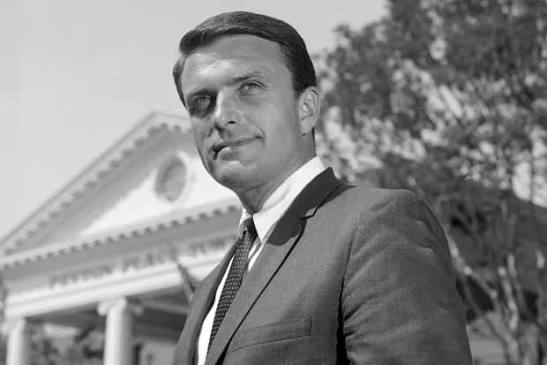
In 1964, Nelson scored the leading role of Michael Rossi and stayed through the entire series and two TV-movie sequels. Male soap opera stars often trade on their good looks and un-subtle acting, but Nelson brought gravitas and an underlying realism to his sympathetic role. After the series ended, he continued to work on a wealth of movies and TV shows. He was in five episodes of Murder, She Wrote (all as different characters and never the murderer), and he did a short stint on the daytime soap Capitol as a senator.
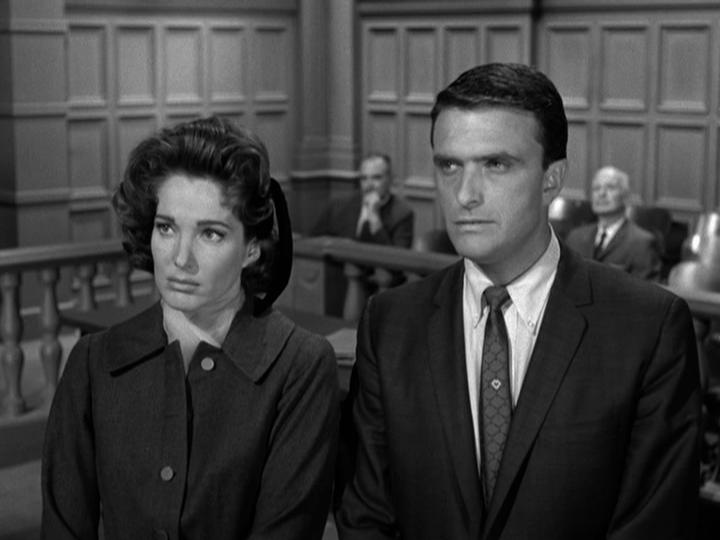
Nelson never got to kill anyone on Perry Mason either; in fact, in both episodes in which he appeared, he played the defendant. We discussed his first episode, “The Case of the Left-Handed Liar,” when we talked about Leslie Parrish. His final stint on the dock took place in the prosaically titled first episode of Season Eight, “The Case of the Missing Button,” which debuted on September 24, 1964. It turns out that this button isn’t a klew but a kid. (Just my luck to end up watching two episodes in a row containing precocious children!)
Button Blake (Claire Wilcox, a child actor who was saddled throughout her career with “cute” character names, like “Penny” and “Bootsie”) is at the center of a bitter custody dispute between her parents Dirk (Nelson) and Janice (Julie Adams, whom we will speak of again). The situation is complicated by the machinations of yachtsman Vince Rome (Anthony Eisley, who guest starred on an odd episode of The Dick Van Dyke Show as a charming lawyer who both Rob and Laura want to match up with women they know – until they discover that he likes to smack women around . . . Yikes!!!) who wants to fix things so that Janice will marry him and he will gain control over little Button’s four-million-dollar inheritance. He spends twenty minutes making everyone hate him (except Button – she likes everyone!), so it’s no surprise when he is shot to death aboard his yacht.
A whole slew of folks are literally circling the waters: Button’s grown cousin Lois Grey and her husband Roger (Dee Hartford and Alan Baxter, who between them have seven PM episodes to their credit) want custody of the girl; Dirk’s secretary Naomi (Lysa D’Anjou, who has five credits on IMDB, which is five too many) wants Dirk; Pancho Morado (Stanley Adams, an avuncular character actor whose long stage and screen career often had him playing Mexican characters, despite the fact that his real name was Abramowitz) wants to hide his criminal activities; and Vince’s deckhand Cully (Mike Mazurki) seems to be channeling “Moose” Malloy, the gangster he played in Murder My Sweet and pretty much every other film in which he appeared.
As it’s the start of a new season, Perry Mason is trying to roll with the times by making the show more action-packed. The episode opens with an apparent kidnapping and closes with Button seemingly in danger of being tossed onto a highway by the killer. But despite a mostly interesting cast (the judge in the divorce proceeding is played by the great Otto Kruger!), an awful lot of over-emoting, and the cute kid, this one still adheres to formula. Nelson and Adams are so angry and appalled and disgusted with each other that you know they’re going to get back together by the end – which means that there’s really only one person who can be the killer.
* * * * *
We’ll close out our Peyton Place/Perry Mason discussion with that rare thing, a really big movie star. Ryan O’Neal did not set out to be an actor: he wanted to be a boxer and trained for it, but while he was struggling in high school in Germany, where his family had moved, his mother, actress Patricia O’Neal, got him a job as a stand-in on a movie set. Working as an extra and a stuntman, O’Neal became interested in acting and when he returned to the States, he started to do some guest stints on television.
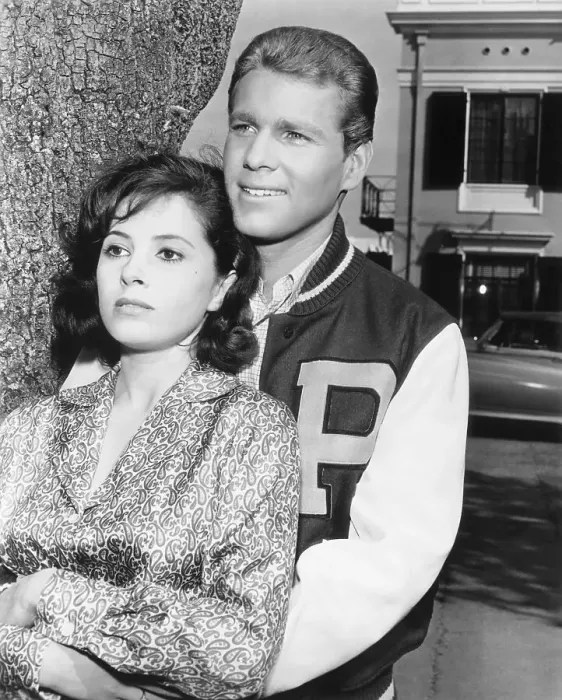
Like Mia Farrow, Barbara Parkins, and Chris Connolly, Peyton Place was the making of Ryan O’Neal. He was cast as Rodney Harrington, a disillusioned young man who loves Allison McKenzie (Farrow) but gets trapped into marriage with Betty Andrerson (Parkins) and – wouldn’t you know it? – eventually realizes that he and Betty were meant for each other. It helps that Farrow wanted to leave the show as soon as possible to make films! O’Neal wanted the same thing, and he ended up a genuine movie star.
He starred as Oliver in 1970’s Love Story. Where do I begin to tell the story of how drippy that movie was to me? But then he made a series of films that showed this good-looking young man could be roguish and funny: What’s Up, Doc?, Paper Moon, and Barry Lyndon are personal favorites. After that, the roles got increasingly bad, and instead of Oscars, O’Neal was nominated for Golden Raspberry Awards for worst performance. His tumultuous personal life didn’t help, nor did some serious health problems. Still, he eventually returned to television and kept working, including a semi-regular role on Bones, until he couldn’t work anymore. He died in 2023, two years after getting his star on the Hollywood Walk of Fame.
Seeing O’Neal on an episode of Perry Mason is like watching a young Robert Redford play Death on The Twilight Zone: you see this man, so young and full of promise, with no idea yet of the career ahead of him. O’Neal appeared in February 6, 1964 in “The Case of the Bountiful Beauty,” the seventeenth episode of Season 7. This one is unusual in that it mimics most of the novels by beginning in Perry Mason’s office. A beautiful woman named Stephanie Carew (Sandra Warner) is trying to get Mason to help her win a libel suit “for a friend.” Like Poirot with Mr. Ratchett, Mason refuses to take Stephanie’s case; obviously, he senses that she will become not a defendant on trial for murder, but the victim.
The defendant is a young author named Deborah Dearborn. (She is played by Zeme North, whose tiny IMDB resume is further proof that an inordinate number of minimally talented young actress cut their teeth on Perry Mason and then stopped chewing . . . ) Deborah has written a best seller, a combination of beautiful prose and salacious comment that may remind some viewers of . . . Peyton Place! The most popular character in the novel is a woman who has done some horrible things, things that Deborah based on stories told to her by ex-boyfriend John Carew (Ryan O’Neal). Now the book sales are climbing and Deborah’s agent Rubin Kason (Douglas Fowley) is about to make a half million dollar film deal on Deborah’s behalf with notable director Gideon Long (John Van Dreelen.)
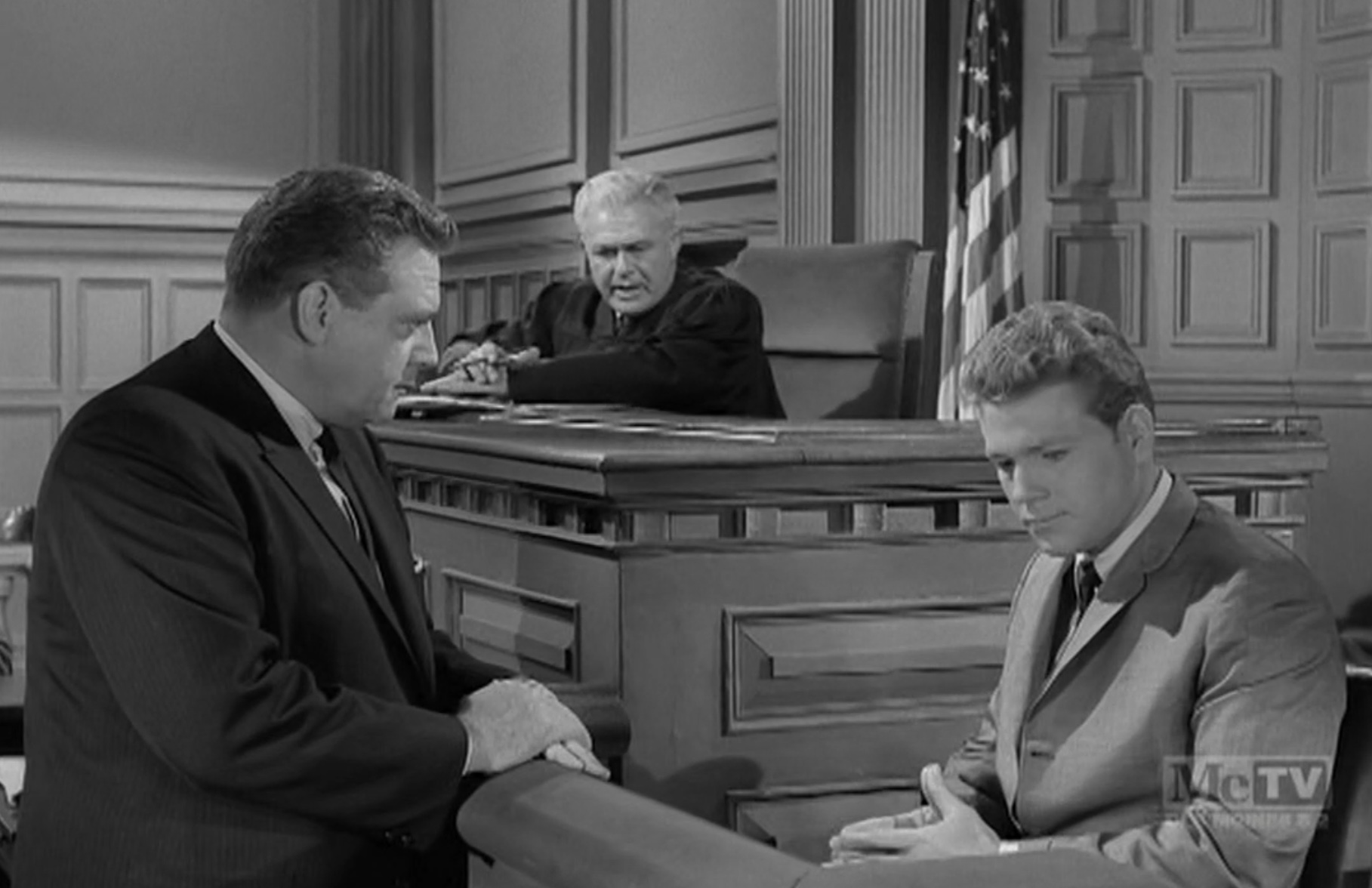
What Deborah never knew was that the stories John told her were true ones about his wicked stepmother Stephanie. Now she is going after Deborah and Rubin and Gideon for money. She is also playing around with millionaire Chet Worth (Maxwell Reed), which doesn’t sit well with Chet’s wife (Lonie Blackman).
This all takes place at a series of Malibu beach houses of various sizes and worth. Stephanie’s body ends up in Chet’s pool, and Deborah is arrested for murder. The story is fine, but the quality of the hour is hampered by an imbalance of focus and acting quality in the suspect list. O’Neal is fine in a namby-pamby part, but since he’s basically a stepmama’s boy till the end, that’s appropriate. Douglas Fowley had a long career in film, including some nice roles in a couple of Charlie Chan movies (. . . on Broadway and . . . at Treasure Island) and in Singin’ in the Rain, but here he delivers a stock character as the agent, down to calling Mr. Mason “Perry, baby!” even on the stand! And both the Worths do nothing but glower; Lonie Blackman doesn’t have a single line!
I wouldn’t say that this episode hinted at the career Ryan O’Neal was about to have. But you know what? Somehow that makes all this even more fun.
* * * * *
Well, folks, this was a long one, and I hope it felt as gratifying as sitting through five seasons of Peyton Place. For our next two Perry Mason TV posts, we are going to temporarily trade the big screen for the small and examine three actors who appeared in a favorite mystery film of mine from the 40’s, and then three more actors who appeared in a favorite from the 50’s.


WOW. What an outstanding piece Brad! I couldn’t stop reading it. It’s 6 degrees of separation mystery novel style and I’m truly enjoying this series. Thanks!
LikeLiked by 1 person