Ask me if I’m a town mouse or a country mouse, and there’s no doubt about it: I’ve always favored the city. I’d rather stay in an Air B&B in the heart of London or a nice hotel in New York City than roll my sleeping bag out under the stars. The same goes for my entertainment: I’ll always prefer gunfire in a murky alleyway to a shootout at the O.K. corral. That’s not to say I don’t appreciate a good Western – and the country boys who appeared in them. Although, not every Western actor was a country boy; some were city boys from British Columbia.
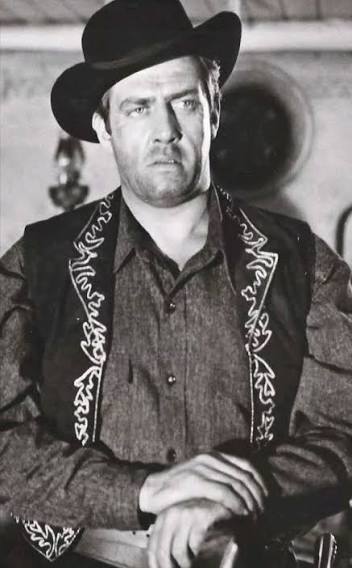
When I was a kid, TV went through a long bucolic craze. Westerns were plentiful, maybe because they were cheap to shoot. Some, like Gunsmoke, were spawned from success on the radio. But there was a time when you could watch Westerns on TV all week long: Bonanza, Bat Masterson, Rawhide, The Lone Ranger, Maverick, Have Gun – Will Travel, Wagon Train . . . The list is, if not endless, mighty long. I watched them all – but then, I was like Mikey with Life Cereal: I’d watch anything.
During the 1960’s, TV comedy hit a bucolic craze. It might have begun with Andy Griffith, whose guest appearance on The Danny Thomas Show spawned a generation of situation comedies centered around naïve country folks. Griffith’s self-titled series brought us to Mayberry, North Carolina every week to sit a spell with the sheriff, his family of Aunt Bee and Opie, his deputy Barney Fife, and a wealth of “hicks” whom we all laughed at – but not too much.
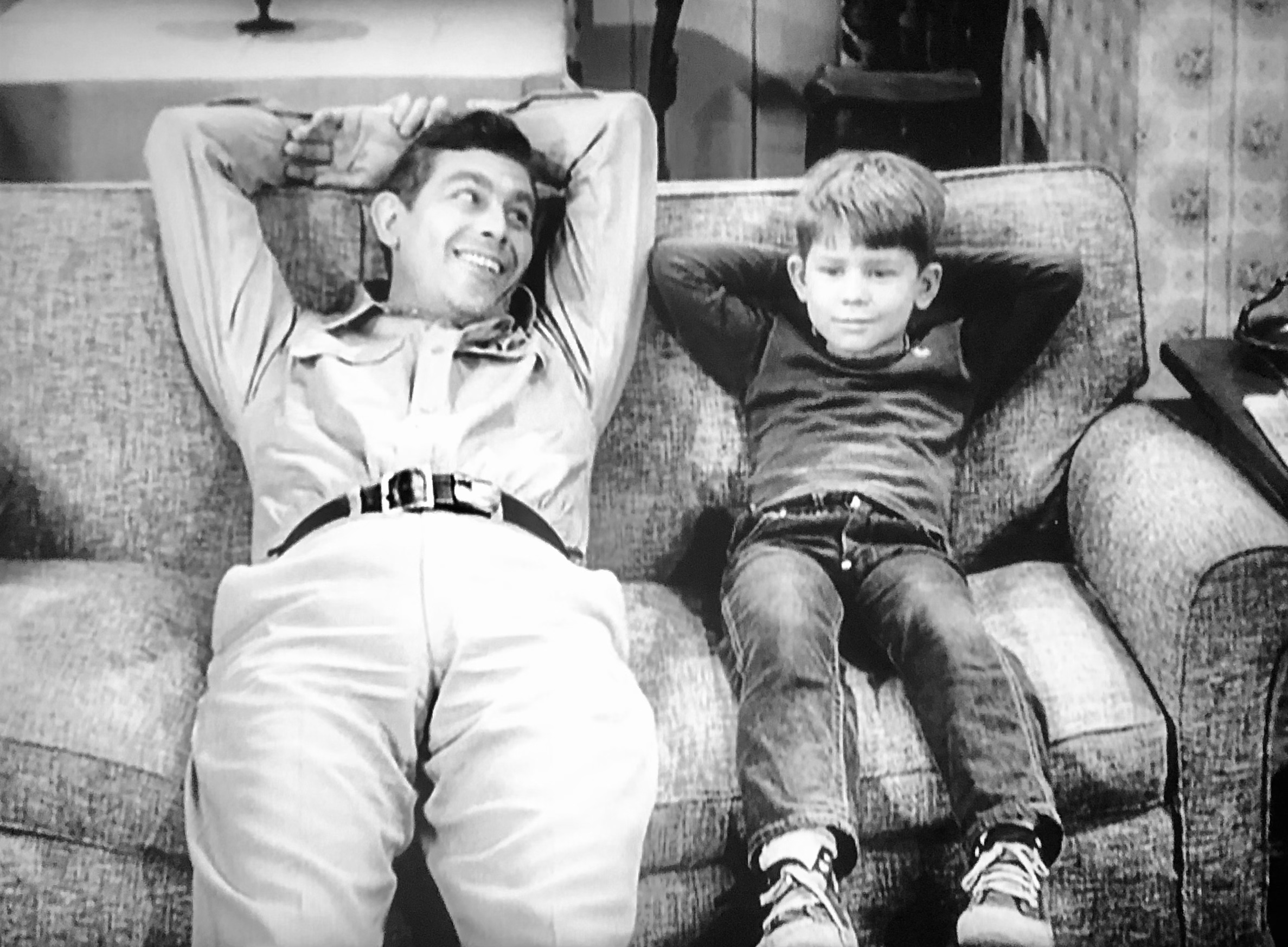
Griffith himself modeled Sheriff Andy Taylor after a bumpkin character he had played onstage and screen in No Time for Sergeants, but by as early as the second season he had transformed the character into a paragon of social and fatherly wisdom. That’s because there were plenty of other fools to laugh at, including Gomer Pyle (Jim Nabors), a simple-minded auto mechanic who would later join the Marines in a spin-off that lasted five seasons.
When Andy retired from being sheriff, the show continued for three more seasons, albeit under a different name (Mayberry, R.F.D.) and with a different star (Ken Berry). Some of the old regulars stuck around, but it never captured the old magic of the original series.
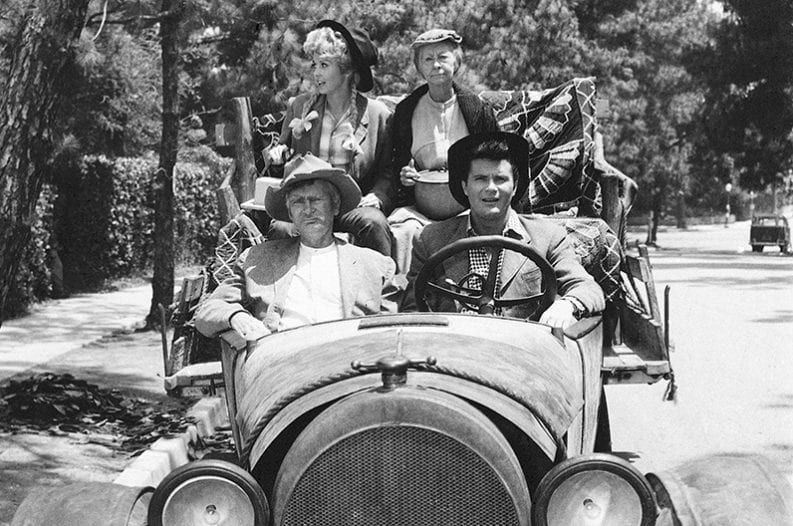
But that wasn’t the end of bucolic television: I talked about this when we discussed Sam Cady in the Rear Window/Perry Mason post: CBS especially loved puttin’ bumpkins on the tee vee! The Beverly Hillbillies had premiered in 1962 and gave us “the story of a man named Jed, a poor mountaineer barely kept his family fed,” who struck oil and moved his grandmother, daughter and nephew to Beverly Hills.
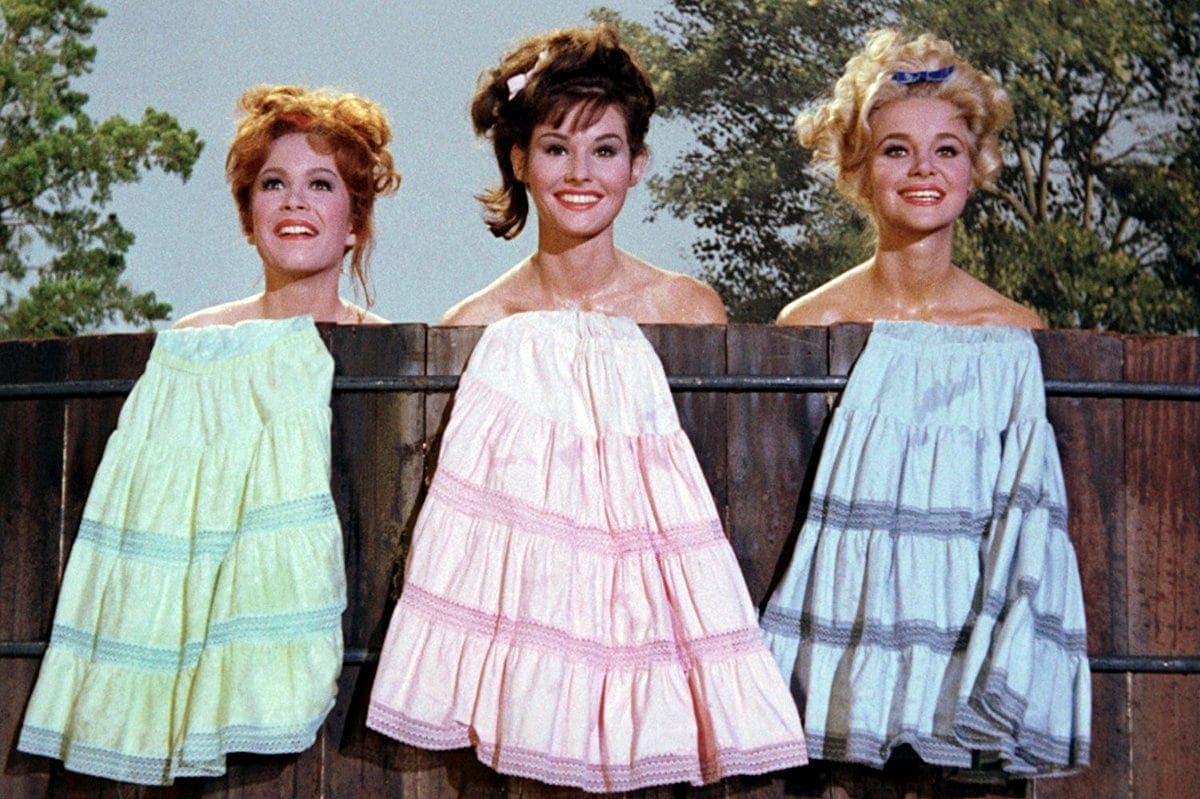
The following year, CBS debuted Petticoat Junction, set in Hooterville, a fictional “place simultaneously Southern and Midwestern, but in a vague sort of way.” Most of the action took place at the Shady Rest Hotel, run by Kate Bradley (Bea Benaderet), the wisest person in town. Comic relief was provided by Kate’s Uncle Joe (Edgar Buchanan) and the two engineers who ran the Hooterville Cannonball. Various plotlines involved the romantic shenanigans of Kate’s three beautiful daughters, Billie Jo, Bobbie Jo, and Bettie Jo. Sam Cady played Mr. Drucker, who ran the general store.
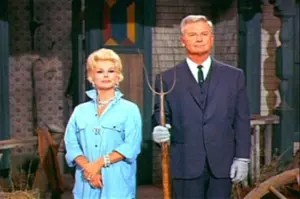
Petticoat Junction, which ran seven seasons, existed in the same universe as The Beverly Hillbillies, which ran nine. Characters from one show might “guest star” on the other. That pairing became a trio in 1965 when Green Acres joined the Hooterville gallery. The series was actually based on a short-term CBS radio program from 1950 called Granby’s Green Acres, about a married city couple (played by Gale Gordon and none other than Bea Benaderet) who move to a farm. On TV, the Granby’s became the Douglases and were played by Eddie Albert and Eva Gabor. The joke was that Albert, as Oliver Wendell Douglas, initially enthusiastic about giving up the city life, became a fish out of water in Hooterville, while the sophisticated Lisa (Gabor) fit right in with the general insanity of the local population. The show was a hit for five seasons.
The 1970’s brought big changes to CBS: the situation comedy took a sophisticated turn thanks largely to two men: Norman Lear, who gave us All in the Family, Maude, Good Times, Sanford and Son (on NBC) and more, and James L. Brooks, who produced The Mary Tyler Moore Show, Rhoda, Phyllis, Lou Grant, Taxi (on ABC) and The Simpsons. As for country fare, it didn’t go away, but it did change. There was still cornpone comedy to be had, on the variety series Hee Haw. But CBS found other ways to explore the scene: The Waltons, inspired by Earl Hamner, Jr.’s life and the 1963 movie based on his book Spencer’s Mountain, brought us the heartwarming saga of a rural mountain family for nine seasons. And in 1979, CBS produced The Dukes of Hazzard, an action-comedy series set in rural Georgia about two sexy cousins, played by Tom Wopat and John Schneider, who got into a lot of shenanigans.
Which brings me to the subject of this week’s “Connections” lesson: in this two-parter, we’re shining a spotlight on five actors whose careers spanned the stage, screen and the radio, whose faces made our faces light up whenever they appeared, and who really should be more famous. The roles they played were more or less diverse (more or less, depending on the actor!), but for whatever reason, they all seemed to shine when playing country fellas! As a result, they all guest-starred Western shows, and most of them appeared on at least some of the shows mentioned above. They even crossed over into each other’s programming – including on Perry Mason, where each of them appeared in multiple episodes. So saddle up, pardner, and let’s skedaddle!
* * * * *
Parley Baer hailed from Salt Lake City, Utah. His life was ever connected with animals: in his youth he worked for the circus, as a publicist, a manager, and a ringmaster. That career was interrupted by a highly distinguished military service in the Army Air Force, but even after he achieved success as an actor he worked with animals, first as a trainer with Jungleland, USA and later as a docent at the Los Angeles Zoo.
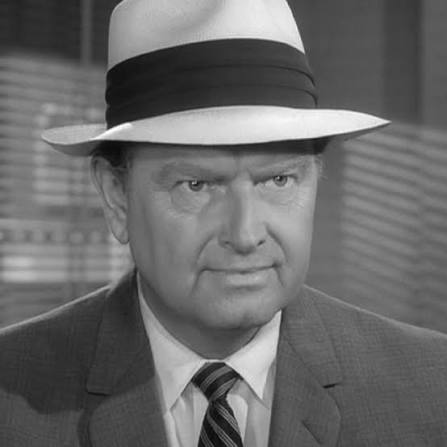
Fans of classic radio will surely recognize Baer’s voice. He started out behind the scenes but by 1933 was appearing on many of the biggest shows, including The Whistler, Suspense, Dragnet, The Lux Radio Theatre and one of my favorite P.I. programs, Yours Truly, Johnny Dollar. But it was in 1952 that he reached the zenith, playing Chester on Gunsmoke, the role played by Dennis Weaver (whom you’ll hear about again shortly). Baer also originated the role of Eb on Granby’s Green Acres and would appear on the TV version four times in other roles.
His distinctive voice, round body, and balding head made Baer a shoo-in to play wheedling officials. He played the mayor in both The Andy Griffith Show and The Addams Family. He was a judge in five episodes of Petticoat Junction and played Doc Appleby in seven episodes of The Dukes of Hazzard. Perhaps his most “ordinary” TV role – and the longest sustained character – was as Ozzie Nelson’s hapless neighbor Darby in The Adventures of Ozzie and Harriet. He also managed to squeeze in three guest shots on Bonanza, two each on I Love Lucy and Gomer Pyle, U.S.M.C., and nine appearances on Bewitched. Baer played a lot of doctors and soldiers and appeared in a ton of Westerns, usually being officious, cantankerous and impatient, a “good man” mostly concerned with his own needs and wants.
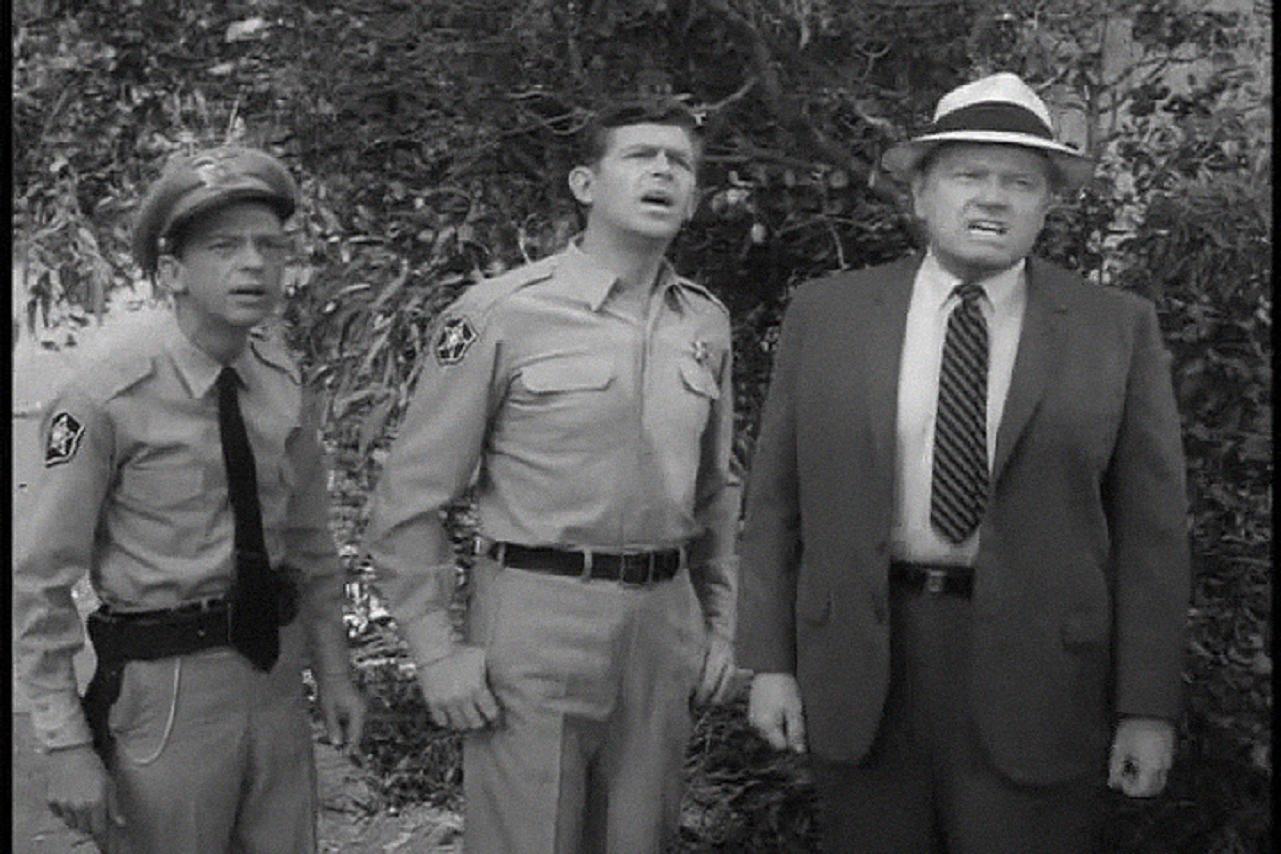
The question? Out of his six guest spots on Perry Mason, how many times, if ever, did Parley Baer get to play the killer? The answer, of course, is – I’m not going to tell you. As far as the series goes, he was the late starter amongst today’s trio, making his debut appearance in the first episode of Season Five, “The Case of the Jealous Journalist,” which premiered on September 2, 1961. This happens to be a BONUS crossover episode in that this marks the third appearance of fellow bucolic Denver Pyle! And while, for me, the killer was obvious throughout, this is a good episode with some neat twists.
It opens in an exciting way, with three men in a rowboat struggling to survive on a raging river. The boat capsizes, and a series of newscasts and newspaper headlines reveal that two of the three men – Adam York, the publisher the Los Angeles Chronicle, and his brother – have perished. The survivor, Tilden Stewart, (Pyle) is the managing editor or something of the paper. In his will, York has bequeathed an equal amount of the shares of the paper to his brother, his two sisters Grace (Irene Hervey, who appeared in three episodes of Perry Mason and then had a regular role as Honey West’s Aunt Meg) and Hope (Frieda Inescort, who had a nice little film career and appeared in 1940’s Pride and Prejudice and 1943’s The Return of the Vampire), and their sons.
The paper is in terrible financial shape, but Grace’s boy, Joe Davies (Linden Chiles, four eps) wants to run the paper and devote its editorial pages to liberal causes near and dear to his heart, like the sale of land for affordable housing. While Hope, her husband Seward Quentin (Baer) and their drunken lout of a son Ralph (Jan Merlin, was one of TV’s first series heroes in Tom Corbett, Space Cadet and spent two years writing for the soap opera Another World) want to sell the paper.
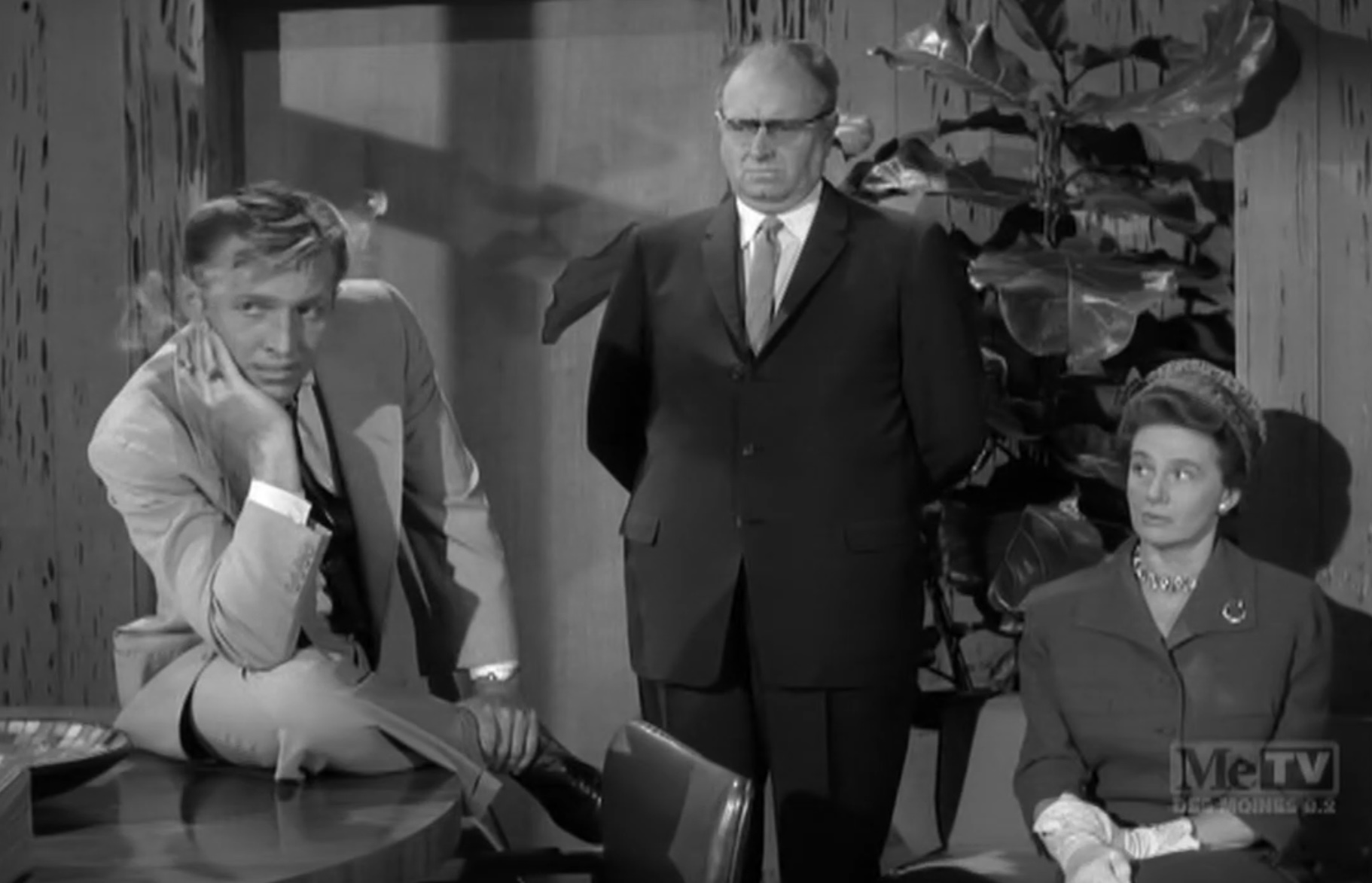
Joe is willing to fight for the paper and believes he has the support from his mother, his loyal secretary Miriam Coffey (Bek Nelson, 3 eps) and his fiancée Kerry Worden (Claire Griswold). He also meets with shifty businessman Boyd Allison (Theodore Marcuse, who always played villains). So it comes as a surprise – and a nifty twist – when at his engagement party, Joe is informed that Kerry will be marrying Ralph instead and bringing the paper down! Joe tries to drown his sorrows at a hotel bar, where he receives a call from Kerry saying she is not going through with that marriage or deal. Joe wobbles off to Kerry’s appointment, stumbles on the ground, picks up a bloody poker (they always do that!) and finds Kerry’s body – just as a neighbor from down the hall wanders in to investigate the ruckus!
The trial begins with two houses divided, and it’s interesting how this episode takes the time to show things that usually are filled in through exposition . . . like, a segment that tries too hard to be amusing where Paul Drake can’t interview a switchboard operator for some important information because he once stood her up on a date! And so Drake sends the tiniest, nerdiest operative he has, and the man comes up with a different sort of plan! Or the fact that, while it’s clear that Joe should end up with Miriam, the screenplay provides us with several scenes to set that whole “true love” relationship up. Anyway, the killer is, of course, the last person you would suspect – unless you’ve been watching your Perry Mason and just saw the same actor confess twice in other episodes.
We’re still in Season Five for “The Case of the Captain’s Coins,” the seventeenth episode, which premiered on January 13, 1962. Like our previous episode, this one is about a divided family; the main difference here is that, despite a good cast and a setting aboard an ocean liner, this one is dull as dishwater. It concerns an ancient coin that had the head of one of the Farraday brothers inscribed on its surface. For generations, everyone has assumed it was one brother, and his branch of the family now controls the business empire. But it just might have been the other brother whose head was on the coin, which would shift the fortune around.
The “haves” are brothers Ben and Edward Farraday (Herbert Rudley, who appeared in four eps, and Parley Baer), while the have-nots consist of Carter Farraday (Don Beddoe, three eps and an interesting career in films such as The Best Years of Our Lives and The Night of the Hunter) and his daughter Evelyn (Joan Patrick). Evelyn’s fiancé, Philip Andrews, tried to help prove that the face on the coin is Evelyn’s ancestor and ended up getting accused of fraud and fired from his job. Philip is hot-headed, which you know because he YELLS EVERY LINE. He’s played by Jeremy Slate, who does a much better job in an episode we’re discussing below, so I’ll move on from him here.
Baer, then, is in a similar position plotwise as he was in the last episode, but he tends to get lost here in the overcrowded field of suspects. I haven’t even mentioned the slinky secretary, played by Allison “50-Foot Woman” Hayes, or the numismatist, played by Jay Novello, a wonderful comic actor who appeared in multiple episodes of I Love Lucy, The Andy Griffith Show, and many others. Arthur Franz, a fine “B” actor who played, among other brilliant roles, the heroic professor in Invaders from Mars, helps Perry out as an officer on the ocean liner.
The final unmasking should come as a surprise to viewers – and maybe it does, but frankly, this one dragged so badly I stopped caring.
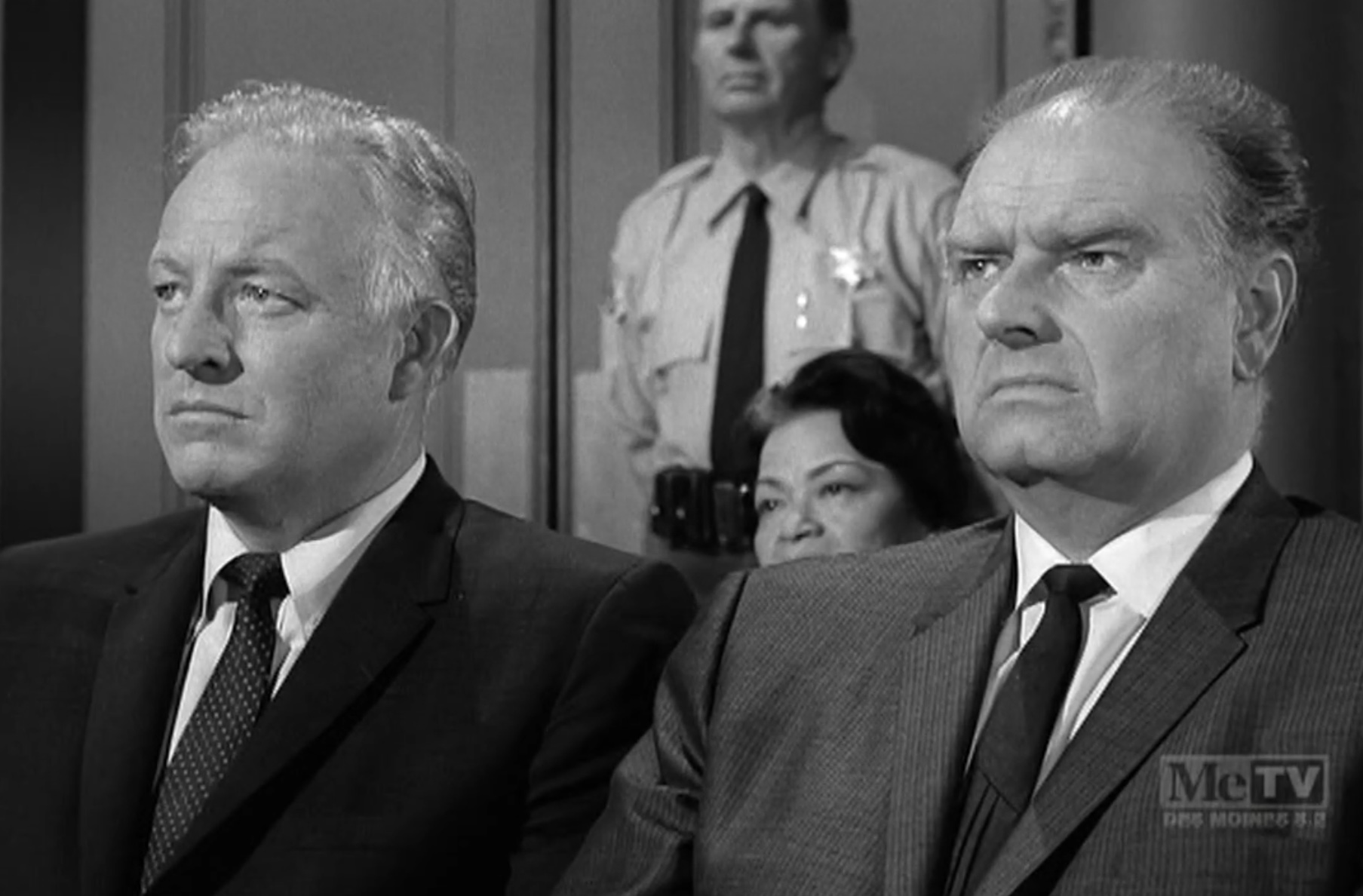
Next up is “The Case of the Stand-in Sister,” which premiered on November 15, 1962, as the eighth episode of Season Six. Let’s talk about the good stuff first: the defendant in this one is played by R.G. Armstrong, who really deserves an honorary place in the Hall of Bucolic Actors. Born in Alabama and educated in North Carolina, he went on to appear in nearly every Western TV series and The Andy Griffith Show and The Dukes of Hazzard. He appeared in three Perry Mason episodes, and his aura of decency was so apparent that he usually played the defendant. However, Armstrong also developed a friendship with Sam Peckinpah and played unhinged Christian fundamentalists in several of the director’s films. He also worked closely with Warren Beatty in several movies and got to play the villainous Pruneface in Dick Tracy.
The other fun fact about this episode is that it’s one of the only times in my memory that Perry Mason stops a trial cold and asks the judge for a conference in chambers. There he reveals a fact that he couldn’t possibly know for sure, but it’s correct and it changes the course of the case.
Other than that, this one is by-the-numbers. Armstrong plays John Gregory, owner of a small fleet of fishing boats. His daughter Helen is engaged to a rising politician named Van Bennett. The actors playing this couple both appeared on the soap opera Days of Our Lives. The difference between them is that the actress is Susan Seaforth Hayes, who was one half of one of the earliest super couples (with her real life husband!) and appeared in about 5,127 episodes of the show, while the man, Walter Stocker, appeared in two episodes as a policeman. He is absolutely terrible in this: throughout the trial, the camera keeps going to him for reaction shots, which he overacts horribly.
Parley Baer is all bluster as usual playing an attorney for someone who wants to buy Gregory’s fishing boats. Peter Whitney, a veteran of three PM episodes, plays “Big Steve” Jahnchek, an escaped gangster, who happens to be Gregory’s brother. And Steven Geray, a Hungarian actor with a long career, including a fascinating role in the noir classic, In a Lonely Place, plays a retired Swiss bank clerk who has come to America to blackmail everyone.
The plot is complicated but mostly involves a lot of exposition. And the killer is the only actor/character I haven’t mentioned – but his guilt is so obvious from the moment he hits the screen that this ending is virtually impossible to spoil.
So far, I have to say that my experiences with Parley Baer on Perry Mason have been less than satisfactory. Our not-quite-final look at his work comes from Season Eight, episode eighteen, “The Case of the Telltale Tap,” debuting on February 4, 1965. (I say “not-quite-final” because there’s another crossover episode coming up later; if this one falls flat, Baer still has another chance!!)
This is yet another case set in the world of big finance; it seems that Baer was often typecast as a blustering executive, and that’s exactly what he plays here. On the plus side, Samuel Newman’s script and Arthur Marx direction of an excellent cast full of Perry Mason vets makes this the most gripping Parley Baer episode I’ve watched yet. There’s another side to discuss – but we’ll get to it.
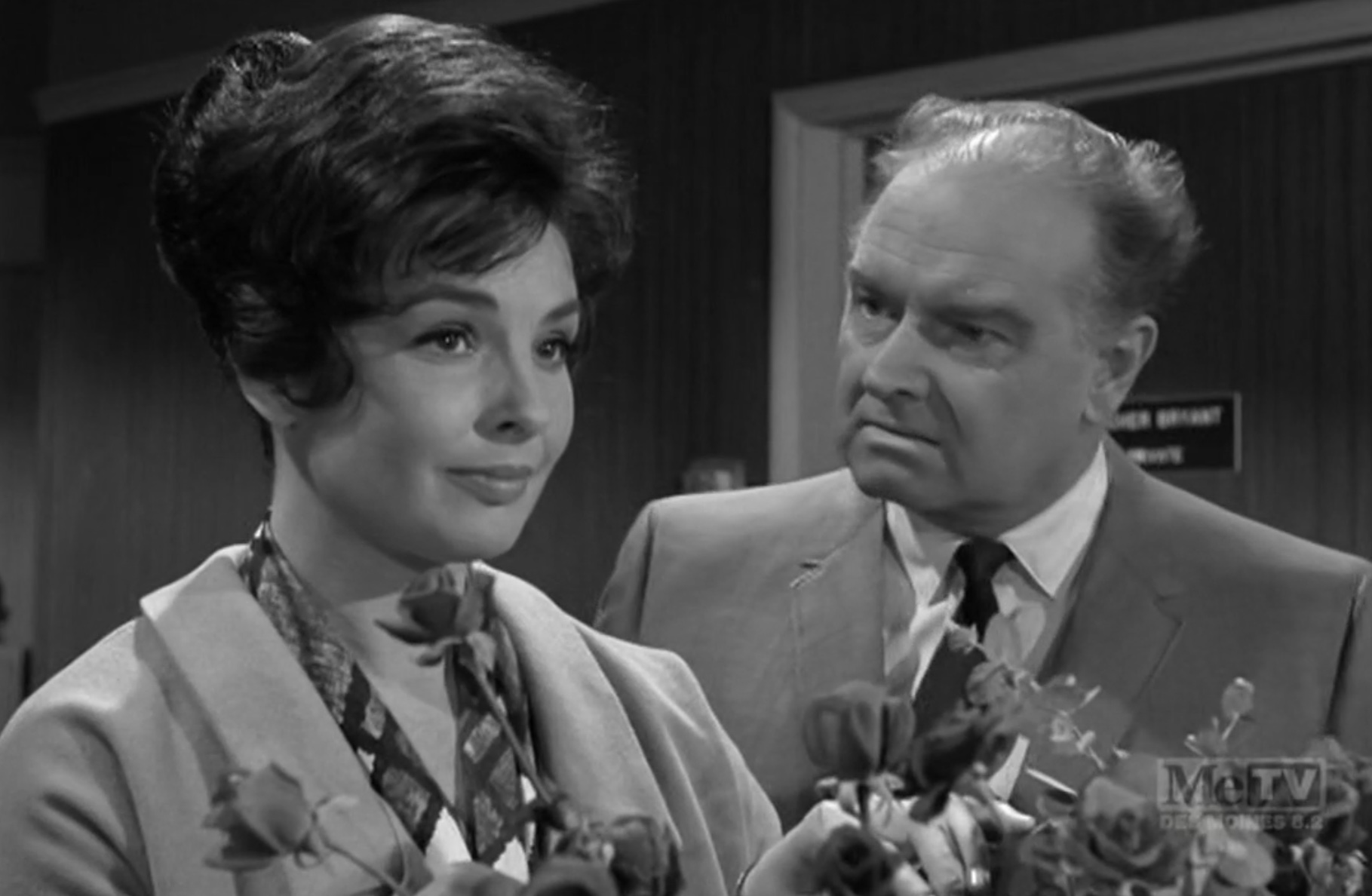
The great Roland Winters, who replaced Sidney Toler as Charlie Chan inthose later mediocre Monogram films, plays Archer Bryant, a savvy businessman and aging lothario who likes to control things at the office and at home. A year earlier, he took in his orphaned niece Nancy (Indus Arthur) and became executor of the million dollars left to her by her parents. He has also been known to control her love life, and when she fell in love with an older accountant who worked at his firm, Archer fired the guy. Now Nancy is in a new relationship, and she’s keeping it a secret from her nosy uncle.
Meanwhile, with the help of his bright, handsome new accountant Clyde Darrell (Linden Chiles), Archer has learned that one of his main stockbrokers Ian Jarvis (Baer) has been leaking Archer’s stock portfolio in order to manipulate the market. He fires Jarvis on the spot and praises Darrell, much to the jealous consternation of company treasurer Elliot Forrest (William Allyn, four PM eps) and to the joy of executive secretary Vera Wynne.
It is Vera who is the key character for the first half of this case. The hour opens with Vera meeting with shady private investigator Glen Holman (H. M. Wynant) and hiring him to wire her boss’ secret office telephone. Vera is a smart, scheming woman, but she has lost some of her careful control by falling in love with the much younger Clyde and doing everything she can to make him the new CEO of the company. That is until she catched Clyde sharing a passionate kiss with Nancy – and then Vera goes crazy.
Jeanne Bal has the distinction of playing the first monster we ever meet on the original Star Trek – a salt-licking shape-shifter. She proved there that she could play many moods, and she used her talents to good effect in four Perry Mason episodes. I know we’re supposed to hate her – and we do! – but Vera is also a victim of the mid-century stereotyping of ambitious women. She has to be cold and is still has to fend off men constantly pawing or propositioning her; even Clyde practically pats her on the head and says, “Good girl!”
That’s the only really tiresome aspect of the case; otherwise, it’s a really good episode. There’s one character who seems destined to be unmasked as “the typical Perry Mason murderer” – and he’s not! Instead, we get some nice twists and a killer who is both logical and surprising.
* * * * *
Ben Cooper is something of an outlier here, in that he was never a comic actor and so didn’t appear on any of the bucolic sitcoms I mentioned above. His background is pure East Coast: born in Connecticut, graduated from Columbia University, Broadway debut when he was nine in the original production of Life with Father: he took over the role of Harlan Day, the youngest son and stayed with the show until it closed, by which time he had grown into the role of older brother Whitney.
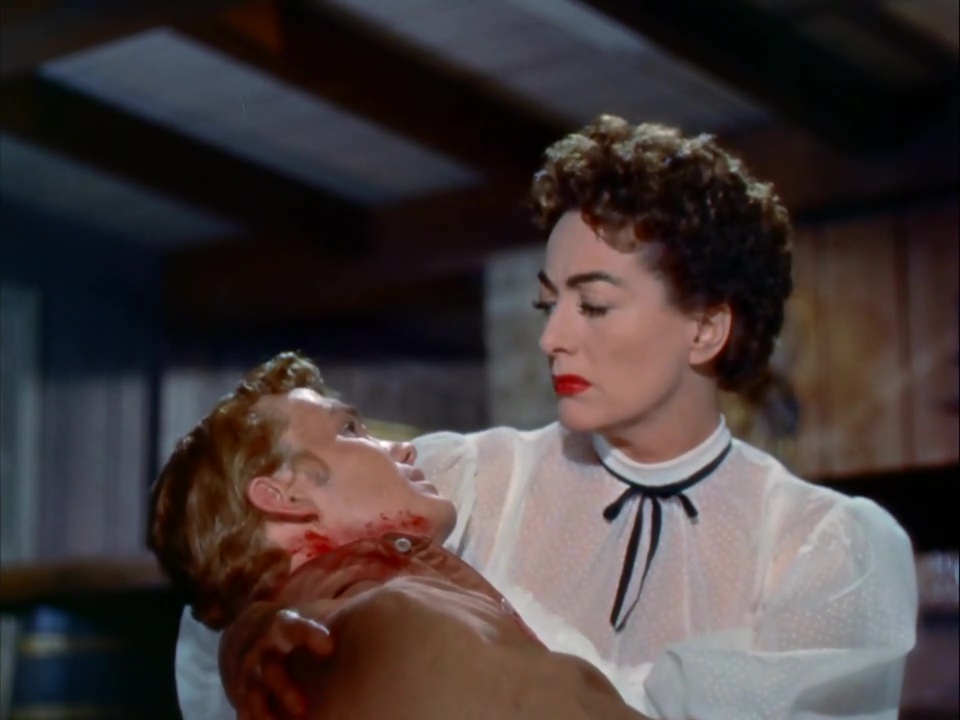
Cooper was a personable, good-looking guy, but he was signed with Republic, a low budget studio; perhaps that is why he never attained stardom. But he was comfortable in the saddle and appeared in a great many Westerns – including my favorite Western of all time, the totally outrageous Johnny Guitar. I refuse to dismiss this film as “camp,” but it does center around a saloon keeper named Vienna (Joan Crawford) who is torn between a singer named Johnny Guitar (Sterling Hayden) and a tough gang leader played by Scott Brady who goes by the name “The Dancin’ Kid!” Then there’s Emma Small (Mercedes McCambridge) who wants to get Vienna lynched. Theoretically, Emma is mad because she blames Vienna for the death of her no-good brother and for taking away The Dancin’ Kid. But the sexual tension between Johnny and Dancin’ and between Vienna and Emma is enough to make your head whirl! Ben Cooper plays the youngest, sweetest and cutest member of The Kid’s gang, and when he dies horribly, even Ernest Borgnine goes into deep mourning like a widow! (If you think I’m reading my own agenda into this, go look up the life of director Nicholas Ray . . . )
Anyway, Cooper went on to appear in dozens of TV Westerns, including Gunsmoke, Rawhide, Laramie, Wagon Train, Zane Grey Theatre and Bonanza. He also appeared in five episodes of Perry Mason and even got to play the murderer at least once. We saw him play a lawyer in “The Case of the Promoter’s Pillbox,” which featured John Lasell of Dark Shadows fame. One other episode was an adaptation of the novel The Case of the Mischievous Doll, and I’m saving another for a look at a special member of the Perry Mason family. So let’s take a look at the remaining two episodes to feature Cooper.
“The Case of the Polka-Dot Pony” debuted on December 15, 1962, the twelfth episode of Season Six. If you’re imagining from the title that this case gives Ben Cooper a chance to put on his spurs, think again: we’re dealing here with a fun episode about orphans and inheritances that gives off distinctly “Christie” vibes – that might, in fact, remind you of a couple of Miss Marple stories.
Many years ago, Angela Renshaw became so hopelessly alcoholic that her Navy husband divorced her and took their baby daughter Maureen with him. When he died in battle on a submarine, the child was placed in an orphanage and then in a series of foster homes. Now two men – a lawyer named James Grove (Cooper) and a slick camera store owner named Burt Renshaw (Angela’s ex-brother-in-law) are both looking for grown-up Maureen in order to reunite her with her now-sober mother whose second marriage to a recently deceased Italian industrialist has left Angela wealthy. (Burt is played by Jesse White, one of the great mid-century character actors; we will talk about him again.)
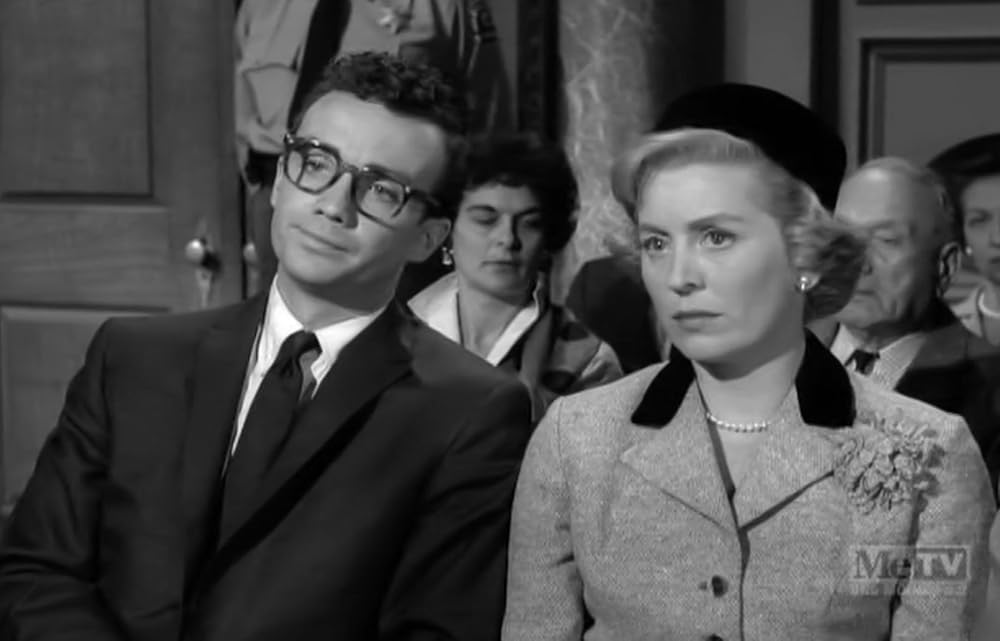
Both men back a different, er, horse: Renshaw claims that Maureen Thomas, a cynical stewardess who is about to marry into a wealthy family, is the real girl, while Grove presents Maureen Franklin, a sweet-as-pie young lady. We’ve already witnessed how unscrupulous Renshaw can be, and so it comes as no surprise when he is murdered and Maureen Thomas is arrested. We’re faced then with multiple questions: who killed the man? which girl is the real Maureen? Who is an imposter in this group? Everyone here does a great job of making you question their motives, and the solution is especially good because it is so reminiscent of Agatha Christie.
One more casting note: Maureen’s future mother-in-law is played by Doris Packer, who could easily have been included in my previous post about the “Broads” who appeared in the show. Although she didn’t appear in any Walt Disney movies, she was a frequent guest star on all the sitcoms and made a striking appearance (with fellow broad Betty Lou Gerson) on The Dick Van Dyke Show, playing Mrs. Huntington, a wealthy matron with a terrible memory but terrific legs!
Cooper’s final appearance on the series occurred in “The Case of the Baffling Bug,” the thirteenth episode of the ninth and final season. As I write this, Bill Gates is the latest tech leader to join his voice to the perilous warning to all human life and fortune of AI. Thus, it gives one such a quaint feeling to watch an episode centered around the “deadly plague” of industrial espionage. Perry Mason even issues a Gates-like warning about how surveillance equipment has the potential to bring down society. Turns out our attorney was rather prescient.
Paul Drake has been hired by Dr. Malcolm Scranton (Gilbert Green, three PM eps), founder and CEO of Tryon Industries, to provide security for an upcoming conference to discuss the Tryon Process, which is as clearly explained here as the Corbomite Maneuver and the Forbin Project are elsewhere, but which has something to do with transforming seawater. Paul does everything in his power to create a secure environment, but the information from the meeting is leaked anyway. This gives the company’s head of security, Lowell Rupert (Cooper), the chance to say “I told you so.”
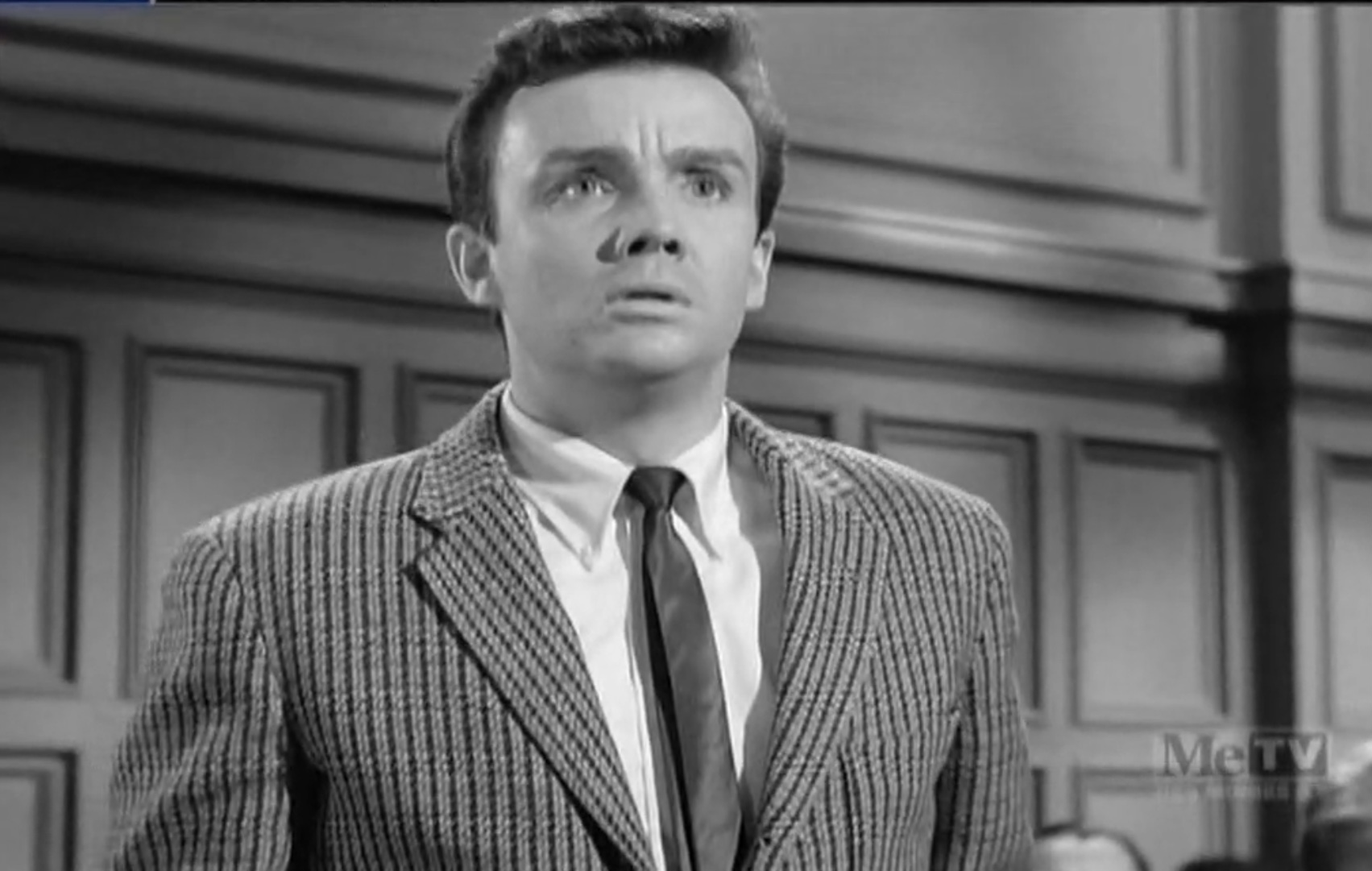
The chief suspect is Dr. Todd Meade (Grant “The Shrinking Man” Williams is back) because Meade used to work for the company that has stolen the process, a company run by his ex-girlfriend Rhonda Coleridge (Dee Hartford, three eps), but since Meade ends up being the defendant, we have to look to other members of the committee. There’s the Japanese scientist, Dr. Maseo Tachikawa (Teru Shimada, who plays a villain in the James Bond thriller, You Only Live Twice), Dr. Nina Revelli (Aliza Gur, a former Miss Israel, whose Italian accent is iffy but who really nails the character by slamming doors and wearing her hair REALLLY big!!), and Dr. Horace Lehigh, who is not actually a doctor but a corporate spy hired by Dr. Scranton to find the leaker and who gets murdered so you can cross him off your list.
There are so many bugs on display here! There’s one in Mason’s office, and in what has become a ubiquitous scene, there’s a mysterious florist’s truck sitting outside the conference. The scene at Sashimi Gardens, a Japanese restaurant, is hilarious as we move from one private dining room to another, discovering that everyone is eavesdropping on everyone else. It’s not my fault that I’m so smart: the solution is a clever one and something of a surprise. It just didn’t surprise me.
* * * * *
If out of reading this post, the only thing you do is watch Johnny Guitar (and you really should!), you’ll notice that the ineffective Marshall trying to arrest everyone and keep Emma’s lynch mob from descending into . . . oh, too late! That guy is none other than our next subject, Frank Ferguson. Frank was in Green Acres, Petticoat Junction and The Andy Griffith Show. He was, in fact, in most series of the 50’s and 60’s, right up through the mid-70’s.
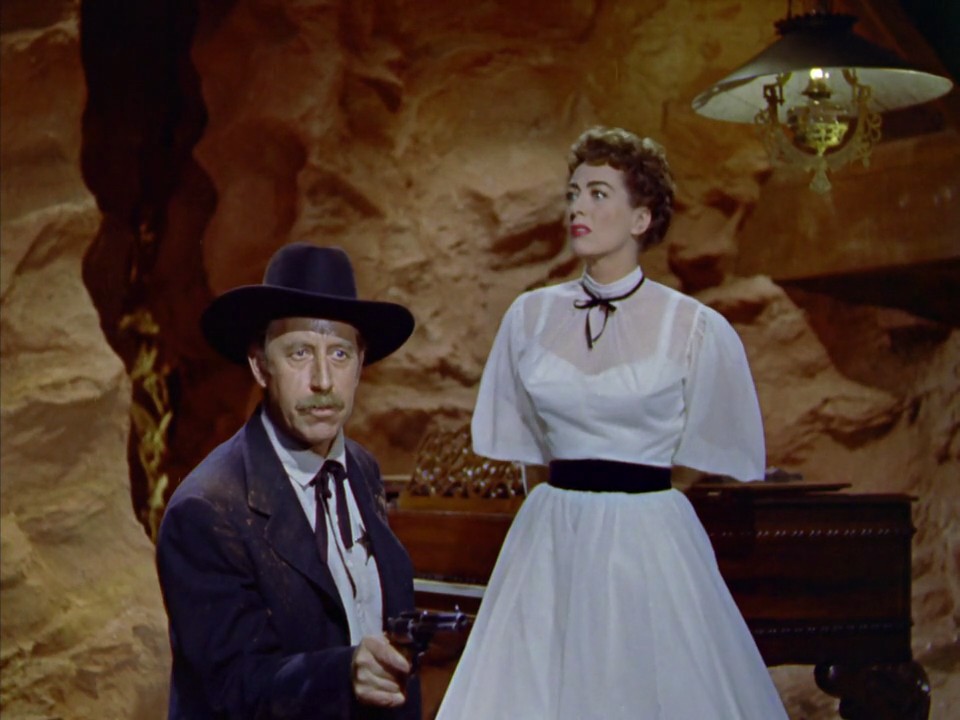
Born in 1899, Ferguson might be the oldest actor represented here. He was born in California, got his BA in speech and drama from the UCLA and his Masters from Cornell. (He would end up teaching at both institutions.) For many years, he was an actor and director for the Pasadena Community Playhouse and made his film debut in 1939. He acted with all the greats: Abbott and Costello, Ma and Pa Kettle, you name it! He played a newspaper editor in Hush, Hush, Sweet Charlotte and was a regular on Peyton Place, playing wise patriarch Eli Carson, father of Dr. Elliot Carson.
His folksy demeanor fit in well with bucolic sitcoms and western series, and he appeared in most of them multiple times. On many westerns, he played a sheriff, and, in fact, in three of his four appearances on Perry Mason he played – a sheriff! His first appearance was in the adaptation of one of my favorite novels, The Case of the Perjured Parrot. Next up was “The Case of the Angry Dead Man,” the eighteenth episode of Season Four, which premiered on February 25, 1961. The angry “dead” man is Willard Nesbitt (good ol’ Les Tremayne, whom we have seen over and over, as victim, defendant, suspect, and murderer), and he has good reason to be angry. Part owner of a mining concern, Willard learns that he doesn’t have long to live, so he decides to sell his half of the business for $10,000 to his partner, Lloyd Castle (Edward Binns, a fine actor who got to play one of the nice guys in Twelve Angry Men but who shows his dark side here). That’ll leave some money for his second and much younger wife, a sweet and luscious Southern belle (Gloria Talbott, four PM eps).
But then Willard goes out boating in a storm, the boat capsizes, and he nearly drowns. And when he returns to land and learns that everyone thinks he has drowned, he decides to stay “dead,” for this means his wife will receive a hundred thousand dollars under a double indemnity policy. Willard’s death leaves nobody happy: Eve is genuinely mourning the loss of her husband, Willard’s lazy son Bruce (Karl Held, whom we will have something to say about at a future date) resents Eve’s newfound fortune, and partner Lloyd Castle realizes that Willard never signed the contract leaving him the company. He connives with his secretary/lover Jenny Bartlett (Carol Ohmart) to break into the Nesbitt home and forge Willard’s signature on the contract. Also in the know is snide office worker Ben Otis (James Millhollin, who was almost exclusively a comic actor, sort of an inheritor to the “Nervous Nellie” mantle from Franklin Pangborn).
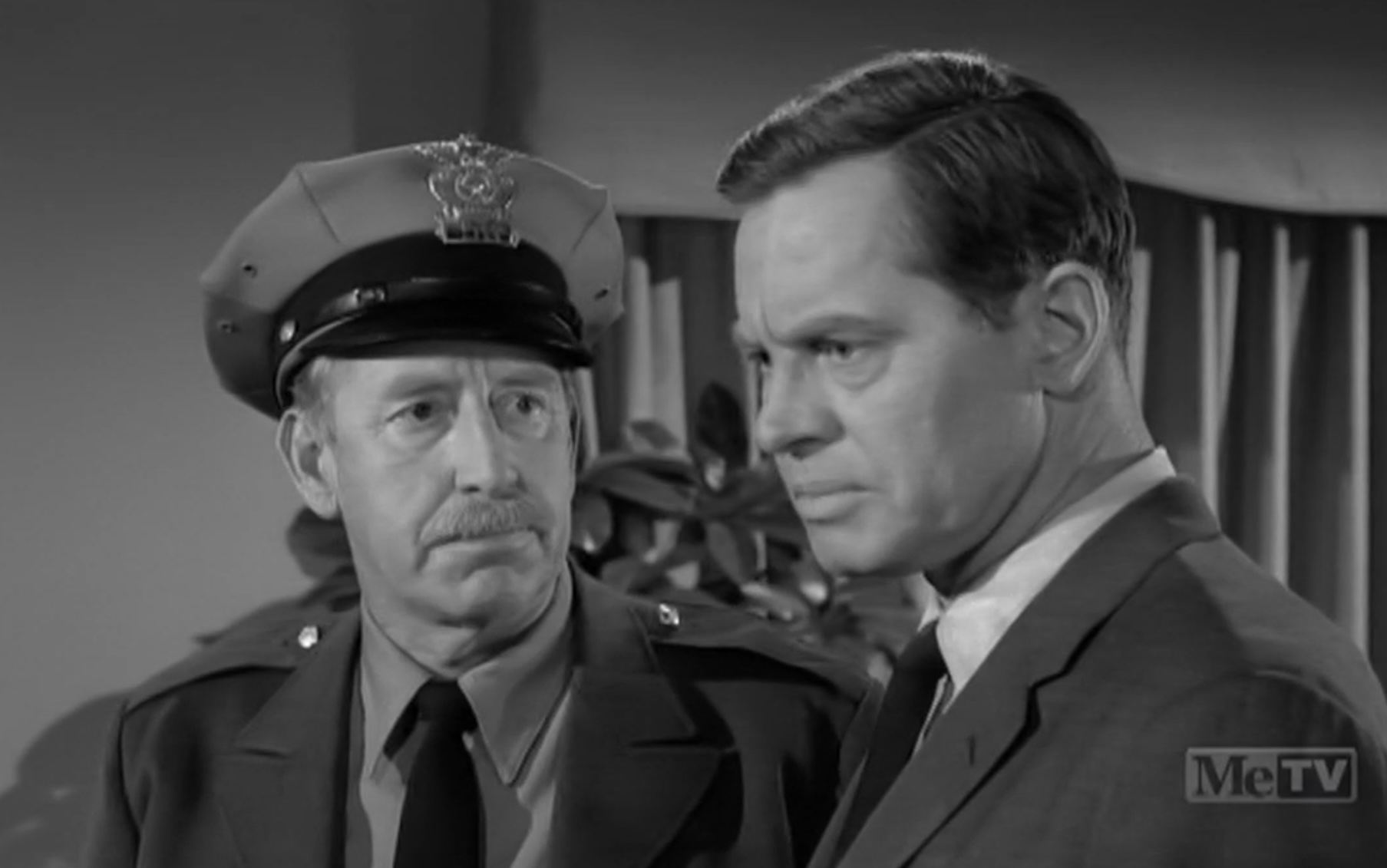
Then Willard, who is living out his last days at a not-so far-off motor lodge, doing odd jobs for the owner, reads that his company has struck gold in one of their holdings. Furious at Castle’s double-cross, which means Eve won’t share in the profits, he calls his “widow” to tell her what has happened. Eve drives up to the lodge to meet her husband and ends up on trial for his murder.
I have to say that I hesitated after immediately picking out the murderer, due to the casting, but my instincts were right. Frank Ferguson plays a handwriting expert, which would normally be a quick cameo on the witness stand but is turned into a much bigger role. First, Mason consults privately with him, and then he puts on a huge demonstration in the courtroom; finally, the writers give Ferguson the final joke in the closing – and it’s a handwriting joke!!!
Jumping ahead to Season Six, Episode Fourteen, “The Case of the Bluffing Blast,” which premiered on January 10, 1963, we find ourselves in Ladera, another one of those small towns near Los Angeles where everyone seems connected to a past crime. Of course, a bus arrives and disgorges Linda Blake (British actress Antoinette Bower), the requisite outsider who is going to face the wrath of the townsfolk and end up on trial for murder.
The past crime turns out to be the murder of Linda’s own father, Addison Blake, and after his death his extensive properties reverted to the community because nobody knew that he had an heir. District Attorney Nelson Taylor (Frank Overton) and Sheriff Orville Ramsey (Ferguson) oversaw the distribution of the monies to fund the local dairy, run by Floyd Grant (Bill Williams, four PM eps), and the local newspaper, now run by Clay Eliot (Peter Breck, a handsome guy who appeared in three PM episodes and then went on to become a regular on The Big Valley with Barbara Stanwyck). Addison is supposed to have died on a hunting trip he went on with Floyd and Charles Lambert (Robert Knapp, also three eps). Lambert was the prime suspect in Addison’s murder, but Floyd gave him an alibi, which should have brought relief to Lambert’s mother (Gertrude Flynn, four episodes and she played Barbra Streisand’s neighbor in Funny Girl) and wife (Mary la Roche, five PM episodes and she played Ann-Margret’s mom in Bye Bye Birdie).
Only it seems nobody feels relieved about anything thanks to Floyd, who spends the first twenty minutes of the episode snarling and threatening and terrorizing everyone, even to the point of setting up one or two of them to be murdered. But it’s Floyd whose head is crushed in by a walking stick, and it’s poor Linda who is put on trial for his murder. Fortunately for her, a certain well-known lawyer is in Ladera doing business with the D.A., and it’s Taylor himself who asks Perry Mason to be Linda’s lawyer.
All in all, it’s a pretty good example of the small-town murder scenario played out so often on the series; at least this time there is no obvious killer lurking in the background. Everyone has their confessional moment in court, and when the culprit is revealed, they are pretty sympathetic for a change.
Our final look at Frank Ferguson’s work on the show comes from Season Eight, Episode Seventeen: “The Case of the Golden Venom,” which debuted on January 21, 1965. And what do you know? We have another small town full of secrets and another interloper barging in to upset the web of silence. What’s more, we’re again dealing with a past murder on a hunting trip, and Frank Ferguson again plays the local deputy sheriff who screwed up that investigation.
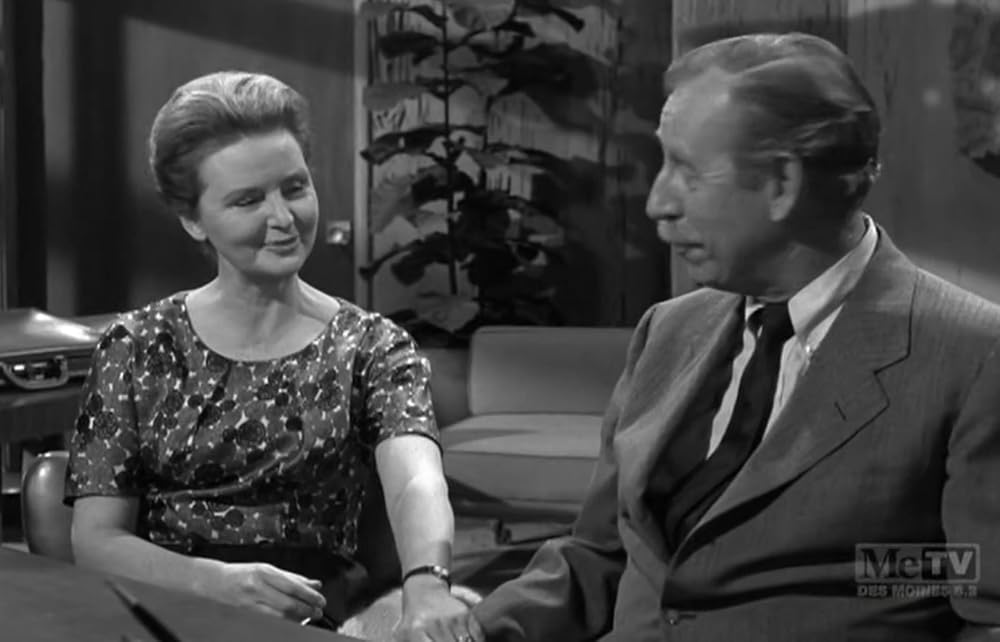
There are some significant differences from “The Case of the Bluffing Blast.” Forrest Junction is close enough to Los Angeles that the case is investigated by Sergeant Ben Landro (Mort Mills) and tried by Hamilton Burger. The interloper is actually something of an insider: Lucille Forrest is the widow of the man whose ancestors established the town. She was actually Mr. Forrest’s housekeeper and then married him to provide a stable home for her son Richard. Lucille is played by Frances Reid, whom we’ve seen before here opposite “guest attorney” Bette Davis in “The Case of Constant Doyle.” She also played the tragic wife in John Frankenheimer’s Seconds and later performed in thousands of episodes of Days of Our Lives as Alice Brady. She is really good here, alternately bitter and cold, then consumed with emotion.
The reason for this is – it was Dick who died on that hunting trip, and the Forrests ran off to Europe to deal with Lucille’s all-consuming grief and anger at the fact that the man she believed had killed her son – Ralph Day, the editor of the town paper (Arthur Malet) – was never prosecuted. Mr. Forrest died overseas, and Lucille has returned to settle old scores with the townsfolk, who outwardly welcome her home. Besides Walter Coffee (Ferguson) who is now operating the local pharmacy and is the executor of Mr. Forrest’s estate, there is Tony Claus (Noah Beery, Jr., perhaps most famous for playing James Garner’s father on The Rockford Files), the foreman of the Forrest property, businessman Kevin Lawrence (Lee Phillips, who played Michael Rossi in the original film of Peyton Place and switched from acting to direction; he even directed sixty episodes of The Andy Griffith Show) and Kevin’s wife Mirna (Carole Wells, another actress channeling a cross between Marilyn Monroe and Ginger from Gilligan’s Island), who used to date Dick and . . . well, all the men in Forest Junction
Lucille invites all of these people to a cocktail party where someone slips some of the snake venom Walter has procured for Lucille’s sciatica into Ralph Day’s cocktail glass. Everyone believes it was Lucille exacting revenge for her son’s death, and Perry Mason has to prove otherwise. (The presumption of innocence is never mentioned on Perry Mason!) He does this by revealing a killer with a secret motive – which isn’t fair play, except that once again all you have to really do is notice the placement of that character in the defendant’s life to know whodunnit.
* * * * *
That’s enough fer now, pardners. I’m gonna mosey on down to the ol’ saloon for a few sarsaparillas. I’ll be back in a coupla days with two more terrific bucolic actors. Y’all come back now, ya hear?


It’s Frances Reid (not Kate) who played Alice Horton (not Brady) on Days of Our Lives, until her death.
Guess when you’re dealing with so many actors/characters it’s hard to keep on top.
So many PM guests also had roles in soaps that you could easily do a series on this.
LikeLike
Thanks – I fixed it (and added Ms. Reid’s credit in Seconds, a really terrifying film! I have thought a lot about a soap series, in fact, and it’s coming up when I can figure out which of the dozens of actors who appeared in both Perry Mason and soap operas I should feature!
LikeLike