“But down these mean streets a man must go who is not himself mean, who is neither tarnished nor afraid. The detective in this kind of story must be such a man. He is the hero; he is everything. He must be a complete man and a common man and yet an unusual man. he must be, to use a rather weathered phrase, a man of honor – by instinct, by inevitability, without thought of it, and certainly without saying it. He must be the best man in his world and a good enough man for any world.”
Up until this Noirvember, the only work of Raymond Chandler’s that I had read was “The Simple Art of Murder,” a short essay written in 1944 that decries the artificiality of the British-born detective story and yearns for a more realistic approach to crime fiction and, as the quote above suggests, the detective himself. Chandler had no patience for the eccentric sleuth, describing Hercule Poirot as “that ingenious Belgian who talks in a literal translation of school-boy French” and condemning the solution of Murder on the Orient Express as “the type that is guaranteed to knock the keenest mind for a loop. Only a halfwit could guess it.”
I never forgave Chandler for that, but he has a point: the popularity of detective stories during and after the Golden Age led to a glut of product (‘The Triple Petunia Murder Case or Inspector Pinchbottle to the Rescue”) that conforms to what we would today label as “humdrum” and what Chandler described as “this average, more than middling dull, pooped-out piece of utterly unreal and mechanical fiction.” Nowadays, writers like Curtis Evans have called for a reassessment of Humdrum writers, and the result is that many forgotten authors have come to be re-published, reassessed, and newly appreciated. Chandler is probably turning over in his grave.
That some of these authors are boring is beside the point: Chandler’s essay is focused on a comparison between crime fiction and literature, and the points he makes, both insultingly and quite humorously, are arguably valid. Why is it next to impossible to publish a bad novel but easy to put over a bad mystery? Why does crime fiction, even bad crime fiction, sell like hotcakes, when a brilliant “straight” novel quickly ends up in the remainder bin of your local charity shop?
Chandler’s answer to the first question is cheeky and unfair. A bad detective story, he says, “is really not very different from what are called the masterpieces of the art. It drags on a little more slowly, the dialogue is a shade grayer, the cardboard out of which the charact4ers are cut is a shade thinner, and the cheating is a little more obvious.” People buy a mystery to play the game, solve the case, match wits with the author – no matter how poorly that game is constructed or packaged. Classic crime writers, according to Chandler, eschew all that is perfect about good writing, “lively characters, sharp dialogue, a sense of pace, and an acute use of observed detail.”
And his revulsion at the ace detectives who populate these books is as mean-spirited as it is funny: “The grim logician has as much atmosphere as a drawing board. The scientific sleuth has a nice new shiny laboratory, but I’m sorry I can’t remember the face. The fellow who can write you a vivid and colorful prose simply will not be bothered with the coolie labor of breaking down unbreakable alibis.”
Mysteries which rely purely on logic and deduction bore Chandler to tears – and I get that. Some of them bore me, too. I’m no sap: I prefer characterization and suspenseful prose in my reading. I also like having a puzzle to solve, even if I don’t actively engage in the game of solving it. I always figured I wouldn’t get that kind of thing if I picked up a Raymond Chandler novel, and so, for the bulk of my life, I haven’t bothered.

Then I started a classic mystery book club through a local bookstore, and a very nice participant asked if we would be reading any hardboiled detective fiction. I mumbled something about “Hammett in the future” because I like Hammett – I like his prose, and he often includes puzzles and clues in his work. The participant was having none of that! “But why not Raymond Chandler?” he asked. I thought of my friend Sergio Angelini, who has been bugging me for years to read Chandler. Then I thought: Why not? And that’s how The Big Sleep came to be our Book Club pick for Noirvember.
When Chandler wrote about his ideal detective in “The Simple Art of Murder,” he was clearly thinking of Philip Marlowe: “He is a relatively poor man, or he would not be a detective at all. He is a common man or he could not go among common people. He has a sense of character, or he would not know his job. He will take no man’s money dishonestly, and no man’s influence without a due and passionate revenge. He is a lonely man, and his pride is that you will treat him as a proud man or be very sorry you ever saw him. He talks as the man of his age talks – that is, with rude wit, a lively sense of the grotesque, a disgust for sham, and a contempt for pettiness.”

This describes Marlowe to a T, and he is easily the best thing about The Big Sleep. Unlike Sam Spade, who Dashiell Hammett vividly describes as a physical embodiment of a handsome sort of Satan, Chandler doesn’t let us know what Marlowe looks like. My only guide is from the movies, and my impression after reading Sleep is that Dick Powell in Murder, My Sweet comes closest to Chandler’s intent. Powell has lost the baby face of the early 30’s musicals, but he’s still a cheeky cutie. The others I can think of – Bogart, Mitchum – have the character down, but they look a little too lived in.
Marlowe seems to have a good relationship with the law; it is, in fact, his friend Bernie Ohls from the District Attorney’s office who refers him to General Sternwood, a dying man who made his millions from oil, who got married late in life and begat two daughters, both of them beautiful on the outside yet rotten to the core. A bookseller named Arthur Gwynne Geiger is blackmailing the General over some gambling debts owed by his younger daughter Carmen. Since the debts are real, Marlowe suggests the General simply pay the blackmail and be done with it, but the old man is too proud for that: he wants Marlowe to take care of Geiger for him.
This is the case that occupies the first half of the novel, but the book is really two cases in one. The second involves Sternwood’s older daughter Vivian, whose college education makes her seemingly more stable than her clearly disturbed little sister. Both girls are drawn to potentially dangerous men. Carmen had been involved with a gangster named Joe Brody, who her father paid off to leave the girl alone, while Vivian married an ex-bootlegger named Rusty Regan. The General seems to have liked Regan like a son, and the two men would spend much time in each other’s company. But then Regan disappeared – rumor has it that he ran off with the wife of gambling king Eddie Mars. Sternwood makes it clear that he is not hiring Marlowe to find Rusty, but the matter of the missing bootlegger hangs over the story until the Geiger matter is resolved, at which point it takes center stage.
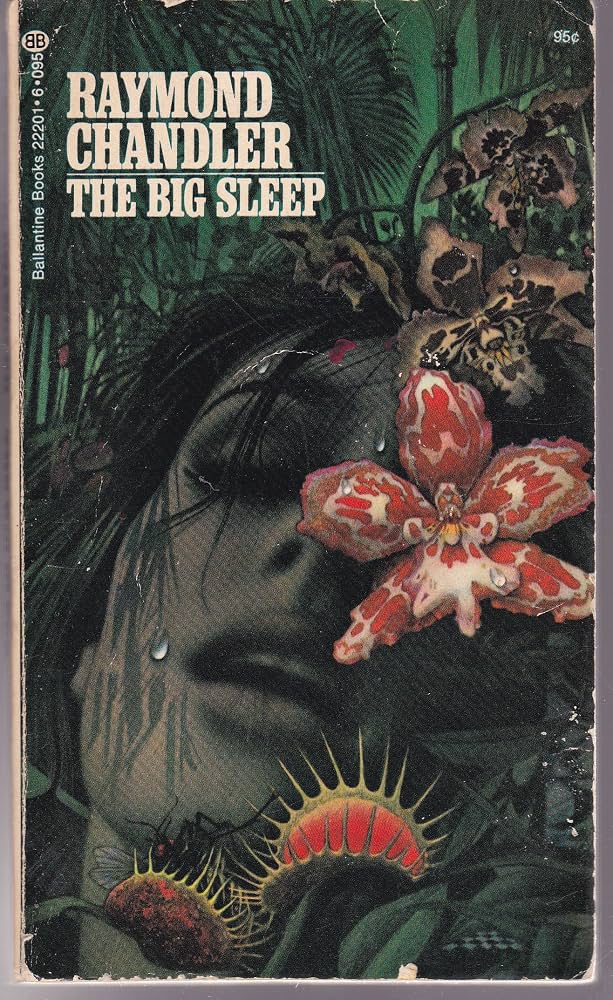
I’m not going to belabor the plot anymore. Frankly, I don’t think it’s as good as anything Hammett dreamed up in his novels, but it’s good enough. The plot is a framework on which to hang a series of adventures, some of them quite thrilling, as well as Marlowe’s glorious commentary, which is so funny that I kept stopping to write it down. Frankly, I think Chandler is talking out of his hat in his famous essay, for none of this feels realistic; in fact, the author himself makes reference to the artificiality of his oeuvre during a terrifying scene near the end when Marlowe has to face down a psychopath, and describes the man thusly: “He moved his dark eyes up and down slowly and then glanced at his fingernails one by one, holding them up against the light and studying them with care, as Hollywood has taught it should be done.”
Even in their darkest moments, Marlowe is aware that he exists in a tragi-comedy of manners! Facing a horrible death, he can’t help but be funny: “Just a plain pine box,” I said. “Don’t bother with bronze or silver handles. And don’t scatter my ashes over the blue Pacific. I like the worms better. Did you know that worms are of both sexes and that any worm can love any other worm?”
The exposition I rattled off at the top may give you the impression that the plot is overly complicated; this is certainly what I was led to believe from hearsay and from my experience with the 1946 film adaptation, which I love but which is complicated for a different reason than you might expect. The plot of the novel twists and turns but is essentially a simple chain of events that leads to a solution. To my mind, all the major issues are explained, despite what you’ve heard about producers calling Chandler and asking him who murdered the chauffeur. (I can tell you who murdered the chauffeur; it’s right there on the page.) Maybe folks get confused because there are several murders and several murderers, but Chandler sorts it all out as he goes along.
Reading The Big Sleep has not necessarily made me hungry to read more Chandler, although I would love some suggestions for short stories that people love, and I honestly would enjoy a booklet containing “The Wit and Wisdom of Philip Marlowe,” his descriptions are that good:
I was as empty of life as a scarecrow’s pockets.
Another man sat at a corner of the desk in a blue leather chair, a cold-eyed hatchet-faced man, as lean as a rake and as hard as the manager of a loan office.
People who spend their money for second-hand sex jags are as nervous as dowagers who can’t find the rest room.
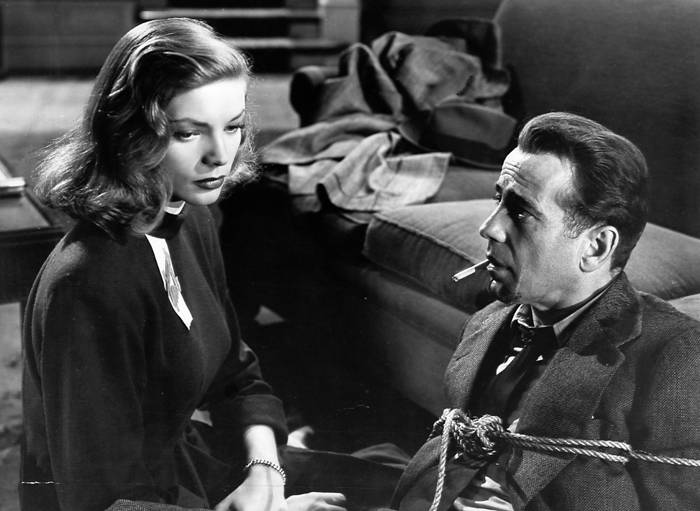
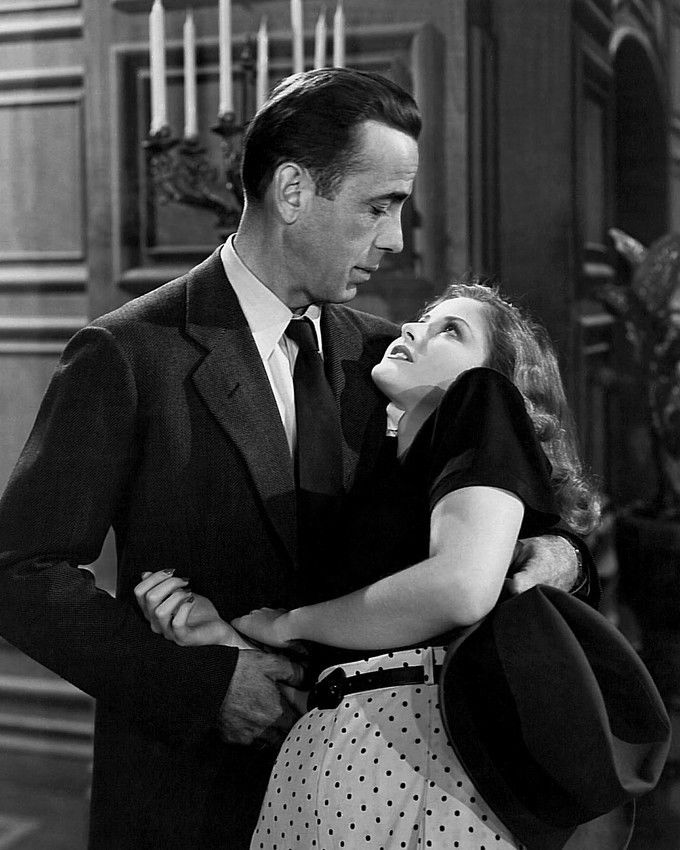
What reading the book has does is make me reassess my feelings for the 1946 film. In many ways, it’s a reasonably faithful adaptation of the novel, albeit one that has been scrubbed almost clean by the Hays Code. (An important subplot about a pornography ring is given a PG rating!) The film has a sterling cast, even if many of the characters have also been scrubbed. Humphrey Bogart as Marlowe is a lighter spirit than Bogey as Sam Spade. You see the joy in his eyes when he lights on the idea to approach Geiger’s bookshop disguised as a homosexual, after which he crosses the street to a rival bookshop and is all-male with the comely clerk (a scene-stealing Dorothy Malone).
The problem with the film is that its first intention was not to make an adaptation of Chandler’s novel but to provide a vehicle for Warner Brothers’ favorite star pairing of Bogey with Lauren Bacall. Who can wonder about that?!? The chemistry between the two is electric and so apparent onscreen that you can understand how it ultimately wrecked Bogart’s troubled marriage to Mayo Methune. Director Howard Hawks was so perturbed by the relationship that he tried to divert Bacall away from Bogey by dangling Clark Gable before her; it didn’t work.
In order to allow the two stars to crackle, writers William Faulkner, Leigh Brackett and Jules Furthman had to redeem the character of Vivian Sternwood, who in the book is really just as rotten as her sister in ways that I don’t want to spoil for you because those scenes are good! In the film, Vivian is no longer married to Rusty Regan, who was hired by the General to be his companion. She was married but is now free. She is a good daughter and a good sister. Sure, she gambles and skirts the wild life, but even in the casino she has time to sit down with Bogey’s Marlowe and crackle ,crackle, crackle!
It’s great cinema, but it misses the point of the book by a mile. Chandler’s novel is rife with misogyny: there’s not a woman around who isn’t morally compromised, and the evils that men do here are nothing compared to the horrors stemming from the lunatic minds of the Sternwood girls. Arguably the truest expressions of love in the novel come from a woman hopelessly besotted with her criminal husband and from a homosexual who kills to revenge his murdered lover. (I dare you to find that in the film!)
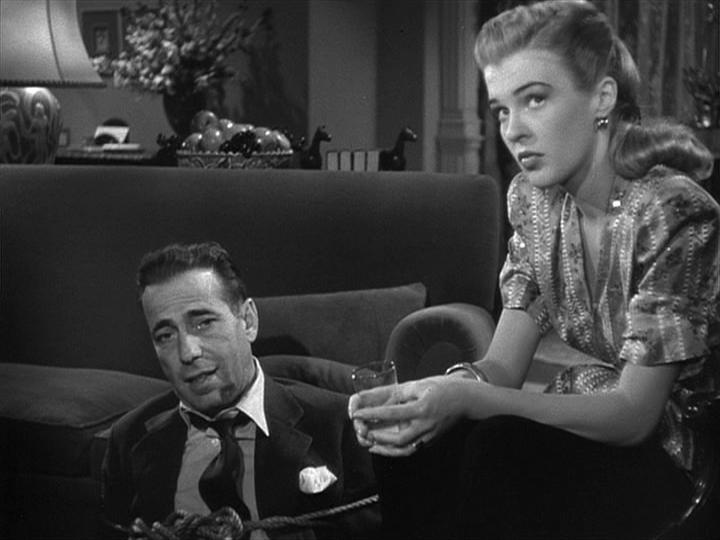
In the midst of all this moral pollution stands Philip Marlowe, a common man, an unusual man, a true man of honor in an ugly world. I’m not sure yet how much Raymond Chandler knew about how to plot a book, but in regard to the creation of a true hero, he comes out aces.


Brad, my friend, I’m downright proud of you. ❤️
LikeLike
Nice piece
LikeLike
I adore Chandler and Marlowe. I’ve just read (or reread) all the novels this year. If you try only one more novel, try The Long Goodbye. It is his best and it is wonderful.
LikeLike