I recently did some research on the concept of déjà vu – not for the first time, I feel almost certain – and I learned that this feeling that we are experiencing something that happened to us before arises from a sort of “glitch” in our brain between the part that detects familiarity and the part that assesses novelty. Even when we find ourselves immersed in the feeling of déjà vu, we know that it’s impossible for us to have lived this same experience before, and yet we revel in this gnawing sense that we might be entering our own tiny little Twilight Zone.
Of course, sometimes we do go through similar experiences more than once and might experience a frisson of that feeling. Think of Captain Hastings at the beginning of Curtain as he prepares to return to Styles Court for a reunion with an old friend. “Who is there who has not felt a sudden startled pang at reliving an old experience or feeling an old emotion? ‘I have done this before . . . ‘” Hastings states at the start of that novel.
A similar experience awaits the consummate mystery fan, who finds himself reading the same plot over and over and over. Another body in the library . . . another trail of footprints in the sand . . . a preponderance of suspects gathered in infinite drawing rooms by mirror images of eccentric and talky sleuths armed with the solution to yet another set of homicides.
It’s like my own personal time loop!
I’m not a science-fiction fan, per se, but the time loop is a favorite trope of mine. Who doesn’t love the movie Groundhog Day, and if you’re looking for some books that do a lovely job with the concept, I recommend Replay by Ken Grimwood or Before I Fall by Lauren Oliver. (I’ll happily take your recommendations in the comments below.) Given my fondness for the trope and my understanding that hybrid-genre novels are all the rage these days, I wish I could go back in time and figure out what went wrong for me when I tried to read Yasuhiko Nishizawa’s The Man Who Died Seven Times. All my blogging buddies loved it, but I couldn’t get through it. The weird “condition” that plagued the main character and caused him to loop occasionally had so many rules and conditions that I scoffed. And once you scoff at a concept, you might as well toss it aside and move on to the next. (For what it’s worth, I gave the book a good home with a friend, who enjoyed it thoroughly.)
But as most time loopers say (because, well, they have to), “If at first you don’t succeed . . . “ And when my buddy Kate wrote a positive review of C.E. Hulse’s Vivian Dies Again, I ordered it through Blackwell’s (as of this writing, the novel isn’t available in the U.S.) and hoped for the best.
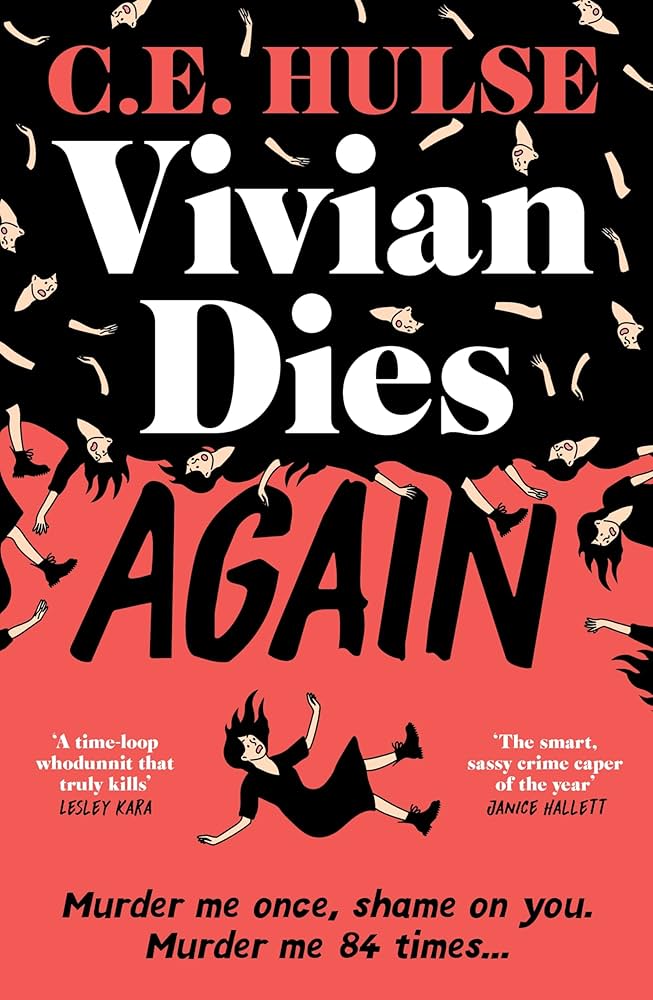
The publisher, Viper Press, presents the book as a comic mystery. There’s the clever cover illustration featuring multiple iterations of a woman falling. There’s the front cover quote by Janice Hallett (I always connect with her humor) that states, “The smart sassy crime caper of the year,” the back cover quote by Heather Critchlow: “Takes the classic murder mystery and drops it on its head – repeatedly”, and the tagline that reads, “Murder me once, shame on you. Murder me 84 times . . .” I went in expecting a light-hearted and witty romp of a mystery.
There certainly is wit in Hulse’s writing, but it is of the mordant kind. Part of the genius of Groundhog Day is that Bill Murray’s Phil Connors may be a rude narcissist, but between his biting humor and those sad eyes that reveal the self-loathing deep deep inside, you can’t help but root for him to figure things out and find his best self in the process. Vivian Slade is also a horrible person, but for different reasons. There is something pathetically sad about her empty life, the years of poor choices, boozing and drug taking, the shambles she has made of her relationships with family and friends. It doesn’t take long to find yourself both disliking and rooting for Vivian and hoping that she would emerge from this extraordinary experience 1) having solved a clever mystery about who kept murdering her, and 2) having found her own better self and living happily ever after, sans loop!
Despite sharing the same sci-fi trope, Hulse’s book differs widely from the Bill Murray film. The location is the rooftop of a posh London museum, where the extended Slade family has gathered a year after the deaths of a beloved uncle and his wife from a motor accident. Vivian mourns the loss of this particular uncle because he seems to be the only relative besides her mother who loves her in spite of all the terrible things she has done. As for the rest of the clan, well . . . Vivian hasn’t even been invited to this party and has to crash it.
Before a quarter of the book is over, someone at the party has crept up behind Vivian and thrown her over the balcony. Only instead of dying, she comes to with a shock and finds herself back at the gathering in the middle of a tense family conversation. Yet here is where Hulse provides her own variation on Groundhog Day: Vivian remembers nothing about having died because this isn’t actually her time loop. For some reason, a nearby waiter, a guy named Jamie who has plenty of problems of his own, has gotten caught up in the drama and has been reliving Vivian’s final hours over and over again. It is his job to fill her in on what’s going on and to try and set our heroine on the course of preventing her own murder, if only so that Jamie can go home, repair the damage he’s done to his own relationship, and get some sleep!
From there, Hulse jumps back and forth between the “Now” of Vivian and Jamie’s shared nightmare loop and various past events that illuminate the kind of person Vivian is and why everyone dislikes her. And here’s where things feel less funny: clearly the woman has been traumatized by various events in her life and nobody has done much to help her with the aftermath. These sections amply display Vivian’s bad behavior, yet at the same time they provide much-needed context that helps us sympathize with her for how she’s being treated by her rotten family.
Ultimately, Vivian undergoes a somewhat more realistic transformation from the experience than Phil Connors does. (Phil becomes a saint and gets the girl; Vivian clearly has more work to do.) She also solves the mystery – unfortunately, it’s not much of a mystery. There aren’t really any clues, and what passes for “sleuthing” is mostly clumsy confrontations with other characters that provide bits of information she will hopefully pass on to Jamie since with each “reset” Vivian forgets everything. The waiter gets his ending as well, but frankly he’s a less developed or connected character and the fact that he shares so much page time with Viv tends to mitigate the emotional impact of their shared experience.
Even though this is being marketed as Hulse’s “first crime novel,” I’m not sure she needs to experiment any more with the genre. I recognize – and sometimes even enjoy – the fact that modern mysteries have moved past the focus on a puzzle and embrace the emotional journey that the characters take through the mystery. But if you’re going to do that, I would prefer that you not ignore the tropes and conventions that make mysteries mysteries! And I’ll tell you another thing: while I got no sense of déjà vu reading Vivian Dies Again, I now wish I could loop back in time and give The Man Who Died Seven Times another chance.


I’m sorry this one did not work for you as much as it did for me. I haven’t really read many books similar to this one, so perhaps it felt fresher to me. Might also have depended on what other books I had read around that time. Certainly been a few duds this year.
LikeLike