It is always a pleasure to return to the work of Anthony Horowitz, an author who never met a meta-fiction he didn’t like. First, he gave us a trilogy about an editor who had to solve the mysteries in the books she published in order to find justice for the bodies dropping all around her. And then we were given the chronicles of a disgraced police detective who sought redemption by hunting murderers, taking on as his Watson a writer who happened to be the author who had created the disgraced police detective in the first place.
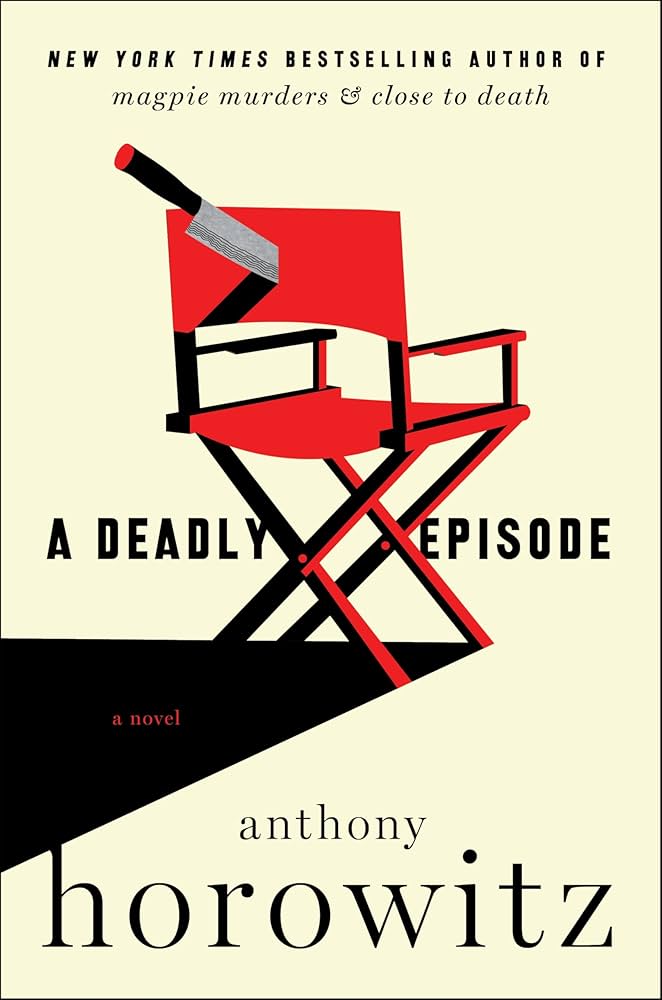
And now, Horowitz has gone one better: in A Deadly Episode, the sixth book in the Hawthorne series, Anthony Horowitz (the fictional version – let’s call him Anthony) joins Daniel Hawthorne (fictional no matter how you slice it) on the movie set of an adaptation of The Word Is Murder (the first Hawthorne/Horowitz adventure) in order to investigate the murder of the fictional fictional version of Daniel Hawthorne, But is the actor playing Hawthorne in the film the actual intended victim – or does someone want to murder – dare I say it? – the real Hawthorne?!?
If this all makes you the least bit dizzy, rest assured that the metafictional aspects of Horowitz’ books are never confusing and always delightful. While Hawthorne himself is frankly an annoying character – great at solving mysteries, kind of a douche as a human being, and very rude to Anthony – the biggest joy here is Horowitz’ take on himself. He knows he can lampoon and lambaste his own character when it comes to taking on the Watson role: he is very good in his job as “chronicler” of these cases (although one character after another tends to disagree with this assessment) but admittedly mediocre when it comes to detection.
Anthony freely admits this when, in the course of the novel, he finds himself investigating alone: “. . . as I’d learned from my time with Hawthorne, I had a habit of missing the obvious.” Yet, while people tend to dismiss, ignore, threaten or tease this fictional construct, Horowitz is secure enough in himself to present Anthony as a mensch, a good husband and father, and a man who is genuinely satisfied with his lot in life.
As mysteries go, the Hawthorne novels are generally light-hearted and not too complex, and the case that begins this sixth adventure is no different. While we can be sure that in real life, Horowitz will have total control over any film adaptation of these books, here Anthony is helpless as his agent signs away the rights to The Word Is Murder to a neophyte production company that plans to make not a mini-series, but a single film (something Anthony would probably not consider if he was making an adaptation himself with his producer wife Jill – which you just know is going to happen someday!) And while Anthony is not offered the job of writing the script, Hawthorne is hired to be a consultant.
This helps explain why Anthony is not on set when the leading actor is violently murdered in his trailer, but he does join Hawthorne on location in Hastings to investigate the crime, at the behest of an unusually friendly (and pretty) Detective-Inspector. The victim has nailed the character of Hawthorne, both physically and emotionally; unfortunately, he turns out to be a truly odious guy whose actions against his co-star, director, screenwriter, producer, agent, and production assistant make them all viable suspects. When one of these six emerges as the most likely killer, Anthony mourns the viability of turning this relatively simple case into a novel: “As far as I could see, the next book in the series had been strangled at birth. Quite apart from the fact that it would end about fourteen chapters in, who would be satisfied with such an obvious solution?” (Naturally, this observation is made fourteen chapters in.) But then Anthony himself is struck with an inspired idea: since the the crime scene has the character’s name – “Hawthorne” – on the door rather than the actor’s name, what if the killer was not a member of the film company but an outsider who thought they were murdering the detective himself?
This spins the novel into another direction – a murder from the past that Hawthorne had helped to solve. After the pair examine this cold case and reveal cracks in the accepted solution, Anthony finds himself spinning solo in a third direction: back to Hawthorne’s home town of Reeth and the overarching mystery of the man’s past that has wound its way through the series. What he finds there is interesting and unsettling, but still too sketchy (for this reader at least) to dig his heels into the “bigger picture” of what happened to Hawthorne. Still, it’s great fun watching Anthony make a mess of his attempts at sleuthing, and his observations of Reeth are amusing: “I was beginning to feel that I’d strayed into one of those horror films where a stranger wanders into a rural community, starts asking inappropriate questions and ends up sliced into pieces in a field.”
By the end, there are many questions in need of answers, and Hawthorne provides, perhaps too quickly, a neat solution that ties the past and present murder cases together, the best part of which is a motive Horowitz dangles right in front of us, only I didn’t see it. With A Deadly Episode, Anthony Horowitz gives us another breezy and entertaining read with some lovely meta-fictional humor. I wish the elements that make up the bigger picture were more memorable, but at last things seem to be coming to a head in that direction. Perhaps the next chapter in the Hawthorne saga will bring us even closer to the revelations of his past, but honestly, I would settle for seeing our Anthony get a little more respect! It’s the least that he deserves!


I’m so excited to read this one!!
LikeLiked by 1 person
I thoroughly enjoyed the Susan Ryeland series and the first three in this one. But I found myself getting more and more annoyed with how whiny and Eeyore-like the fictional Anthony gets with each passing book. My irritation with the character has definitely coloured my reading experience.
That said, I love the puzzles and the fair-play clueing and the realism that Horowitz brings to his works. Few contemporary authors are as loyal to or as good at classic mystery style writing.
LikeLiked by 1 person