At the midpoint of 4:50 from Paddington, Lucy Eyelesbarrow enters the Long Barn at Rutherford Hall for the first time. She is looking for a body. This is what she finds:
“At a first glance, Lucy felt that she was in a singularly bad museum. The heads of two Roman emperors in marble glared at her out of bulging eyeballs, there was a huge sarcophagus of a decadent Greco-Roman period, a simpering Venus stood on a pedestal, clutching her falling draperies. Besides these works of art there were a couple of trestle tables, some stacked-up chairs, and sundry oddments such as a rusted hand mower, two buckets, a couple of moth-eaten car seats, and a green-painted, iron garden seat that had lost a leg.”
SPOILER ALERT: look in the sarcophagus. It is the most likely and the most theatrical place to store a corpse. I share this description with you, however, for another reason. During her writing career, Agatha Christie created hundreds of crime scenes, and while some are viewed merely in passing merely in order to discover a victim, the canon is stuffed like a museum with fascinating locations that required the author, a woman well-known for her love of houses and of decorating them, to take on the role of set designer, properties mistress, and lighting consultant.

Christie had an eye for a dramatic scene, even those that required little to no furnishing. From a favored spot on Burgh Island, she created the beach at Pixie Cove for Evil Under the Sun, where the body of Arlena Marshall lies on a stretch of sand, clad in a white bathing dress, her face covered by a green coolie hat. There’s not much else to see (although we should pay attention to the small cave nearby, both for what we find and what we can smell.) Christie could also take an overused trope – the body in the library – and suffuse it with power by making it the library of the Bantrys, a couple we know and love, and by making the victim as incongruous a corpse as you could find in such warm and comfortable surroundings.
Mostly, though, Christie’s mind had to function as a kind of scene shop and properties room, the sorts of spaces that sit adjacent to, or lie underneath, many a professional and community theater. She had to pick her furnishings carefully, and organize her physical clues with the same care. Even though Agatha was not known for lengthy descriptions of places, not only do we know exactly what we need to know about how a crime scene is put together, but we are endlessly surprised, horrified and entertained by what we find there.
Take the common trunk, a furniture piece both functional and decorative. In Christie’s hands, you would have to guess if it stores blankets, photographs or old clothing, but you can be certain it contains a body. Something as innocuous as a table can provide a vital clue: in Cards on the Table, the actions of a quartet of bridge players is vital to the discovery of who killed the host sitting mere feet away from them; in A Murder Is Announced, a burn mark on a table gives Miss Marple the solution to how a vital effect was achieved; in After the Funeral, the absence of a vase of wax flowers on a green malachite table unmasks a killer.
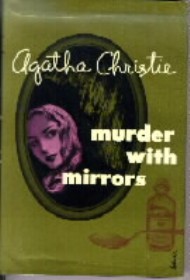
Think, too, of all the mirrors that serve as more than mere backdrop in Christie’s world.
Some of them reveal significant truths about a case, as in Dead Man’s Mirror or Dumb Witness – but only if you look at things the right way round – or After the Funeral. Others distort the truth, as in the story “In a Glass Darkly.” There are even metaphorical mirrors, as in They Do It with . . . or those that Crack’d from Side to Side – both novels that are theatre-adjacent and deal with matters of sleight of hand, of “seeing” things that aren’t actually there.
Adjacent to the gigantic furniture warehouse in Christie’s mind are various rooms full of props. Most notable might be the Weapons room where, beside the vast amount of guns and knives are found an assortment of more bizarre engines of destruction:
- An electrified chessboard, used in The Big Four to murder chess master Gilmour Wilson;
- A sugar hammer purchased at a jumble sale and used to bludgeon Mrs. McGinty to death;
- A clock shaped like a bear that was pushed from a window to crush Mr. Blore’s skull in And Then There Were None;
- An ordinary tape measure, used to strangle Mrs. Spenlow in “The Tape Measure Murder;”
- A beautiful Persian cat named Wonky Pooh whose infected ear was weaponized to kill Dr. Humbleby in Murder Is Easy
- Various jars and bottles marked “Tonic” or “Hat Paint” or “Calmo” gathered next to syringes loaded with botulism, a dish of hundreds and thousands that has been soaked in arsenic, port decanters laced with nicotine, tubes of toothpaste tainted with thallium and face creams loaded with belladonna. And, for God’s sake, stay away from that stack of chocolate boxes, each one of them postmarked to an unlucky recipient.
In other rooms, we find objects that are more beautiful but no less significant. The one marked “Jewelry,” is filled with treasures that will take your breath away – sometimes literally! A pair of enormous rubies lay side by side: one is the notorious “Heart of Fire,” which caused violent death in The Mystery of the Blue Train, while the other appears to be stained with the crumbs of an old Christmas pudding. If you wonder at the slightly soapy smell emanating from that pretty pink pearl on display, ask Tommy Beresford. Of course, pearls are always more appealing as a set: here lies Mrs. Opalson’s grand necklace, from “The Jewel Robbery at the Grand Metropolitan,” while Linnet Doyle’s strand from Death on the Nile is even grander – although you are highly advised to check the pearls for authenticity! Diamonds are a thief’s best friend, and the “Western Star”, stolen from the left eye of a Chinese idol, proves it. Or, wait! That might be “The Star of the East,” an identical jewel which came out of the right eye! And if you’re wondering what a tennis racket is doing in the Jewelry Room, pick it up and feel its heft, then unscrew the end of the handle and let the diamonds pour out into your hand, enough to fund a country’s revolution!
Further beauty awaits in the “Art Gallery,” a long chamber where the walls are adorned with paintings, and the tables are set with various sculptures. Two sculptures by the noted artist Henrietta Savernake stand side by side: a clay horse of unusual heft, and a hauntingly exquisite abstract sculpture called “The Worshipper.” These two works share space with a piece of fakery: a plasticine head, horrifically ugly, that suggests the ancient masks used in Assyrian or Sumerian rituals. (God, I would hate to see that fellow pop up outside my window . . . ) On the next table is a curious piece of sculpture: the circular base supports ten figurines shaped like soldiers . . . or perhaps they are members of an indigenous community? It’s almost as if their identity shifts with the times . . .

And what a diverse assortment of paintings hangs here! The most prosaic by far is an amateur rendering in oils of a harbor scene at Polflexan Bay, so fresh that you can almost smell the paint! It hangs next to an exquisite painting by Rubens called The Girdle of Hippolyta, a highly sensual depiction of the Amazon about to bestow her girdle to Hercules. I’ve heard a rumor that there’s also a Vermeer somewhere in the gallery, but I have no idea where it’s hanging.
The most haunting painting is titled The Dead Harlequin: “The forefront of it represented a floor of inlaid squares of black and white marble. In the middle of the floor lay Harlequin on his back with his arms outstretched in his motley of black and red. Behind him was a window and outside that window, gazing in at the figure on the floor, was what appeared to be the same man silhouetted against the red glow of the setting sun.” Is it my imagination, or are the watcher and the dead figure the same man?
At the end of the gallery, two portraits hang side by side. The first is a powerful depiction of the Madonna and Child, the mother laughing at the perfection of her babe. Beside that is a portrait of a beautiful young woman whose flashing eyes belie the calm serenity of her pose. The emotional power of these artworks is staggering, but then they would have to be if they are to be the inspiration for murder.
I could fill pages with list after list of significant objects from Agatha Christie’s fertile mind, but the important thing is how a diverse array of furniture and props come together to create a theatrical crime scene. Let’s examine seven examples, ones that could easily transfer to the stage or screen; in fact, they all have, in one adaptation or another.
Emily Inglethorpe’s bedroom (The Mysterious Affair at Styles)
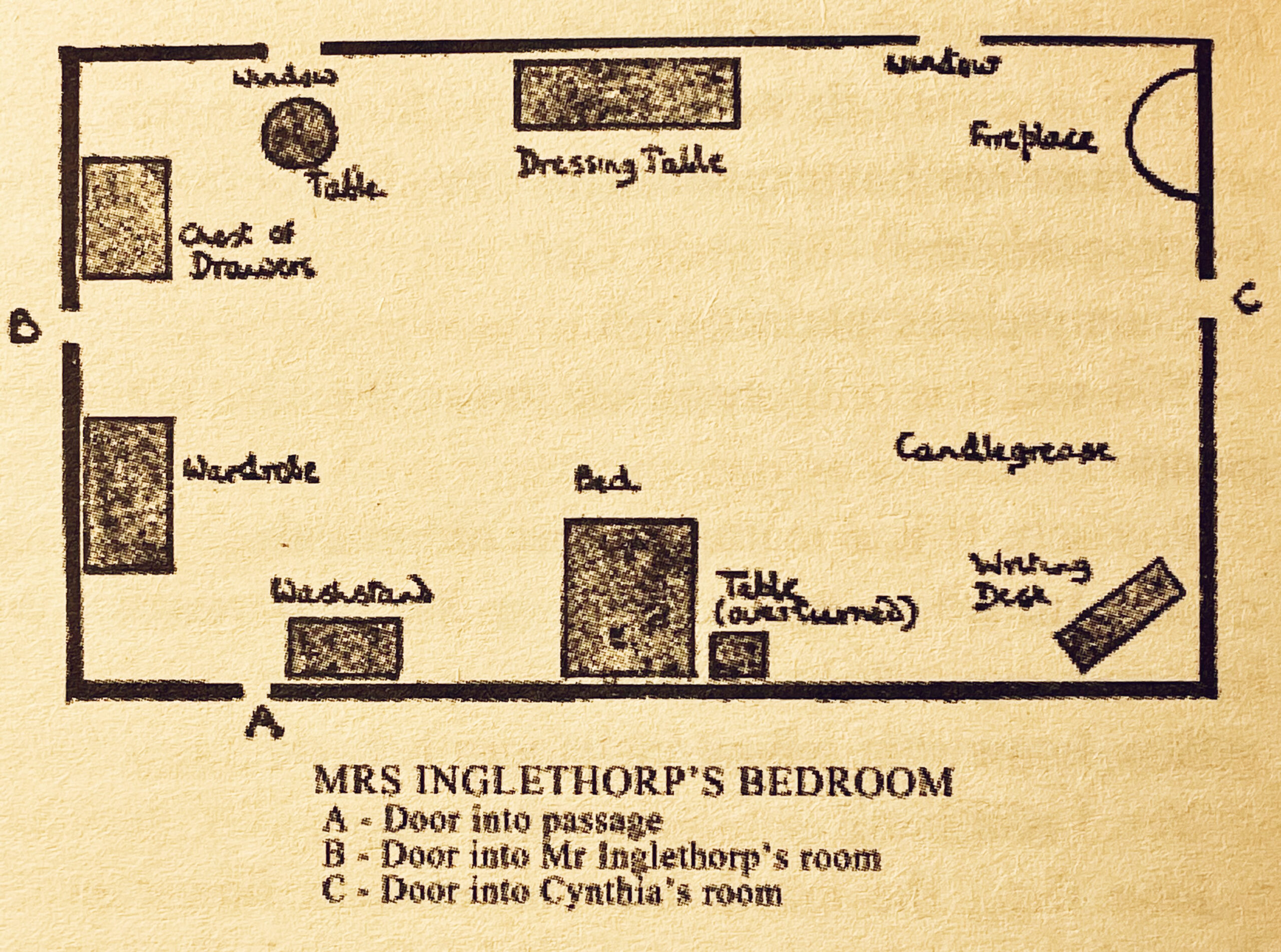
The very first crime scene created by Agatha Christie has all the dramatic detail and action of an exciting stage play. Imagine that we are peering through the windows as members of the “audience.” We find a large rectangular room with three entrances: the one furthest upstage (A) leads into the passage and, at the time Emily Inglethorpe is discovered in the throes of agony, it is locked. At Stage Right, entrance (B) leads into Mr. Inglethorpe’s bedroom; it is empty, and the husband is nowhere to be found. Entrance (C) at Stage Left leads to the chamber of Cynthia Murdoch, Emily’s ward, who often attends to the lady’s needs; it, too, is bolted.
The first murder in the canon takes the form of a horrifying vigil, and those with a knowledge of poisons will have a head start at figuring out what caused the victim’s slow death. The action revolves around Emily’s bed, which stands center stage. The family is gathered around Emily, and her suffering is terrible to behold. After her death, Hercule Poirot is brought into the case and is allowed to examine the room, where he finds enough clues to frankly fill three mystery novels. On the small round table by the window is a purple dispatch case containing valuable information. On the chest of drawers is a saucepan sitting atop a spirit lamp and containing the dregs of a dark liquid – cocoa with a dash of rum! The table by the bed has been overturned, spilling its contents: “A reading lamp, some books, matches, a bunch of keys, and the crushed fragments of a coffee cup . . .” Who crushed the cup to bits – and why? Is it because, as Poirot surmises, “because it contained strychnine or – which is far more serious – because it did not contain strychnine!”
Poirot goes over the room carefully. He removes a fragment of dark green fabric from the keyhole, he notes a dark brown stain in front of the window near the fireplace, and he finds a spot of candle grease on the floor near the writing desk. The sleuth gets on his hands and knees and sorts through the ashes in the fireplace, where he finds a burnt fragment of a will. And with all this discovery, the reader may dismiss a moment where Poirot “walked slowly across to the mantelpiece, where he stood abstractedly, fingering the ornaments, and straightening them – a trick of his when he was agitated.” Except that this is more than a mere character trait!!
Roger Ackroyd’s study (The Murder of Roger Ackroyd)
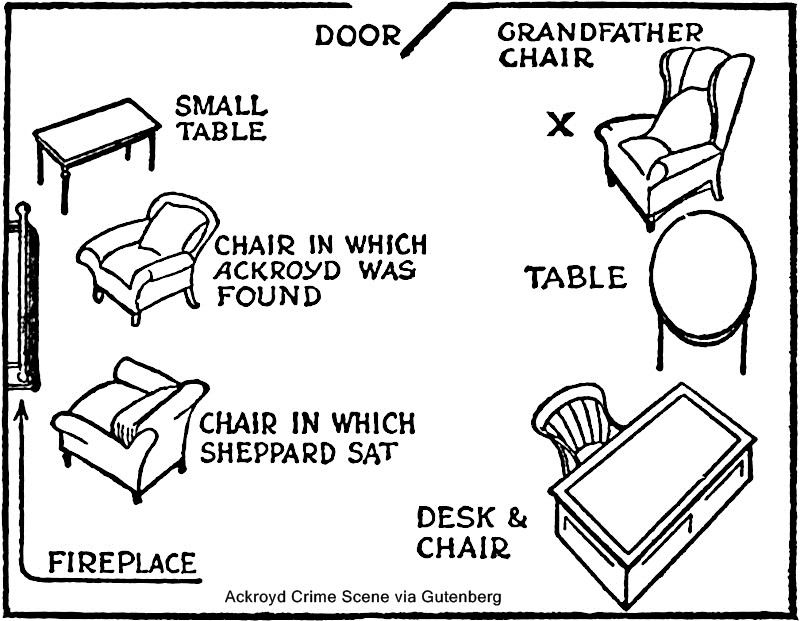
In a home, the study is a person’s sanctum sanctorum, a place where they can conduct their business, indulge in their pleasures and store their secrets. It radiates a sense of privacy and security, which is why it seems to be a favorite place in which to kill someone. Roger Ackroyd’s study is the first of many, “a comfortable apartment. Bookshelves lined one wall of it. The chairs were big and covered in dark blue leather. A large desk stood by the window and was covered with papers neatly docketed and filed. On a round table were various magazines and sporting papers.” The only legitimate entrance, the door, is locked when Dr. Sheppard arrives in answer to a phone call announcing Ackroyd’s death. The window becomes a key center of suspicion, especially after the discovery of footprints in the flowerbed.
The uncovering of secrets in a study often lies not so much in physical clues but in an understanding of the owner’s habits. The study must be Just So, and any deviation – a chair moved out of place, say – becomes important. As we will discover here, (and in The Murder at the Vicarage and They Do It with Mirrors and Ordeal by Innocence) is that what we think happened in the study is mere illusion.
Leonard Clement’s study (The Murder at the Vicarage)
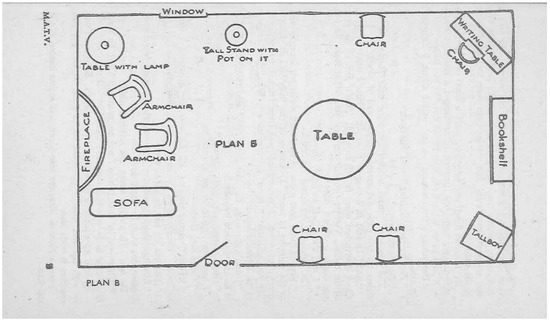
Christie doubles down on the sanctity of the study by having Colonel Protheroe get murdered in the Vicarage study. It is a prominent setting in the novel, the only setting in Moie Charles’ and Barbara Toy’s stage adaptation, and the source of much reflection by Leonard, who is one of my favorite narrators and characters in the canon.
It is also a great spot for a murder: it offers the privacy Clement needs to write his sermons – and where someone can commit a quiet murder – and we have seen people enter and exit from the door leading out to the hall and from the window leading into the garden. The pulling off of the crime requires the dexterous hiding of a weapon, some good acting on the part of one killer (who fortunately has had experience with amateur theatricals) and clever costuming on the part of the other killer. As the misunderstood clock on the vicar’s desk reminds us, everything depends on the timing!
Samuel Ratchett’s train compartment (Murder on the Orient Express)
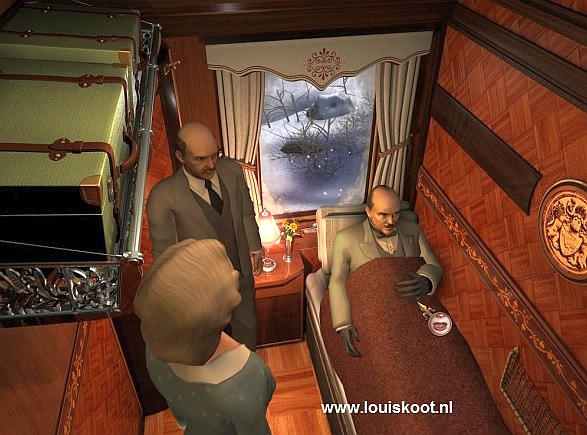
The compartment where Samuel Ratchett is found brutally slain is less than a quarter the size of Mrs. Inglethorpe’s bedroom at Styles Court, yet contains as many clues as were found their after her death. The room has three means of egress: the door into the train passage, which was bolted on the inside; the window, which was wide open, suggesting, albeit falsely, that the murderer escaped from there; and a communicating door into the next compartment, occupied by Mrs. Hubbard, which is also bolted, on her side.
The body itself holds a wealth of clues, including the number, angle and severity of the stab wounds, and a gold watch, which gives an accurate (yeah, right!) assessment of the time of death. Under the pillow, Poirot finds an automatic pistol, which Ratchett could not have used because the empty glass by the bed contains the dregs of a powerful narcotic. An ashtray contains a cigar butt, two burnt matches, and the charred remnants of two messages that should have been burnt completely. Importantly, the matches, er, do not match, indicating that two different people used them! On the floor beside the bed are found a lady’s monogrammed handkerchief and a man’s pipe cleaner.
It’s all . . . too much! Poirot, who freely admits that “I am not one to rely upon the expert procedure. It is the psychology I seek, not the fingerprint or the cigarette ash,” realizes that he cannot ignore all this physical evidence. “The compartment is full of clues,” he complains, “but can I be sure that those clues are really what they seem to be?”
Linnet Doyle’s stateroom (Death on the Nile)
Linnet occupies one of the four cabins de luxe on board the S.S. Karnak, which, like Mr. Ratchet’s compartment on the Orient Express, is beautifully appointed but small. (The Doyles have also booked an adjoining cabin for Simon.) Like Ratchet, Linnet dies in bed, and as in the previous case, her room is abundant with clues. The wounds on her body tell Poirot much about how the killer approached the body. The white painted wall above the bed is marred with a dying message, “a big wavering letter J scrawled in some brownish-red medium.” An empty bottle of nail polish provides further information. Some clues are notable by their absence: why did the murderer not leave the weapon behind as further proof of Jackie de Bellefort’s guilt? Where are Linnet’s pearls?
Christie parses the drama everywhere in this epic mystery, in England, America, and Egypt, and all over the steamer. Much of the best shifts to Simon’s cabin, where a conversation with the maid, Louise Bourget, will reveal much, and where Mrs. Otterbourne is center stage for one of the most theatrical murders in the canon.
The parlor at Little Paddocks (A Murder Is Announced)
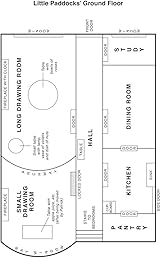
The opening chapters of the best of Miss Marple novels introduce a rich dramatis personae. Bring them together in a dramatic way and then have them do theatrical things to each other. When the neighbors arrive at Little Paddocks in answer to the summons to a murder, the scene comes straight out of domestic comedy. The conversation rings with “Your chrysanthemums are lovely” and “You’ve got your central heating on” as ten or so disparate characters try to navigate through the social awkwardness of an evening whose outcome is uncertain.
The setting is the double drawing room with two fireplaces (although neither is lit – a clue!). The furniture includes the aforementioned table with the burn mark on it – except the mark isn’t present yet (another clue!) A lamp stands on the table, adorned with a Dresden figurine of a shepherd (or is it a shepherdess . . . clue!). On the table is a vase with fresh-picked violets (the murder of the violets provides another clue!) The murder takes place at 6:30pm and involves a killer and a victim who are both playing roles. (Others in the room are doing the same thing, but that’s more of a red herring than a clue!)
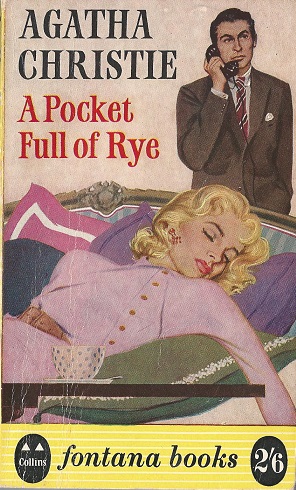
We close our section on crime scenes with one of the most intricate. Christie worked nursery rhymes into many of her stories, with mixed results. One of the more successful occurs in 1953’s A Pocketful of Rye, which introduces us to one of the most heartless killers in the canon. Lance Fortescue has always been the black sheep in the family and was kicked out of the family business by his father for writing a bad check. He finally has a chance for redemption when he finds true love, but he the plan he forms to set them up for life is horrifying: to murder his father and stepmother, worm his way back into the family, and take ownership of the seemingly worthless Blackbird mine.
Disguising himself as a working-class Joe, he seduces the awkward and unattractive Gladys Martin, making her his unwitting accomplice. He plans on using the “Four and Twenty Blackbirds” rhyme as a means of working through three murders and framing an old enemy of his family for the spree. What we end up with in the first half of the book then is a trio of crime scenes that are grotesquely funny: the death in his “counting house” of “King” Rex Fortescue, his pocket teeming with rye, the poisoning of “Queen” Adele Fortescue in her parlor while consuming bread and honey, and, most cruel of all, the murder of Gladys Martin outside by the clothesline, with a peg “nipping” at her nose.
It is the theatricality of these crimes that infuriates Miss Marple, the callous disregard for life itself but also for the dignity of the victims. Alongside the sense of righteousness that she feels after catching the killer, Miss Marple sheds tears “Succeeding pity there came anger – anger against a heartless killer.” And while we gentle souls who read Christie’s books no doubt share the old lady’s outrage, we have also been mesmerized and thoroughly entertained by this killer’s flair.
Some good backstage direction will always elicit that effect!


wow, Brad, this is a huge and wonderful post! So many on-point details. Love it. Thank you!
LikeLiked by 2 people
Thank you, Marthe! I’m having so much fun reexamining Christie through this theatrical lens.
LikeLike
Just wonderful!
One point I keep noticing over and over and this is the language barrier in action: all those people going in and out of windows! When what Agatha means (and other English writers) is those folks are going in and out of French doors and sliding glass doors.
They’re not climbing out through a double-hung sash window.
LikeLiked by 3 people
Yes, I’ve thought of that – and yet, as you see, the floor plans draw and label them as regular windows. Maybe the Brits resent giving any credit to the French!?!
LikeLiked by 1 person
Or maybe everyone really does crawl through the window like a burglar.
LikeLiked by 1 person
This is where your experience in theatre really shows, Brad. You made me look at all these scenes from the point of view of staging. I’ve never appreciated so much how well Agatha directs our attention (not just those of her characters, but us, the audience) literally. Notice this, let your glance sweep over this bunch of things, completely ignore this other thing, and so on.
I’m not surprised she’s so good at this, given how enthusiastic she was about theatre. In fact, I think she does setup and direction even better than Ngaio Marsh, who was even more of a theatre expert. Ngaio’s setups and buildup to the murder are good, but I don’t think she uses stage direction as well to trick the audience.
LikeLiked by 2 people
Marsh brilliantly took us time and time again into the theatre milieu, even setting some of her murders on stage and capturing the capricious nature of theatre folk with insight and humor. I always felt, however, that her puzzles lacked cleverness, and the endless series of interviews bogged down the story. Why couldn’t actors be more clever when facing down the police?!?
LikeLike