In the early, pre-Barnabas Collins, days of Dark Shadows, the show tried to behave like a normal soap opera, albeit with Gothic trappings. The main storylines centered around Victoria Winters, a grown-up orphan who had come to Collinsport to take a job as governess to the young Collins heir because of a hint she had received that she might find her true ancestry there, and around Burke Devlin (Mitchell Ryan – until he got too drunk to play the part and was replaced by Anthony George), who had been framed and sent to prison for a hit-and-run murder that was probably the fault of Roger Collins, father to Vicky’s young charge.
In keeping with the soap vibe, nobody was completely good or bad (except for Vicky, who was sickly sweet), but morally gray. The brother and sister who ran Collinwood each had the same secret: they had (or thought they had) killed a man. Ultimately, neither secret mattered very much when the vampires came to town. Before Barnabas, the first real villain on the show was a dull one: Matthew Morgan, the family caretaker who murdered a man to protect the Collins secrets. There were two good things about Matthew: first, he was played by Thayer David, who went on to play far better parts on the show, including Count Ptofi, one of the best villains; and the second great thing was that Matthew was killed by ghosts, which signaled the arrival of actual supernatural creatures to the program. Then came Laura Collins, the Phoenix, who failed in her attempt to serve her little boy to the flames.
Once Laura exited the picture, the show seemed to step back to a more traditional sort of soap villain: Jason Maguire, played by Dennis Patrick, was a true rogue, an old friend of Paul Stoddard, the missing husband of matriarch Elizabeth Collins Stoddard, who had smacked Paul on the head and buried him in the basement. Patrick gave the series a much-needed boost of energy and fun as Jason, who literally knew where the bodies were buried and put the bite on Elizabeth for lots and lots of money, which he would have continued to do had his confederate Willy Loomis not unlocked the coffin imprisoning vampire Barnabas Collins.

After that, Dark Shadows became all about vampires and witches and werewolves and time travel. A boring human villain like Jason wasn’t worth the time, and so, in a fit of family pride, Barnabas strangled him. Patrick would return a couple of years later, ironically to play the not-so-dead Paul Stoddard (Jason knew this all the time!). Paul was a weakling and very fond of his daughter Carolyn – except for the fact that he had promised her hand in marriage to the Lovecraftian serpent monster who was the head of the deadly Leviathan cult. Most deservedly, Paul also came to a violent end.
Dennis Patrick was another actor who worked steadily, primarily in television, for decades. Perhaps his most prestigious credit was playing banker Vaughn Leland on Dallas, where he was one of the prime suspects in the “Who Shot J.R.?” mystery. He also managed to make four appearances on Perry Mason that covered most of the series’ run. His first episode in 1959 was an adaptation of one of the novels; we’ll get to that during next year’s Perry Mason theme. But the other three cases, in Seasons 3, 5, and 9, are all original teleplays.
The first of these, “The Case of the Prudent Prosecutor” debuted January 30, 1960 as the 14th episode of Season Three. You would probably call this one of the series’ “special” episodes because it casts one of the series regulars, District Attorney Hamilton Burger, played by William Tallman, in a new light. Burger loves to go hunting and fishing in one of those suburbs of Los Angeles that more closely resembles the Old West. One of his dear friends there is Jefferson Pike (played by veteran actor J. Pat O’Malley), who once saved his life by carrying a wounded Burger through miles of frozen water, losing three of his own toes in the process!
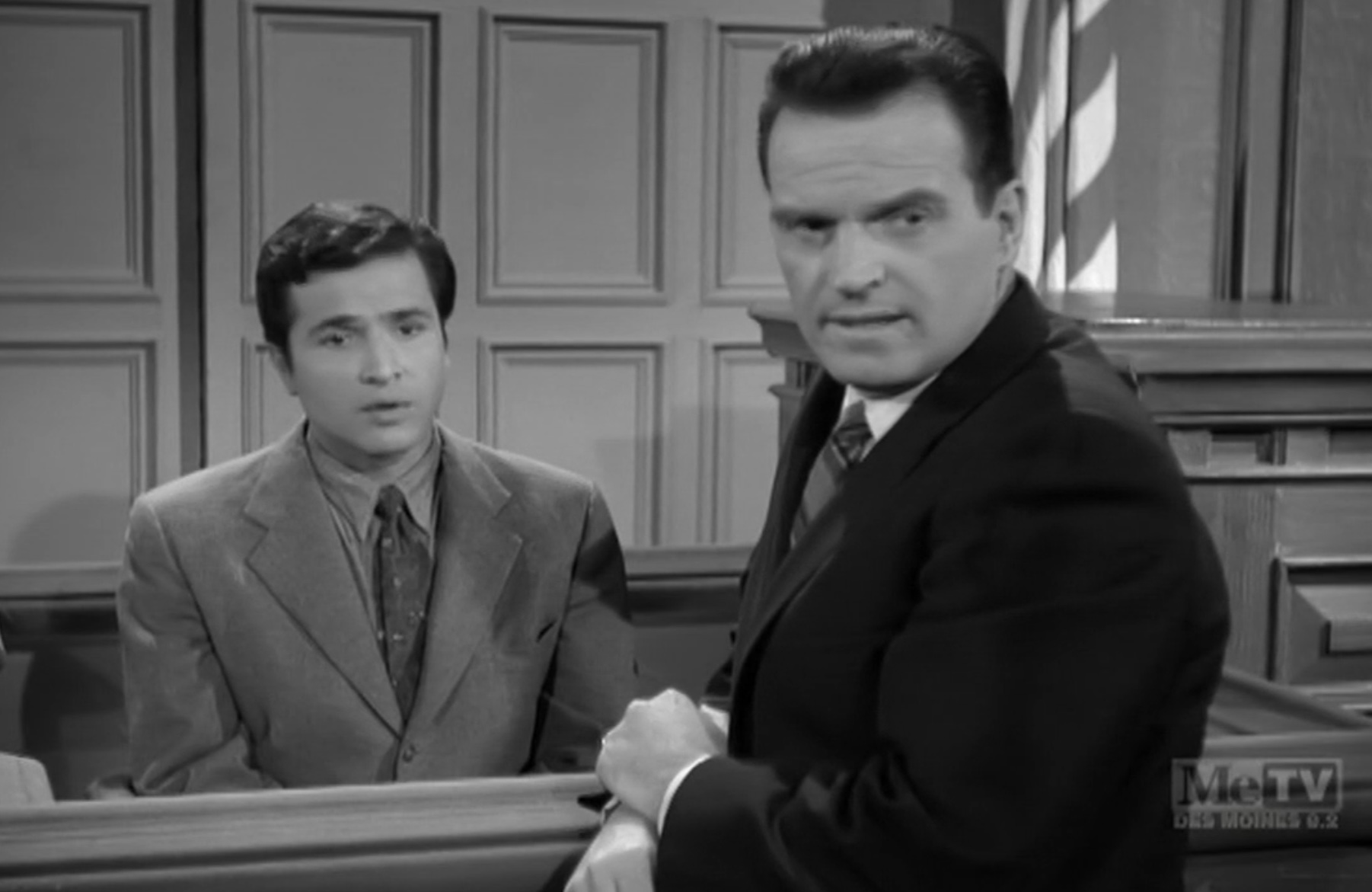
Jeff is having troubles with local conniver Denver Leonard, and things have gotten so bad that Jeff steals Leonard’s gun and shoots himself in the leg in order to frame the man and get him out of his family’s hair. Seems that Jeff’s son Fred is a former Olympic skater whose career was cut short in an auto accident and who is being framed by Leonard for cutting checks on the man’s account. Anyway, Jeff and Fred are on hand when Leonard and his long-suffering wife entertain a wealthy couple, Asa and Vita Culver. Actually, Vita and Leonard are having a fling as they work together to cheat Asa out of a large sum of money. It all culminates in Leonard being bludgeoned to death with a shotgun that has Jeff’s prints all over it.
Not only does Hamilton Burger recuse himself from prosecuting his old friend, he begs Perry Mason to take the case. One of the best lines is Perry saying to Burger, “I’ll take the case, Hamilton – even if he did save your life!”
Well, somebody has to prosecute the case, and that’s where Dennis Patrick steps into the story as visiting D.A. Daryl Teshman. He’s perfectly okay in the part, but he’s no Ham Burger! And the case itself is strictly ordinary, with the real killer standing out by a mile, at least for this old Perry Mason fan!
Patrick made his next appearance in “The Case of the Tarnished Trademark,” which debuted on January 22, 1962 as Episode 18 of the fifth season. Here he plays the victim, Martin Somers, who has just purchased the trademark for Axel Norstaad’s (Karl Swenson) highly esteemed furniture line. All you have to do is look at Patrick standing there sneering as Norstaad announces the deal to his employees to know that he’s up to no good. All too quickly, checks are bouncing and once highly prized and sturdy chairs are being manufactured out of balsa wood. By the first commercial break, Martin is lying battered to death in a motel room.
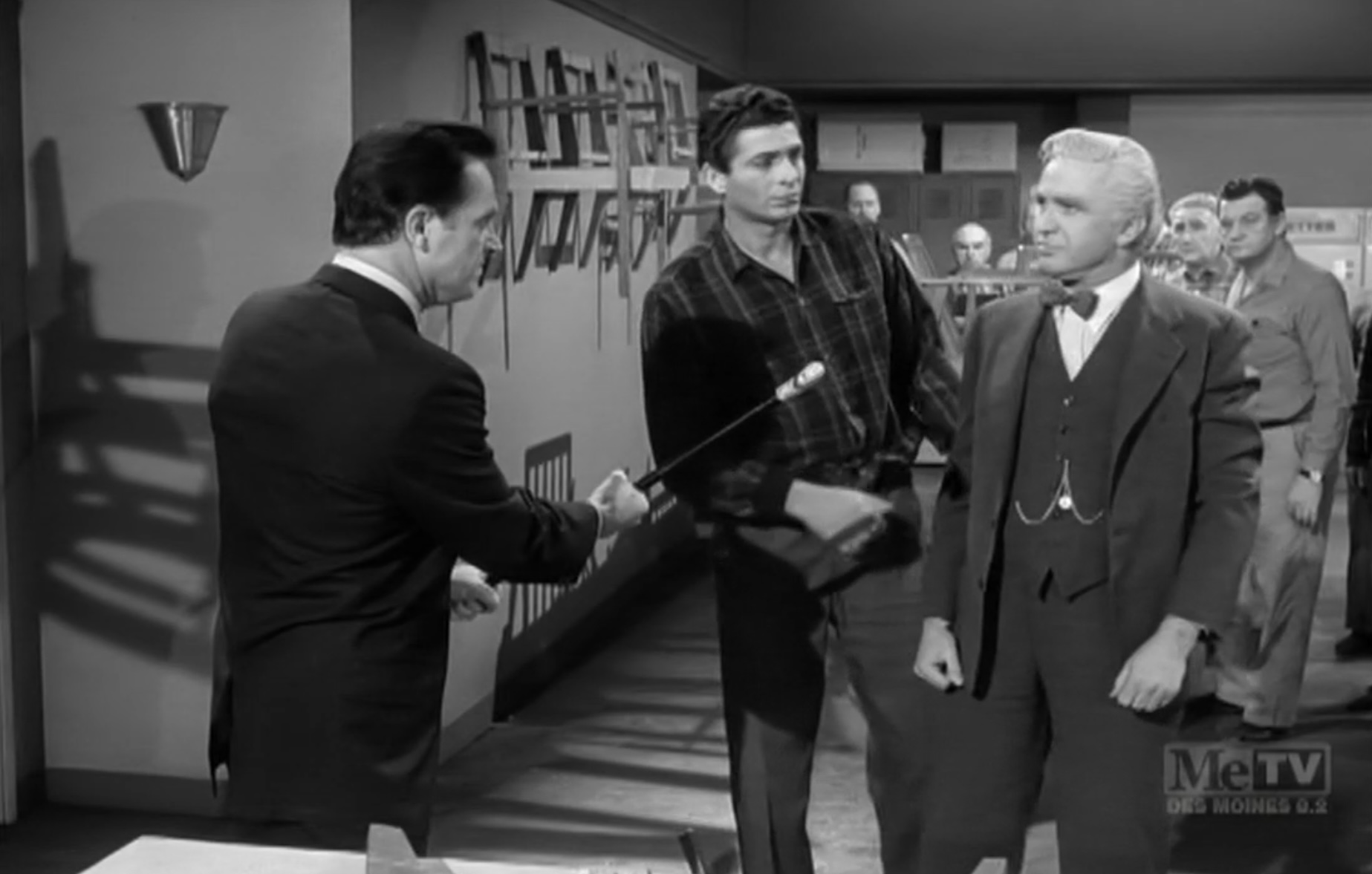
This happens to be an episode I remember very well. It’s hard to forget Swenson, who shouts every line as if he’s on a huge stage somewhere. I don’t believe I’m saying this, but for once there are too many suspects: Swenson’s office manager Lisa, who connived with Somers to get him the bid; Lisa’s brother Carl, who expected to continue supplying wood to Somers; Edie Morrow (Marie Windsor), who might be a crook or might be in love with Axel; Latham Reed, Edie’s ex-husband, who might be in on the scam or might be another patsy; and about four others.
The good news is that all of these actors have appeared in multiple episodes of the show, but even their skill can’t keep this plot from dragging. However, there are a few things that happen here which offer a rare parallel to the original novels. First, the killer turns out to be a fairly minor character, which always pisses me off but is actually handled well here, particularly with a tricky camera move at the end. Secondly, at the very end, Della makes a comment to Perry about men getting married at a later age, which her boss deftly dodges. It’s one of the rare moments where it seems there just might be something going on between these two!
Dennis Patrick’s final episode of Perry Mason came toward the end of the series, in Episode 18 of Season 9, “The Case of the Golfer’s Gambit,” which debuted on January 30, 1966. For me, golf is a sport that must be more fun to play than to watch, so I didn’t jump into this viewing with my usual enthusiasm. And yet, despite more than a few shots of putting on the green, this one more than capably represents the best of late series Mason: the sense of noir is gone, replaced by firmly structured whodunnits that don’t necessarily give the game away purely by character type or casting choice.
Patrick has a ball as the victim, a vicious and morally corrupt professional golfer who is reduced to being a pro at an exclusive club when the PGA suspends him. His name, perfect for a golfer, is Chick Farley, and he spends half the episode slapping around his alcoholic wife, making passes at the hottie he thinks is his mistress (and then slapping heraround when she refuses him), humiliating the pseudo-mistress’ husband, cheating the younger pro, who’s clearly a better golfer, out of a championship, blackmailing the club president, and refusing to share his winnings with his caddy.
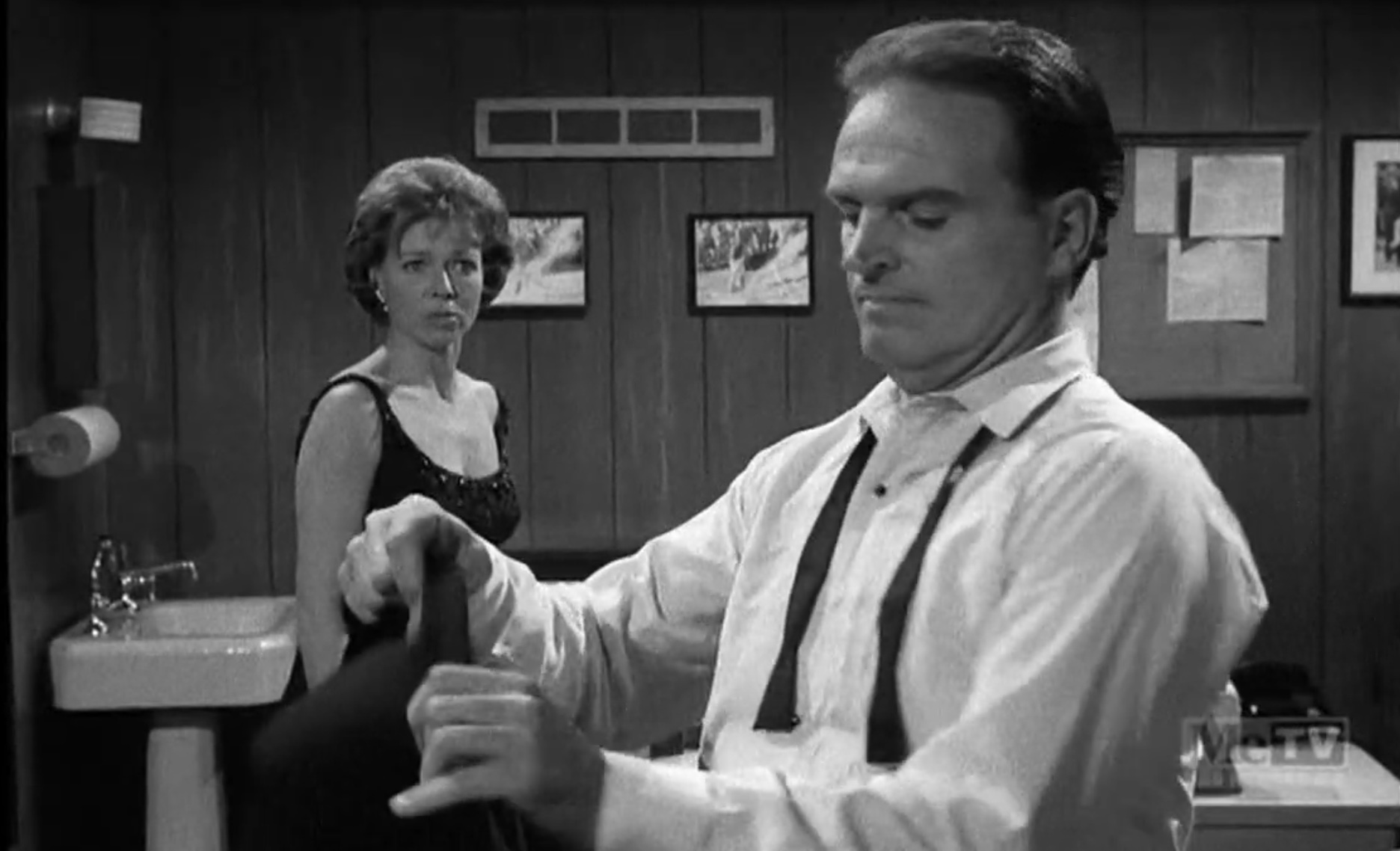
Naturally, Chick is beaten to death with a club on a night where we have watched all the suspects dashing chaotically around the club. But it’s the young pro who gets caught holding the bloody niblick and has to be defended by Mason, who faces off against one of the club’s most prestigious board members: D.A. Hamilton Burger! Perry manages a double bluff, mostly for the audience’s sake, but this time I managed to figure out the killer right away. Never mind – there are some great players who performed in multiple Perry Mason episodes here, and I give a special shout-out to Nancy Kovack, who epitomized the kind of femme fatale that Gardner liked to include throughout the Mason canon.
This concludes our look at Dennis Patrick and the Dark Shadows connection to Perry Mason. When I return with more reviews of the series’ original teleplays, we’ll examine a group of actors connected to yet another famous 1960’s TV series. Which one? Here’s your clue:
KER-POW!
 Ah Sweet Mystery!
The Neil Hamilton/Yvonne Craig connection is one of the great coincidences of television!
LikeLike
The Neil Hamilton/Yvonne Craig connection is one of the great coincidences of television!
LikeLiked by 1 person
It’s coming here!!!! Stay tuned!
LikeLike