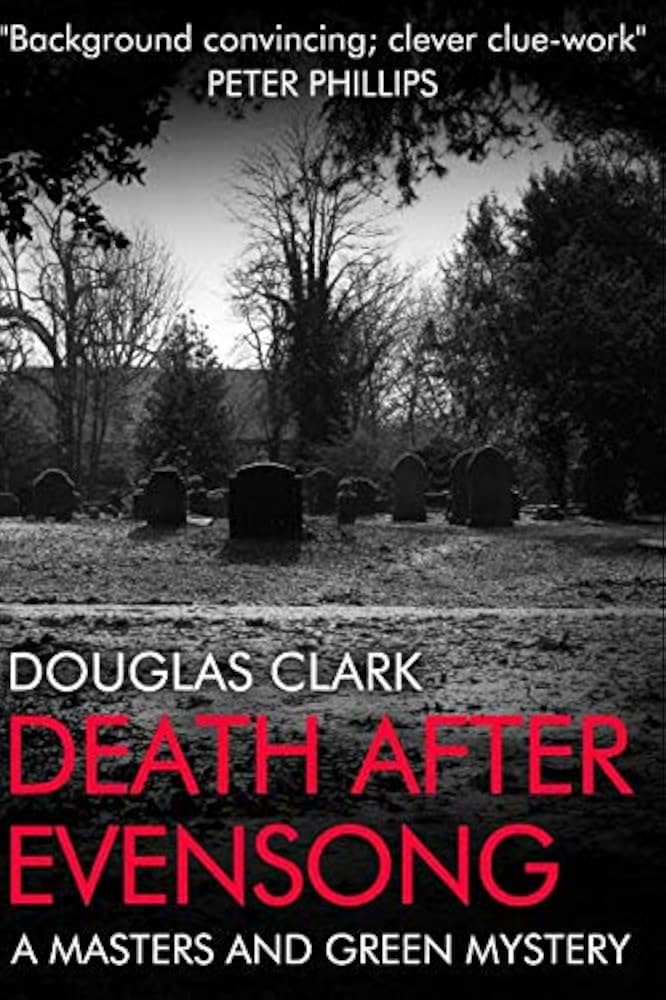
Knowing full well that my favorite mystery author got her start after working in the pharmaceutical business (dispensing drugs, don’t ya know!), you would think that another writer with a similar resume might spark a similar interest. And wouldn’t you know it? This month my Book Club has decided to look into the writings of Douglas Clark, a pharmaceutical executive who, in his spare time, wrote twenty-seven police procedurals about Scotland Yard detectives Masters and Green. Death After Evensong (1969) is the second case for this duo, and it involves their traveling to the northern village of Rooksby-le-Soken, located in the middle of a peat bog, to investigate the mysterious death of the vicar.
Listen, it’s a gargantuan task to gather seven well-read, highly opinionated classic crime enthusiasts together every month and expect to find a title that will at least please some of the people some of the time! Last month’s book was a dud (so much so for me that I couldn’t write about it), and before I could sit down and read this one, I was hit with the old one-two of Kate’s review and that of the Puzzle Doctor. I have to admit that I began my morning feeling quite daunted. But I persevered by heading to my favorite weekend breakfast joint and replenishing myself with the veggie scramble, a fresh-made blueberry biscuit, and a cappuchino and prepared to tackle another iffy Book Club selection.
Police procedurals are generally not my thing, but there’s no doubt here that Clark could write atmosphere. Rooksby-le-Soken isn’t the sort of place in which anyone would want to pass the time of day: the townsfolk are downright hostile to outsiders (even those who have lived there for years), and the whole place feels cold, sticky, and depressing. Entering the town, the police team passes a brand-new school with “single-stories, glass-walled classrooms strung out in great wings from a brick-built nuclus. Lights were burning, illuminating an end-on view of rows of children, listening to teachers, with their hands in the air, reading. (Masters) got the impression the kids were miserable.”
Later on, after settling in the Goblin Pub where they will be staying, Masters cases the joint to get the lay of the land (I’ve got a million cliches to go, folks!) and discovers that these poor kids grow up to be equally miserable young men and women with nothing to do but make babies and get married, in that order. Now young wives are trapped at home, tending to the kids, while their young husbands escape to the bar to play darts and drink themselves into oblivion – except that their poverty makes it impossible to afford the good ale.
When murder ventures into this gloomy landscape, the local constabulary sends for Scotland Yard immediately. Herbert Parsloe, the vicar, has been found brutally slain in the old school by some workmen who are tearing it apart to put up an office building. Parsloe seems to have been shot – there’s a hole in the center of his chest and a horrific exit wound on his back – but despite the blood on the wall behind him, there isn’t a trace of any sort of bullet. Masters and Green are tasked with figuring out how Parsloe was killed, as well as who killed him among the growing list of people who hated him.
The list of suspects is long and varied. There’s the proprietor of the Goblin, his Italian wife and her beautiful daughter who is, mystifyingly, still unmarried; the local G.P. who examined the body and his partner in his practice, who also happens to be his son; the Vicar’s two daughters, the older of whom seems to be a chip off the old block and the younger so kind that she is dismissed by the locals as an idiot; and various villagers with grudges against this unpleasant cleric. Some are working class, while others are part of a more prosperous community of bridge-playing professionals; despite the fact that they drink in different rooms of the pub, they are all to varied degrees hostile to the police and all in agreement that Parsloe’s death is a blessing.
From here, your enjoyment of Death After Evensong will probably depend on how you feel about police procedurals – and about this team in particular. As I said, it’s not my favorite sub-genre: I always enjoy Ngaio Marsh’s mysteries until after the murder when Inspector Alleyn sets up shop and begins dragging the Marsh, suspect by suspect, witness by witness, until you’re just hoping a second murder will alleviate the gloom. I am fond of Ed McBain’s 87th Precinct series (and really must return to it one of these days), but that’s because I like the men in the force, their personalities and interactions, and the fact that each novel deals either with one thrilling case (King’s Ransom) or a series of cases that are sometimes intertwined in delightfully surprising ways.

I imagine that Douglas Clark sat down at his desk one day and said to himself, “Why don’t I write a series of mystery novels about a pair of policemen who start out loathing each other and gradually develop into best friends?” What I have gathered from fans of Clark’s books is that Detective Chief Inspector George Masters and Detective Inspector Green will come to like and respect each other. This is early days, however, and the bad feeling between the pair drags this book down considerably.
All in all, I tend to side with Masters here over Green, who comes off as a jealous sod most of the time. Masters is indeed “masterful” at his work, smart and sensitive and expert at dealing frankly with the complex assortment of personalities he meets. He also shows great sympathy for the more downtrodden of the villagers and even takes time to better the lives of two undeservedly miserable young women.
I end up in a bit of a quandary over Douglas Clark. I do like Chief Inspector Masters, and I think the characterization here is first rate. But the investigation does plod on and on. I happen to know that my friend Bev Hankins, over at The Reader’s Block, is quite fond of Clark’s work and even gave a positive review to Poacher’s Bag, the only other novel of his that sits on my shelf. As this is the twelfth novel and by now Masters and Green are not only great friends but are vacationing together, I just may have to give it a try . . . one of these days.


By Book Twelve, Green actually has a first name!
So far, two of the three comments on my blog, when I asked for a recommendation, did cite this as one of their favourites. And there is good stuff here… Just not enough for me.
LikeLiked by 1 person
I have never heard of this book but recently read one with a similar title: Murder before Evensong written by a minister turned writer. It is now also a tv series that you can watch on Acorn. It had a Golden Age feel to it although it was written recently and is considered “period” because it is set in the 1980s. I wonder if the author had heard of the book you are reviewing?
LikeLiked by 1 person
I had never heard of this other book and series until I went searching for alternate covers for my book. The new one looks very cozy; Clark’s novel is anything but.
LikeLike
Murder Before Evensong is the book by the Rev. Richard Coles. I enjoyed it and the sequels. Definitely not Scandi-Noir – more GAD Homage – so you might find them interesting. Coles is one of those authors where you’re well advised to read in order.
The Acorn tv version sticks close to the book. So it didn’t disappoint the way so. many TV adaptations do. BTW: I can also recommend The Chelsea Detective.
LikeLiked by 1 person
Sometimes I have no idea what WordPress is doing. I didn’t notice it had changed my user name until after I’d hit send.
LikeLike
Glad to read your review! My chemist friend loves the poisoning plots of Douglas Clark, but I haven’t read too much of his work… If you plan to read, though, I’ll plan to follow your thoughts!
Also happy to announce my slow return back to regular reading + blogging + interacting with other blogs. It’s basically been a whiteout from me for a couple years now, but trying my best to start getting back to where I was before. Happy to be reading your thoughts again, Brad!
LikeLiked by 1 person
Happy that you’re back, Libby! I’m not sure how much I will be exploring Douglas Clark in the future, although I do have another of his books on my shelf. But I saw your post to Jim about Erle Stanley Gardner, and I’m raring to have any discussions you want about any of his books! Check out my Gardner index to see what I’ve read. I’m having a blast exploring Perry Mason, especially.
LikeLike
Now I’m embarrassed that I didn’t ask you for ESG recommendations first!
I think the Ace Attorney series is some of the finest mystery writing that exists, if only the people of our community could get the bah out of their humbug when it comes to video games! The creator of Ace Attorney proudly boasts about his experience reading Ellery Queen and Anthony Berkeley and Erle Stanley Gardner and G. K. Chesterton and Jacques Futrelle and even some bizarre relics like Gerard Kersh and Thomas Hanshew(!?), so he knows his stuff when it comes to writing proper puzzle plots.
But, of course, as a fan of the series, I’ve been wanting something to scratch the same itch of fusing puzzle plot mysteries and courtroom chicanery. Yet there is only really fanfiction of the series (written by people whose only experience with mystery fiction is Ace Attorney, so no cigar) to give me that feeling…
Am hopeful to get something of that from Perry Mason, of course, so happy to discuss it with you!
LikeLiked by 1 person
If I only played video games, I would be on Ace Attorney in a hot second. I don’t even know what platform you play it on.
I also don’t know how impressed you will be with the puzzle plot elements of Gardner’s books. Sometimes they’re there, but mostly the books read a bit differently. And reading one after another, as I’ve been doing for the past few years, really underscores how formulaic they are. Still, it’s a formula I love, and when Gardner breaks it, it can make for a wonderful surprise.
LikeLike
Nowadays, you can play it on everything. Phone and computer, included!
Well, I’m sure there have to be a few humdingers in there. I’m looking at your index now, but what are some favorites of yours?
LikeLiked by 1 person
I think that it’s a given, generally speaking, the the first half of Perry Mason’s career (the 30’s and 40’s) is better than the latter half. There is a definite shift in focus and style between the 30’s and the 40’s, with much more legal action in the 40’s. And, indeed, my favorite Mason case so far is a 40’s book – TCOT Drowsy Mosquito. But I’m going to recommend some 30’s titles for the mystery aspect: I agree with Jim on Lame Canary, and I would add . . . TCOT Sleepwalker’s Niece, which is that rare thing in Gardner, a country house mystery; TCOT Stuttering Bishop, which immediately followed that one the same year and couldn’t be more different – it’s more action-packed and has some nice stuff in court. And, finally, TCOT Perjured Parrot has oodles of courtroom fun with multiple birds (Mason would play this trick over and over in his career, but usually with guns) and also has some really cool character/philosophy stuff.
These are all quick reads. If you find you don’t get along with the 30’s noir feeling, I’m sure Jim and I can give you some 40’s titles to look at.
LikeLike
I’ll read them all, thanks so much for the pointers! Perjured Parrot was actually on my radar since it was a direct inspiration on a famous scene in Ace Attorney in which the protagonist demands to be allowed to cross-examine his suspect’s pet parrot!
I can’t wait to read them, thanks so much for the pointers! I’m very excited to finally dig into this author I’ve neglected too much. Crimson Kiss is also on my radar.
LikeLiked by 1 person
Thanks for the mention, Brad. I do like this series, though I don’t like the early ones as much–the difficulties between Masters and Green just don’t sit well with me after I started with later ones where they get on quite nicely. What I like best about the series isn’t the police procedural part (although I think I may like them better than you do), but the interesting murder methods that Clark comes up with.
LikeLiked by 1 person
I believe your review of Poacher’s Bag was pretty positive, Bev, and that’s the only other Clark I have. One of these days . . .
LikeLike