We’ve spoken at length about criminals utilizing dissembling and disguise in order to (sometimes literally) mask their guilt – but what of the detective? The history of fictional sleuths donning a disguise to infiltrate a villain’s lair or track down a vital clue is long and fascinating – and, most significantly, based on truth. The Pinkerton Agency, established in 1850 and active until its merge with the rival William Burns Agency in 1999, trained its detectives in the skills of role-playing and disguise, although by “disguise” this mostly meant learning to blend in with the crowd. Kate Warne, the first female operative, cracked cases through undercover work, once disguising herself as a fortune teller to worm information out of a suspect. She even protected President Abraham Lincoln from assassination by accompanying him on a train, disguising themselves as brother and sister!
Charles Frederick Field, one of the most famous Scotland Yard detectives of the 19th century, was fond of utilizing disguises, even when they weren’t necessary! He was also a friend of author Charles Dickens, who once hired Field to provide security at the performance of a play by Lord Lytton, Not So Bad as We Seem, that was being attended by the Queen and other royalty. (In this case, Field dressed in plain clothes and remained on the lookout for Lytton’s estranged wife, who had threatened to disrupt the performance by disguising herself as a peddler and either pelting the stage with fruit or Her Majesty with rotten eggs.)
Dickens most likely used his friend as the model for Inspector Bucket of the Metropolitan Police, who in Bleak House (1852-3), investigates the murder of the lawyer Mr. Tulkinghorn. At one point, Bucket disguises himself as a physician, “a very respectable old gentleman, with grey hair, wearing spectacles, and dressed in a black spencer and gaiters and a broad-brimmed hat, and carrying a large gold-headed cane . . . “ in order to infiltrate the shooting gallery owned by prime suspect Mr. George. Such shenanigans may not have been necessary to Bucket’s job any more than they were to Fields’, but they satisfied Victorian readers’ tastes for a sensationalistic view of public and private sleuths.
An even more fanciful instance occurs in Dickens’ final novel, The Mystery of Edwin Drood (1870). In Chapter 18, Dickens introduces Dick Datchery: “At about this time a stranger appeared in Cloisterham; a white-haired personage with black eyebrows. Being buttoned up in a tightish blue surtout, with a buff waistcoat and grey trousers, he had something of a military air . . . “ Dickens flouts the fact that Datchery moves about in disguise, and although we will never have proof of the fact, the standing theory is that this person, who has come to Cloisterham to solve a mystery, is actually a character we have met before, in disguise. Could it be the legal clerk and frustrated thespian Mr. Bazzard? Or even a woman like Helena Landless, an experienced cross-dresser? Is it possible that Datchery is the missing Edwin Drood himself?!? Tragically, the novel was unfinished, and we can only guess at Dickens’ original intent for the character.
Other Victorian authors created detectives who dissembled and disguised themselves in the course of their work. Edgar Allan Poe provided perhaps the most subtle example in his short story, “The Purloined Letter,” where private detective C. Auguste Dupin dons a pair of dark green spectacles in order to mask his intense examination of the apartment where the letter went missing.
In 1894, Catherine Louisa Pirkis published a collection of stories, The Experiences of Loveday Brooke, Lady Detective. One of the first women private eyes in literature, Miss Brooke was forced to seek employment after hard times dissipated her fortune. Naturally, she sought work with a private detective. Her nondescript appearance served her well: Loveday Brooke often went undercover as a servant or a lodger in order to expose and capture criminals.
Pirkis was clearly inspired by her contemporary, Arthur Conan Doyle, who was the leading light of the day when it came to detective fiction (not that he appreciated shouldering that mantle). In the sixty canonical cases that Doyle created for Sherlock Holmes, he had the sleuth employ disguise some eighteen times. One of the most noteworthy examples is in an early story, “The Man with the Twisted Lip.” This 1891 tale begins not in 221B Baker Street but at the home of Dr. and Mrs. John Watson. A woman arrives begging the Doctor to assist her in rescuing her beloved from an opium den where he has gone to exercise his filthy habit.
Watson gives us a rich description of the den and its inhabitants, including an old man, “very thin, very wrinkled, bent with age, an opium pipe dangling down from between his knees . . .” Imagine Watson’s surprise when the old man turns his back, turns back around, and “his form had filled out, his wrinkles were gone, the dull eyes had regained their fire, and there, sitting by the fire and grinning at my surprise, was none other than Sherlock Holmes.”
These moments of disguise and unmasking in Doyle, Pirkis, Poe and Dickens provided great theatrical effect, as they did in the thrillers of writers like Sax Rohmer and Edgar Wallace. No doubt they were part of the voracious reading of young Agatha Miller, who took to heart that sometimes detectives put on disguises or lie, nearly as often as the murderers they seek to capture.
HERCULE POIROT
Hercule Poirot entered the landscape as a private detective on British soil after a long and illustrious career as a Belgian policeman. While the details of his work are scant, we strike a bit of gold in the short story, “The Chocolate Box” (1923), in which Poirot narrates to Captain Hastings the history of one of his few “mistakes.” In the course of his investigation into the murder of Paul Déroulard, Poirot infiltrates the home of one of the suspects by disguising himself as a plumber!
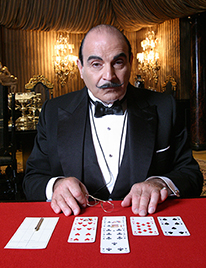
The following year, 1924, saw the publication in The Sketch of a series of stories called The Man Who Was No. 4 that would eventually become the novel The Big Four. This is not a country house mystery or village whodunnit; rather, it chronicles a series of adventures in which Poirot and Hastings do nothing less than save the world! We have already discussed how prevalent disguise is in this book: Number Four, “The Destroyer,” plies his deadly trade of assassination with the frequent use of disguise, a skill gleaned from his earlier life as an actor.
Lots of people get into the act of disguise and impersonation here. At one point, Captain Hastings impersonates a secretary to infiltrate the home of Abe Ryder, the American Financial wizard who also happens to be Number Two. Naturally, Hastings fails miserably at this task. Still, it makes sense for the world-famous Hercule Poirot to depend on the relatively unknown Hastings for any tasks requiring disguise. With his egg-shaped head, glowing green eyes, and luxuriant moustaches, it would be seemingly impossible for Poirot to alter his appearance and fool his enemies.
And yet, this is exactly what Poirot accomplishes! Trapped in the Felsenlabyrinth with his dear Hastings, Poirot faces the Big Four and their accomplice – and old acquaintance of the detective – Countess Vera Rossakoff. Poirot greets her, and then . . .
“As he spoke I saw a sudden suspicion flash into her eyes, and at the same moment I knew the truth, which subconsciously I already sensed. The man beside me was not Hercule Poirot. He was very like him, extraordinarily like him. It was the same egg-shaped head, the same, strutting figure, delicately plump. But the voice was different, and the eyes, instead of being green, were dark, and surely the mustaches – those famous mustaches –?”
The effect is so startling that the Countess reaches over and tugs at Poirot’s mustaches: “They came off in her hand, and then, indeed, the truth was plain. For this man’s upper lip was disfigured by a small scar which completely altered the expression of the face.” The truth of the matter is that this is not Hercule Poirot but his twin brother Achille Poirot in disguise as Hercule! It is only after he has convinced the Big Four of their folly, given Countess Rossakoff the only bribe she will accept to help him and effect the imminent destruction of the Big Four and their plans for world domination that Achille reveals that he is, in reality . . . Hercule Poirot in disguise. This is perhaps the biggest most ridiculous obfuscation Poirot will commit in his entire career. His subsequent various employments of dishonesty will be more subtle and infinitely more satisfying.
All Golden Age sleuths must play their cards close to the vest in order to be successful; after all, they are interacting with various criminals in all their cases. It’s a given that a detective must be able to put a murderer at his or her ease, or else the game will be given away, both to the culprit and the reader.
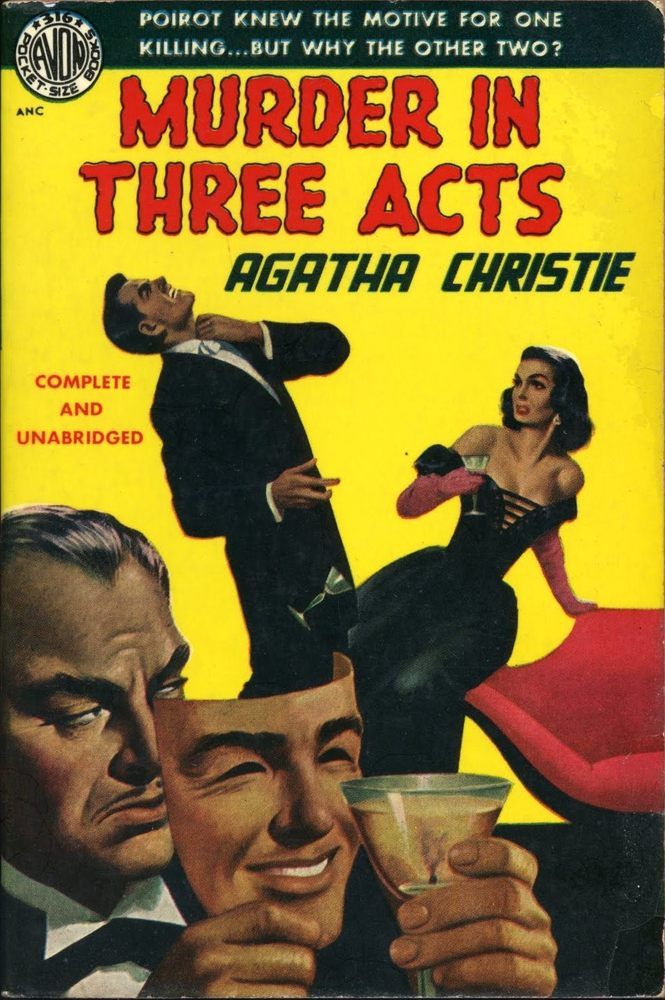
But there’s more to it than that! Think of all the instances in the 1930’s where Poirot colludes with a team of amateurs to take down a killer, only to discover that the guilty party is one of the team! In 1934’s Three-Act Tragedy, although he has come to realize that his partner-in-crime-solving Sir Charles Cartwright is actually a triple murderer, Poirot has no qualms in directing the actor in a scene to trap a killer: the two men gather all the suspects and stage the mock death-by-poisoning of Sir Charles. This serves two purposes: it gives Poirot a chance to test his theory of how the murderer absconded with the poisoned cocktail glass and it lulls the murderer into a false sense of security.
Another brilliant example occurs in Death in the Clouds (1935), where Poirot is all but certain of who murdered Madame Giselle quite early in his investigation, simply by examining the passengers’ luggage. Yet without proof of method or motive, he must continue to investigate, and he does so by establishing a more intimate relationship with his main suspect, Norman Gale, deputizing both him and Jane Grey as assistant sleuths.
At one point, Poirot enlists Norman to follow the main suspect, mystery author Daniel Clancy, and suggests that Norman wear a disguise. Norman responds by assembling the silliest, most obvious disguise, but after Poirot corrects him, the young man can’t help but demonstrate how easy it is for him to play another character. It’s an amusing episode, yes – it’s also a nail in the coffin for Norman Gale. And it makes for a most satisfying denouement when Poirot invites Norman to join him in a visit to Mr. Clancy in order to bring down the murderer once and for all. He goes so far as to sketch out why his first instinct was to suspect the dentist and not the mystery author of the crime. Norman then turns to Poirot and asks, “’When did you stop pitching on me as the murderer?’
“Poirot wheeled round on him. ‘I never stopped. You are the murderer . . . ‘”
Throughout his career, Poirot anticipates the ingrained British prejudices against foreigners and leans into them, becoming ever more “foreign” in order to lull his suspects into underestimating him. In 1953’s After the Funeral, Poirot infiltrates the Abernethie household posing as M. Pontarlier of U.N.A.R.C.O., an imaginary organization that is interested in purchasing the estate. Christie writes about the propensity of the English to buy into these lies.

“Everyone had accepted U.N.A.R.C.O. as a matter, of course – had even pretended to know all about it! How averse human beings were ever to admit, ignorance! An exception has been Rosamund, who had asked him wonderingly: ‘But what is it? I never heard of it.’” In a moment of delicious irony, it is Rosamund, presented as vague and rather stupid, who blows Poirot’s cover because “You were pointed out to me once in a restaurant.”
And we can’t leave M. Poirot without including one of his most extraordinary moments. In the 1936 short story “Problem at Sea,” Poirot impersonates a ventriloquist in order to catch a murderer who used that very skill to establish his alibi. At least, Christie does not endow her sleuth with those actual skills; instead, a female crew member supplies the voice of the dead woman. But I want you all to take a moment and imagine Poirot sitting before an audience, holding up a dummy named Arthur in a velvet suit and lace collar and changing his voice: “. . . his voice changed subtly – it was no longer foreign – it had instead a confident English, a slightly Cockney inflection.”
Do you have that marvelous image in your head? Good. Now we can move on.
MISS JANE MARPLE
If Hercule Poirot cuts such an overtly theatrical figure that the employment of show biz trickery comes naturally to him, the gentle, prosaic Miss Jane Marple seems far removed from such nonsense. At first appearance, she strikes one as a fluffy old lamb: “Miss Marple wore a black brocade dress, very much pinched in around the waist. Mechlin lace was arranged in a cascade down the front of the bodice. She had on black lace mittens and a black lace cap surmounted the piled-up masses of her snowy hair. . . . Her faded blue eyes, benignant and kindly, surveyed her . . . guests with gentle pleasure.”
This fluffy exterior is a front, for Miss Marple leans into the public perception of the elderly as safe, invisible old dears as much as Poirot accentuates his foreignness when it suits him. A much more accurate description of the old lady comes from the Vicar, Leonard Clement, in 1930’s The Murder at the Vicarage: “Miss Marple is a white-haired old lady with a gentle appealing manner – Miss Wetherby is a mixture of vinegar and gush. Of the two Miss Marple is much the more dangerous.”

Although her sleuthing is rooted in the inductive reasoning of a master of human nature, we quickly discover that Miss Marple is not above a moment of theatrics when the need arises. Towards the end of Vicarage, she reveals the identity of the murderer with logic and precision; unfortunately, as so often happens in her cases, Miss Marple has no proof. And thus she directs a little play that will act as a trap to catch the killer. It’s a thrilling scene, in that it poses actual danger to her confederate, Mr. Hawes. And yet, it works like a charm.
With that success under her belt, Miss Marple directs another thriller at the end of her next case, The Body in the Library (1942). This time she enlists the aid of millionaire Conway Jefferson, who cheerfully sets himself up as bait for a killer. Again, the murderer rises to the bait and is caught.
Surely, this is not going to be a pattern, is it? Cut to Miss Marple’s third case, The Moving Finger (1942), which finds Miss Marple determining that the only way to catch this murderer is to enlist the acting skills of Megan Hunter in enacting a scene of blackmail. The result? Megan is drugged and then carried by the killer to the kitchen where her head is put in the gas oven.
And then Miss Marple yells “Cut!”
Without a doubt, Miss Marple is a risk taker: in at least three other cases, she faces down the murderer directly, risking her own life; clearly, she expects the same of others in the cause of justice. Diving more deeply into the issue of theatricality in the Christie-verse, there are two major instances where Miss Marple stages a trap in which she herself performs.
The most outrageous of these happens at the climax of 1950’s A Murder Is Announced. Soon after the third murder, Miss Marple herself simply – disappears. Inspector Craddock is left behind to expose the myriad of lies centered around Little Paddocks. The result is that Pip and Emma Stamfordis are unmasked, and Mitzi, the cook, accuses Miss Blacklock herself of being the murderer. The desperate lady of the house follows Mitzi into the kitchen and attempts to drown her in the sink. Suddenly, she hear the voice of her dear friend – her dear dead friend – Dora Bunner: “Oh, Lotty, Lotty . . . don’t do it . . . Lotty . . . “ Miss Blacklock breaks down “just as Miss Marple stepped, flushed and triumphant, out of the broom cupboard. ‘I could always mimic people’s voices,’ said Miss Marple.”

This has always been my favorite Miss Marple mystery, but even I raise my eyebrows at the utter . . . convenience of having Miss Marple possess this skill. And to think she had been waiting decades to reveal it!
The second instance at least requires Miss Marple to portray nothing more extraordinary than herself. In 4:50 from Paddington, she realizes that if Dr. Quimper is not to get away with murder, a measure of extreme subterfuge must be undertaken. She therefore stages a scene where she and Elspeth McGillicuddy will have tea at Rutherford Hall with the family. Mrs. McGillicuddy’s instructions are simple: at a certain point, she must excuse herself and go to the bathroom. That’s when Miss Marple springs into action and begins to choke on a non-existent chicken bone.
Sure enough, Dr. Quimper springs into action and places himself at the lady’s disposal – in the exact same position in which he strangled his wife on the train. Right on cue, Mrs. McGillicuddy returns and excitedly reacts to the tableau before her. Miss Marple is in complete control of this improvisation and hastens to silence her friend when Mrs. McGillicuddy is about to reveal that she never saw the killer’s face. Crisis averted, and another monster headed to the dock.
TOMMY AND TUPPENCE BERESFORD
Ian Fleming wrote twelve novels featuring James Bond, the world’s most famous spy. Agatha Christie wrote twelve novels containing at least elements of espionage. These are chockful of characters practicing deceit, sometimes in the most theatrical ways – the exact sort of fun that Tommy Beresford and Prudence “Tuppence” Cowley are looking for when they establish “The Young Adventurers, Ltd.” in the first of five books about them, The Secret Adversary. In their attempts to find Jane Finn and unmask the evil Mr. Brown, Tuppence goes undercover as a maid, but is all too quickly unmasked. Jane Finn, herself, is much more successful at undercover work, but it’s possible that Tuppence only needs more practice.
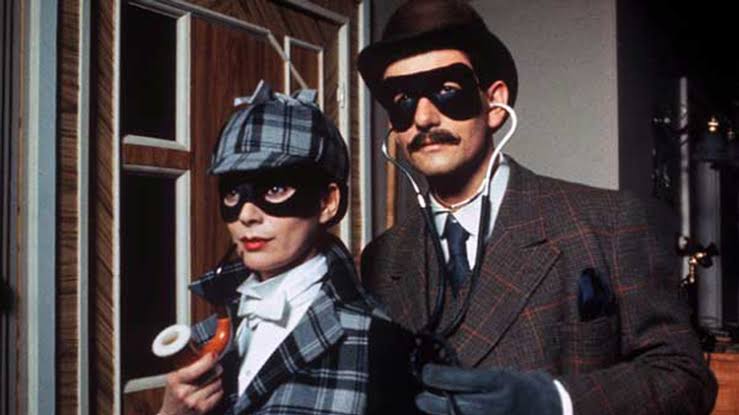
In their second adventure, Partners in Crime, the Beresfords impersonate Mr. Theodore Blunt, a private detective, and his secretary Miss Robinson in order to help the government expose and defeat an international conspiracy of spies. This story collection is an interconnected maze of disguises and impersonations, with half the “clients” who come to Blunt’s Brilliant Detectives revealing themselves to be enemy agents. As for Tommy and Tuppence, each adventure gives them the opportunity to take on the roles of various classic detectives: Tommy saws away at a violin when he pretends to be Sherlock Holmes or feigns blindness as Thornley Colton, a.k.a. “The Problemist,” the 1915 creation of author/screenwriter Clinton L. Staggs. Sometimes, as in the Colton-inspired story “Blindman’s Buff,” these disguises become central to the plot mechanics of the tale.
In their final two adventures, By the Pricking of My Thumbs and Postern of Fate, an older Tommy and Tuppence rely on their sleuthing skills rather than on disguise to ferret out the truth. However, their adventure in middle-age, N or M, is perhaps the supreme example of the couple’s prowess as undercover agents. This is mean to be Tommy’s case alone, perhaps because his agency superior, Mr. Grant, considers the assignment too dangerous for Mrs. Beresford. Tommy is sent to a boarding house on the South coast at Leahampton: he will search for one or both of a pair of disguised German agents there, himself disguised as Mr. Meadowes, an unassuming middle-aged man, just like Tommy Beresford.
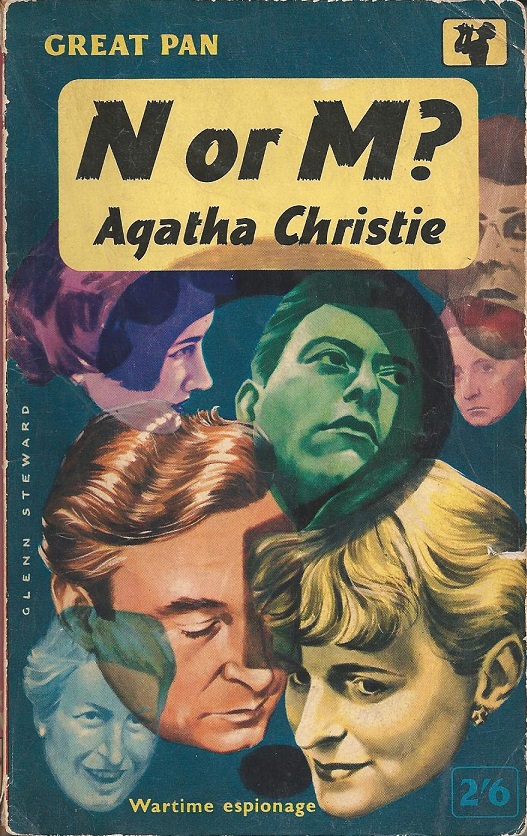
At least Tommy has the decency to feel horrid for lying to Tuppence, explaining away his absence as a request to do some clerical work for Grant in aid of the war. Fortunately for us all, Tuppence Beresford is no ordinary wife:
“’I always introduce my guests,’ said Mrs. Perenna, beaming determinedly at the suspicious glares of five people. ‘Mrs. O’Rourke . . . Major Bletchley . . . Mr. Von Deinim . . . Miss Minton . . . and Mrs. Blenkensop.’ More knitting – an untidy dark head which lifted from a contemplation of a Balaclava helmet.
“Tommy held his breath; the room spun round. Mrs. Blenkensop! Tuppence! By all that was impossible and unbelievable – Tuppence calmly knitting in the lounge of Sans Souci. Her eyes met his – polite uninterested stranger’s eyes. His admiration rose. Tuppence!
In the Christie-verse, espionage involves role-play and undercover work; fortunately, it’s relatively easy to work incognito. Tommy and Tuppence and the spies N and M all wander around Leahampton trying to unmask each other – and they eventually do, placing the Beresfords in grave danger and then, ultimately, tilting the fortunes of war in our favor!
MR. PARKER PYNE
People have mixed feelings about the single volume of adventures featuring retired bureaucrat Mr. Parker Pyne. Robert Barnard called the collection “mediocre,” which is a good indication that I quite love these stories. The first half are not mysteries, and yet they are eminently theatrical: Mr. Parker Pyne attempts to solve the personal problems of ordinary people through what amounts to period cosplay. He utilizes a pair of . . . actors? spies? Operatives? Claude Luttrell and Madeleine de Sara will play any role needed to help the latest client find happiness.

In one case, their efforts fail miserably, but most of the time the scenarios furnished by scenarist-for-hire Mrs. Ariadne Oliver resemble nothing more than movie melodramas. And sometimes, these personal dramas have the additional effect of helping the British government, as in “The Case of the City Clerk,” where a shy little businessman has the adventure of his life aboard a train and helps a grand and beautiful duchess protect the family jewels from dastardly thieves – when all the while, the clerk is unknowingly transporting important documents from one place to another.
As for the Duchess, “In the Geneva-Paris Express, this girl was the Grand Duchess Olga; in Mr. Parker Pyne’s office she was Madeleine de Sara; and in the house at Streatham she was Maggie Sayers, fourth daughter of an honest, hard-working family. How are the mighty fallen!
The final six stories in the Parker Pyne collection are straight detective tales which take place on a tour such as Agatha Christie herself would have taken across the Middle East. Of these, the final tale is the most interesting: “The Oracle at Delphi” concerns a wealthy widow whose son is kidnapped from their hotel. Fortunately, she has befriended a man named Parker Pyne who offers to assist her as she negotiates a ransom for her son’s return. The thieves demand the valuable necklace she has in her possession, and Mr. Parker Pyne makes arrangements so that she can get her son back and keep the necklace.
In the end, the story works as a sort of inverse of The Big Four. a little man by the name of Thompson happens to be staying at the same hotel, and it turns out he is traveling incognito. Sometimes criminals would do well to remember that!
SUPERINTENDENT BATTLE
There is literally no sleuth in the Christie canon whom you would think less likely to go about in disguise than the stolid, nearly wooden Scotland Yard detective, Superintendent Battle. And yet, The Seven Dials Mystery proves the lie to this assumption. A secret organization exists in London that scares the bejeezus out of our heroine, Lady Bundle Brent. In the end, she faces down the Seven Dials society, and the explanation of their plot includes the far-fetched image of Superintendent Battle in a mask!

* * * * *
I’m going to take a little break on this series. When I began, it was with the possible intention of seeing how it might shape up as a book. I haven’t received much feedback on it, and frankly I’m not sure how to proceed. I’m going to talk the project over with a couple of people when I’m in England for the Agatha Christie festival next month and try to figure out whether there’s a way forward. At the very least, I hope this exploration over the past eight months has been enjoyable for you stalwart Christie fans.


This isn’t exactly on topic but it is.
We recently watched (via YouTube) and then livestreamed a local theater’s production (from November of 2020) of “The Adventure of the Western Star.” Stuart Landon wrote an amazingly faithful script of “Western Star,” incorporating some elements of “Styles” and Agatha’s own autobiography into the narration. He gave it a longer title: “Poirot Investigates: The Adventure of the Western Star.” Look for Open Stage of Harrisburg. Four actors played the entire cast, doing quick changes of costumes.
It was fascinating to watch because we don’t think of how theatrical her stories are! It made me wonder how easy it would be to rewrite her other short stories into plays.
Stuart Landon played Poirot and did very well, too. He also is planning to adapt another Poirot short story for Open Stage for circa April/May of 2027. We’ll be there!
Our livestream is here, where we compared the two versions of “Western Star,” the 1990 one with Suchet and this play. The play holds up very well. Bill’s got a link to the production on YouTube so you can find it. https://www.youtube.com/watch?v=ike7mEPPCcg&t=1276s
LikeLike
I haven’t always commented on your series about the theatricality of Agatha Christie but I’ve enjoyed it very much.
I do think that there’s plenty of material, enough to become a book. Sadly, I don’t have any advice on how to turn what you’ve already gotten into a book.
LikeLike
I’ve enjoyed this series very much. I hope you work it into a book – it ‘s a great topic.
LikeLike