For a moment in 1935, it looked like there could have been, not twelve, but thirteen Miss Marple novels. If you pull out your volume of Agatha Christie’s Secret Notebooks and turn to the section on Death on the Nile, you will find that, as she was planning, Christie made a list of potential characters, and at the top of that list is . . . Miss Marple! True, there’s a question mark beside the name, but if you make your way further down the list, Miss Marple is listed again, sans question mark.
Before you spend too much time imagining that good lady taking tea on deck with Mrs. Allerton or finding Louise Bourget’s corpse, Dr. John Curran posits that, at the time, the exotic nature of a trip to Egypt and a cruise down the Nile was so, ahem, foreign to most British folks’ way of thinking that “to transport Miss Marple, from the (admittedly relative) safety of St. Mary Mead to the banks of the Nile . . . may have been seen as a journey too far – hence Poirot was substituted.” Almost thirty years later, Miss Marple would have her foreign adventure in the Caribbean; until then, her journeys would take her to no more exotic place than the spa at Medenham Wells. And that has left us with only twelve Miss Marple novels.
But that changes today! Miss Marple now has a thirteenth case to solve, one that takes her far afield from England, to a luxurious ski resort in the frigid climes of Switzerland. Murder at the Grand Alpine Hotel comes from the pen of Lucy Foley, the acclaimed author of a number of mystery thrillers. (Full disclosure: I bought my special edition copy with beautifully gauffered edges at the Agatha Christie Festival just before listening to the author herself talk about how much she loves Christie, and especially Miss Marple, and of the joys and challenges of writing this book. After that, the author personally inscribed my copy.)
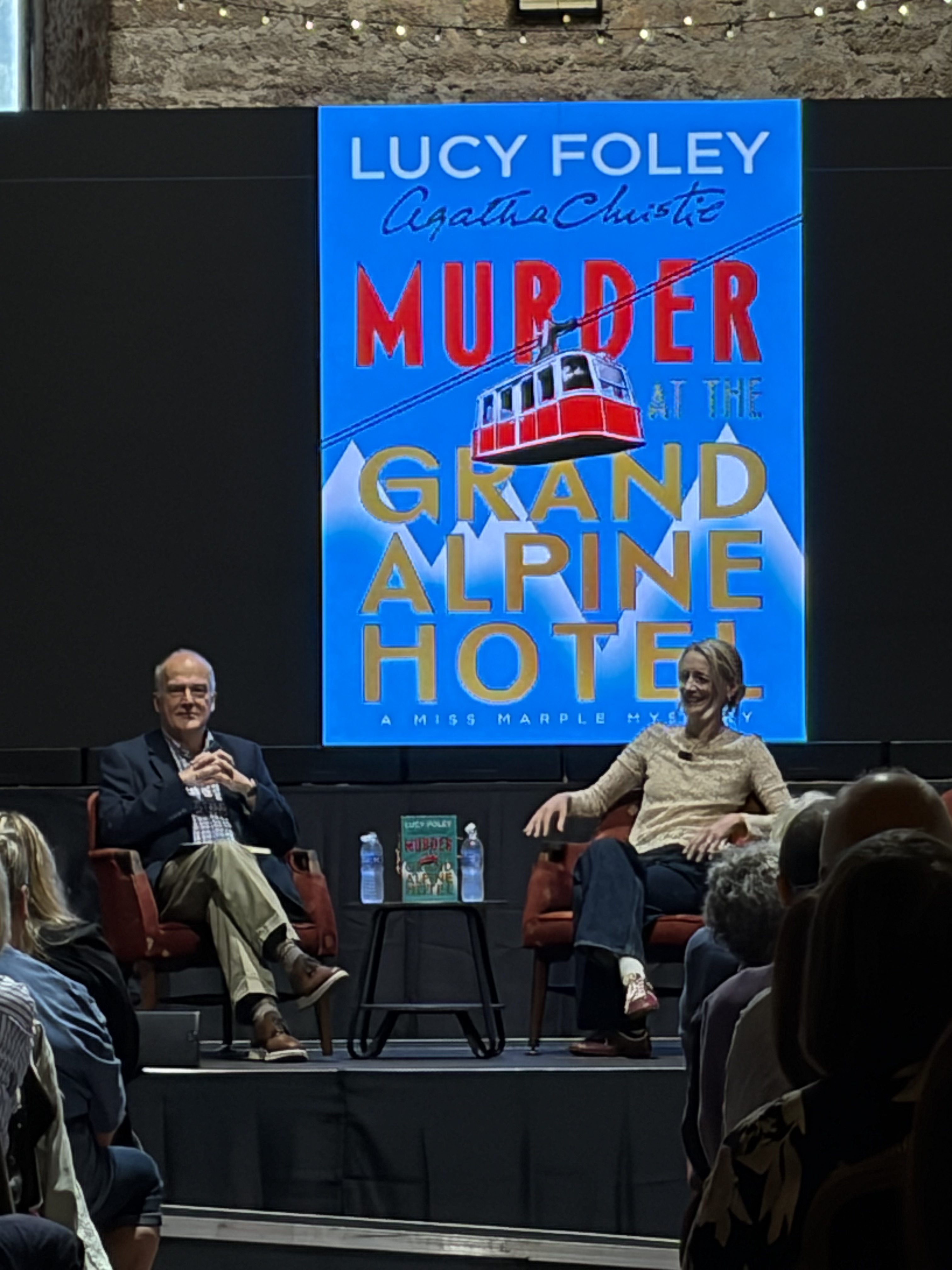
Of all the authors who might have been commissioned to write a new Miss Marple mystery, why, you might ask, did Lucy Foley get the job? My theory is that hers was one of the best of the short stories found in 2023’s Marple: Twelve New Mysteries, a collection which confirmed my impression that Miss Marple, with her gentle, appealing personality and her intuitive ways of solving cases, might be an easier character to “continue” than Hercule Poirot seems to be. Foley’s tale was certainly one of the most traditional, with a nice twisty plot and a version of Jane Marple that one could easily recognize.
But, of course, modern authors have no desire to copy Christie’s style, and I fear very few of them have the ability to even approximate the cleverness of her plotting. In her conversation with Harper Editor David Brawn, Foley said her priority was to get the character right, but the book that followed was always going to be basically a “Lucy Foley” mystery with Miss Marple in it; otherwise, all you’re left with is a pastiche of the original.
If you’ve not read any of Foley’s books, like The Hunting Party or The Paris Apartment, know then that what this constitutes is less of a puzzle mystery and more of a thriller, told from multiple points of view by a series of troubled and deeply unreliable narrators. The question here is: how much is Foley able or willing to mesh her own particular style of plotting and prose with a Christie-style plot and a beloved classic character?
The answer to that question is . . . a bit complicated.
It’s 1950, and newly widowed Dolly Bantry has decided to take a vacation in Switzerland. She brings along her new secretary-companion, Diana Glass, who is young, efficient, observant, but troubled and clearly hiding some secrets. (Hence, she is NARRATOR #1.) Dolly has also brought along her best friend, Miss Jane Marple. Having these two together again, and in the roles of Holmes and Watson to boot, is the best part of this novel. Perhaps Foley leans a bit too far into the expected character tropes: Miss Marple knits while Mrs. Bantry dithers. Miss Marple looks through her bird-watching binoculars while Mrs. Bantry reminisces – not always fondly – about her dear Arthur. The ladies drop phrases about Bertram’s Hotel and dear nephew Raymond and the body in the library. And Miss Marple drops one village analogy after another . . . and another and another . . . until even Dolly begs her to stop!
As the lavish hotel and grounds are really a haven for partiers and skiers, the two old ladies intend to relax in the various rooms and observe – and there’s plenty to see. An English politician named Andrew Narracott is staying there. He is a handsome devil with a slight limp as a reminder of his heroic feats during the war, and he brings his wife Catherine with him. She is of noble stock, mildly pretty, troubled and deeply unreliable. (Hence, she is NARRATOR #2).
Right away, we see that Andrew is a cad and worse. His limp comes and goes at his convenience. He attacks his wife’s abilities in bed (!) and then he bruises her body and spirit. He sneaks off to meet his mistress and then tries to drown her in a tub. Oh yes, the mistress is another (albeit unexpected and unwelcome) guest of the hotel. Sylvia Sinclair is a Hollywood legend, sort of an amalgam of Jean Harlow and Marilyn Monroe, whose star is fading, whose spirits are buffeted by massive amounts of cocaine, and who finds solace in the arms of her massive wolfhound Herb. Sylvia is still beautiful, seductive to all men, deeply troubled, and unre- (oh, heck! she’s NARRATOR #3.)
Also at the hotel is Bruno Crane, who fought alongside Andrew in the war and lost an ear, his looks, and his spirit doing so. (Well, wouldn’t you?) He also took part in Something Awful back then with Narracott that is hopefully about to pay off – if mysterious forces don’t stop them from cashing in and if Bruno can withstand the torrent of verbal abuse Narracott heaps at him. As deeply screwed up and bitter as Bruno is, he makes a perfect NARRATOR #4.
For nearly half the book, we alternate every few pages between these four storytellers, and for me this comprises the weakest part of the novel. The sense of place is terrific: we feel like we are in the midst of a post-war escape, full of English tourists starved from years of rationing, an assortment of other Europeans, and large groups of nuns who believe the hotel stands on holy ground. (And the nuns love to ski and pamper themselves in the spa!) We see little of Miss Marple and Mrs. Bantry, and we meet very few other characters: a gruff military man, a disturbed lad who follows Narracott everywhere, a handsome stranger who seems interested in Diana. The storytellers all seem untrustworthy, so who on earth are we to root for?
Things pick up after the murder. A combination of circumstances causes the hotel to be cut off from civilization. The handsome stranger identifies himself as Inspector Moreau, a French policeman, and he takes up the case, even welcoming Miss Marple into the investigation. Here is where Foley does something really interesting by giving Miss Marple her full voice and really give vent to her detecting abilities. (Normally, the sleuth has to navigate around the egos of the detective d’histoire.) Dolly Bantry makes for a perfect foil in this, even helping out when Miss Marple’s famous analogies threaten to go off the rails. And with Miss Marple in charge, the narrative moves along at better steam, with a few secrets revealed and a couple more murders thrown in for fun.
The solution, when it comes, certainly hearkens back to Christie in its structure and some of its trickery, but leans into Foley and other modern writers in its details. There’s also an extended denouement that’s meant to be exciting but contains maybe one too many false endings. I don’t think the mystery is fairly clued, and Foley’s narrative structure does more harm than good here on that score. To be fair, I’m not much of a fan of present-tense narration, but it’s more about the fact that all modern writers could take a lesson from Christie’s expertise in fashioning an unreliable narrator.
In the end, I think Lucy Foley did exactly what she set out to do: she recreated a solid, recognizable semblance of our beloved Miss Marple, and she put her in a Lucy Foley mystery. I’d read another, but if I could go back in time to the moment when the author and I were chatting as she signed my copy, I might try to gently nudge her more firmly into Christie territory in any possible future endeavor.
And I’d suggest she re-read Roger Ackroyd.

