“There must be no love interest in the story. To introduce amour is to clutter up a purely intellectual experience with irrelevant sentiment. The business in hand is to bring a criminal to the bar of justice, not to bring a lovelorn couple to the hymeneal altar.” (S. S. Van Dine, “The Third Rule for Writing Detective Stories”)
When it comes to matters of romance, the difference between Agatha Christie and fellow writers Ngaio Marsh and Patricia Wentworth was that you could never cross lovers off the list of suspects in one of Christie’s mysteries. Miss Silver solved mysteries at least partly to clear the path for someone’s marriage; Marsh wasn’t far behind in absolving young lovers of guilt. This wasn’t true for Christie: women fall for monsters all the time and, on a lesser scale, men do the same. Sure, occasionally love finds its true course, but this tends to happen more in the thrillers and the less puzzle-centered novels, like The Pale Horse, The Man in the Brown Suit, Murder Is Easy, and Why Didn’t They Ask Evans. In the best of Agatha’s whodunnits, the most romantic thing one finds are couples who slay together!
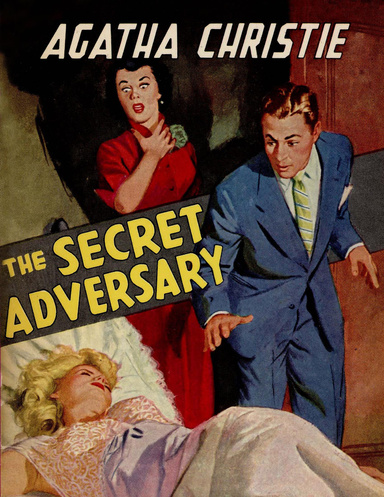
Ironically, Christie’s clear-eyed view of how romance can be subverted to meet the needs of her chosen genre didn’t prevent her from creating one of the happiest couples in detective fiction. When Prudence Cowley and Thomas Beresford bumped into each other after the War at the start of 1922’s The Secret Adversary, we might have suspected that old friendship would blossom into love. But how many readers expected to follow along for fifty years as this snappy couple saved the world not once, not twice, but three times, and grew blissfully old together?
Readers have always been divided about Tommy and Tuppence – you either love them or you hate them. An easy reason for this is that none of their books contain a particularly good example of a Christie puzzle. The novels work more as thrillers, and the short stories, based though they are on the exploits of a dozen early detectives, are clever romps that amount to pastiches of others’ work rather than examples of Christie at her most devious.
I imagine that adapting Tommy and Tuppence to the screen would pose several challenges. First and foremost, their romantic history is simple: they go from friends to a married couple, and then stay blissful to the end. The conflicts that beset them come from the outside, from dangerous elements that threaten their lives, but never their love. Tuppence gets upset with Tommy the same way that Lucy Ricardo gets mad when Ricky won’t let her go into show business, and like Lucy, Tuppence simply presses on and proves her mettle (or takes her lumps, often quite literally.)
Secondly, there were only five books written about the Beresfords, and they are bright young things in only two of them. If one imagines a series, will the same actors be hobbling around in old age makeup by Season Five? Which brings up the fact that the couple’s history encompasses the history of an age. Suchet’s Poirot set all of his cases maddeningly in the 1930’s in order to save money; ditto the later Marples, all placed in the 50’s. The Beresfords save the British government after World War I, fight Nazis in the Second War, and then become ancients in “modern” times.
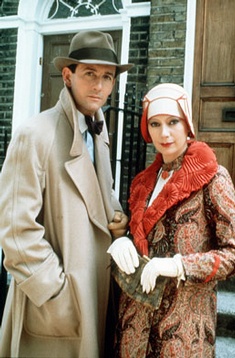
Clearly, some thought has to go into adapting Tommy and Tuppence. The attempt generally thought of as the most successful happened in 1982-83 when Francesca Annis and James Warwick played a slightly more glamorous version of the Beresfords in adaptations of The Secret Adversary and Partners in Crime. To adapt beyond that point would have meant moving time forward significantly and aging these perfectly lovely people; I’m not aware that anyone ever seriously considered this idea, and the series ended.
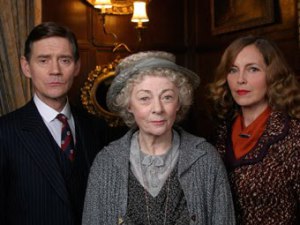
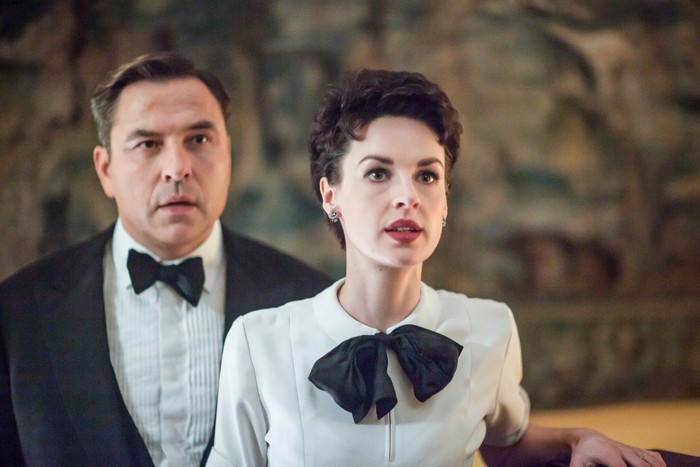
Other attempts in the English-speaking world to bring the couple to the screen have been rare and extremely problematic. In an ill-conceived 2006 adaptation of By the Pricking of My Thumbs, screenwriter Stewart Harcourt got everything wrong, from the insertion of Miss Marple into the proceedings to the depiction of Tommy and Tuppence as a miserable pair. Anthony Andrews was borderline abusive as Tommy, and Greta Scacchi played Tuppence as a miserable drunk. Next came the BBC’s first attempt at a mini-series called Partners in Crime, with an utterly charmless David Walliams opposite a miscast Jessica Raines in just-barely recognizable adaptations of several of the novels. Most agree that it stank to high heaven.
Frankly, I wonder if it’s worth the bother to attempt another adaptation of these characters. Both literature and film have been inundated with excellent examples of the lover-detectives, from Harriet Vane and Lord Peter Wimsey to Nick and Nora Charles, both of whom have been adapted, the latter so well that the film depiction arguably outshines the one on the page. And there are tons of lesser-known detective couples who, to this fan, deserve a screen audience, including: Craig Rice’s Helene and Jake Justice (who did appear in the 1945 film Having a Wonderful Crime, which resembles the novel in title only); Kelley Roos’ Jeff and Haila Troy (also present in a couple of early 40’s screwball mysteries, a French film starring Brigitte Bardot, and Scent of Mystery, notable for being the first film to utilize Smell-O-Vision!); Delano Ames’ Jane and Dagobert Brown (yup, there’s a 1950 British film based on She Shall Have Murder); the Lockridge’s Jeff and Pam North (who not only appeared on film and in a long-running radio series but in a Broadway play that was then adapted into a TV series); and Frances Crane’s Pat and Jean Abbott (a couple of radio series but, as yet, no films).
However, we’re talking about Agatha Christie here, and once again someone has capitalized on the brand and brought us a new TV series about the Beresfords. Agatha Christie’s Tommy and Tuppence has been developed and written by playwright Phoebe Éclair-Powell and consists of three two-part adventures based oh-so-loosely on two short stories and a novel. I have only seen the first four episodes because Britbox America has come up with another cash-grabber called “Premier” for those of us who have forgotten what it was like to wait a week for a new episode to drop and must . . . binge . . . NOW!!!! Having watched the cases that wildly approximate “Finessing the King” and “The Man in the Mist,” two stories from Partners in Crime, I’m in no hurry to see what Éclair-Powell does to By the Pricking of My Thumbs.
I could simply give you a rundown on how the new series differs from the original texts, but that would simply label me a strict purist, which I am not. If this writer wants to set the stories in the modern day – fine. If she wants to make Tommy a successful crime writer and Tuppence and up-and-coming actress who is unhappily married to a jerk named Julius (yes, Julius!) when she meets up with her ex-college boyfriend Tommy at a wedding – okay, sure. If she can grab no less a national treasure than Imelda Staunton and cast her as Tommy’s Aunt Ada, who used to run a detective agency called Blunt’s Brilliant Detectives before retiring and moving to the Shady Ridge Home for sharp aunts and serial killers – all of this I am willing to approach with an open mind.
That, based upon the first four episodes, I can say that the series stinks has less to do with the acting – both Josh Dylan and Antonia Thomas are fine in their roles, even if neither is playing Tommy OR Tuppence, and Imelda Staunton, though severely underused, dominates the screen every time she appears – and more to do with the abysmal, lazy writing that trades on cliches and F-bombs, and the plotting that can’t be bothered to come up with a halfway decent puzzle.
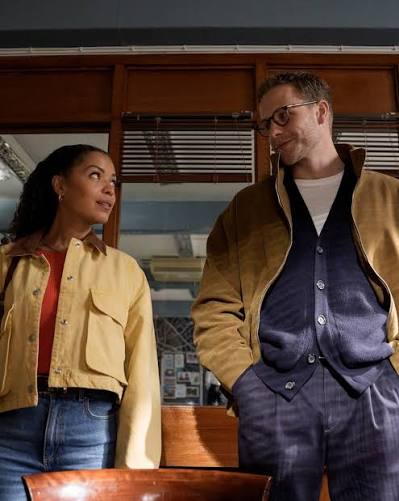
To be fair, the first two episodes comprise a kinda-sorta straightforward adaptation of Christie’s story: despite a change in setting and some different characters, the murderer is essentially the same person in both incarnations. For the adaptation of “The Man in the Mist,” the only similarity is in the name of the main female character, actress Gilda Glen. This character bears no resemblance to the one in the story, who is murdered, while in the TV version she is not. The plot is wholly original and so typical of every C-grade romantic mystery found on Netflix or Lifetime that it’s frankly depressing that the Christie estate let Éclair-Powell get her mitts on these characters.
You know something is truly wrong here when more attention is given to the troubled path toward romantic happiness of our title characters than it is to the story. The real Tommy and Tuppence never had these troubles, but if you’re going to give the modern versions of these folks such tsuris, at least try to make the problems original. And while I am certainly not a prude, I would appreciate a modicum of respect for the Beresfords, who drop the word “f*ck” into every other sentence and who are so hot for each other that they strip down and go at it against a wall, only to be interrupted by Tuppence’s equally hot estranged husband.
The biggest problem with the latter moment is that Tommy is much hotter than Julius. Yes, Tommy, the lad whom Christie described thusly: “His bared head revealed a shock of exquisitely slicked-back red hair. His face was pleasantly ugly – nondescript, yet unmistakably the face of a gentleman and a sportsman.” Actor Josh Dylan is a stud! As for Tuppence, I suppose that Antonia Thomas’ version is as impetuous as the book character (and at least has the decency to get conked on the head once or twice), but she’s also a terrible sleuth. Her “quick-witted” improvisations in the face of danger are abysmal flops. Aunt Ada has to continually lecture the couple on the most basic precepts of how to be a detective.
All they had to do was read Van Dine’s rules – which, come to think of it, I believe should be required of the writers and producers for all future BBC TV adaptations.


I am Team Tommy and Tuppence, mostly because of their spunky attitudes.
For love affairs used in crimes, see also A Pocket Full of Rye and Endless Night.
LikeLiked by 1 person
SPOILERS – The thing I love about Pocket Full of Rye is that the killer, one of Christie’s vilest creations, hides in plain view from the reader because he’s genuinely in love with his wife. And since she loves him back, why shouldn’t we??
I don’t think this new Tommy and Tuppence are spunky enough.
LikeLiked by 1 person
Yeah, I meant book Tommy & Tuppence 🙂
LikeLike
I’m SO with you
LikeLike
I watched all six episodes, and while the leads are not Francesca Annis and James Warwick they’re a big improvement over the others (whose names will not be spoken). To give them credit this new version of By the Pricking of My Thumbs does a good job with a late Christie meddle of a book.
This version goes for a very trendy current style – I can live with it, pleasantly entertained and keeping score of many plot points are hit or missed.
The French versions of Christie are better at sticking to the plot even when they go their own way in all other respects. See Associés contre le crime or any of the Les Petits Meurtres. Although even the French had trouble with By the Pricking of My Thumbs.
LikeLike
Tommy and Tuppence effin’ and jeffin’? Good lord!
LikeLiked by 1 person
OK I may be one of those rare AG fans who loves the Beresfords and always wanted more. I would love to see a faithful (Chris Chibnall?) adaptation of N or M starring David Tenant and Olivia Coleman. What say you, Brad? Anyone?
LikeLiked by 1 person
I love them both, but I can’t think of two actors who strike me as more unlike Tommy and Tuppence than those two! However, I am totally on board for an adaptation of N or M!!
How about Damian Lewis and Rachel Weisz?
LikeLiked by 1 person
Damian Lewis lacks charm and charisma. Weizt is ok, but too glam for the role. This is why I love Tenant and Coleman, great actors with great chemistry and comedic timing. And Keeley Hawes as Mrs. Sprot.
LikeLiked by 1 person
I’m trying to find a Tommy with red hair! And isn’t Keeley Hawes too old to play a young mother?
LikeLiked by 1 person
Hair dye? And KH is a chameleon and could probably pull it off. Mrs. Sprot never struck me as “young” .. but more a 30 something. And for the adaptation Betty would probably be aged a few years.
LikeLike