If Perry Mason had practiced law in England, would he have been considered a barrister or a solicitor?
According to AI (which untied and fed me in order to allow me to write this article), Mason would have been considered a barrister. “Barristers specialize in speaking in court and trying lawsuits in front of a judge and jury. Perry Mason rarely spent time drafting routine office contracts or managing general client business out of court. His famous last-minute witness cross-examinations match the daily work of a trial advocate.”
Personally, I think Perry did all of this and more! The AI (whose name is HAL) explains that solicitors “meet with clients first, give initial legal advice, and handle the paperwork.” Mason certainly did this, and he also jumped on running boards, raced up and down the California coast, and found bodies in apartments, bungalows, cars, dark houses . . . well, there’s a whole alphabet’s worth of places where the attorney/barrister/solicitor crossed paths with a corpse, sometimes with Della Street, his secre-TREE, and/or private enquiry agent Paul Drake at his side.
I thought a lot about this when I was in England. I also asked myself: “Which British actors appeared on the series Perry Mason?” The answer led to some excellent viewing and to some wonderful actors whom you may have known mostly from other performances (“Klaatu barada nikto!!”) on the big screen or on television. It seemed like an excellent subject to bring us back into our “Perry Mason Connection” series.
Actually, we’ve already seen quite a few British actors – well, Bernard Fox, who played Dr. Bombay in Bewitched was actually born in Wales, and Tom Conway, who played The Falcon in a series of “B” movies, was of British parentage but hailed from Russia. We’ve seen Antoinette Bower, Anna Lee, and Patricia Medina already, and I’m afraid there aren’t any more episodes of theirs to share. However, I’m going to showcase five other actors today. One of them I’ll freely admit is a cheat, but I love him so much I’m going to throw him in as a bonus! Here they are in alphabetical order.
* * * * *
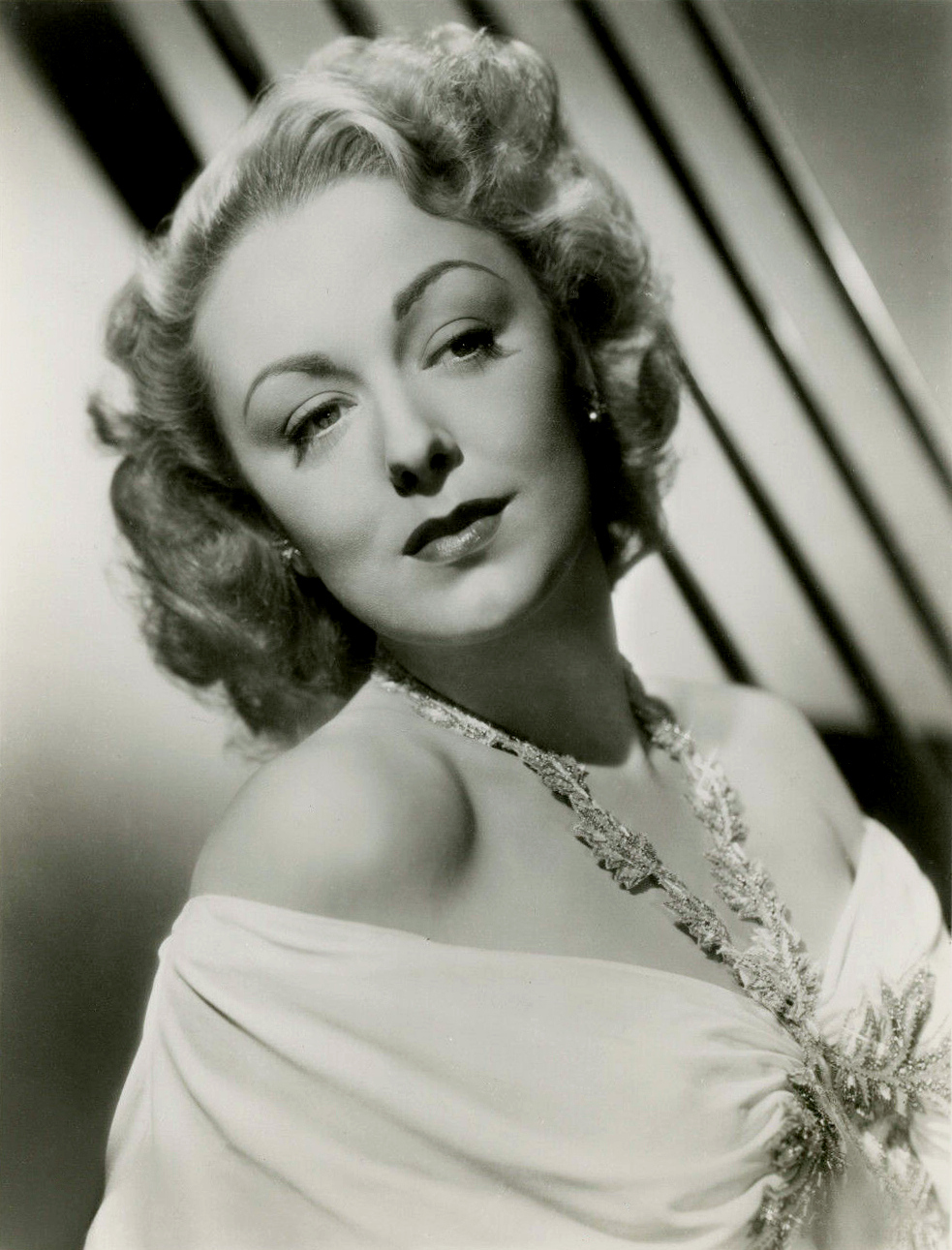
Virginia Field’s career in film and television spanned over forty years and included some prestigious projects – she received fourth billing in the 1940 tragedy Waterloo Bridge playing Vivian Leigh’s best friend and played the heroine in Charlie Chan at Monte Carlo (1937, the swan song for Warner Oland as the great detective. Field also appeared in several Mr. Moto movies with Peter Lorre.
Born in London, her father was a judge and her mother a cousin of Confederate general Robert E. Lee. She studied abroad in Paris and Vienna, and in the latter city acted for the great Max Reinhardt. Returning to England, she studied acting and made her film debut in her teens as a maid in a Leslie Howard picture, The Lady Is Willing. She made her American film debut playing a singer in Little Lord Fauntleroy (1936), and then her career took off. Field was a fine actress: she could play both good girls and bad (she was the villainous Morgan La Fay opposite Bing Crosby in 1949’s A Connecticut Yankee in King Arthur’s Court) but best of all she could play a combination of both. This skill served her well in Perry Mason, where she appeared in six episodes that spanned the series, playing everything from the defendant to the murderer. (And she was always an interesting murderer!)
We’re going to look at two of these episodes here. The first is “The Case of the Provocative Protégé,” which was the eighth episode of Season Four and debuted on November 12, 1960. This one is a tight and moving mystery that subtly and nicely subverts the series formula. David Carpenter (Gregory Morton, who also appeared in six episodes), a world-famous concert pianist, has learned that a debilitating condition has put an end to his career. He has an adoring wife, Anita (Field) and a beautiful and talented protégé named Donna Ross (Kathie Browne, four PM eps) with whom he has fallen in love, despite the vast difference in their age (which stops NO man in 1960’s television . . . maybe in any era) and the fact that she has very gently repulsed his advances. When Carpenter’s car goes over a cliff, it is assumed that, after all these bad breaks, he has committed suicide.
Carpenter leaves behind a financial mess, and both his business partner, Eric Sturgis (Charles Cooper, who played one of the main detectives in Hitchcock’s The Wrong Man) and his financial manager Andrew Collis (Robert Lowery, who played the Caped Crusader in the 1949 serial, Batman and Robin) urge Anita to pressure, whom she considers to be like a daughter, to give up her concert dreams and work a lounge act in Lake Tahoe for big money.
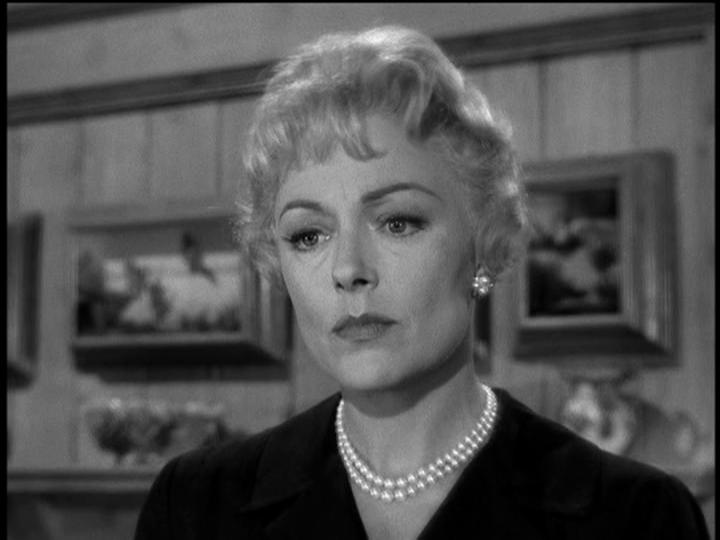
Anita cannot collect insurance on her husband’s death because of a “no suicide” clause. But then a sketchy fellow named George Worthington (Harry Jackson, seven episodes!) appears at Anita’s door and says he saw someone push her husband’s car off the cliff. He wants a thousand dollars for his story, but Anita insists on dragging him off to her attorney, Perry Mason, to figure out the right way to go about things. For Mason, this means bringing in the police, and although Worthington is soon discredited as a witness, Lieutenant Tragg discovers the story he told is true. Who then murdered David Carpenter? The police say it’s Donna and arrest her. Anita insists that Perry defend this innocent girl, no matter who the truth hurts.
What follows is a wonderful episode with so many interesting character turns, even on the part of the defendant (a role that is often maddeningly passive on the series) that it all feels fresh. Field is marvelous here, so poised and dignified, yet warm and sympathetic. It reveals a fantastic range, considering we recently saw her play a strikingly different character in “The Case of the Polka-Dot Pony.” The final reveal is quite moving and, considering the reliance on formula here, even surprising.
The only thing that mars it is the Assistant District Attorney, played by Robert Karnes in one of four appearances he made during Season Four as this particular D.A. Karnes overacts horribly, and I was going to make more of this, until I read that he was blacklisted by the anti-communist muckrakers, which put an end to his film career and relegated him to television. Because of that, I’ll go easy on the guy.
Field’s final appearance was in “The Case of the Tsarina’s Tiara,” the twenty-third episode of Season Nine, which premiered on March 20, 1966. It’s a very choppy case, full of weird tonal shifts. It begins in Central America, with the theft of priceless jewels that are embedded in a carefully guarded statue. The actions of the thief, Nils Dorrow, wordlessly encompass the first five minutes of the episode, and while there’s nothing “high tech” about the process, the sequence is exciting and pre-dates the CBS premiere six months later of Mission: Impossible, which would begin its long run after Perry Mason had ended.
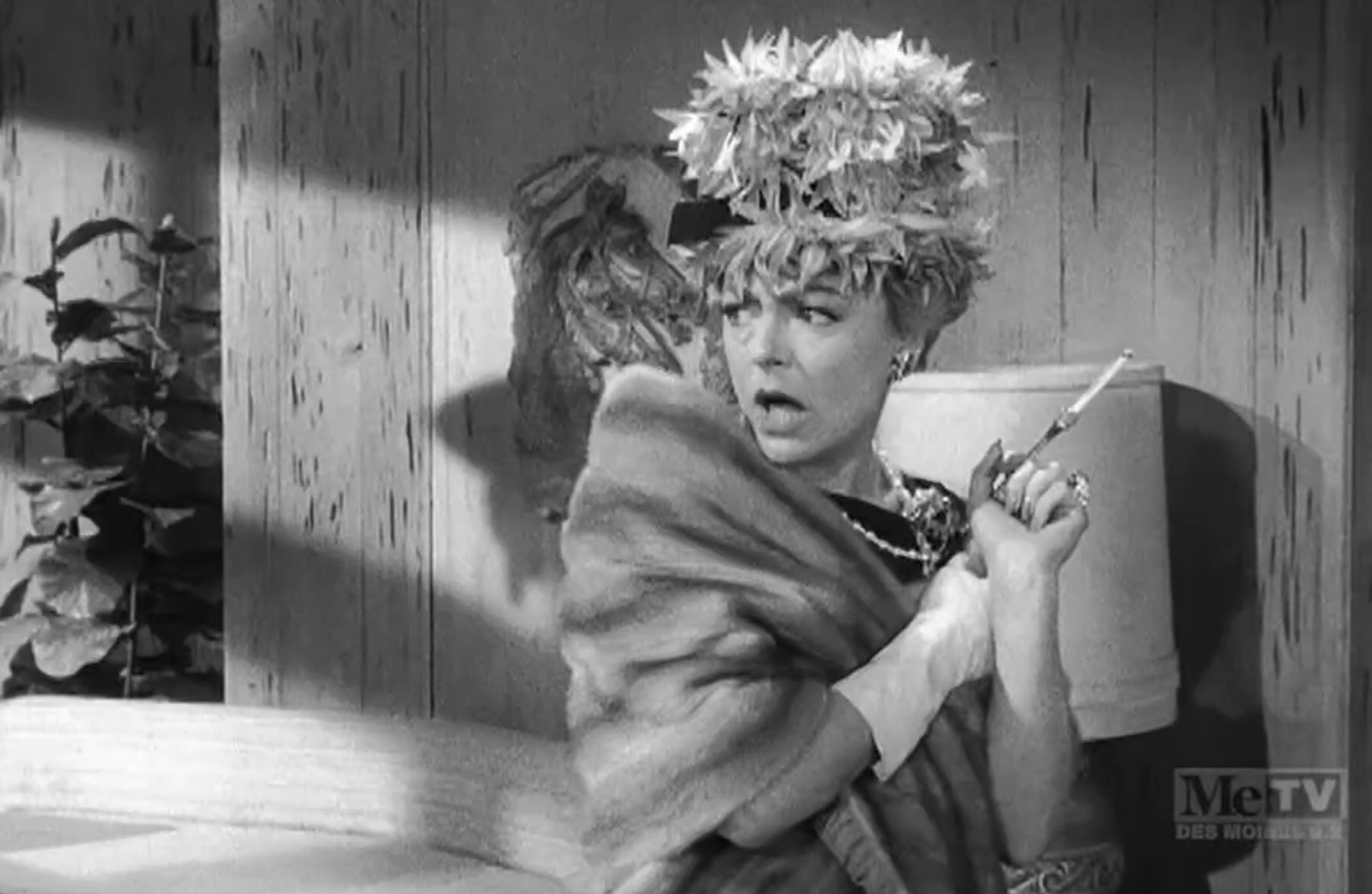
The next sequence is out and out farce and features Fields as Madame Sonya Galinova, who comes to Mason to complain about being cheated by Vyacheslav Gerznov, who had stayed with her and paid for his stay in jewelry that she claims is worthless. But when Mason brings the Madame upstairs to his clients, Van Ness and DeVry Jewelers, Joachim DeVry (Wesley Addy, whose long career included classic films like Network, Kiss Me, Deadly and The Verdict), tells Mason that the jewels are priceless. Now Madame Sonya wants Mason to assure her that Gerznov’s handoff of the jewels as rent is legal. Paul Drake visits Gerznov (Leonid Kinskey, another distinguished actor, born in Russia, whose comic resume includes featured roles in Duck Soup, Ball of Fire and Casablanca) and gets him to sign off on Madame’s ownership of the jewels.
All the scenes between Field and Kinskey here are played for broad comedy with wild accents and heavy-handed gesticulations. And then everything shifts again as Gerard Van Ness (Kendall Clark) returns home from a business trip in Central America. On his way home, he is stopped by police who have received a report that the car he’s driving is stolen. When the cops open the trunk, they find a dead body – it’s the corpse of the thief, Nils Dorrow.
We have barely gotten to know Van Ness before he is put on trial for murder. And it’s hard to piece together a suspect list! Madame Sonya and Gerznov seem to belong in another series, while the couple they have sold the tiara to, Pauline and Rolf Thorson, barely register in the story – although Rolf is played by Philip Terry, a fine actor who appeared in five PM episodes, three of which we’ve reviewed on other posts, and Pauline is played by Broadway royalty Vivienne Segal, famous for her roles in two Rodgers and Hart musicals, Pal Joey and A Connecticut Yankee in King Arthur’s Court. The film industry was unkind to Miss Segal, and she retired from acting after making this episode.
Raymond Burr seems a little bored playing straight man here – maybe it’s because the humor isn’t funny. But Perry gets his revenge by proving most of these people are in on a huge conspiracy to get rich, a conspiracy that folks say more than once was never meant to hurt anyone until the dead man got greedy. Still, there’s only one character who plays it straight enough throughout to be seriously considered for the role of killer. No surprises here – ho hum.
* * * * *
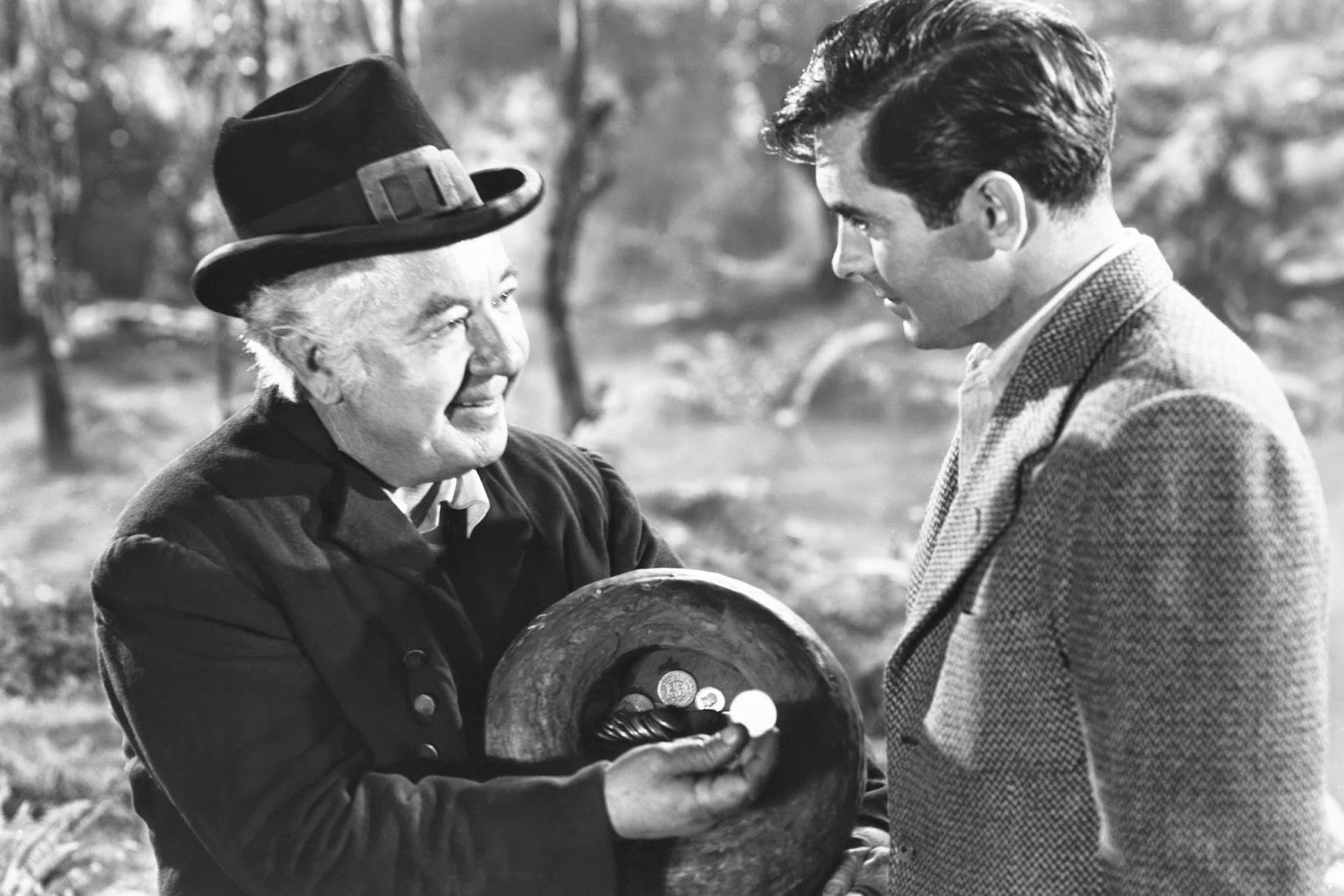
Cecil Kellaway is the cheat that I mentioned above. He was actually born in South Africa (his dad was friends with nation-builder Cecil Rhodes, who became namesake and godfather to baby Cecil). He was educated partly in England but began his theatre training and career back home. He then emigrated to Australia and had a booming career there in theatre and film.
When he finally came to America, Kellaway worked steadily, first for RKO and then for Paramount, in mostly small roles. Even in his younger years, Kellaway would often get typecast as henpecked but good-hearted husbands and fathers. It was a career that frustrated him, and he toyed with returning to Australia for the chance to run a studio. Eventually, though, he became an American citizen and appeared in many films and TV series, acting opposite a list of actors as diverse as Katharine Hepburn and Abbott and Costello! You might remember him as the head of the sanitarium in Harvey, the wise scientist in The Beast from 20,000 Fathoms, the absent-minded professor in The Shaggy Dog, the kindly priest in Guess Who’s Coming to Dinner? or the snoopy but sensitive reporter in Hush, Hush, Sweet Charlotte.
I don’t know . . . it was a strange career, but I loved the guy. Evidently, Perry Mason did, too, because in the one episode in which he appeared – Season Two, Episode Fourteen, “The Case of the Glittering Goldfish,” which debuted on January 17, 1959 – Kellaway received equal billing with Raymond Burr! I only wish he had a better script and story. At least the episode is stylishly directed, one of four Masons that was helmed by German émigré Gerd Oswald, who directed the film version of A Kiss Before Dying and helmed fourteen episodes of The Outer Limits. We have already seen his work in “The Case of the Lost Last-Act.” Oswald’s work is highly stylized here, with a camera that moves constantly, strong shots and angles, and silhouetted lighting. The background music here is tense and jazzy, even when it doesn’t need to be.
But the story is strictly by the numbers. (Warning: I’m going to SPOIL this one.) Struggling scientist Tom Wyatt (John Hudson) has invented a substance that will cure gill fever in goldfish. His plan is to market it through the store of his old friend Frederick Rollins (Gage Clark. (NOTE: this makes no business sense whatsoever. Rollins runs a small-time fish store in financial straits, with limited options, and this invention is a game-changer for fish health care!) Have no fear, though: Rollins has been bought out by Jackson Huxley (Mervyn Vye), who has the capacity to broaden the sale of Wyatt’s drug.
What follows is fifteen tiresome minutes of Huxley screwing over every character in the episode. First, he informs Wyatt and Rollins that he’s taking the invention for himself and kicking them both out of the business. Then we have a scene where he comes to the refurbished shop and walks up to two women sitting at their desks. One of them, Donna Sherwood (May Wynn) is dressed for dancing and stares at him as if they left each other’s bedside an hour earlier. The other, Sally Wilson (Jacqueline Scott, three PM eps) sits demurely at her desk, typing away. The good girl vs. the femme fatale. Huxley ignores Donna and flirts with an uncomfortable Sally. He then fires Donna and orders Sally to cancel her evening date for some “late night work.”
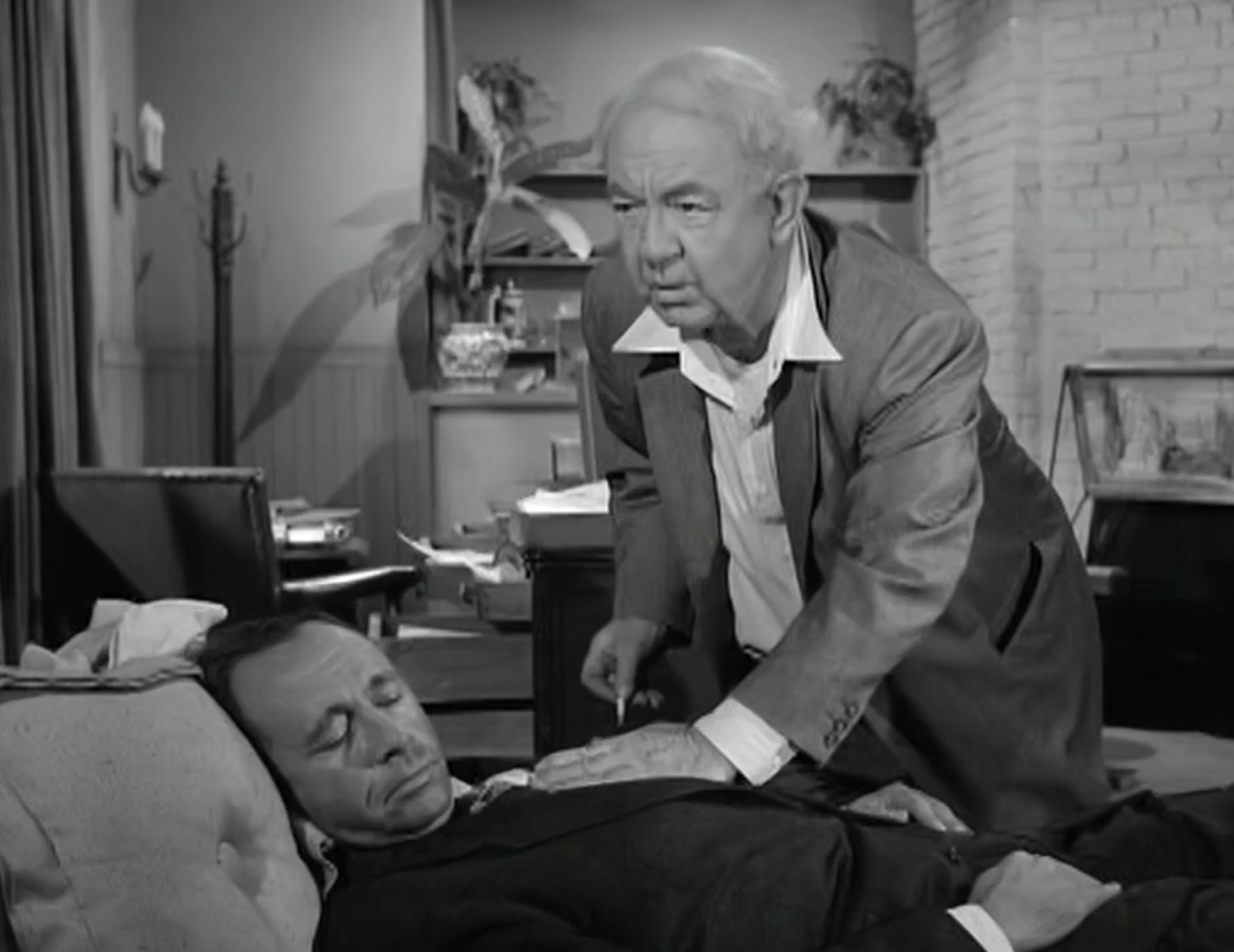
Then Huxley calls his wife to tell her he won’t be home for dinner. It’s late morning and Nora Huxley (Catherine McLeod) is already drunk as a skunk. Then Huxley’s partner, Dan Myers (Willard Sage, three eps) shows up and the two men have an argument. Then Huxley goes to the lab with Wyatt’s formula and demands of the scientist there, Darrell Metcalf (Mr. Kellaway) that he analyze the substance for reproduction. Metcalf isn’t just drunk – he’s rolling! And his clothes look three sizes too big!! Huxley forces Metcalf’s head under the sink and tells him to get to work.
The rest of the episode doesn’t matter. Of course, Huxley is murdered, and Wyatt is charged with the crime. Most of the characters are in cahoots with at least one other character. The good guys (Wyatt, Sally and Rollins) all lie to Mason for a good cause and then shout out truths to him at the defendant’s table during the trial. Nothing that’s revealed is particularly interesting, but it is filmed and scored in an interesting way.
And Kellaway is treated like a true guest star, even though his character seems superfluous to the action. He plays a pixilated drunk throughout, and nobody takes notice of it. He has a long scene in Perry Mason’s office which is really just a showcase for Kellaway’s charm (and Burr, Hale, and Hopper are clearly charmed), and when he takes the stand the first time, he messes up the oath because he’s loaded – and nobody does anything about it. When it comes time to unmask the killer, who do you think it’s going to be? Of course, Kellaway gets a striking final scene on the witness stand, and the whole courtroom is riveted as he reveals that he killed the guy because . . . well, someone had to rid the world of this walking case of gill fever!
* * * * *
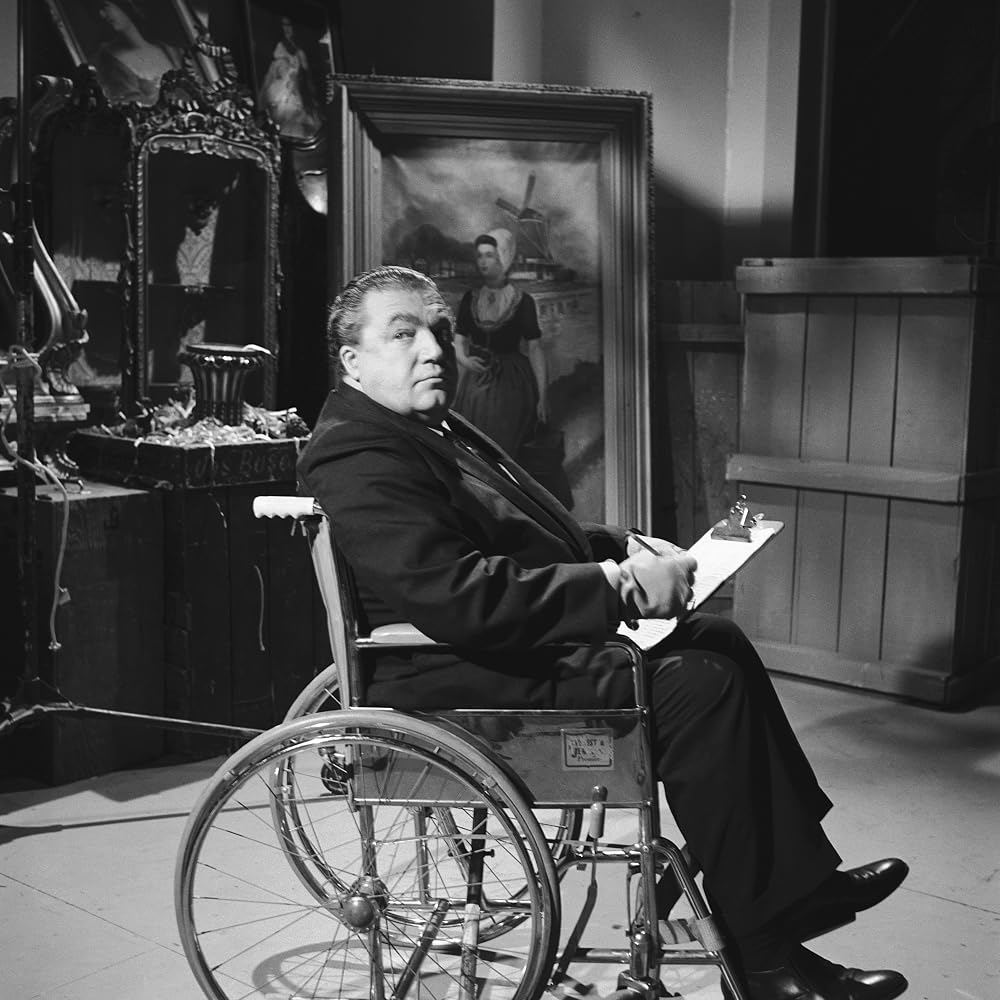
We have already watched Ronald Long perform in “The Case of the Renegade Refugee,” with Denver Pyle, and “The Case of the Fugitive Fraulein,” with Jeanette Nolan. Each time I have told you that I knew this guy because he used to sell prunes in a series of funny commercials. His Teutonic heavy set features made him a shoo-in to play Germans and villains (and German villains!) But he was an Englishman, and TV made use of his antecedents too, in classic roles such as Friar Tuck, Henry VIII, and Mr. Bumble and on various comedies and dramas as characters with names like Sir Widgin Willingham or Sir Malcolm Forrester.
Born in London in 1911, Long performed on the stage, including at the Old Vic, before emigrating to American in the 1940’s. Most of his work was on TV, where he played a host of colorful characters on many sitcoms. Of course he appeared in Hogan’s Heroes (but as an English major rather than a German), and he played villains twice on Get Smart, including Leadside, a parody of Raymond Burr’s Ironside.
I was fascinated to learn that Long appeared on a soap opera, playing attorney on Evans Baker on Love of Life for four years during the 1950’s. He served more as a confidante and legal advisor to other more major characters. Most interesting was that he was described as “a perennial bachelor” and effected an arch, humorous character like a modern-day Oscar Wilde. Evidently, this was a sort of coding that the gay writers of the soap used to introduce characters that couldn’t be overtly homosexual. (Long kept his personal life private.)
At least we have one more episode of Perry Mason featuring Long that we can discuss here. “The Case of the Elusive Element,” the twenty-fourth episode of Season Six, premiered on April 11, 1963. It is full of guest “regulars” we have seen before, including Gloria Talbott, Douglas Dick, George Macready and Gerald Mohr. We’ll talk mohr about More, er, more about Mohr, in the near future, but he’s the main attraction here as Austin Lloyd, business partner to Dwight Garrett (Douglas Henderson, six PM episodes) of Aerospace Reliability Associates. Garrett wants to sever his partnership with Lloyd and join a rival company run by Myron Baker because, as Garrett’s lawyer Perry Mason explains, Garrett has been doing the lion’s share of management and development and has come to regret his decision to hire Lloyd as his partner. Things are further complicated because Garrett is in love with Lloyd’s wife, Bonnie (Gloria Talbot).
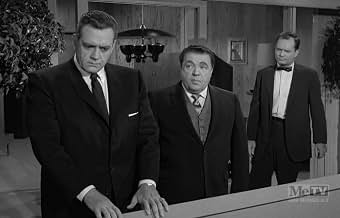
The first quarter of the teleplay plays like a juicy episode of Columbo: Lloyd devises a clever way to frame both Garrett and Bonnie as co-conspirators in both cheating the company and attempting to murder Lloyd by poison. But something goes wrong: as Garrett and Bonnie run into each other at the airport in total surprise, each on an errand for Lloyd that will make it look like they are trying to escape together to Mexico, they are met by Lieutenant Anderson with the news that Austin Lloyd has actually been murdered!
All of this is really good stuff, and we have a rare instance of a pair of defendants. Mason has his work cut out for him to uncover the dead man’s scheme, and he does this in a way that is typical of the courtroom scenes in the novels – he does some funny business with two typewriters to show how the frame was done. It turns out that the “elusive element” is not a scientific thing at all but the elements in an office typewriter. The episode’s title also gives Perry a chance to quote John Donne: “I am a little world made cunningly of elements.”
The only weakness here are the other suspects, none of whom stand out much from each other. I made a correct stab at which one was the murderer purely by casting; this is the surefire method of impressing your friends once you get the hang of t.
* * * * *
I’m purposely focusing on character actors for this series of articles, but someday soon I will talk about some of the really big names who made appearances on Perry Mason before they became famous. And then there were a few movie stars who made a guest appearance on the show during Season Six, when Raymond Burr had to take an extended leave to have surgery. We’ve already talked about Bette Davis and Hugh O’Brian. Today’s leading man is Michael Rennie.
At least Rennie wasn’t born in the Midwest or the South, didn’t move to California and take over the Pasadena Playhouse, didn’t appear first on radio and the Broadway stage. He was born in Yorkshire to a man who owned a successful Scottish wool mill. As a result, the family was well off, and after being educated at Cambridge, young Eric Alexander Rennie returned home to join his father’s business.
It didn’t take. Neither did working in his uncle’s steel ropes factory or selling cars. At the age of twenty-six, Eric decided to change his first name to Michael and become an actor. Since he had no training or experience, just good looks, Rennie signed on with Gaumont British Studio to take on small, uncredited roles and learn the business from the ground up. His debut performance was in Alfred Hitchcock’s Secret Agent, where he worked as stand-in for the film’s star, Robert Young. Try as he might, however, Rennie’s inexperience showed, and he returned to Yorkshire and began training for the profession in live theatre. When he returned to films, Michael Balcon, who had left Gaumont to run Ealing Studios, rehired him and slowly built up his career.
From 1941 to 1944, Rennie served as a flying officer for the British in World War II. Some of his training was conducted in the United States, and a funny moment occurred when his Air Corps camp in Alabama showed Ships with Wings, the film that turned Rennie into a leading man. After the war, Rennie continued to build a film career in Great Britain, but it wasn’t until 1950 that he attracted the attention of an American Studio, 20th Century Fox, which was making a film, The Black Rose, in England. Rennie was cast, and studio head Darryl F. Zanuck was so impressed that he signed Rennie to a seven-year contract.
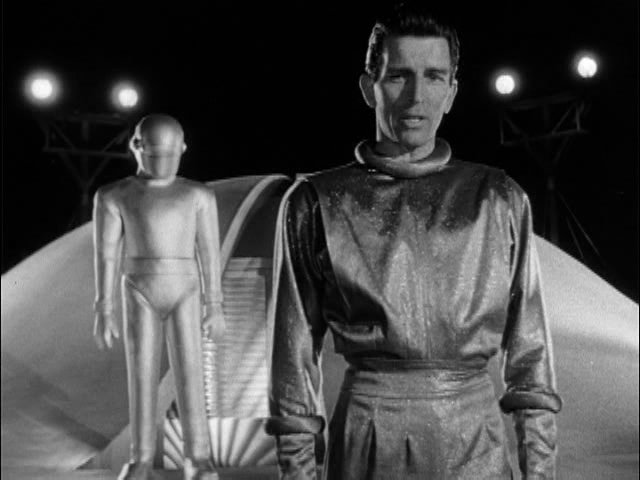
I knew Michael Rennie primarily for three science-fiction roles: as the benevolent alien Klaatu in Robert Wise’s The Day the Earth Stood Still, as a member of a committee of scientists looking for the person who can kill people with their mind in the sci-fi whodunnit, The Power, and as the alien zookeeper (called The Keeper) who wants to take Will and Penny Robinson as specimens in Lost in Space. But his career was a long and mostly distinguished one.
Rennie was the second of four guest stars to take over for Raymond Burr in the middle of Season Six. “The Case of the Libelous Locket” was the seventeenth episode and premiered on February 7, 1963. Rather than play an attorney, he is Edward Lindley, a law professor who tells his students that the greatest advances in the legal profession have been made by academics; trial attorneys like Perry Mason, he tells them, are a combination of a parrot and a jackass in that they recite law and act stubbornly on behalf of their client. For the rest of the episode, Lindley has to eat those words!
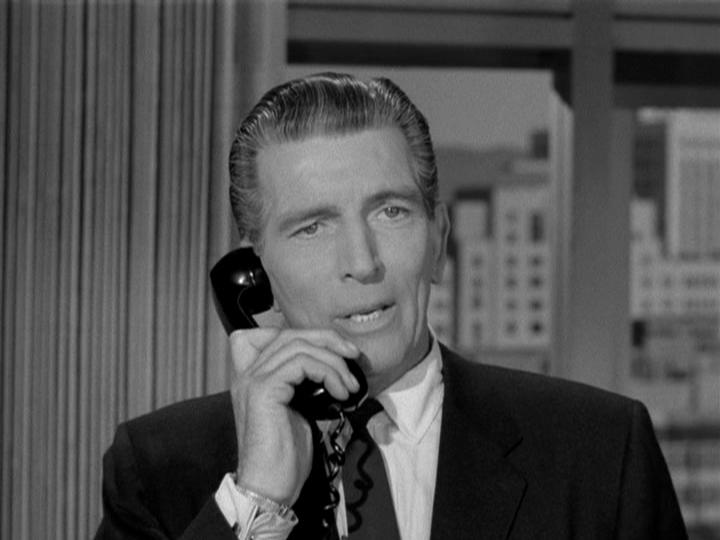
At the end of class, the professor heads to his office where he discovers Janice Norland (Patricia Manning), a student of his, who has missed class for the first time in months. She’s got a good reason: she tells Lindley that she has just confronted a man whom she had been dating and has killed him with a fireplace poker at his apartment; now she wants the Professor to take her to the police. Lindley has the better idea of escorting Janice to the crime scene to see if the man is really dead. Naturally, when they arrive, the apartment is corpse-free. It seems that the man, dance instructor Raul Perez (Carlos Romero), is setting Janice up for blackmail with his boss Vivian Cosgrave (Ruta Lee, a staple of television for decades and still with us, she played “the Other Woman” in Billy Wilder’s Witness for the Prosecution and appeared in five PM eps).
Janice has two people on her side, although for a while she (along with the viewers) doesn’t know it. Her father Darwin Norland (John Hoyt, an actor we’ll be discussing in October) and stepmother Maureen (Patrice Wymore, three eps) have had their own issues with Perez and are both strong suspects for his murder. Which means, of course, that they’re both innocent because, sadly, Perry Mason doesn’t play that way. Ruta Lee might have done it, but we can’t help but notice the two older men lurking about the episode, both of them merchants who work next to Perez’ apartment building and who claim to have seen Janice Norland on the night of the murder. One of them is Pedro Diaz, a man who acts and sounds justs like comic Mel Blanc when he plays Sy on The Jack Benny Show (“Sy?” “Si!”) To make matters worse, he is played by Dan Seymour, a nice Jewish boy whose great weight made him the self-professed “young man’s Sidney Greenstreet” and who appeared in several Humphrey Bogart movies, including To Have and Have Not and Casablanca. He was also a dear friend to director Fritz Lang, and he appeared in seven Perry Mason episodes.
Seymour always played the heavy. The other guy, photo shop owner Sidney Hawes, wisas played by Harry Von Zell, a famous radio announcer, who occupied the same space in George Burns and Gracie Allen’s lives as Don Wilson did for Jack Benny. Largely known for being a straight man to comics, it’s odd to see him here – and so I just kept waiting for him to confess!! I will say that the episode contains an enormous dramatic twist that more than makes up for the obviousness of the killer’s identity. It’s a twist that almost derails the plot, but it is given such a dramatic performance by the actors involved that it’s mighty engaging to watch.
* * * * *
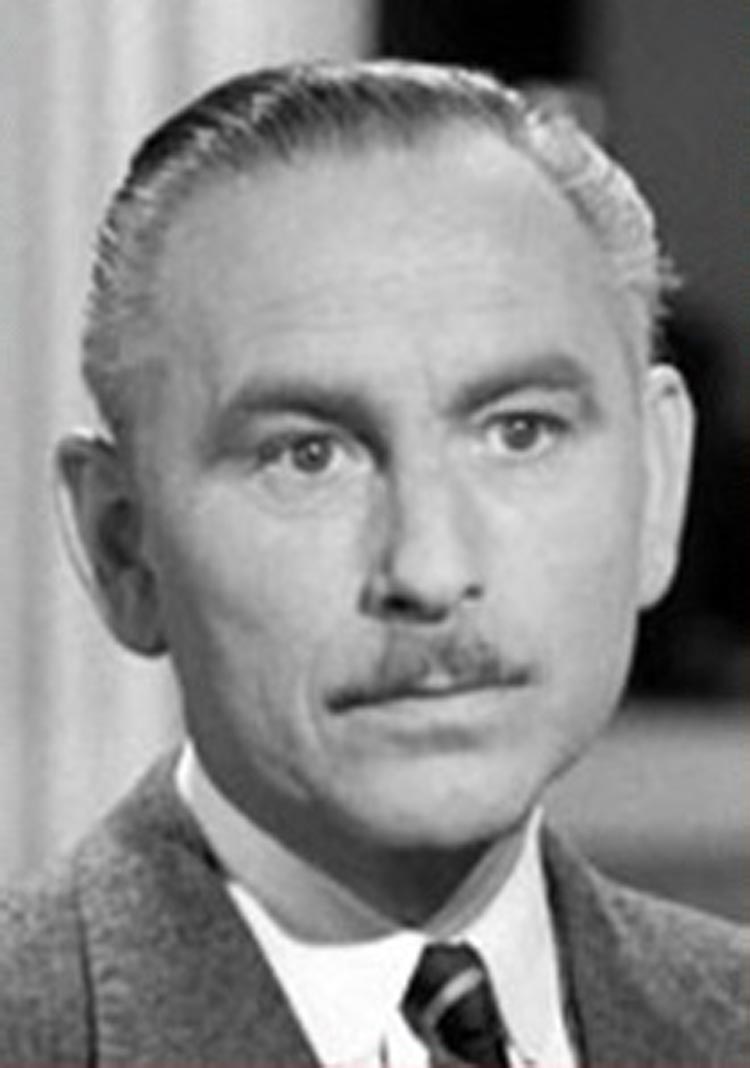
Our final Brit under consideration here is Ben Wright, who first came to my attention because of my love of classic radio mysteries. One of my favorite programs is The New Adventures of Sherlock Holmes, which ran from 1939 to 1950. Of course, the best Holmes by far was Basil Rathbone, who originated the role as an offshoot of the successful series of films that was just beginning. He played the role opposite Nigel Bruce through 1946. For the final four years, three other men played the Great Detective: Tom Conway covered the first year and seemed to model his performance after Rathbone. John Stanley took over the next two seasons, and Ben Wright was the final Sherlock Holmes before the series was canceled.
Wright was born in London, studied at the Royal Academy of Dramatic Art (RADA) and became a stage actor on the West End. He did his service during WWII in the King’s Royal Rifle Corp. In 1946, he journeyed to America to attend a cousin’s wedding, went to Hollywood, and decided to stay there.
With his plummy voice, Wright certainly played many British characters, but I think the most famous of these was probably Roger, husband to Anita and father to 101 Dalmations in the classic Disney cartoon. (He also appeared in The Jungle Book and played Grimsby, the Prince’s steward, in The Little Mermaid – his final role before he died.
Wright’s vocal mastery got him cast in a lot of non-English roles. He voiced a number of the aliens in The Outer Limits and played various Nazi officers on five episodes of Hogan’s Heroes. But his most famous Nazi by far was Herr Zeller in The Sound of Music. He appeared on television in both comedies and dramas, even Westerns. He was a semi-regular for a while on Gunsmoke as the owner of Dodge City’s billiard parlor, then went on to play several other recurring and one-off roles. He appeared in three episodes of Perry Mason, including the adaptation of The Case of the Terrified Typist, my review of which was posted last month. Here, then, are the two other cases featuring Ben Wright.
The nineteenth episode of Season Three, “The Case of the Bashful Burro,” debuted on March 26, 1960. It calls to mind several tropes from the original novels: a small Western town, the mining background, the pivotal use in the plot of an animal. A young couple, Sally and Gerald Norton (Sue George and Ray Stricklyn) are trying to make good with an old gold mine left to Gerry by his uncle. According to local assessor Crawford Wright (Ben Wright, sporting the oddest Welsh accent I’ve ever heard), thar’s no gold in that thar mine, but since Gerry’s uncle insisted it was worth something, the Nortons refuse to bow to pressure from the local bigwig, Ken Bascombe (Hugh Sanders, five PM eps) to sell to him.
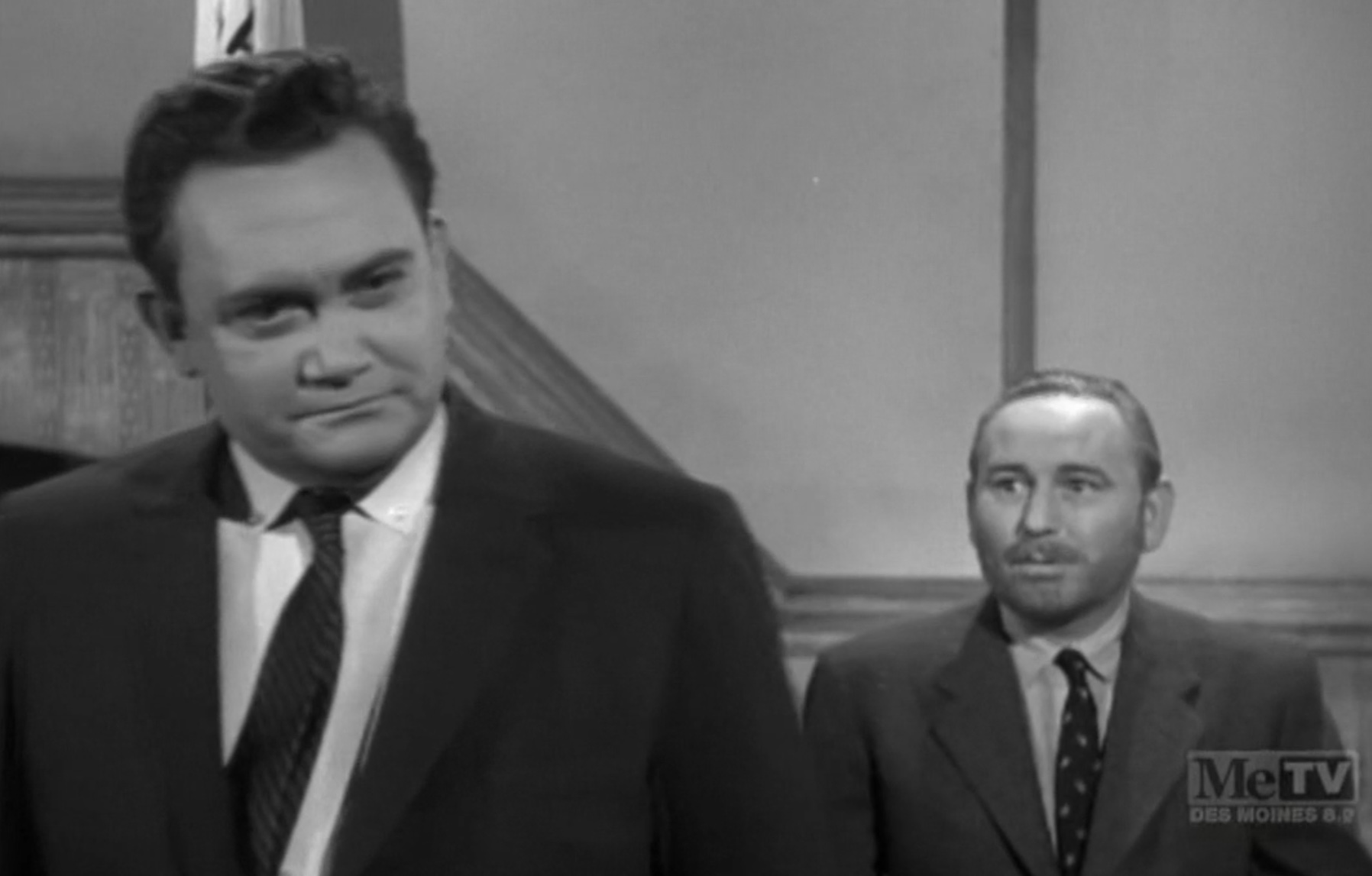
Bascombe is a dirty dog, who is constantly putting the moves on Sally. His wife Hazel (Elisabeth Fraser, three eps) is having an affair with his general manager Roy Dowson (Charles Bateman). And there’s an old prospector running around named Amos Catledge (George Mitchell, who was ignominiously replaced from his role on Dark Shadows after only three episodes!!) who drags his bashful burro Sheba around with him and seems to be either the nicest guy in the west or a dirty dog – or a combination of the two.
Bascombe is murdered, Gerry is arrested, and Perry Mason, who is in town on some other business, defends him. I pegged the murder immediately and then got bored, but it was a nice callback to novels like The Case of the Perjured Parrot when Mason called Sheba the burro to the stand – and she actually helped move the case forward!
The twenty-eighth and final episode of Season Four, “The Case of the Guilty Clients,” premiered on June 10, 1961. The premise sounds great: Perry Mason takes on an old friend as a defendant in a murder case. Halfway through the trial, another suspect stands up in court and confesses to the crime, at which point the defendant himself rises and insists that he is guilty!
I wish the episode lived up to this promise, but it’s only fair, marred as usual by a more than usually obvious murderer. It begins, however, with an acrimonious divorce between Jeff Bronson (Charles Bateman, two episodes of Perry Mason, plus he had a long-term soap role as patriarch C. C. Capwell in Santa Barbara) and his soon-to-be ex-wife Lola (Lisa Gay, seven episodes!). Lola hails from Argentina, along with her VERY SULLEN cousin with the great name of Concepcion O’Higgins (played by Faith Domergue, who we saw get murdered in “The Case of the Greek Goddess.” She played a number of heroines in 50’s sci-fi films, like This Island Earth and It Came from Beneath the Sea. Here she’s pushing forty, and did I mention how SULLEN she is?!?)
Perry Mason is at the divorce proceedings to make sure his old friend Jeff has not been cheated out of his share of the small-potatoes aeronautics firm he and Lola owned. Jeff has designed a new airplane that he hopes will rival that of the big companies and make everyone a fortune. The final test is coming up, and it is in the hands of test pilot Bill Ryder, who manages to cram the following into the first ten minutes: he makes a play for Lola as he guzzles down a pint of booze, all while flying a small plane; he kicks his wife out of the house; he sabotages the test flight to aid rival businessman Leander Walker (William Mimms) who wants to buy out Jeff’s company and sell it to Lockheed.
Lola figures all this out and goes to Bill’s house to confront him. A gun appears, the pair struggle, and the gun goes off, whereupon Bill falls to the ground. Lola flees, just missing Clarence Keller (Wright), the mechanic who built the new plane. Later, it is Jeff whom we see standing over Bill’s body and setting up the crime scene to look like a robber had broken in and killed the pilot. But Jeff does everything wrong (come on, folks, you never break the window glass toward the outside to indicate a robbery!!) and he’s arrested for murder.
It’s Lola who stands up in court and confesses, not out of a sense of loyalty but because she truly thinks shedunnit; it’s Jeff who then confesses in order to protect Lola. Because if you haven’t realized from the first minute that these two shouldn’t get divorced, then you aren’t qualified to watch Perry Mason. Naturally both these kooky lovebirds are innocent, and the killer is staring the rest of us in the face. Wright’s role is a pretty minor one here. There are a couple of other suspects (including Charles Bateman again, in his second and final guest appearance), but they fade in the woodwork when up against Faith Domergue!!!
* * * * *
And that’s ta for now to our British guest stars on Perry Mason. We’ve got some new connections coming up soon, including a trio of scary-themed posts at the end of October in honor of You-Know-What and then a look at some tough guys in Noirvember!!

