The witching hour is fast approaching, and as scary as some of the male guest stars on Perry Mason had it in some of their more horror-filled exploits, the four women we’re about to discuss had it even worse! For although one of the ladies in question became a monster herself, the other three became a monster’s . . . object of affection! Each of them provides evidence that Beauty did indeed kill the Beast . . . but did she end up paying for similar crimes in a Los Angeles courtroom? Read on to discover whodunnit!!
* * * * *
Betty May Adams was born in Iowa in 1926. Due to her father’s death and her mother’s alcoholism, she spent her late teenage years living in Arkansas with relatives. After being crowned “Miss Little Rock” in 1946, she moved to Hollywood to become an actor, taking speech classes to drop the Southern accent she had cultivated. She started getting larger and larger film roles, mostly in Westerns. Universal Studios signed her to a contract and changed her first name to Julia, but she didn’t much like that name and changed it herself to Julie.
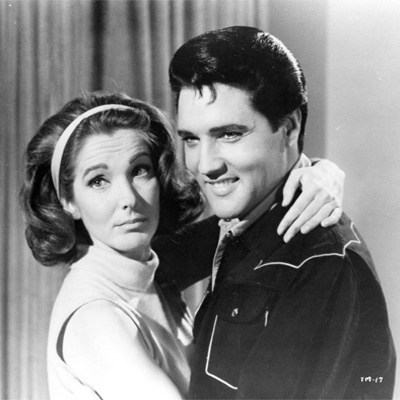
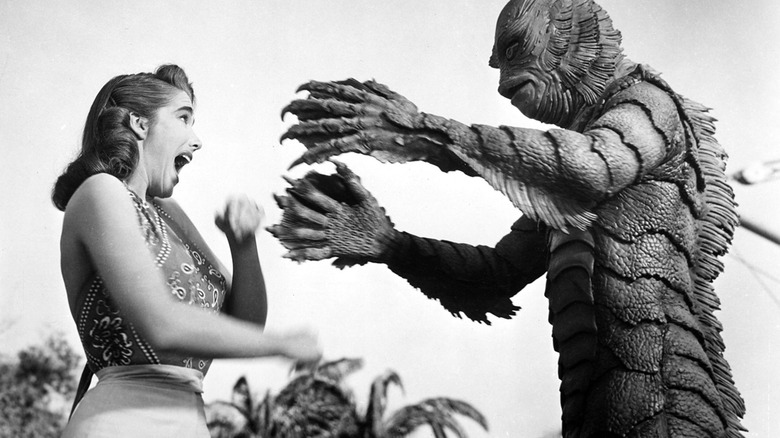
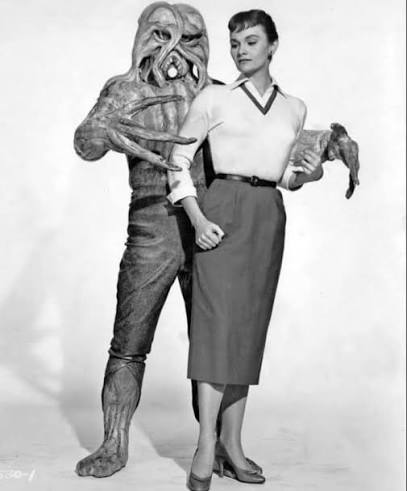
Julie Adams had a nice little career through the mid-1950’s as a “B” leading lady, playing opposite some big stars, including James Stewart, Rock Hudson, Tyrone Power, Charlton Heston . . . and Ben Chapman. Who’s Chapman, you say? Only Adams’ leading man in the film she is best known for, 1954’s The Creature from the Black Lagoon. Chapman played the infamous gill man who falls in love with Adams’ fetching ichthyologist, Kay Lawrence. (She doesn’t so much make the monster as make his day!) The actors worked together on land only, since both had stunt doubles to do the underwater work.
The movie ends tragically for the Creature, who simply had the misfortune to fall for Kay. Tragedy is relative in horror movies: the Creature came back to life for two sequels. Personally, though, I prefer Guillermo del Toro’s The Shape of Water, which gives the Creature the girl a happy ending. In Black Lagoon, Kay ends up back with her boyfriend Mark, played by Richard Carlson, and the two are destined for a happy life together because of one thing they have in common: both appeared in multiple episodes of Perry Mason.
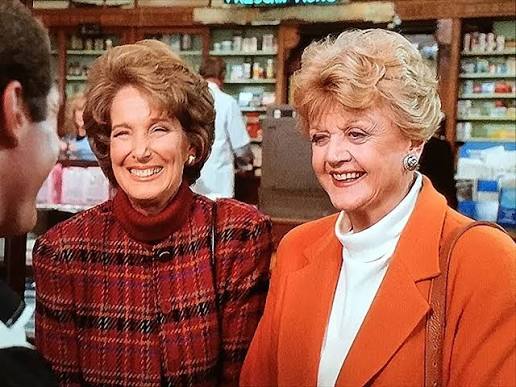
Adams’ acting career really took off on television. She guest-starred on many dramas and comedies, often playing the latest love interest for the show’s leading man. Andy Griffith feel for her on his show; so did Chuck Connors on The Rifleman and James Stewart on The Jimmy Stewart Show – in fact, Adams played Stewart’s wife on that short-lived series. She also had a recurring role on Murder, She Wrote as a real estate agent in Cabot Cove, appearing in ten episodes. She made four guest appearances on Perry Mason, one in each of the final four seasons. We already talked about “The Case of the Missing Button” when we discussed Ed Nelson and Peyton Place, but there are three more cases to sink our teeth into, the second of which is one of my favorites and one that places Julie Adams in a unique position in the annals of the series.
First up, though, is “The Case of the Lover’s Leap,” the twenty-third episode of Season Six, which premiered on April 4, 1963. Director Arthur Marx has everyone acting at such a fever pitch from the first moment that it gets exhausting – but it sort of works for Julie Adams here. John Conte, who made five appearances on the series and has an odd enough puss that he could easily have portrayed a monster, plays Roy Comstock, a beleaguered businessman – or is he a con artist? – who seems to be welching on a deal with young scientist Peter Brent (Carleton Carpenter, best known for singing “Aba Daba Honeymoon with Debbie Reynolds in 1950’s Two Weeks with Love). Roy is in the throes of divorce with his wife Valerie (Adams), is playing hanky-panky with his secretary (Maura McGiveney, four PM episodes), is conniving with his oily lawyer (Marvin Miller, whose voice I remember as the narrator in reruns of the bizarre 1955 TV show The Millionaire), and is a possible romantic rival to Valerie’s assistant Willie (a young Richard Jaeckel). There’s also a married couple who may be the most extraneous suspects in the history of the series.
This episode twists and turns until a very late murder and leads to a trial that is a showcase for Adams, who takes the stand in the weirdest condition. Watching Perry Mason take advantage of that condition is something to see! The near-hysterical acting of most of these folks nearly did me in, but the saving grace is watching Mason and Hamilton Burger work together more closely than usual to bring the correct culprit to justice.
In my recent review of The Case of the Terrified Typist, I mentioned that while Perry only lost one case in his literary career, he lost three on the series. Easily the best of these was the fourth episode of Season Seven, “The Case of the Deadly Verdict,” debuting on October 17, 1963. If ever there was a “Very Special Episode” of Perry Mason, this is it!
It begins at the end – with the jury that had recently convicted Janice Barton (Adams) of the murder of her wealthy Aunt Amanda returning to the court to decide on her punishment. Their verdict? Death by the gas chamber . . . and although few women had historically ever undergone such punishment, the whole episode becomes a ticking clock as Mason’s appeals and the legal machinery countdown to Janice’s fate.
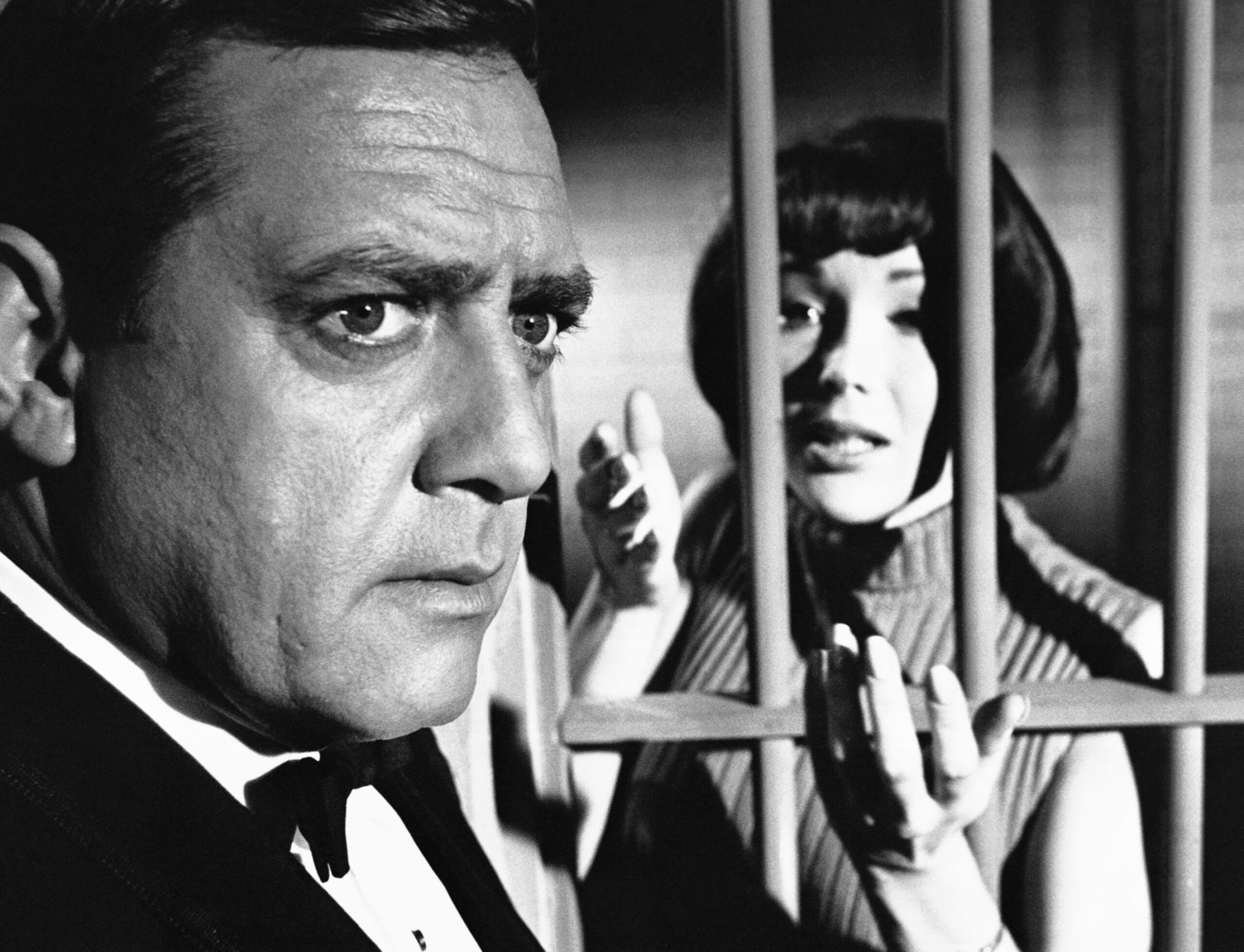
Meanwhile, Mason re-litigates the entire case, trying to figure out a way to prove his client not guilty. As is often the case, his goal is complicated by his client refusing to tell the truth. In this case, Janice had offered a false alibi, and she absolutely refuses to state the real one, for reasons her attorney has to discover for himself. He also has to figure out which of Amanda’s other relations could be the killer. Is it Paulette Nevin (Jan Shepard, veteran of four Perry Mason episodes), Janice’s sister, who has been confined to a wheelchair thanks to Janice’s reckless driving? Her husband, Dr. Nevin (Lee Bergere, three episodes), who has a secret that might save Janice? Was it Emily Green (Joan Tompkins, three episodes), Amanda’s housekeeper, who was bitterly jealous of Janice’s closeness to her aunt? Or was it one of the other heirs: self-righteous Letitia (Erin O’Brien Moore), would-be actress Violet (Hollis Irving) or nephew and legal advisor Christopher (Steve Franken)?
The legal legerdemain is over, and this becomes a tense example of racing against the clock toward an execution, a familiar trope to classic mysteries (Mrs. McGinty’s Dead, He Who Whispers, The Phantom Lady) and practiced thereafter by every legal series to hit the airwaves. Adams doesn’t have to spend most of the episode sitting in a chair, and she nails the feelings of a woman in her position perfectly: the fear and desperation, but also the guilt for every past misdeed and the hopeless feeling that maybe she deserves to die, no matter whether or not she’s guilty. Director Jesse Hibbs does a sensational job ratcheting up the suspense; the ending, free of any music score and with its slight shades of Psycho, is particularly effective. Easily a top ten episode on my list!
Adams returned as the defendant for one final episode in Season Nine: “The Case of the Fatal Fortune” was that season’s second episode and premiered on September 19, 1965. Unlike the other three episodes where her character begins the drama in extremis, here Adams is glowing as Pat Kean, the beautiful fashion buyer working with Max Armstead (Jesse White, of whom more will be said in a later post). Max is physically frail but an emotional dynamo, and he clearly adores Pat. But she is uncertain about her future, and as a lark she and her friend, company secretary Beth Fuller (Nan Martin) visit Marius Stone, a fortune teller (James Lanphier), who predicts a series of events for Pat, including a big romance, marriage to Max, and swift widowhood – all of which mysteriously comes true.
Do you believe in the supernatural? It’s too easy to figure out where this one is heading, so the “surprise” ending may not surprise you. Still, it’s still a beautifully acted episode, a real showcase for Julie Adams, and a lot of fun to watch. Especially good here is Bill Tallman as D.A. Burger, who develops a passionate hatred for a particular suspect – with good reason, it turns out.
* * * * *
Doris Jensen was a Nebraska farm girl who decided she wanted to leave rural life behind and get an education. She received her bachelor’s degree from Hamline University in Minnesota and then made her way to California where she studied at UCLA. Some stage work in L.A. got her noticed and she signed a contract with 20th Century Fox in 1944, changing her name to Coleen Gray.
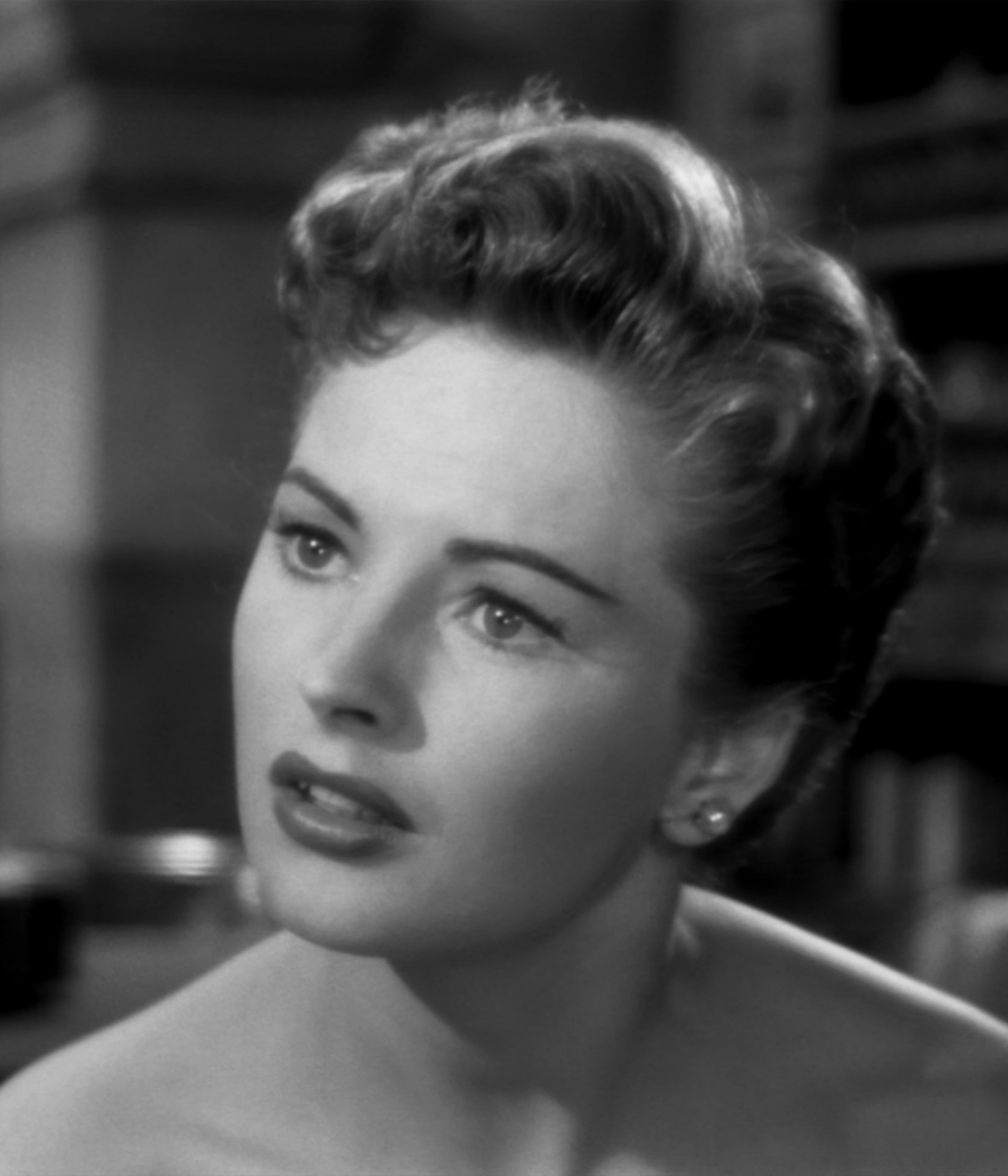
Gray rightfully belongs in next month’s discussion of noir actors and their connection to Perry Mason for the two films she made in 1947: first she played Victor Mature’s wife in Kiss of Death, and then she married Tyrone Power in Nightmare Alley. The following year saw the release of Red River, in which she played John Wayne’s wife (the better role belongs to Joanne Dru, who gets the better man – Montgomery Clift). Gray’s film career is filled with instances of her hooking up with bad guys and victims: in The Killing (1956), she’s criminal Sterling Hayden’s loyal girlfriend, and she performs the same function for John Payne in 1953’s The Vanquished. Ellery Queen fans will be excited to know that Gray played the key role of Mrs. Cazalis in Ellery Queen: Don’t Look Behind You, the Peter Lawford-starring TV adaptation of Cat of Many Tails.
I place Ms. Gray here for her performance in one of the hokiest horror movies of the mid-century, 1960’s The Leech Woman. Here Gray is bad as bad can be as June Talbot, an alcoholic who accompanies her scientist husband to the jungle and discovers a gruesome way to regain her youth. Of course, fiddling with “science” like this always ends badly, and Gray must keep killing men and sucking out their glands in order to stay young. It’s a terrible film, but the fun fact for us Mason fans is that it co-stars Gloria Talbott (see below) as the film’s good girl.
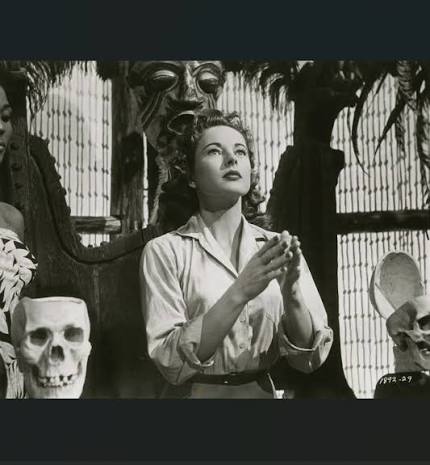
Colleen Gray had a busy career on TV, including short term stays in two soap operas, Days of Our Lives and Bright Promise. She also made four appearances on Perry Mason, including two episodes adapted from novels and the fine “The Case of the Wandering Widow,” which we discussed when we talked about Paul Langton and Peyton Place. Gray’s third appearance was in “The Case of the Fifty Millionth Frenchman,” the nineteenth episode of Season Seven, which premiered on February 20, 1964. This one has a great cast, beginning with David McCallum, the Scottish actor who, six months after this episode aired, would debut as sexy spy Ilya Kuryakin in The Man from U.N.C.L.E.. Here he plays Philippe Bertain, a humble French bookstore clerk, naïve to the point of idiocy, who comes to the aid of lovely Ninette Rovel (Roxane Berard), whose husband Armand (Jacques Bergerac) is a ski instructor and a louse.
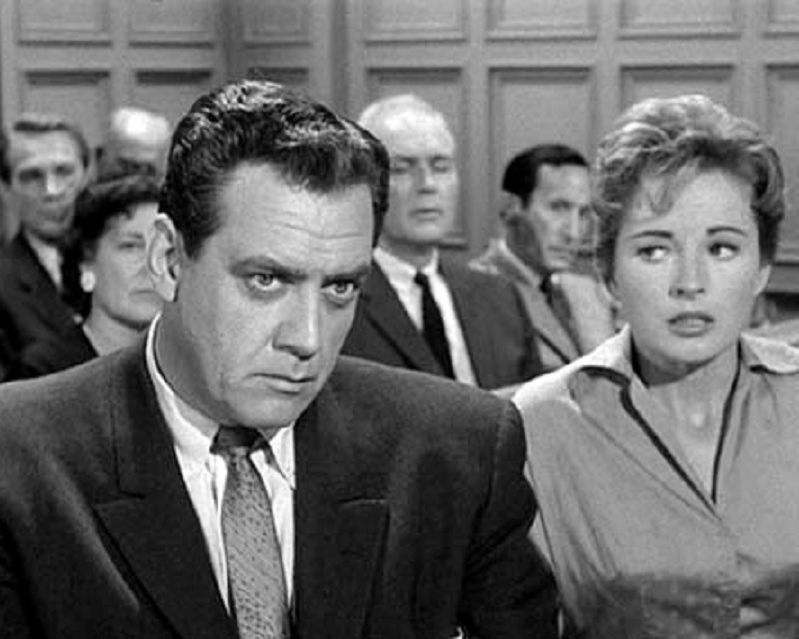
That Armand isn’t the only immoral member of the Rovel household will come as no surprise to anyone but Philippe, who lends Ninete all the savings he was going to use to buy the bookstore from Mrs. Kransdorf (Naomi Stevens, who was in three PM episodes, and who could play Jewish women, Italian women, Latina women – you name it, she played it!). Naturally, Ninete doesn’t pay Philippe back, he blames the whole thing on Armand, and he ends up flying to a distant ski lodge to confront his fellow Frenchman. There, he comes upon Arthur Franz, as the lodge’s owner, Janet Lake as Franz’ beautiful sister, who is in love with Armand, Coleen Gray as the lodge’s bookkeeper, who is also in love with Armand, Jackie “Uncle Fester” Coogan as the lodge’s bartender, and Don Collier as a handsome pilot who is Armand’s rival for girls and power in the community.
The main problem with this episode is how much it plays up Philippe’s puppy-dog naivete as something attractive. It ultimately lands him in court, on trial for Armand’s murder – the murder is well-handled – and it’s up to Mason to figure out which of the others is the murderer and how they managed to kill the fifty-millionth Frenchman. I know the ending is supposed to be a walloping surprise, but once again they couldn’t pull the beret over this viewer’s eyes.
* * * * *
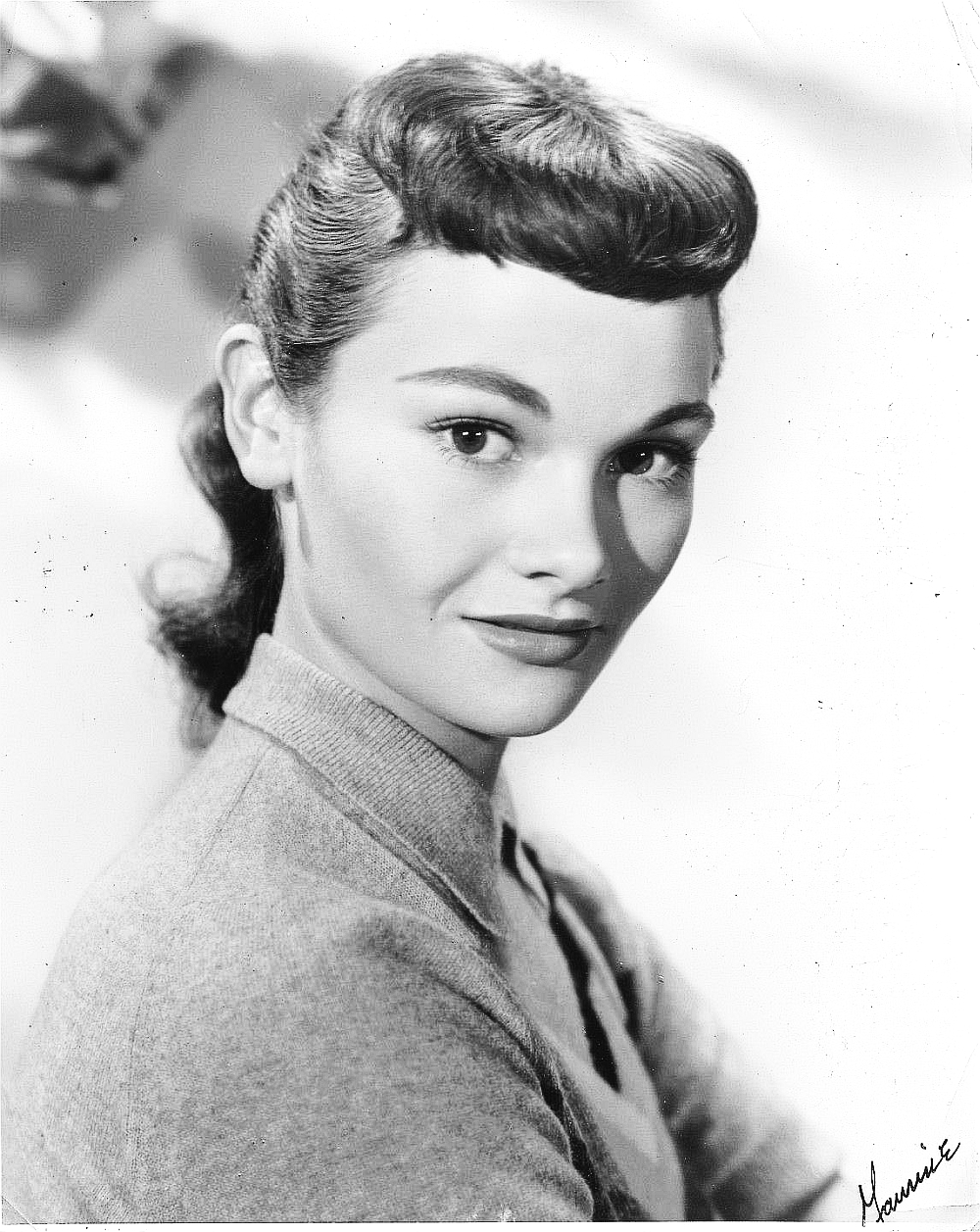
By the time Gloria Talbott co-starred with Coleen Gray in The Leech Woman, she became one of the earliest examples of that sub-category of actress known as the “Scream Queen.” But first, the California native turned child actor turned beauty queen did plenty of acting in comedies and dramas. When cast in a Western, Talbott often went by character names like “Princess Irawanie” and “Ruth Red Hawk.” On TV, Talbott guest-starred on plenty of Westerns, including Wyatt Earp, Gunsmoke, Wanted: Dead or Alive and Bonanza, but she also made the rounds of the Warner Brothers crime dramas.
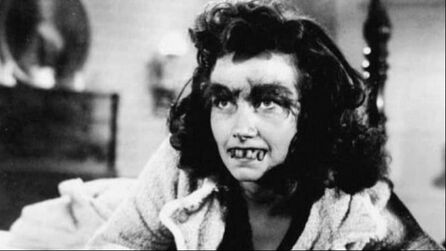
In 1957, Talbott starred as The Daughter of Dr. Jekyll, directed by low-budget king Edgar G. Ulmer. In the film, Talbott believes that she has inherited her father’s curse of transforming into a murderous monster, but the answer to her dilemma is far more interesting. The following year, Talbott followed this treat with another title role in the classic I Married a Monster from Outer Space. (Talbott is the “I”!) It helped that most of the time this monster looked like Tom Tryon. By the time she got to The Leech Woman in 1960, Talbott felt like a go-to when you were looking for a beauty to be menaced by a beast!
Along the way of a successful TV career, Talbott appeared in four episodes of Perry Mason. Her attractiveness and vulnerability made her a shoo-in half the time to play the defendant. We’ve already discussed three of these episodes when looking at the careers of Frank Ferguson, Ronald Long, and Wendell Corey. Fortunately, we have one more chance to focus on Gloria herself, in the fifth episode of Season Five, “The Case of the Crying Comedian,” which premiered on October 14, 1961.
It starts off well: we watch Anne Gilrain (Talbott) make her way down the long drive of a grand estate at night. She’s clearly sneaking around, and it’s only after she walks through the gates that we realize she is escaping from an asylum. Back in L.A., Anne is let into an apartment by a friendly doorman and immediately calls a nightclub, asking to speak to someone named Gunner Grimes. But while the waiter searches for her party, Anne can hear the act playing on stage: it’s comedian Charlie Hatch (Tommy Noonan) doing his schtick, and we will learn that Anne and Charlie were once an item until they broke up and her parents died and she married the execrable Tom Gilrain (Liam Sullivan, who made a creepy villain in three PM episodes). Evidently Tom helped push Anne into a nice case of alcoholism, and she had been at the asylum seeking the cure, until Gunner Grimes (Jackie Coogan) called to warn her that Tom was stealing her money.
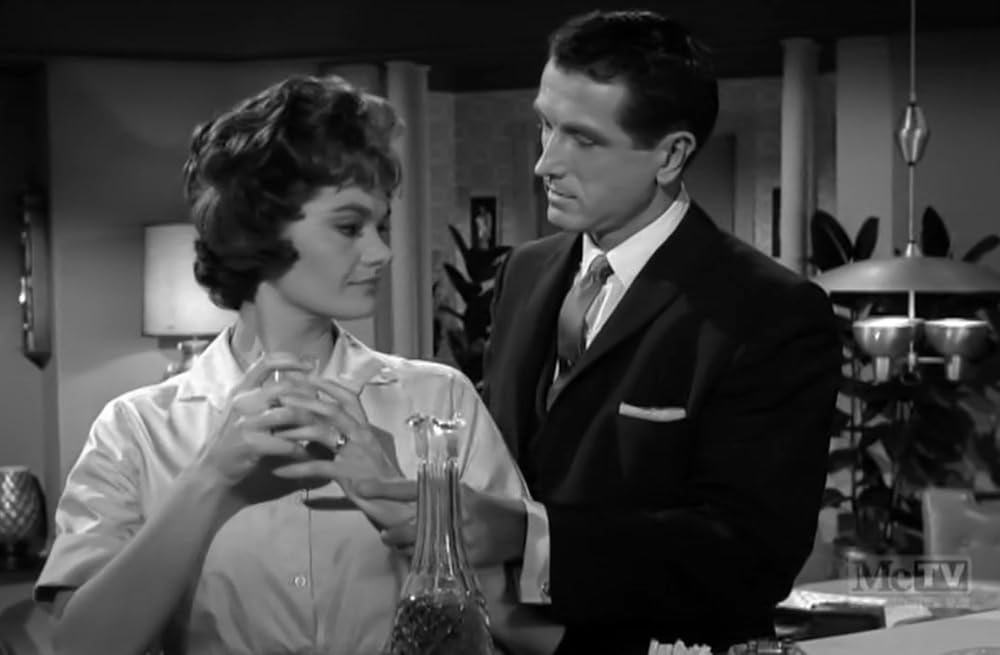
At least . . . I think that’s what’s happening. The plot of this one started to blur as I became fixated on Noonan’s eyebrows (could they move any higher??) which seemed the source of all his acting. And Sue Ane Langdon shows up again in another one of her “sexy kook” roles (the first of three on the show), and I don’t even remember Tom getting murdered but he does. And there’s a past casino robbery and a suspicious-acting insurance agent, and – those eyebrows . . . those eyebrows!!! I think I spent fifty-three minutes with this unpleasant group of people so that you don’t have to!
* * * * *
It’s fitting that we end our tribute to the monster makers and the women who loved them with one of the original Scream Queens, Fay Wray. Wray was born in Alberta, Canada, and her parents, members of the Church of Latter-Day Saints, moved the family to Salt Lake City. Later, they came to Los Angeles, where Fay began working in films while in high school.
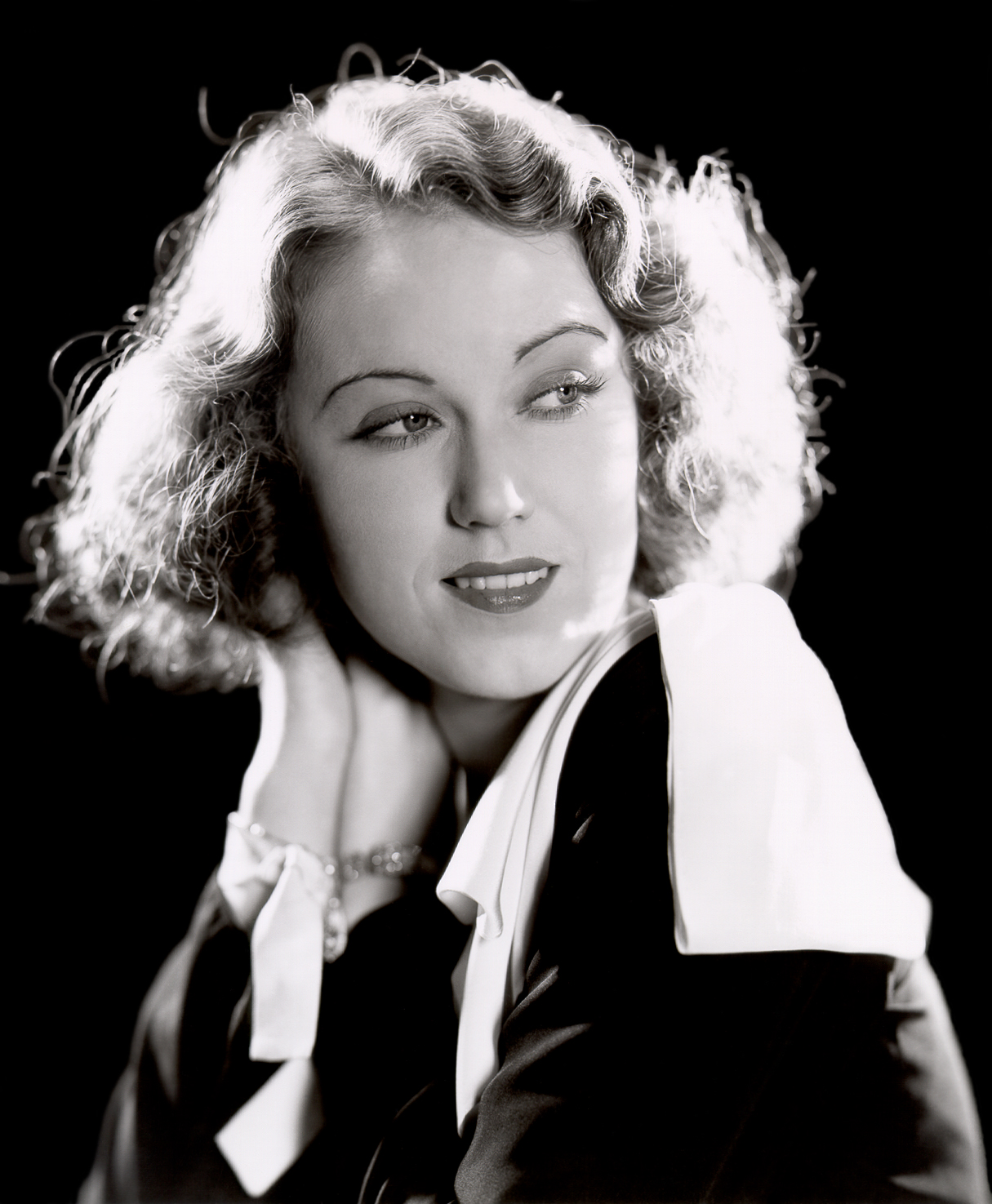
In 1926, Wray was designated one of the WAMPUS Baby Stars. That’s okay, I’ve never heard of it either! Every year, from 1922 to 1934, The Western Association of Motion Picture Advertisers named thirteen young women (fifteen in 1932) whom they deemed were about to become movie stars. Most of these predictions proved incorrect, but a certain number of these designated actresses did achieve stardom, including Clara Bow, Janet Gaynor, Joan Crawford, Mary Astor, Loretta Young, Jean Arthur, Joan Blondell and Ginger Rogers. One year after being put on the list, Wray was cast in the leading role of The Wedding March, a film by Erich von Stroheim. The film bombed, but audiences took notice of Wray.
While she made all manner of pictures, Wray’s career is definitely linked with the horror genre. She was menaced by Lionel Atwill in 1932’s Doctor X and 1933’s The Mystery of the Wax Museum. She and Joel McCrea were hunted down by Lesley Banks in 1932’s The Most Dangerous Game. But by far Wray’s most famous role was as Ann Darrow in 1933’s King Kong. Her career was so identified with the victim-love interest of a gigantic ape that up until the end of her life, Wray would make special appearances at the Empire State Building.
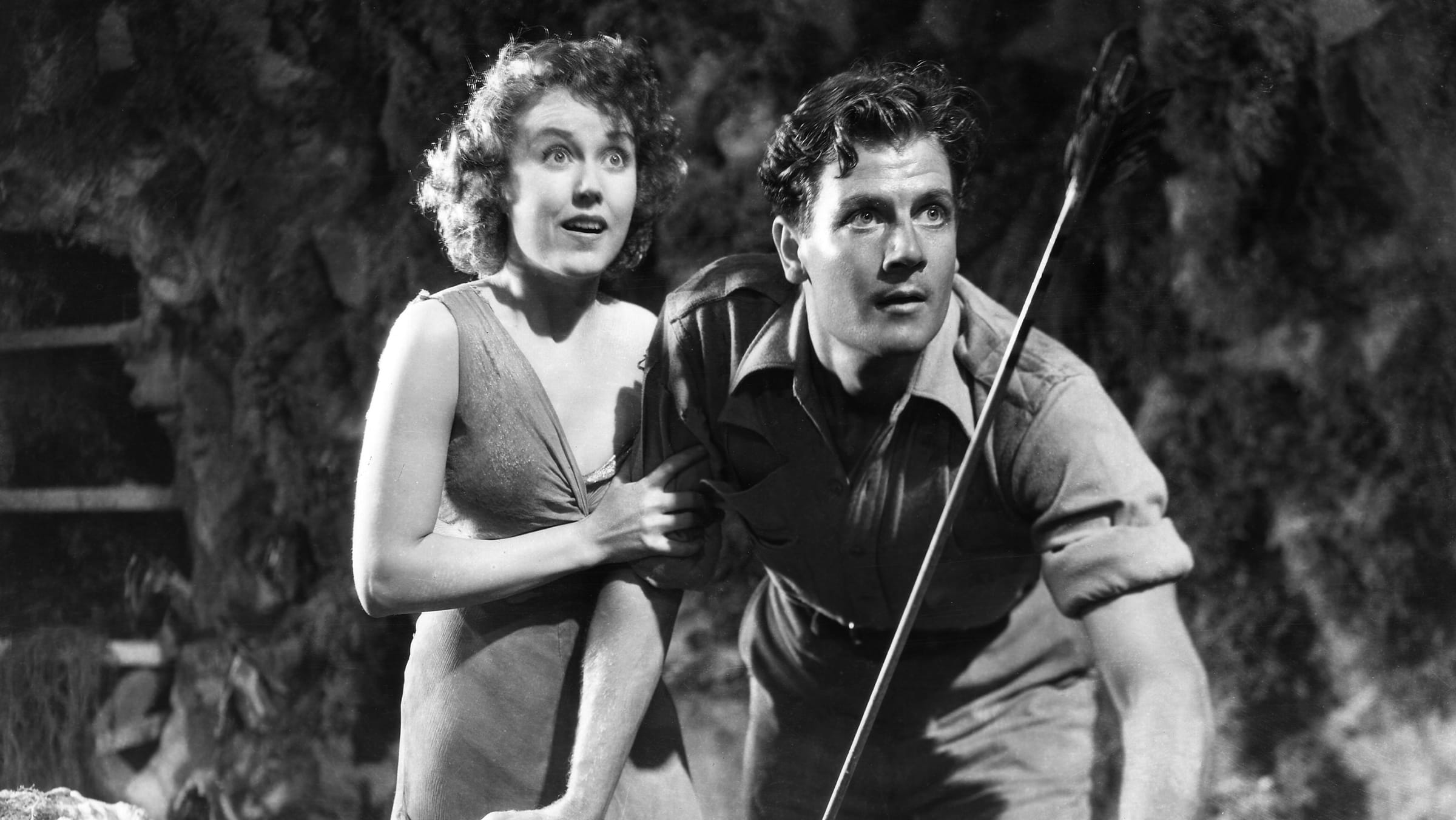
Although her film career was pretty much washed up by the early 1940’s, Wray would go on to a long career in television. She was offered the role of the older Rose in James Cameron’s Titanic, but she turned that down; the role passed on to Gloria Stuart, who enjoyed a bit of a revival thanks to her appearance. Personally, I think Stuart was the better choice; Wray always had an offbeat quality that wouldn’t have worked as well in Cameron’s film.
Wray showed up in three episodes of Perry Mason, and we’re going to talk about the final one, “The Case of the Fatal Fetish,” which premiered on March 4, 1965, the twenty-first episode of Season Eight. The title may sound kinky for a 1960’s TV drama, but here the word “fetish” takes on a literal meaning: it is a voodoo fetish used by Wray’s character in her nightclub act! We see the act over and over during this episode, and while it makes the proceedings very weird, it sets a perfect mood for our Halloween celebration.
Wray plays Mignon Germaine, a woman well-steeped in the lore of voodoo from her time spent in New Orleans. Now she dances in a club and worries about her son Larry (Gary Collins), who happens to be a rising star in the District Attorney’s office, where Hamilton Burger, an old friend of Mignon’s, keeps an eye on him. Now both mother and boss are concerned over Larry’s newfound affection for Carina Wileen (Karen Steele, whose biggest claim to fame might be as the leading lady in the Star Trek episode, “Mudd’s Women.”) Carina is a piece of work, as evil as she is beautiful, but usually drunk as a skunk.
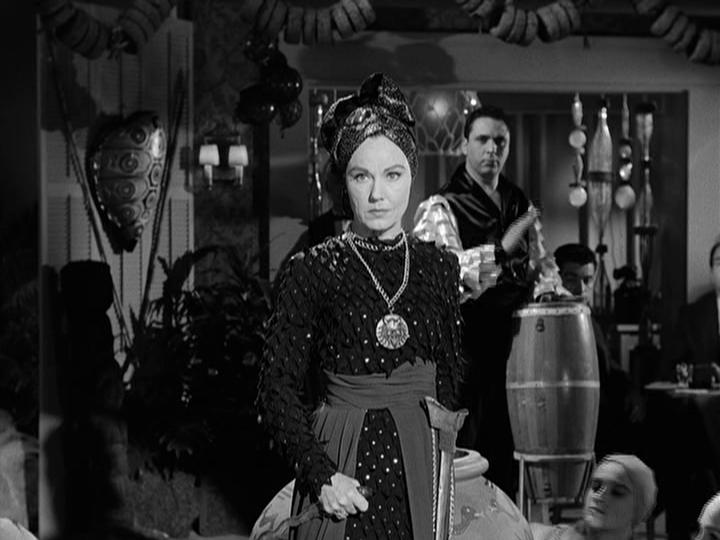
As it turns out, Carina is doing some dirty work that is connected with a scientist named Brady Duncan (Douglas Kennedy, veteran of four Perry Mason episodes), who is being sued by another scientist over a potentially stolen formula. At the nightclub one evening, Brady is there with his wife (Lynn Bari, two episodes), his lawyer (Richard Devon, three episodes), and his vice president (Alan Hewett, four episodes). Also present is Agnes Fanchon (Erin Leigh) who is one of the weirdest “good girls” I’ve ever seen on the show. In a highly effective moment, Mignon breaks from her normal act, carries a fetish with blonde hair like Carina’s to the table where that evil minx is sitting and drinking, and stabs the fetish with a ceremonial voodoo knife. Carina rises and collapses and is rushed to the hospital where she falls into a coma. Later, Larry is found in her hospital room, standing over her body, the ritual knife plunged into her heart!
The rest of the episode isn’t half as good as these scenes, partly because Carina’s death robs the hour of much of its dark energy, partly because the killer’s identity is so obvious. But it’s always nice to see Hamilton Burger have a big stake in hoping Perry Mason wins the case. The final scene of an episode usually involves Mason and his team explaining to the defendant how the murderer’s scheme unraveled. This time, Burger joins in, and the weird thing is that they’re explaining everything to Larry while his mother’s act is going on in the nightclub. Even though we’ve seen the act several times already, I wouldn’t shushed them!
* * * * *
Thanks for mounting your broomstick and joining me on our spooky journey connecting Perry Mason with some of his more ghoulish friends. We have one more special treat for you Halloween lovers: our next post about my favorite lawyer will deal with a connection to one of the most distinctive science-fiction TV shows of the 1960’s. (Cue interstellar music . . . )

